UPDATED; NHA CCMA 2026| COMPLETE EXAM SET (questions and verified answers)frequently most tested questions | already passed!!
 Call Kai
 Learn
Learn Practice Test
 Spaced Repetition
 Match
Match Flashcards
 Knowt Play
1/148

There's no tags or description
Looks like no tags are added yet.
Name | Mastery | Learn | Test | Matching | Spaced | Call with Kai |
|---|
No analytics yet
Send a link to your students to track their progress
149 Terms
A CCMA must choose the correct tube color to correspond with which of the following?
Laboratory test
Each tube color is drawn for a designated test.
A CCMA must invert anticoagulant tubes to prevent which of the following?
Clotting
A first-time patient is late arriving to the office. Which of the following should the CCMA say first?
"Hello. Welcome to our office."
Clients should be greeted and welcomed before checking in, making appointments, or checking on a bill.
An adolescent child is covered by two insurance policies under her married parents. In order to determine the primary policy, which of the following should the CCMA obtain?
The policy of the parent with the earliest birth month.
This is a primary insurance for that patient according to the third party guidelines.
Which of the following is an example of the acceptable reporting of routine lab results?
Send the results to the physician in a marked envelope.
This is the most confidential option.
Which of the following should a CCMA recognize as "open hours" scheduling used at the urgent center where she works?
Patients arrive at their convenience and are seen on a first-come, first-served basis.
This is the definition of open-hours scheduling.
Which of the following should a CCMA perform on a hemostat prior to autoclaving?
Sanitization
Sanitization is washing, which is necessary prior to autoclaving to remove organic material.
A CCMA is caring for a patient who has active tuberculosis. Which of the following PPEs must be used during the patient's care?
N95 respirator
Airborne precautions (including a N95 respirator) must be used for a patient with active tuberculosis.
A patient reports she weighs 110 lb. How much does the patient weigh in kg?
50 kg
To convert to kg, divide the lb by 2.2
Which of the following is the proper procedure after collecting an ammonia specimen?
Place the specimen tube in an ice-water slurry
Chilling the specimen slows down metabolic processes and protects the analytes.
Which of the following techniques should the CCMA use when bandaging a wound?
Wrap the wound from distal to proximal
A CCMA is measuring the intervals on an EKG tracing. Which of the following is an anticipated finding of impaired conduction through the AV node?
Prolonged PR interval
The PR interval is a direct reflection of AV node conduction
When instructing a patient to obtain a midstream urine sample, which of the following instructions should a CCMA offer?
Begin urinating into the toilet, collect the next portion, and complete urination into the toilet
A CCMA is caring for a patient who is crying. Which of the following actions should the CCMA take?
Allow the patient to cry
The patient should be permitted to express his emotions
The Clinical and Laboratory Standards (CLSI) states that needle insertion in the antecubitalarea should be at a
15 to 30 degree angle
Which of the following is the ergonomically correct method for lifting heavy loads in the workplace?
Squat and lift with the legs
Which of the following is appropriate for cleansing around the urinary meatus in a clean-catch urine collection?
Benzalkonium chloride
A CCMA is caring for a 4-month-old infant who has a temperature of 100.4 degrees F. Which of the following is this temperature in Celsius?
38 degrees F
(100.4 - 32) x 5/9
A CCMA should recognize that which of the following statements by a patient indicates a need for further education?
"I will take my medication with food before I go for my surgery."
The patient should be NPO prior to surgery.
A CCMA is caring for a patient who has a body mass index (BMI) of 23. This patient should be categorized as which of the following?
Normal weight
A BMI of 18.5 to 24.9 is considered an acceptable weight for a healthy adult
Which of the following is the proper time period for the collection of a newborn screening card?
1 to 7 days
A CCMA is caring for a number of patients at the same time. For which of the following patients should the CCMA interrupt a previously scheduled appointment?
An adult who is experiencing dyspnea and congestion
Difficulty breathing is considered a life-threatening situation. This patient receives priority treatment.
Some older-adult or obese patients may not have accessible antecubital veins. In these situations, the CCMA can use which of the following?
Hand veins
The veins on the back of the hand may be the only accessible site, if the patient is an older adult or obese.
Which of the following is a CLIA-waived laboratory test?
HCG test
Certificate of waivers are required for low complexity tests. The human chorionic gonadatropin (HCG) test falls under the category of low complexity test.
When should the code on glucose cuvettes be compared to the code on the glucometer?
Before a patient is test
Coding should be checked every time the glucometer is used to check a patient's glucose levels in order to ensure the most accurate results.
Which of the following should a CCMA do first when blood is splashed in her eye?
Flush with tepid water
A patient loses consciousness. The EKG tracing reveals ventricular fibrillation. Which of the following should the CCMA do first?
Call for help and begin CPR
According to the AHA resuscitation guidelines, a CCMA should call for help and perform CPR immediately following witnessed cardiac arrest
A CCMA is to use the Snellen chart to test an adult patient's visual acuity. The CCMA should instruct the patient to stand which of the following distances away?
20 feet
Each line of the Snellen chart should be ready by patients six or older at 20 feet away
A CCMA is preparing a patient for a 12-lead EKG. Which of the following is the c orrect placement for lead V4?
The 5th intercostal space at the midclavicular line
Which of the following is the most important factor to consider when collecting a chain of custody specimen?
Proper identification
Identification prevents chain of custody breakdown at the early stages of the process. Identification is the most important factor for any medical specimen.
A CCMA is preparing to draw venous blood samples. Due to OSHA requirements, the CCMA should wear which of the following protective devices?
Gloves
OSHA requires use of gloves to provide sufficient protection while performing venipuncture
In which of the following positions should a CCMA place a patient for a rectal exam?
Sims
A CCMA has orders to collect blood cultures, CBC, PTT, and an iron panel. He forgets to draw for the PTT. Which of the following actions should the CCMA take?
Keep the specimens collected and draw the PTT
The other specimens are acceptable. The CCMA needs to collect the PTT.
Where should a CCMA place the electrodes for V7, V8, and V9?
Evenly spaced on the back between the axillary line and the vertebral column at the 5th intercostal space
A patient calls a facility and asks for the cost of a surgical procedure. Which of the following is an appropriate response by the CCMA?
Quote the cost of the procedure
The CCMA has the responsibility to quote the cost to the patient over the phone or in person
Which of the following steps for a finger stick should a CCMA complete first?
Confirm the correct identity of the patient
What is the name of the legislation that protects health care staff from retaliation by their employers when they report cases of patient neglect and abuse?
Whistleblower Protection Act
The Whistleblower Protection Act protects employees from retaliation when reporting suspected unsafe activities in the workplace
A provider requests that a CCMA provides lab results to a patient. When the CCMA calls, the phone is disconnected. Using the EMR program, what is another way to get lab results to the patient?
Certified mail
Certified mail offers proof of receipt, proving the patient was sent the results
A CCMA needs to type a professional business letter from the office. Which of the following formats is appropriate?
Keep flush with the left margin
While performing a pulse oximetry reading on a patient, which of the following factors should the CCMA recognize as contributing to an erroneous result?
Patient's movement
The patient's movement could alter results in the pulse oximetry readings.
A clinical medical assistant is drawing five blood collection tubes. When should the tourniquet be released?
Within 1 minute of application of the tourniquet
Tourniquet application lasting more than 1 minute increases the risk of hemoconcentration
A patient's body temperature will be at its lowest at which of the following times?
4:00 AM
Body temperature is at its lowest at approximately 0400
When using CPT codes, what do modifiers indicate?
Alteration in service performed
Which of the following can cause a hemolyzed specimen?
Shaking the tube vigorously
This will cause the red blood cells to rupture, causing hemolysis
A CCMA is performing a chain of custody specimen collection. Which of the following statements by the CCMA indicates a need for further teaching?
"Specimens collected at the end of the day should be transported immediately the next morning."
Specimens must be transported the same day they are collected
The CCMA should recognize that a typical 7-year-old child's heart rate should be which of the following?
Lower than a newborn's
The range of 130 to 140 beats/min would be correct at birth and is the highest of all pulse ranges. A 7- to 14-year-old child's heart rate range would be approximately 76 to 90 beats/min.
In addition to name and phone number, which of the following pieces of information is required to schedule an appointment?
Reason for visit
When scheduling an appointment, the information needed is reason of visit, name, and phone number
In which of the following scenarios should a CCMA choose a CPT modifier?
Special circumstances applied to the procedure performed by the provider
A CCMA should recognize which of the following blood pressure readings as indicative of a patient who is prehypertensive?
130/86 mm Hg
Prehypertension is classified as above 120/80
When determining therapeutic medication monitoring levels, which of the following information should the CCMA recognize as most important in measuring trough levels?
Time next dose is due
This is done when measuring the lowest level of medication in the blood serum, and occurs just before the patient takes his next dose of medication
For 5-lead electrode placement for ambulatory monitoring, where should the CCMA place the green ground electrode?
Centered over a rib on the right side
Which of the following is required to schedule an outpatient procedure after receiving a provider's order?
The patient's demographic information
A medication container states there is 250 mg of medication in each scored tablet. The provider orders 375 mg. How many tablets should the CCMA give the patient?
1.5 tablets
1.5 x 250 = 375
The lab report on a patient indicates a hemoglobin level of 7 g/dL. Which of the following is the first action for the CCMA to take?
Notify the provider
The provider must be notified, because the results are at a critically low level
Which of the following lead groups represents Einthoven's Triangle?
Leads I, II, and III
There are the only leads that form the triangle
Which of the following dressings should a CCMA use on burns or wounds that have necrotic tissue?
Hydrogels
Hydrogels are used on wounds that are sloughing off, have necrotic tissue, or are burns
How often should a CCMA perform an inventory of controlled substances?
End of each shift
An employee at a cardiologist's office calls a CCMA's office, inquiring about a referral patient. Which of the following test results can the CCMA disclose to the caller?
LDL
Low-density lipid protein is a test for cardiac risk assessment and would be appropriate information to disclose
When recording information into the medical record for a patient diagnosed with inflammation of the lining of the heart, which of the following terms should the CCMA use?
Endocarditis
Which of the following techniques should the CCMA use for routine cleaning of EKG cables?
Disinfect
A CCMA is taking the temperature of a patient who just smoked a cigarette. Which of the following is the correct sequence for taking this patient's temperature?
Pulse, respiration, blood pressure, and temperature
Vital signs are taken as temperature, pulse, respiration, and blood pressure unless the patient has been eating, drinking, or smoking. In this case, temperature would follow blood pressure.
Twenty seconds into measuring a patient's pulse, a CCMA detects an irregular heartbeat. The CCMA should take which of the following actions?
Measure the pulse for 2 min
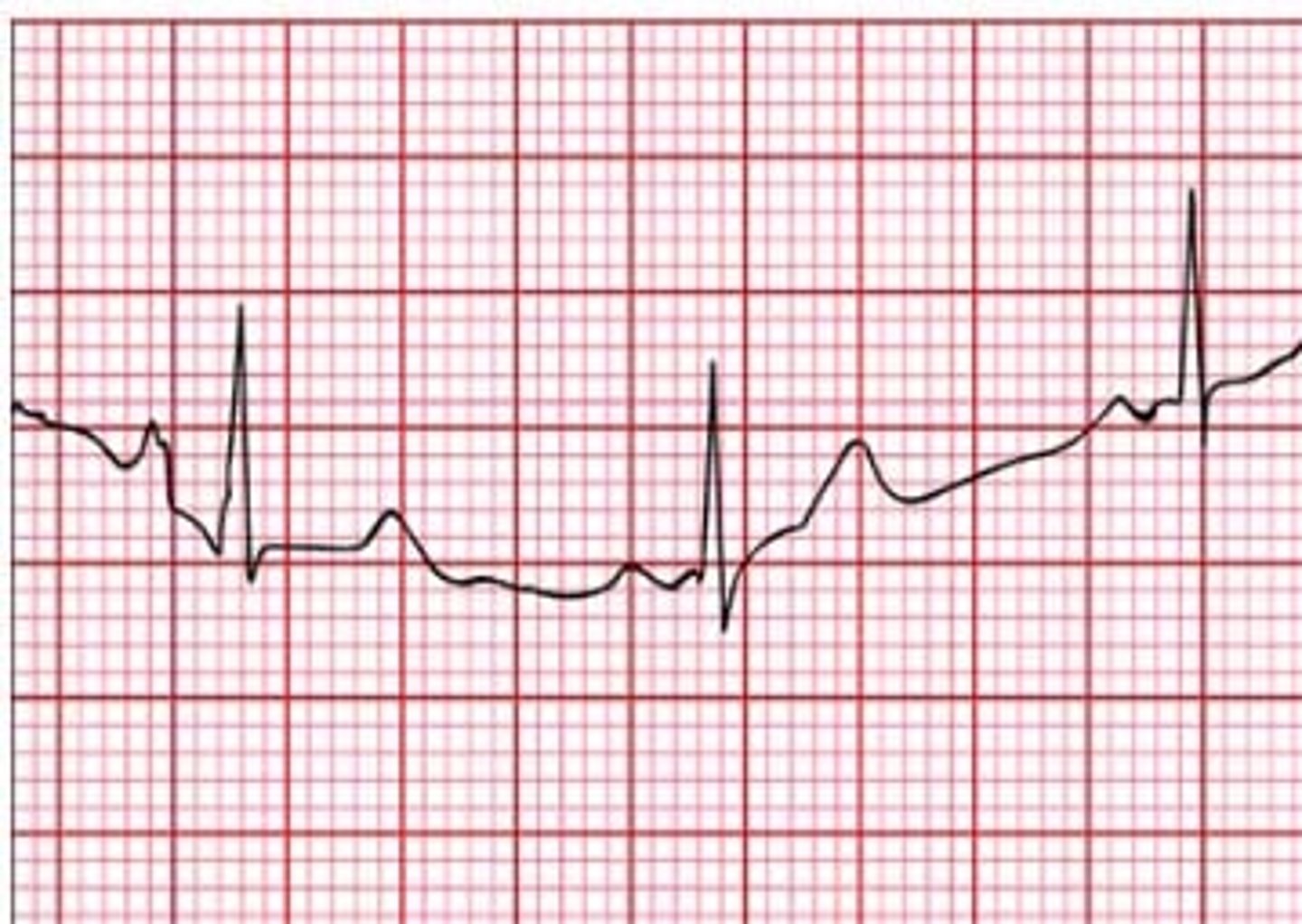
Which of the following types of artifacts is shown in the above tracing?
Wandering baseline
A wandering baseline occurs when the stylus moves from the center of an EKG. This can be a result of too much lotion or sweat on the skin, an inadequate attachment to the skin, or additional reasons.
Which of the following reasons should a CCMA document on the chart when a patient calls to cancel a postoperative appointment, and she says that she will reschedule later?
To prove that the office wasn't negligent
This is a legal responsibility. Because the patient said she would reschedule, that breaks the contract. Documenting the information covers liability.
When applying a Holter monitor, how many monitor leads are placed on the patient?
5
A CCMA is preparing sterilization for hemostats before an invasive procedure. Which of the following techniques should the CCMA use?
Autoclave
Autoclaving is used on items that penetrate skin or tissue
A patient states that this is his first blood draw. Which of the following actions is appropriate?
Describe the procedure.
An explanation of the procedure is a requirement
A CCMA is preparing a patient for a near visual acuity test. How far away should the patient hold the chart from the face?
15 inches
This would be the appropriate distance for an adult patient to hold the near visual acuity chart
A phlebotomist receives orders to draw an infant screening card, O2 levels, bilirubin, and DNA. Which of the following should be drawn first?
O2 levels
The infant may cry due to the draw, so every attempt must be made to collect the O2 levels as close to resting as possible
Which of the following tests is granted waived status under Clinical Laboratory Improvement Amendment (CLIA)?
Rapid strep test
A blood specimen was rejected by the laboratory with the abbreviation QNS. Why was the specimen rejected?
The specimen was insufficient
The abbreviation QNS means "quantity not sufficient." Certain tests required a certain amount of blood
Which of the following is required when drawing a forensic sample?
Have the receiving laboratory sign a chain of custody form
Personnel releasing or receiving the specimen must sign and date a chain of custody form
Which of the following methods for calculating a patient's heart rate from the EKG is correct?
Divide 1,500 by the number of small boxes between two R waves
An office is still using paper charts. In which of the following orders would the CCMA return the chart of Mary St. Thomas? Other charts include Mary Perez, Elizabeth Saint, and John A. Thomas.
After Elizabeth Saint and before John A. Thomas
Fits in alphabetically. Filed with "Saint" spelled out.
The Patient's Bill of Rights protects individuals from which of the following?
Denial of care due to the patient's age
The Patient's Bill of Rights protects patients from being denied fair treatment or participation in research studies
A CCMA has a blood pressure cuff inflated and partially opens the valve to deflate as she listens with a stethoscope. When should she read the diastolic pressure?
When the sound disappears
The primary code in the CPT coding systems consists of how many digits?
5
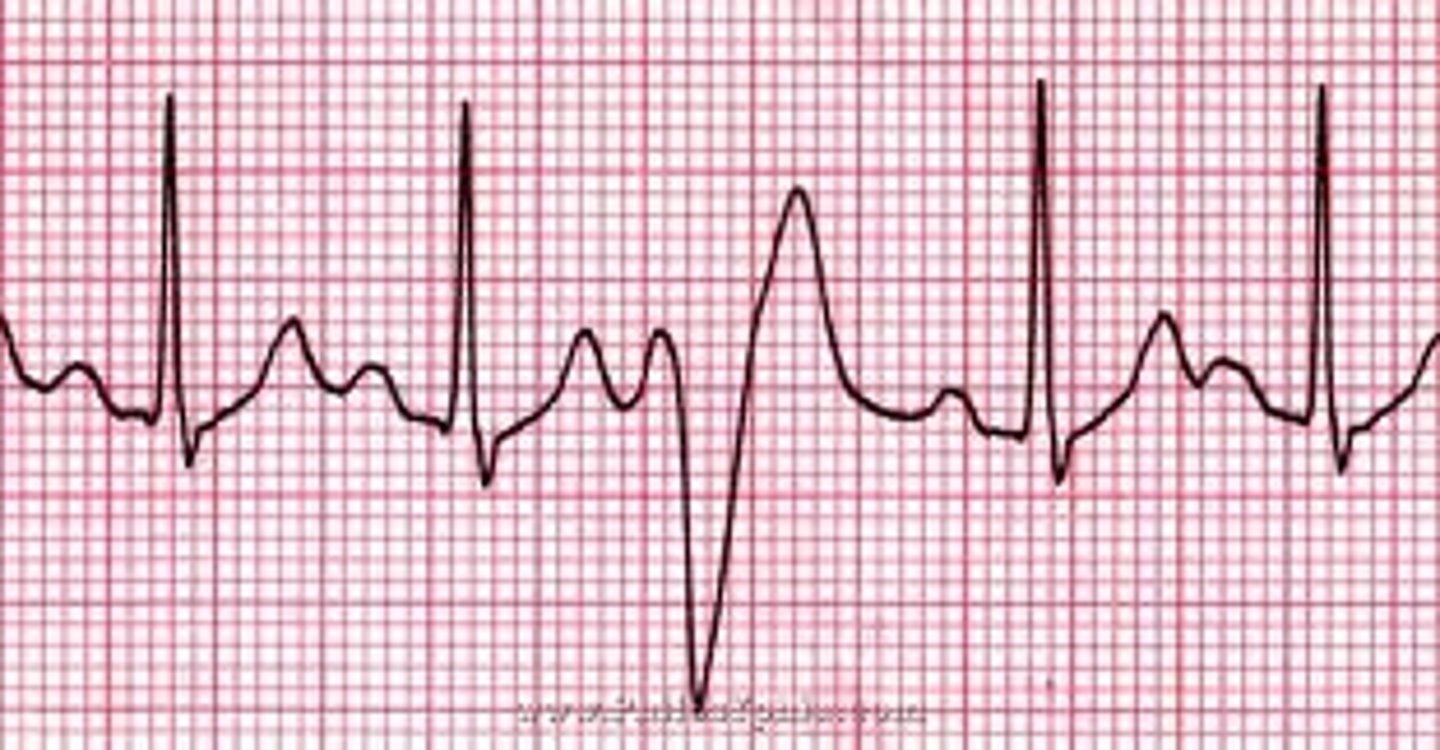
Which of the following findings on the tracing below should a CCMA be most concerned with?
The absence of a P wave
The absence of a P wave in this tracing is related to a premature ventricular complex, which can be a sign of ischemia within the ventricles. Low cardiac output can result from frequent PVCs and need to be address promptly.
Which of the following is a CCMA's role in pulmonary function testing (PFT)?
Coach the patient through the test
A provider has ordered a patient to wear a telemetry monitor at home. Which of the following statements by the patient indicates a need for further instruction?
"If an electrode comes off, I will reattach it at home."
Electrodes should be reattached by medical staff to ensure proper placement
The clinical medical assistant is coding an office visit where the provider reviews the systems that are related to the chief complaint, but does not go into the patient's family or social history. In determining the level of service provided, which of the following will the assistant use to code this visit?
Expanded problem-focused history
An expanded problem-focused history includes the systems related to the chief complaint; however, it does not include a family or social history
Which of the following abbreviations applies to HIPAA regulations and to insurance in the health care setting?
PHI
Protected health information is correct
Which of the following needle sizes is the most appropriate for a subcutaneous injection?
25 gauge
During a routine venipuncture, the patient becomes pale and diaphoretic. What condition is most likely to occur in this patient?
Syncope
If these symptoms occur, there is a chance the patient may faint. Precautions should be taken.
A provider is going on vacation and wants a CCMA to notify his patients. Which of the following is the best form of communication for notification for a patient who cannot be reached by phone?
Encrypted e-mail
Reaching patients by phone should be the first option. If unable to reach patients by phone, or for efficiency, e-mail is the next best option as long as patient information is not communicated
A CCMA is providing instruction to a patient prior to a pulmonary function test. Which of the following statements by the patient indicates a need for further education?
"I can use my nebulizer 20 minutes prior to the pulmonary function test."
Patients should not use a nebulizer for 6 hours prior to a pulmonary function test.
A CCMA is collecting a blood sample from a patient and notices the patient becomes unresponsive. The CCMA determines the patient is not breathing and does not have a pulse. Which of the following should the CCMA do first to respond to the patient's status?
Begin chest compressions
Chest compressions should be performed first in response to the patient's status
A CCMA is scheduling a patient for an outpatient procedure. The CCMA should take which of the following actions first?
Obtain an oral or written order from the provider for the procedure
Which of the following statements made by a new CCMA, regarding an artifact, demonstrates a need for further teaching?
"Electrical interference on the EKG is not caused by cell phones."
Which of the following actions should the CCMA take to verify the quality of venipuncture supplies before beginning a blood draw?
Inspect the integrity of the needle's seal.
This helps assure sterility of the needle.
A CCMA is educating a patient about the home use of his ambulatory telemetry monitor. The CCMA should tell the patient that, if his electrodes become loose, the patient should do which of the following?
Apply surgical tape to the electrodes to keep them in place.
Surgical tape will deter the electrodes from tugging and pulling away from the skin. The CCMA should send surgical tape home with the patient to use if needed.
Which of the following is the first step in the blood collection procedure?
Test requisition
A provider's order for a test is the first step in blood collection
What is the name of the arrhythmia in the EKG tracing below?
Atrial flutter
It is characterized by flutter waves between QRS complexes. The most common flutter to ventricular response ratio is 2:1, as is the case in this tracing

A patient presents to the emergency department with a large laceration to the wrist that is bleeding profusely. Which of the following actions should the CCMA take first?
Don gloves
Gloves must be donned prior to wound care to prevent further contamination
Which of the following instructions should a CCMA use to administer an enteric-coated tablet to a patient?
Swallow the tablet whole with a glass of water
Enteric coated tablets cannot be crushed, chewed, or dissolved. The tablets need to arrive in the small intestines as a whole.
A CCMA is caring for a patient who weighs 72 kg. What is the patient's weight in lb?
158.4 lb
72 x 2.2 = 158.4 lb
A CCMA is educating an older adult patient on wound care. Which of the following should the CCMA do to ensure patient understanding?
Have the patient repeat information.
Whether the patient is an older adult or not, this is active listening and is the best technique to ensure that the patient understands the instructions.
Which of the following routes for taking a patient's temperature is the most accurate?
Rectal
Rectal temperature is the most accurate method, because the rectum is the most closed cavity for administration of all routes.
A CCMA is caring for a patient who is 5'7'' tall. Which of the following is the patient's height in centimeters?
170 cm
Covert 5'7'' to 67 inches. Convert inches to centimeters by multiplying by 2.54, which gives you 170.18
A CCMA has a request to collect a routine CBC from a healthy 10-month-old infant. Which of the following is the most appropriate collection site?
Left heel
Children under 12 months should have routine testing collected as a heel stick, even if there is a well-developed vein available. The heel stick is sufficient and causes less trauma.