Chemistry Final Exam All Terms
 Call Kai
 Learn
Learn Practice Test
 Spaced Repetition
 Match
Match Flashcards
 Knowt Play
1/29

There's no tags or description
Looks like no tags are added yet.
Name | Mastery | Learn | Test | Matching | Spaced | Call with Kai |
|---|
No analytics yet
Send a link to your students to track their progress
30 Terms
mole / mol (ch.10)
the amount of a substance that contains, large amount of representative particles in a substance
Avogadro’s number (ch.10)
6.02 × 10²³ (1 Mole)
Molar Mass (ch.10)
mass (in grams) of 1 mole
STP (ch.10)
volume of a gas usually measured
0 Degrees Celsius
Pressure of 101.3 kPa / 1 atm
Molar Volume (ch.10)
22.4L per 1 mole of gas at STP
Percent Composition
Relative amounts of elements in a compound
Empirical Formula (ch.10)
lowest whole-number ratio of elements
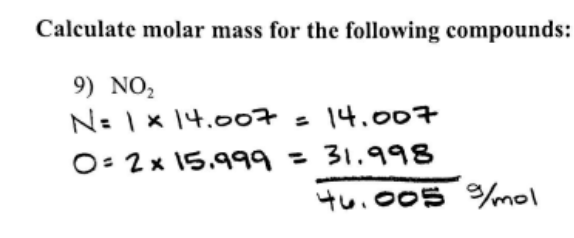
How to Calculate Molar Mass (ch.10)
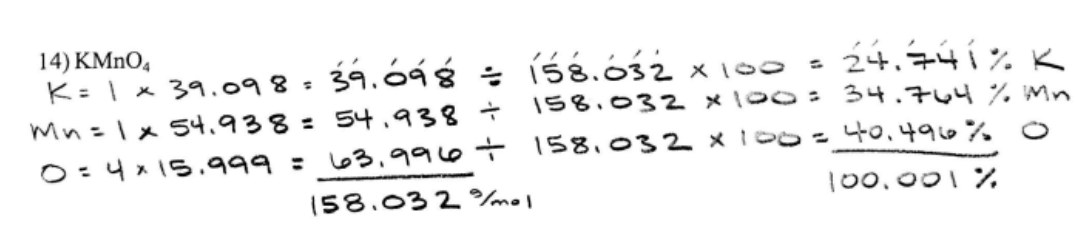
How to Calculate Percent Composition
Find Molar Mass of each and find the Total
Divide each molar mass by total
Multiply by 100
You get % of Each
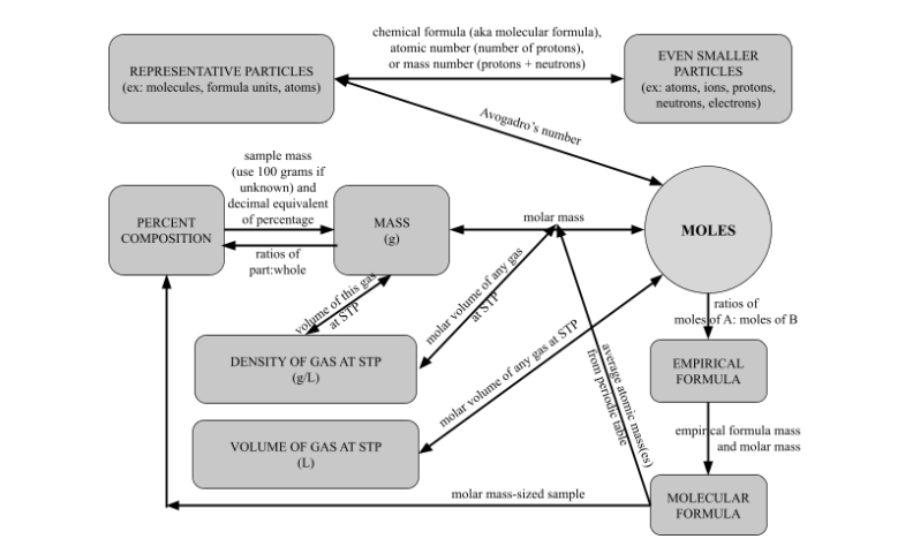
Converting with mole map (ch.10)
Convert .43 mol H2O to _____g H2O
starting with moles you multiply on top
use molar mass of H2O

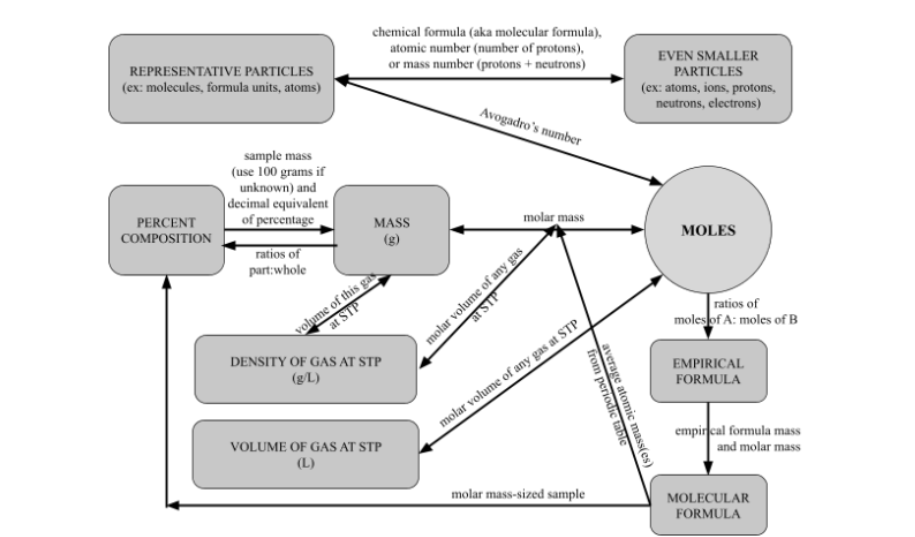
Converting with mole map (ch.10)
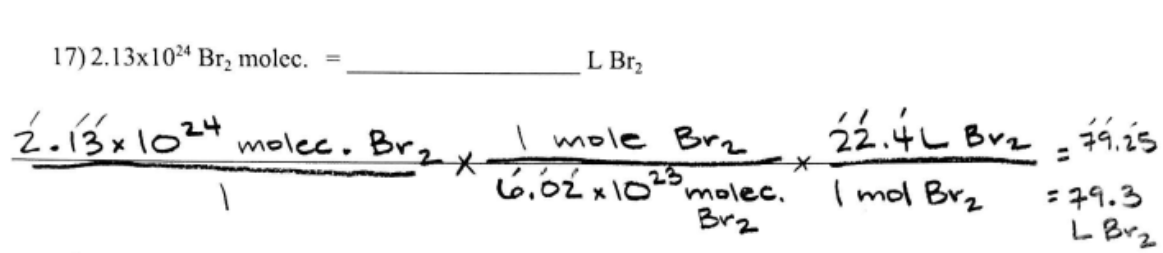
2.13×10 ^ 24 Br2 Molec. to ____L Br2
use avogadro’s number (6.02 × 10^ 23) but this time it is on bottom because you go to moles
Multiply by 22.4 L to get it to liters
Calculating Empirical Formula (ch.10)
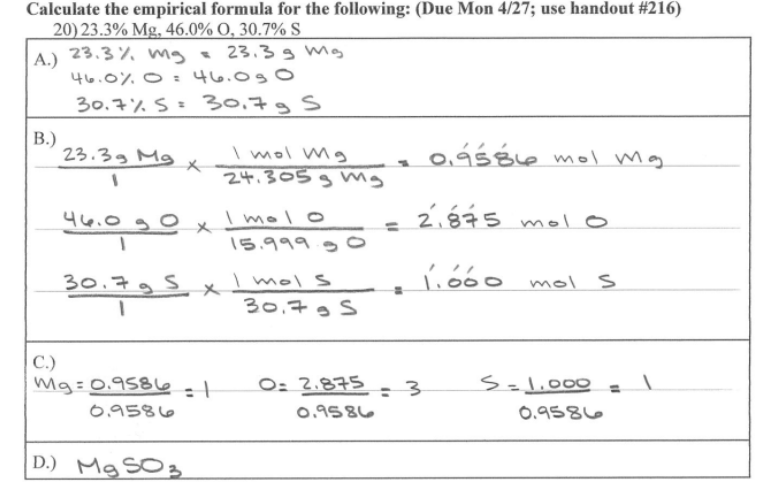
Convert the % to a regular number with decimal
Divide it by it’s own molar mass
Round to the nearest whole number
Whole number = the amount of element in that formula
Calculating Molecular Formula (ch.10)
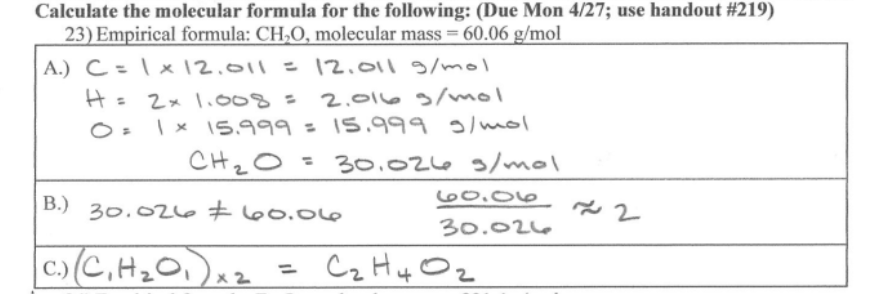
DIvide the element molar mass by the molecular mass
the Molecular Mass/Molar Mass
Chemical Equation (ch.11)
an expression representing a chemical reaction: the “recipe”
Conservation of Mass (ch.11)
matter/mass cannot be created or destroyed
Reactant (ch.11)
left side, the “ingredients”
Product (ch.11)
right side, what was “made”
Coefficient (ch.11)
full size number in front of a chemical formula
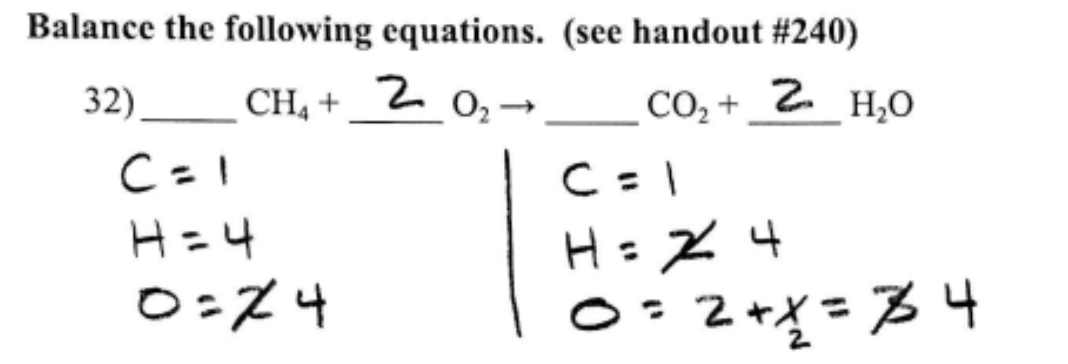
How to balance a chemical equation (ch.11)
Synthesis/combination (ch.11)
A + B ⟶ C
Two or more substances react to form one

Decomposition (ch.11)
D ⟶ E + F
single compound broken down into two or more

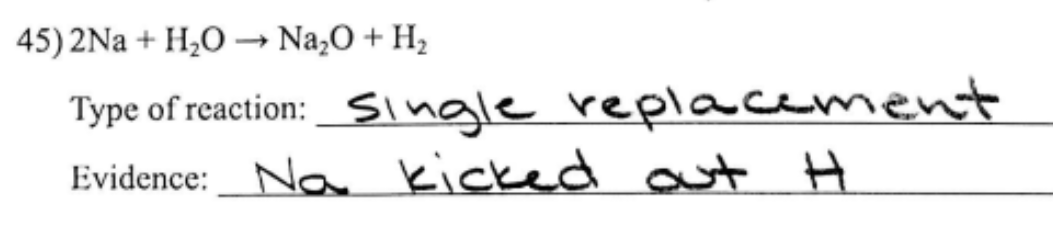
Single Replacement (ch.11)
M + AB ⟶ MB + A (m replaced A)
one element replaces a second element
Double Replacement (ch.11)
AB + CD ⟶ AD + CB
an exchange of two compounds
Combustion (ch.11)
hydrocarbon + oxygen reaction
CH + O
Phase Symbol (ch.11)
(s) = solid
(l) = liquid
(g) = gass
(aq) = dissolved in water
Yields (ch.11)
forms / produces
Catalyst (ch.11)
speeds up a reaction (not used up)
Diatomic Molecules (ch.11)
chemical structures made up exactly of two atoms

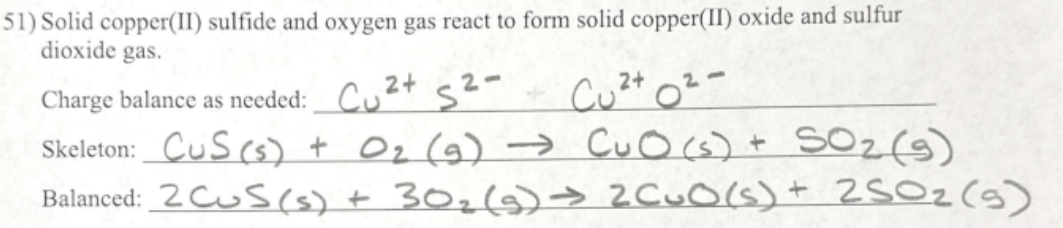
How to write a Skeleton Equation and then Balance It (ch.11)
Precipitate (ch.11)
an insoluble reaction