Volcanoes
 Call Kai
 Learn
Learn Practice Test
 Spaced Repetition
 Match
Match Flashcards
 Knowt Play
1/13

There's no tags or description
Looks like no tags are added yet.
Name | Mastery | Learn | Test | Matching | Spaced | Call with Kai |
|---|
No analytics yet
Send a link to your students to track their progress
14 Terms
What is a volcano
A vent in the Earth’s crust through which lava and gases erupt.
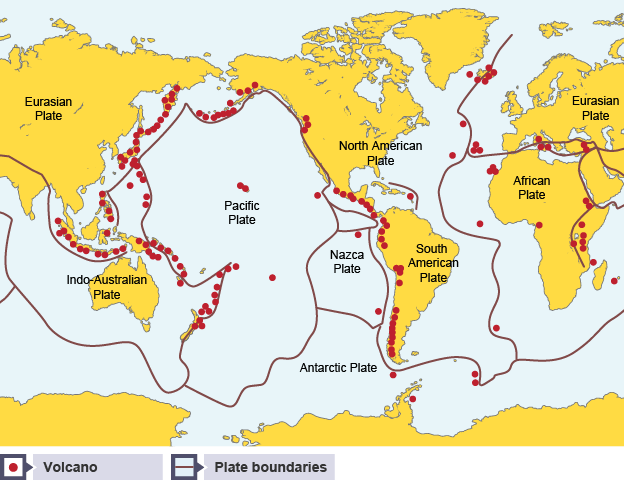
Where volcanoes are found
Mostly found on plate boundaries and on the coast of countries. Most volcanoes found in pacific ring of fire.
How can we measure a volcano
Using VEI (Volcano explosivity index)
1 VEI is gentle
4 VEI is cataclysmic
8 VEI is mega colossal
What is basaltic lava
Low-silica magma is very hot (around 1200 °C), runny, and low in viscosity allowing gas to escape easily so eruptions are gentle and frequent. Lava flows effusively as rivers of molten rock, mainly producing lava and steam, and takes a long time to cool.
What is andesitic lava
High silica content around 800oC viscous and flows slowly. Less frequent eruptions but violent due to gas build up. Pyroclastic eruptions and lava. Erupt explosively as magma cooler and pressure builds up as gas cannot escape easily, till has explodes blast rock and lava fragments into air.
Fissure eruption volcano
Forms at constructive plate margins where plates diverge and magma fills gap. Gentle basaltic slope of lava. Produces low viscosity basaltic lava and effusive eruptions. Iceland an example
Shield volcano
Formed at constructive plate margins or hot spots. Lava flows gently from a central vent. Effusive eruptions. Hawaii is an example
Ash and cinder cone volcano
Formed at destructive plate boundaries.
Melting subducting plate produces gas rich magma which rises. Pressure builds up and explosive eruption releases ash and rock fragment.
Ash and rock fragment fall back down around vent and build up forming a steep cone with a crater at the top.
Example is Mt Etna
Composite volcano (stratovolcano)
Form at destructive boundary. Subducted plate melts and silica-rich magma forms. Highly viscous so gas cannot escape easily. Pressure builds so explosive eruptions. Mt St Helens is an example
Acid/ dome volcano
Formed at destructive plate margin where there is silicon rich magma which is viscous. So it rises very slowly, as it cannot flow very far it accumulates over the vent. Gas often gets trapped so explosive eruptions. Cotopaxi is an example.
Caldera volcano
Form destructive plate margins.
Forms after eruption of blocked dome volcano leaves a well,
Or when volcano collapses inward.
What type of volcanoes form at constructive plate boundaries and why
Fissure eruption and shield volcanoes
Basaltic lava so gas escapes easily so gentle eruptions
As plates move apart magma either erupts through crack( fissure) or flows easily overtime forming gently sloping volcanoes (shield)
What type of volcanoes form at destructive plate margins and why
Composite (stratovolcano), ash and cinder, acid/dome and caldera
Andesitic lava which is viscous and traps gas meaning pressure builds up so eruptions explosive
One plate is subducting under the other to form andesitic lava
Lava viscous so does not flow far forming volcanoes with steep sides
How do subduction zones lead to eruptions
Denser oceanic plate is forced beneath plate into mantle and subducting plate melts to produce magma
This magma rises through cracks in crust and can erupt up to surface
Magma often andesitic so is viscous so pressure builds up for explosive volcanic eruptions