AP Calc: Formulas, Rules, Reciprocals, Derivatives, Inverse Derivatives, Integrals...
 Call Kai
 Learn
Learn Practice Test
 Spaced Repetition
 Match
Match Flashcards
 Knowt Play
1/54

There's no tags or description
Looks like no tags are added yet.
Name | Mastery | Learn | Test | Matching | Spaced | Call with Kai |
|---|
No analytics yet
Send a link to your students to track their progress
55 Terms
b*h
Area of a Rectangle
½*b*h
Area of a Triangle
½*(b1+b2)*h
Area of a Trapezoid
π*r²
Area of a Circle
2*π*r
Circumference of a Circle
(4/3)*π*r³
Volume of a Sphere
4*π*r²
Surface Area of a Sphere
π*r²*h
Volume of a Right Circular Cylinder
(1/3)*π*r²*h
Volume of a Right Circular Cone
????
LEFT Riemann Sum Formula
????
RIGHT Riemann Sum Formula
????
MIDPOINT Riemann Sum Formula
Overapproximates
When a RIGHT riemann sum is INCREASING it…
Underapproximates
When a RIGHT riemann sum is DECREASING it…
Underapproximates
When a LEFT riemann sum is INCREASING it…
Overapproximates
When a LEFT riemann sum is DECREASING it…
????
Trapezoidal Sum Formula
Overapproximates
If a trapezoidal sum is CONC UP it…
Underapproximates
If a trapzoidal sum is CONC DOWN it…
Cosecant (csc0)
Reciprocal of Sine (1/sin0)
Secant (sec0)
Reciprocal of Cosine (1/cos0)
Cotangent (cot0)
Reciprocal of Tangent (1/tan0)
cos(x)
Derivative of sin(x)
-sin(x)
Derivative of cos(x)
sec2(x)
Derivative of tan(x)
sec(x)tan(x)
Derivative of sec(x)
-csc2(x)
Derivative of cot(x)
-csc(x)cot(x)
Derivative of csc(x)
1/(1-u2)1/2 du/dx
derivative AKA dy/dx if y = arcsin(u) AKA sin-1(u)
-1/(1-u2)1/2 du/dx
derivative AKA dy/dx if y = arccos(u) AKA cos-1(u)
1/(1+u2) du/dx
derivative AKA dy/dx if y = arctan(u) AKA tan-1(u)
-1/(1+u2) du/dx
derivative AKA dy/dx if y = arccot(u) AKA cot-1(u)
arctan(u) + c
integral of 1/(1+u2) du
arcsin(u) + c
integral of 1/(1-u2)1/2 du
derivative of outside*inside*derivative of inside
chain rule memory trick
(low*di-high - high*di-low) / low2
quotient rule trick
first*di-last + last*di-first
product rule trick
lnlxl+ c
integral of 1/x dx AKA x-1 dx
ax/lna +c
integral of ax dx — (“a” means any constant integer)
ex + c
integral of ex dx
they equal “1/2e2x + c” and “1/2sin(2x) + c”
for cases like “integral of e2x dx” and “integral of sin(2x) dx”
make the answer (-) b/c it began with a “c” named trig function!!!
if you take an integral of trig functions “sinx” “csc2” or “cscx*cotx”, what must you remember?
side2
volume of a solid of square cross sections
length*height
volume of a solid of rectangle cross sections
1/2*(pi)*(diameter/2)2
volume of a solid of semi-circle cross sections
(pi)*(diameter/2)2
volume of a solid of circle cross sections
side2(root3 / 4)
volume of a solid of equilateral triangle cross sections
1/2*leg2
volume of a solid of isosceles right triangle cross sections w/ leg on base
(hypotenuse)2 / 4
volume of a solid of isosceles right triangle cross sections w/ hypotenuse on base
A = interval integral of (rightORtop - leftORbottom)
Formula for AREA of a region on a graph
V = “pi” * interval integral of (outer2 - inner2)
Formula for VOLUME of a region on a graph
“x =” for the outer/inner equations, and “y =” for the interval. make sure to end the formula with “dy”
Being rotated around a vertical line (incl. the y-axis aka x=0) means…
“y =” for the outer/inner equations, and “x =” for the interval. make sure to end the formula with “dx”
Being rotated around a horizontal line (incl. the x-axis aka y=0) means…
V = “pi * interval integral of ((2 - outer2) - (2 - inner2))” if the line is above/to the right of the original region → OR, V = “pi * interval integral of ((outer2 - 2) - (inner2 - 2)) if the line is below/to the left of the original region.
if rotated around a line with a value > 0 or < 0, such as “x = 2” or “y = 2”, the volume equation must be…
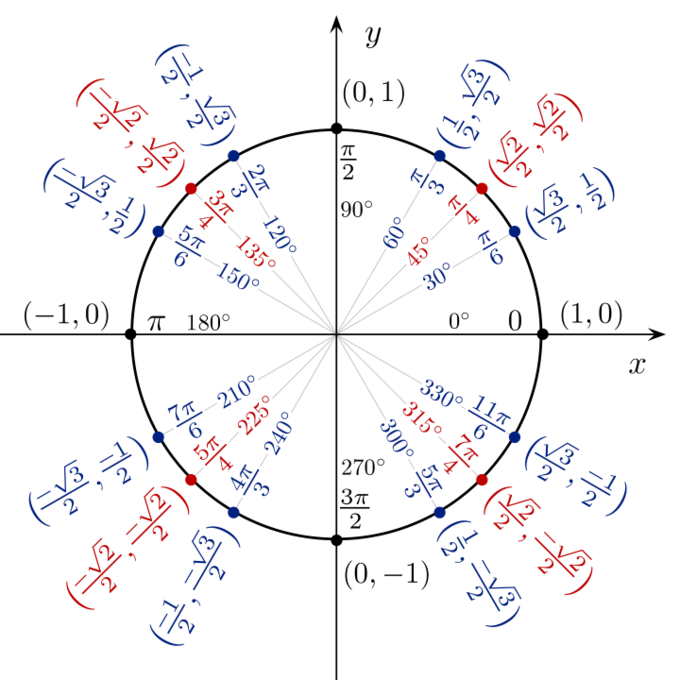
UNIT CIRCLEEEEEE