resp exam 1 review
 Call Kai
 Learn
Learn Practice Test
 Spaced Repetition
 Match
Match Flashcards
 Knowt Play
1/41

There's no tags or description
Looks like no tags are added yet.
Name | Mastery | Learn | Test | Matching | Spaced | Call with Kai |
|---|
No analytics yet
Send a link to your students to track their progress
42 Terms
Father of medicine
hippocrates
4 essential elements
-phlegm
-blood
-yellow bile
-black bile
whats the primary focus of respiratory care
Respiratory care aims to assess,
- treat,
- manage patients with respiratory or cardiopulmonary disorders,
-ensuring optimal patient outcomes.
what scientist determined sub atomical pressures
Leonardo da Vinici
Scientist that discovered CO2
Joseph Black in 1754
Scientist that discovered O2
Joseph Priesley in 1774
What law is having to do with the relationship of Gas temp and volume
Charles Law
What law is having to do temperature and pressure
Joseph Lous Gay-Lussac
Who was responsible for the germ theory
Lous Pasteur
When was the ITA founded
1947, first professional association.
During what decade was the educational inhalation therapist developed?
1960’s
What year was the term respiratory therapist used?
1974
What does the Clark electrode measure?
measurement of partial pressure of oxygen,Pa02 (measures PaO2)
Be familiar with William McQueen and what was his milestone
A notable figure in respiratory therapy history, known for his contributions to the development of respiratory devices and therapies.
What was the year that epinephrine was used on asthmatic patients?
1910
Who introduced the iron lung?
Philip drinker
Who developed the iron lung?
Jack Emerson
When do we celebrate respiratory week?
3rd week of October 18-24.
The roles of AARC
-The leading national and international professional organization for RTs.
Primary Professional association that advocates for the profession and publishes journal.
The role of NBRC- National Board for Respiratory Care
offers entry level certification and advanced registry (RRT). Examinations for RTs. It provides certification. Credentials.
-: A voluntary credentialing agency that sets standards for RTs.
The role of CoARC
Accredits schools and respiratory care educational programs.
What year was CoArc formed?
1996
What is the mission of the American care foundation?
-provides updates,
-best practice,
-opinions,
-themed highlights,
-professionalism within the respiratory care profession.
-Governed by board of directors, house of delegates, and other bodies.
What is the role of a respiratory therapist?
Patient assessment,
-disease management,
-diagnostic evaluation,
-management, education,
-rehabilitation,
-care for patient with deficiencies of the cardiopulmonary systems
What is the primary duty of inhalation therapists?
apply scientific principles to prevent identify and treat acute or chronic dysfunction of the cardiopulmonary system
What is the focus of respiratory therapists in the future
-Involves participation in professional organizations,
-continuous professional enhancement, and
-skill enhancement
Type of models of respiratory therapy departments?
-centralized model
-Traditional Model (Volume-Based): Efficiency = RVU / FTE
-New Model (Value-Based): Efficiency = Benefit / FTE
What is the scope of practice of respiratory therapists?
Application of technology and the use of protocols across all care sites: including but not limited to the hospital, clinic, physcians office, rehab facility, skilled nursing facility, and patients' homes.
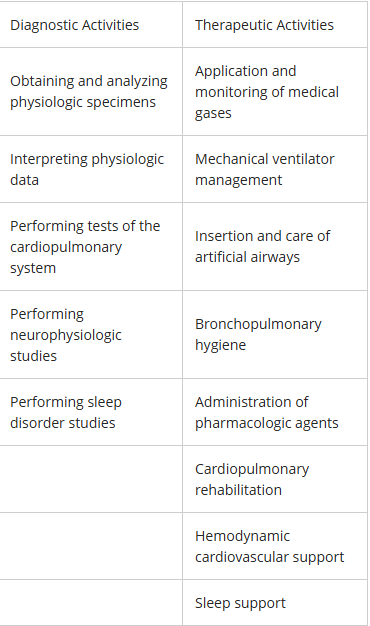
Where do RTs normally work
Hospitals, medical offices, insurance companies, homes, interfacility transports, sleep labs, skilled nursing facilities, pulmonary rehab programs, and outpatient clinics.
Dept Director
Most important element (for delivering quality care) Highly skilled RT
Quality assurance Coordinator
helps evaluate efficiencies of the clinical staff but also the value associated with respiratory care
Educational coordinator
Assessing the individual needs of RTs within the department and assigning resources to help reduce educational deficiencies.
Who is responsible for the quality of clinical care in the hospital?
medical director
How does a person/student obtain CRT/RT credentials? What are the things that they need to do?
CRT are entry level credentials for RT passed by written exam.
What are some study options available for RTs? Like advanced degrees?
These are achieved by achieving a higher cut score to earn RRT.
Other specialties are Certified Pulmonary function technologist (CPFT),
Registered Pulmonary function technologist(RPFT),
Neonatal/Pediatric specialist (NPS),
Adult critical care specialist (ACCS),
Sleep disorder specialist (SDS)
What is the purpose of the house of delegates?
A representative body for chartered affiliate societies contribting to the governance and growth of the profession of respiratory care through grass roots efforts.
Who serves on president council of the AARC?
An advisory body composed of past presidents of the AARC.
What is the joint commission and their purpose?
a non profit organizations that evaluated and accredates different types of healthcare facilities.
4 Koch's Postulates, which are the fundamental scientific rules used to prove that a specific microorganism causes a specific infectious disease. [1]
Association: The suspected bacterium must be found in every case of the disease and absent in healthy hosts.
Isolation: The bacteria must be isolated from the infected host and grown in a pure culture.
Inoculation: A sample of the pure culture must cause the exact same disease when introduced into a healthy, susceptible host.
Recovery: The bacteria must be re-isolated and recovered from the experimentally infected host to prove it is the exact same organism
centralized model,
-department director]-medical director - educational corridnator
-quality assurance corrindator
research/scienstist, supervisior/lead therapist- rt clinical staff
Traditional Model (Volume-Based): Efficiency = RVU / FTE
model measures efficiency by the number of procedures (Relative Value Units) completed per Full-Time Equivalent employee.
New Model (Value-Based): Efficiency = Benefit / FTE
model defines efficiency by the amount of benefit provided by a therapy (e.g., cost savings, improved survival, patient-perceived benefit) divided by the effort in FTEs. High-quality care is defined as care that is both safe and cost-efficient.