Bio 125
 Call Kai
 Learn
Learn Practice Test
 Spaced Repetition
 Match
Match Flashcards
 Knowt Play
1/126

Earn XP
Name | Mastery | Learn | Test | Matching | Spaced | Call with Kai | Chat |
|---|
No analytics yet
Send a link to your students to track their progress
127 Terms
Cytoplasm
Everything inside the cell except the nucleus
why are cells small
cells are small because of metabolic activity needs to have a small volume but a large surface area to let material in and out

Smooth endoplasmic recticulum
the primary site of lipid production

Rough endoplasmic recticulum
the primary site of protein creation by ribosomes
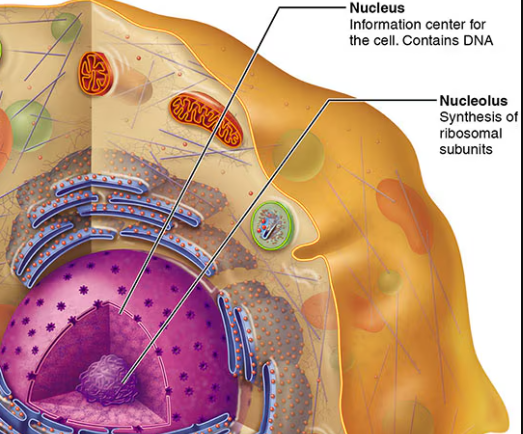
Nucleus
Holds the genetic material of DNA

Mitochondria
Creates power for the cell called ATP

Ribosomes
Use amino acids to make protein

Golgi apparatus
Refinds and moves proteins

Lysosomes
Uses enzymes to digest bacteria and other big things

Peroxisomes
Uses enzymes to destroy toxic waste

Centrioles
Help with cell division by aligning and dividing the cell wall
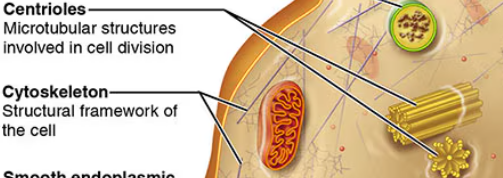
Cytoskeleton
supports the cell structure

Proteins
Act as a receptor for signals and acts as a gateway for larger molecules to pass through. The key part of facilitated transport

Cholesterol
Stiffens the cell membrane

Biopholipid bilayer

Carbohydrate groups
Identifies cell

cillia
Short hair like structures for moving things on the ovaries
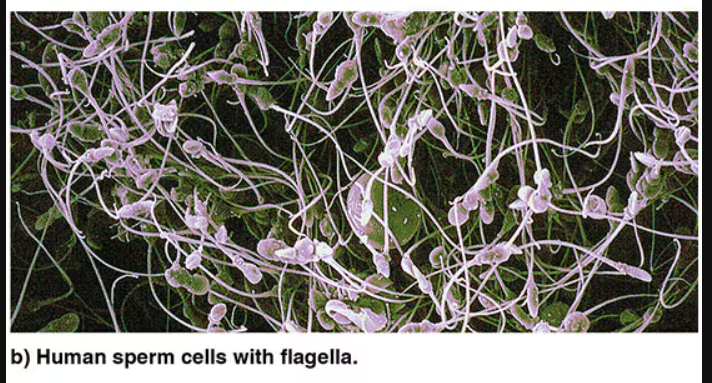
Flagellae
Longer whip like structure for moving things on sperm celsl

Microvilli
Hairs on the surface of cells that move things found in the digestive system
Passive transport
The cell doesn’t use any ATP instead relies on diffusion
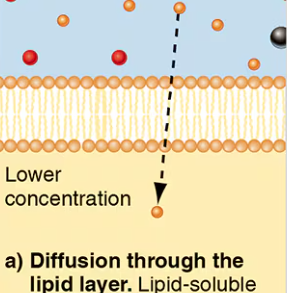
Membrane passive transport
Molecules that are lipid-soluble like oxygen
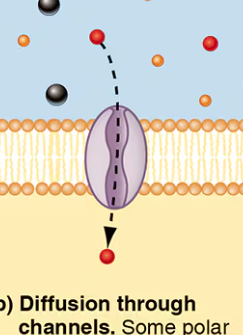
Channel diffusion
Molecules passes the cell membrane through protein gateways like with water
Facilitated transport
Molecules bind to a protein change its shape and pass through like with glucose

Endocytosis
Moving material into the cell

Exocytosis
Moving material out of the cell
Isotonic
There is no net movement because the intercellular and extracellular fluids are the same strength there is no change in the cell shape, size, or volume

Hypertonic
The strength of the solution is higher than that of the intercellular fluid, so water leaves the cell making it shrink

Hypotonic
The strength of the solution is weaker than the intercellular fluid, so water enters the cell making it expand
Metabolism
The sum of all chemical reactions in an organism
Catabolism
Where larger molecules are broken down for energy
Anabolism
Where molecules are assembled into larger molecules
Tissue
Groups of cells that have a common function
Epithelial tissue
Covers and protects and some are specialized and make a product and push it out
Muscle tissue
connects and shortens itself
Nervous tissue
Stimuli and signals it picks up and interprets
Connective tissue
it connects things together
Organ
several groups of tissue grouped together

Basment membrane
Directly beneath the epithelial cells it is the noncellular supporting layer
Cell junctions
Protein canals that connect epithelial cells together

Tight junction
spot welds between the 2 cell membranes that hold the cells tightly together to prevent leaking
Ex: Digestive tract cells bladder cells

Adhesion/desmosomes junction/spot
Allow for stretching between cells like skin and muscle and the stomach
Ex: epithelial tissue the skin
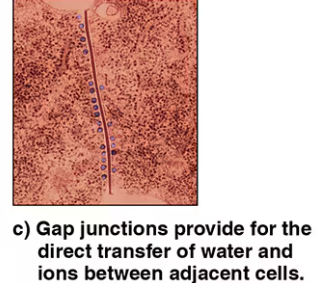
Gap junction
Protein channels or tunnels for rapid sharing or communication between two cells
Ex: liver, heart, some muscle tissue

Simple squamous epithelium
Allows for the exchange of gas waste and nutrients
Ex: air sacs of lungs and lines blood vessels

Stratisfied squamous epithelium
Protects from abrasions infections and drying out
Ex: Outer layer skin, mouth, vagina

Simple cuboidal epithelium
Absorbs water and other small molecules
Ex: kidney tubules and glands

Stratified cuboidal epithelium
Secrets water and ions it lines ducts of sweat glands

Simple columnar epithelium
Absorbs nutrients and secrets mucuse lines digestive organs
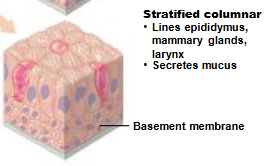
Stratisfied columnar epithelium
Secrets mucus lines the mammary glands and larynx
Connective tissue makeup
C.T is made up of living cells in a nonliving matrix
Types of connective tissue
Fibrous & Special
Elastic
Elastic a fibrous connective tissue is around organs that stretch like the stomach
Reticular
Reticular a fibrous connective tissue is a fine and delicate in framework found in the liver spleen and lymph nodes
Loose
Loose fibrous connective tissue is a packing material around organs that attaches the skin to the tissue below
Dense
Dense fibrous connective tissue is in the tendons and ligaments lower layer of skin
Cartilage
A special connective tissue made from chondrocytes with three types: elastic in the ears hyaline at the ends of growth plates
Bone
A special connective tissue that is made of mineral deposits of calcium and phosphate that forms the skeleton
Blood
A special connective tissue that carries oxygen and defends against infections and heals
Adipose
A special connective tissue that stores energy in fat
Muscle tissue
Striated muscle contracts when stimulated has three different types: smooth cardiac and skeletal
Smooth muscle
Non-striated muscles of hollow internal organs and tubes
Ex: Bladder, uterus, digestive tract
Skeletal muscle
Moves the skeleton using tendons which attach muscle to bone and ligaments which attach bone to bone
Cardiac muscle
Strained involuntary muscles around the heart
Nervous tissue
Consists of cells that generate and transmit electrical impulses in the body using neurons
Axon
sends the signal to the next cell; it randomly divides

Gilal cell
They support the neuron guards they protect, insulate and nourish

Dendrites
Extensions of the cell membrane that pick up the signal and bring it into the cell body
Synovial membrane
Line freely movable joints creats joint fluod
Cutaneous membrane
It is skin is the integumentary system
Mucuse membrane
Lines areas of the body that are open to the outside
Ex: digestive capacity, nose, eyes, vagina
Serous membrane
they cover organs & body cavities
Functions of skin
Protects against dehydration and injury, defends against infection, regulates body temperature, makes vitamin D, and provides sensation

Cranial cavity
Where is the brain

Vertibral canal

Thoracic cavity
Where are the lungs

Separates the thoracic and abdominal cavities
Diaphram

abdominal cavity
Where is the digestive system

Pelvic cavity
Where are the reproductive organs

Anterior cavity

Pericardial cavity
Where is the heart

Pleural cavity
Where the lungs are

Mistigial plane
divides the body into right and left

Frontal plane
Divides the body into anterior and posterior

Transverse
Divides the body into superior and inferior

Anterior
the front of the body

Posterior
the back of the body

Distal
farther from the base of the body

Proximal
closer to the base of the body
Superior
closer to the top of the headd
Inferior
farther way from the base of the head
Medial
closer to the midline
Lateral
farther from the mid line
Structures of the skin
the dermis and epidermis have six different structures for the hair, sweat and oil
Hair
Grows from the follicle and pushes hair to the epidermis
Sebaceous gland
Oil gland that moisturizes the skin and hair
Smooth muscle
Pulls on hair making it stand up

Blood vessels
Keeps the tempature regulated by dilating or constricting to let heat out or keep it in

Sensery nerve endings
Allow for the feeling of sensations like touch or heat
Sweat glands
Aids with temperature regulation by producing sweat to cool down
Functions of bones
Supports and moves the body and protects the organs, stores minerals, and makes blood cells
Structure of bone
Made up of osteons in a calcium phosphate matrix that looks like a tree stump full of osteocytes that live in the lacunae