Physiology Oct. 9th
 View linked note
 Call Kai
 Learn
Learn Practice Test
 Spaced Repetition
 Match
Match Flashcards
 Knowt Play
1/12

There's no tags or description
Looks like no tags are added yet.
Name | Mastery | Learn | Test | Matching | Spaced | Call with Kai | Chat |
|---|
No analytics yet
Send a link to your students to track their progress
13 Terms
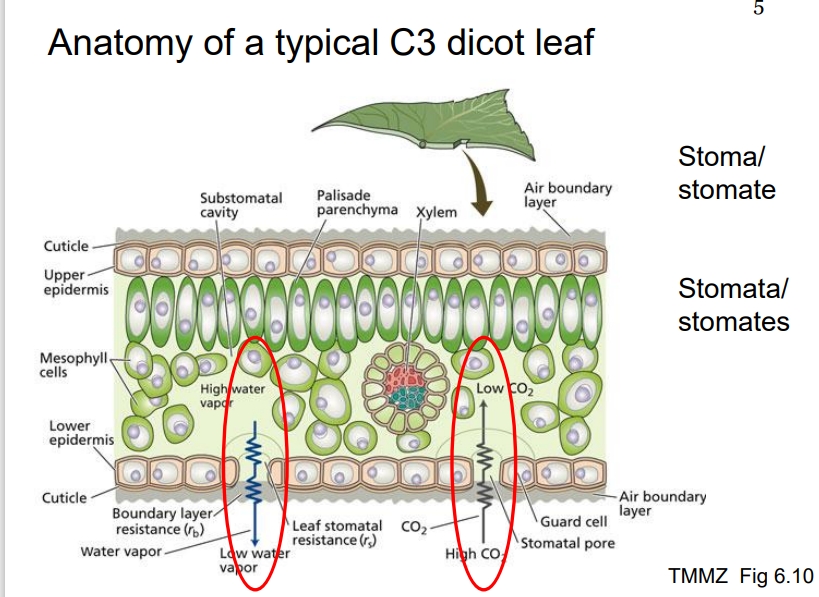
Explain briefly a leafs structure
C3 metabolism is the default metabolism in plants, where CO2 is initially fixed into a three-carbon compound.
Stomata are pores, primarily on the lower leaf surface, for gas and water exchange between plants and the atmosphere.
Open is…
good for CO2 uptake
“bad” for water loss
essential for transpiration
The upper leaf surface (illuminated side) generally lacks pores due to direct sun exposure, which would lead to excessive water loss.
Mainly does not contain photolytic cell types; thus, minimal photosynthesis occurs here.
Mesophyll cells:
Two main types in C3 leaves:
Palisade mesophyll cells: Densely packed and columnar, located just beneath the upper epidermis, optimized for light absorption and primary site of photosynthesis.
Spongy mesophyll cells: More loosely arranged with ample air spaces, facilitating efficient gas diffusion throughout the leaf.
Explain how plants get CO2
Atmospheric CO2 concentration is low (approximately 0.04%)
To facilitate carbon fixation, plants maintain even lower CO2 levels in air spaces:
CO2 is continuously consumed during the dark reactions (Calvin Cycle) of photosynthesis, maintaining a steep concentration gradient.
The low internal CO2 levels create a partial pressure gradient for diffusion from the atmosphere into the leaf.
Explain water movement in plants
Plants continuously transpire and photosynthesize, driving water movement from roots to leaves and out into the atmosphere.
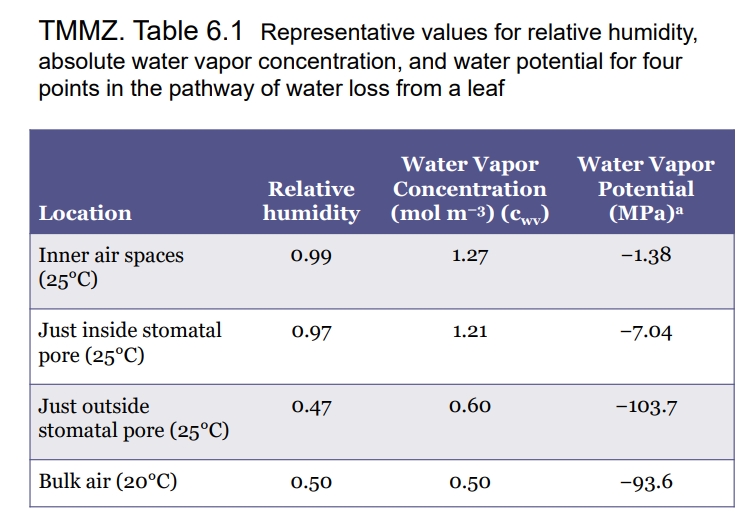
Water vapor diffuses from the moist inner air spaces of the leaf to the drier outside air
This process is transpiration and its driven by:
differences in humidity and vapour concentration (high humidity to low humidity)
differences in water potential (higher water potential (less negative) to lower water potential (more negative)
What are some resistance factors for water movement?
Resistance factors for water evaporation and diffusion:
Size and density of stomatal pores:
Smaller and fewer pores reduce transpiration by increasing diffusion resistance.
Boundary layer:
A layer of stagnant air immediately surrounding the leaf surface that acts as a barrier to gas exchange.
It thickens under still conditions, reducing the rate of water vapor diffusion out of the stomata and thus decreasing transpiration efficiency.
Cuticular resistance:
The waxy cuticle on the leaf surface significantly reduces water loss, although some minor diffusion can still occur.
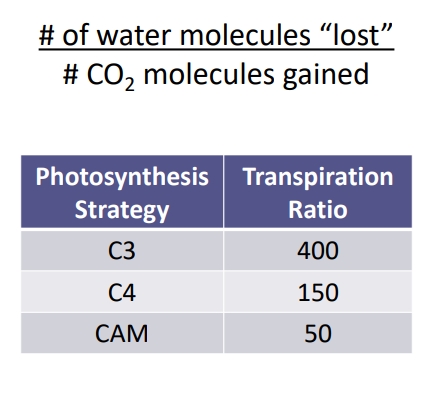
What is the transpiration ratio?
In C3 plants, the ratio is approximately:
400 molecules of water transpired for every 1 molecule of CO2 taken up. This high ratio reflects the trade-off between CO2 acquisition and water conservation.
C4 plants have higher water use efficiency; they transpire fewer water molecules to collect the same amount of CO2 due to their CO2 concentrating mechanism.
What is the structure of the stomata?
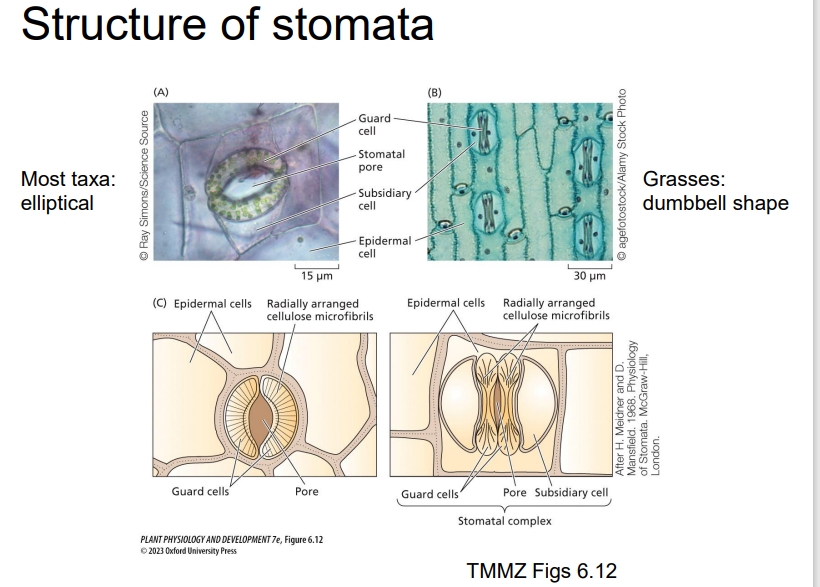
Under a microscope, stomata consist of two specialized guard cells that surround the stomatal pore and regulate its opening and closing.
Guard cells expand by absorbing water due to changes in turgor pressure, causing them to bow outwards and open the stomata for gas exchange.
When in a flaccid state (low water potential/turgor), the guard cells relax, causing the stomata to close.
Explain the mech. behind stomatal opening and closing
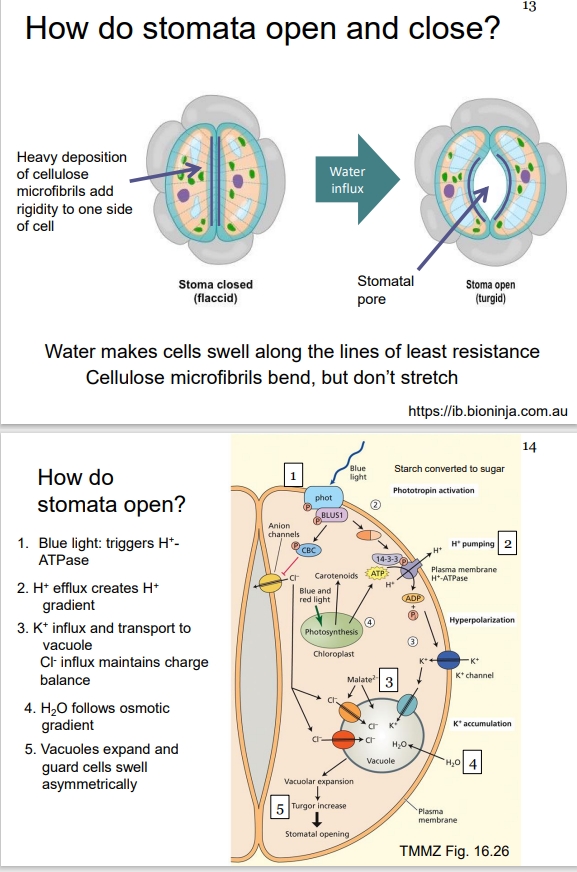
Light primarily impacts guard cells, specifically blue light which triggers phototropins (blue light receptors) located in the guard cell plasma membrane.
Upon activation by blue light:
Plasma membrane H+-ATPase proton pumps are activated, consuming ATP to actively pump protons (H+) outside the cell, into the apoplast. This action creates an electrochemical gradient and leads to hyperpolarization of the guard cell membrane.
This hyperpolarization triggers the opening of voltage-gated potassium (K+) channels, allowing potassium ions to flow rapidly into guard cells, moving down their electrochemical gradient.
Concurrently, anion channels (e.g., chloride channels) are inhibited from efflux, or specific anion uptake mechanisms are activated, also increasing chloride (Cl−) levels inside the cell.
Together, this massive influx of K+ (and Cl−) significantly lowers the water potential within the guard cells. Water then osmotically moves into the cells from surrounding epidermal cells, causing vacuoles to expand, increasing turgor pressure, which leads to stomatal opening.
What two things are in relation to stomata opening and closing?
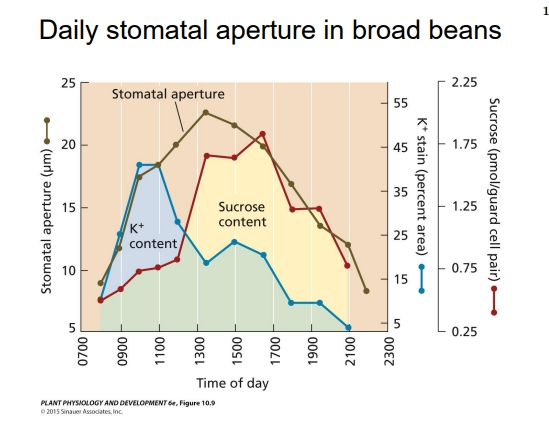
Potassium (K+) levels
In the morning, K⁺ content rises sharply, and stomatal aperture increases.
This means: K⁺ ions are pumped into the guard cells, lowering their water potential.
Water moves into the guard cells by osmosis, making them turgid, so the stomata open.
Sucrose levels
Around midday, K⁺ levels start to drop, but sucrose content increases.
Sucrose (produced from photosynthesis) helps maintain osmotic pressure in guard cells even as K⁺ declines.
This keeps stomata open while photosynthesis is at its peak.
Around night, both sucrose and K⁺ contents fall, and stomatal aperture decreases.
Guard cells lose turgor pressure, causing stomata to close for the night.
(Stomata close as solutes leave guard cells and photosynthesis stops (no need for gas exchange at night))
How is the stomata regulated?
Stomata do not simply open and close at set times; their behavior is dynamic and precisely regulated:
Influenced by light levels (blue light for opening, general light intensity affects photosynthesis).
CO2 availability: Low internal CO2 levels promote stomatal opening, while high CO2 concentrations trigger stomatal closure to conserve water.
Water stress: Conditions of drought or water scarcity induce stomatal closure to retain moisture, often mediated by the plant hormone abscisic acid (ABA), which signals water deficit and promotes ion efflux from guard cells.
Whats different about aquatic plants?
Low O2 concentrations in water
Plants can drown!
Most submerged aquatic plants (algae) are not complex
Almost every cell photosynthesizes
Rely on diffusion
Emergent and floating vascular plants have stomata on the upper leaf surface
What adaptation do aquatic plants have?
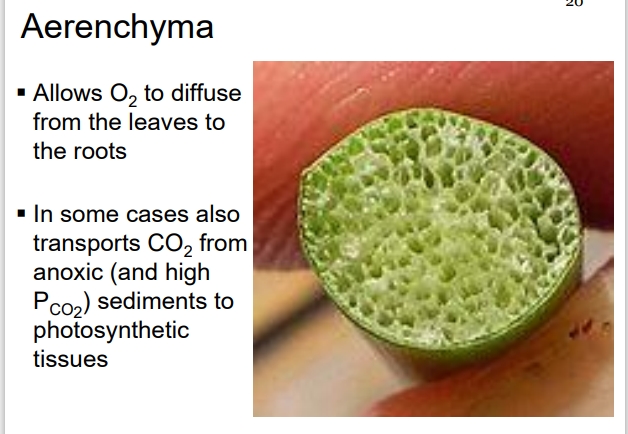
Some aquatic plants develop Aerenchyma structures (tubular formations of air-filled tissues) that facilitate gas exchange between submerged tissues and above-water tissues.
Aerenchyma provide mechanical support, buoyancy, and reduce resistance to gas diffusion in fluid environments where oxygen availability is often limited.
Gas exchange within aerenchyma is primarily through diffusion, although in some cases, pressure-driven convection currents (ventilated systems) may assist, especially in larger plants.
In what other conditions can aerenchyma develop?
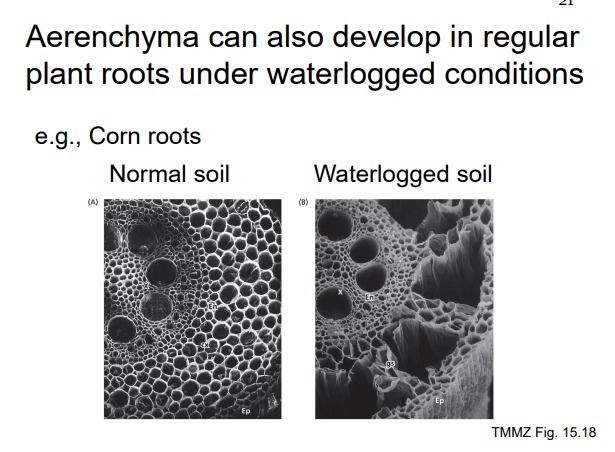
Under waterlogging conditions, roots are deprived of oxygen.
Plants may form larger hollow tubes within their stems and roots via programmed cell death (lysis of cells) to link submerged tissues to the atmosphere.
This adaptation maintains gas exchange by diffusion, ensuring oxygen supply to roots and allowing CO2 removal, even when roots are saturated with water and soil oxygen is scarce.