Fungal modes of pathogenicity II
 Call Kai
 Learn
Learn Practice Test
 Spaced Repetition
 Match
Match Flashcards
 Knowt Play
1/6

There's no tags or description
Looks like no tags are added yet.
Name | Mastery | Learn | Test | Matching | Spaced | Call with Kai |
|---|
No analytics yet
Send a link to your students to track their progress
7 Terms
How does the body react to pathogenic fungi?
Fungi are recognised by cells of the innate immune system
Pattern recognition receptors on surface of cells (dendritic cells, macrophages etc.) bind fungal cell wall components
Initiates phagocytosis; production of cytokines, chemokines and reactive oxygen species
Activation of T cells follows
Most animals can control fungal infections through action of innate immune system
An individual with lowered immunity cannot mount a strong enough or long enough immune response
Provides a foothold for fungal infection to persist and spread
What are fungi’s main pathogenic strategies?
• Generally chronic diseases
• Often produce granulomatous reaction
• Poorly-defined virulence factors
• Toxic metabolic products
• Require prolonged course of treatment
What is aspergillus?
Saprophytic, opportunistic, systemic mould
Replies on impaired, overwhelmed or bypassed host immune defences
Several species known to cause Aspergillosis
Primarily respiratory infection (can become generalised)
Immune competence determines outcome of infection
Corticosteroid therapy and long-term antimicrobial therapy increase risk
• Spores are very small
• Can pass through upper respiratory tract
• Carried to terminal part of bronchial tree
• Spore germination and invasion of tissue is controlled by many factors
• No true virulence factors
• Combination of factors leads to disease state
Strategies:
• Invasion
• Immunosuppression
• Spread
How does aspergillus disseminate?
• Hyphal invasion of blood vessels
• Vasculitis and thrombus formation
• Formation of mycotic granulomas in the lungs
• Vascular dissemination
• Colonisation and invasion of other internal organs
• Additional mycotic granulomas
What is Candida albicans?
• C. albicans is the most important (yeast) pathogen in animals
• Causes candidiasis: localized mucocutaneous disease
• Worldwide distribution
• Infection due to disruption of mucosal integrity; urinary catheters; administration of antibiotics; and immunosuppressive drugs or diseases
• Most frequently infects birds
• Commensal yeast that lives on mucosal membranes
• Pleomorphic switch from yeast to filamentous growth
How does Candida albicans act as a pathogen?
• Phagocytic clearance eliminates most yeast cells
• Those that survive convert to hyphal forms
• Enables tissue penetration and resistance to phagocytosis
Strategies:
• Adherence
• Avoidance
• Flexibility
• Integrin-like molecules on cell surface
• Allows adhesion to matrix proteins on mucosal cells
• Transition to hyphal morphology and expression of additional adhesins
• Secretion of toxins; proteinases; lipases and phospholipases to aid tissue invasion
• Msb2p counteracts complement system (antimicrobials)
• Vascular invasion by hyphae
• Haematogenous spread
• Production of systemic lesions
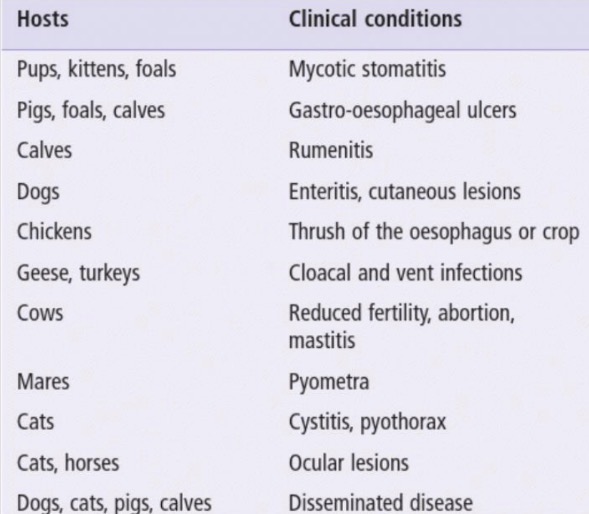
What are the clinical conditions associated with C.albicans?