Saavadrea and Silverman (button phobia)
 Call Kai
 Learn
Learn Practice Test
 Spaced Repetition
 Match
Match Flashcards
 Knowt Play
1/26

There's no tags or description
Looks like no tags are added yet.
Name | Mastery | Learn | Test | Matching | Spaced | Call with Kai |
|---|
No analytics yet
Send a link to your students to track their progress
27 Terms
phobias
the irrational fear of an object or event that posses little to no danger
classical conditioning
a learning process where a neutral stimulus becomes associated with a naturally occurring stimulus, ultimately triggering a conditioned response
evaluative learning
the change in a person's affective evaluation (liking or disliking) of a neutral stimulus after it is associated with a positive or negative stimulus
→ a neutral stimulus becomes negatively evaluated, leading to disgust rather than fear
operant learning
a learning process where voluntary behaviours are modified by their consequences: reinforcement increase the behaviour, punishment decrease the behaviour
expectancy learning
a neutral stimulus becomes associated with a threatening outcome → the individual develops a fear response to the stimulus
background (4)
phobias are diagnosed by psychiatrists & clinical psychologists using the manual DSM-5
semi-structured interview were used to diagnose the phobia, including assessing the severity & duration of symptoms
previous researchs:
targeting disgust can help adults with blood-injury phobias
fear reduction also lessen disgust in spider-phobic children
aims
To investigate how classical conditioning can be used to treat a child’s phobia by targeting disgust and fear responses
research method
case study
data collection techniques
interviews
various scales
observations
→ data collected before, during & after therapy & at 6 & 12 months follow-ups
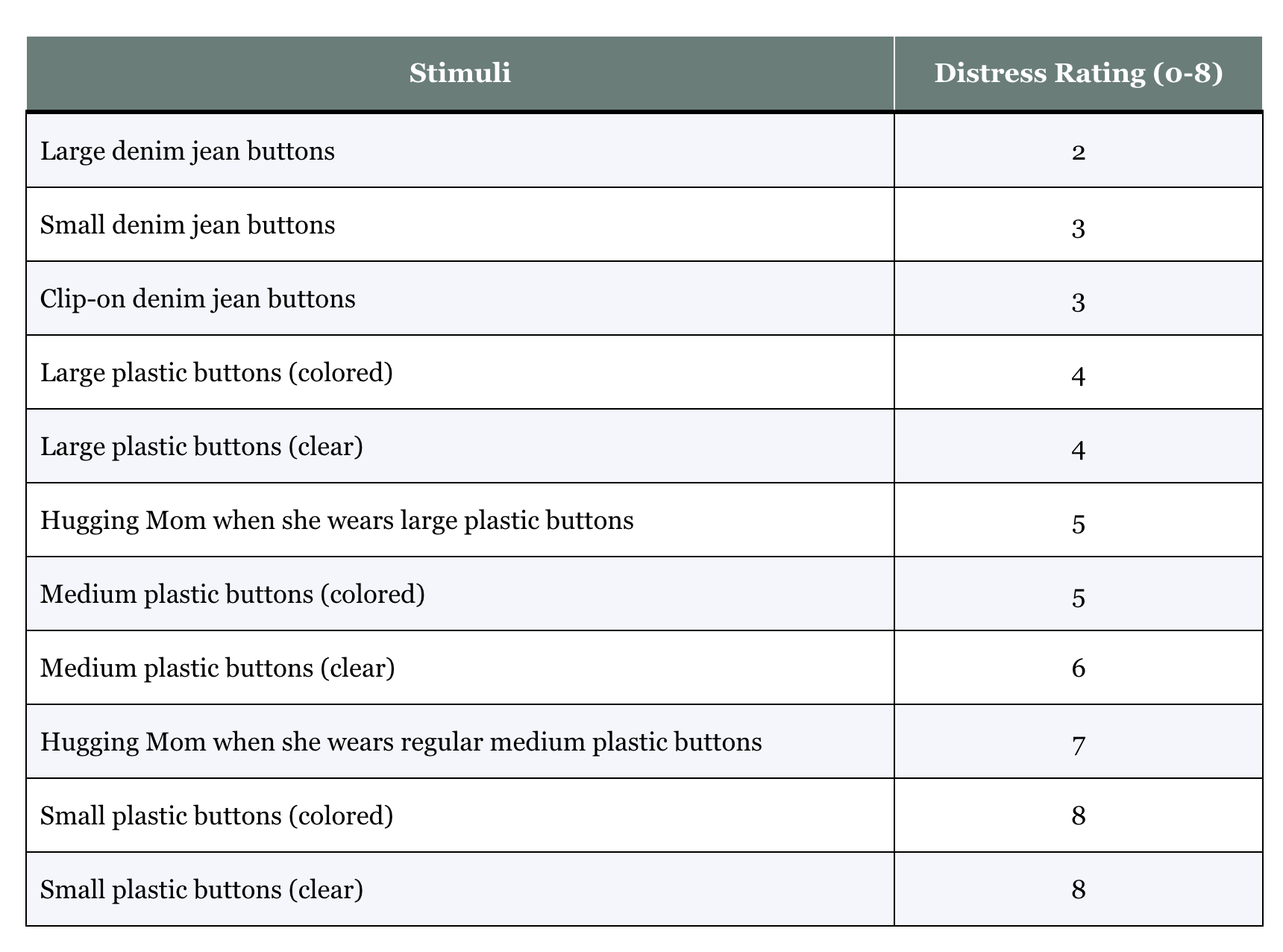
feeling’s thermometer
measures button-related fears on a scale from 0 (minimal distress) to 8 (maximum distress).
Large denim buttons were the least distressing, while small, clear plastic buttons were the highest distress.
sample (4)
9 yo boy
hispanic-american
has no other disorders (OCD was ruled out)
opportunity sample
interview & observation
semi-structured interview & observation of therapy session
→ notes were made about approach/avoidance of buttons
procedure: assessment of phobia (3)
the DSM-IV was used to confirm the boy’s phobia diagnosis using a semi-structured interview
feeling’s thermometer was used to assess symptoms severity
possible triggers of the phobia were explored to inform treatment
procedure: behavioural exposure (4)
four 50-min sessions (20-min with mother)
based on the boy’s hierarchy of distress, starting with less upsetting buttons (large denim) and moving gradually to more distressing ones (small, clear)
the boy was psoitively reinforced for tolerating/touching the buttons by his mother
aimed to reduce his avoidance behaviour by making the exposure manageable and gradual.
procedure: imagery exposure (5)
seven sessions
the boy were asked to imagined and described the look, smell and feel of buttons
used cognitive restructuring to challenge his negative thoughts about buttons
helped him explore why he thought buttons were disgusting and replace these ideas with less negative ones.
sessions were designed to become gradually more challenging.
procedure: 6 months and 12 months follow ups
distress level and ability to handle buttons were measured by feeling’s thermometer & interviews
ethical issues (5)
Informed consent was taken from the mother and the boy
confidentiality of the boy was kept
protection from harm: the sessions start with least distressing scenario & the boy received positive reinforcement from his mother
therapeutic context
follow-ups to check on the boy
results: cause of phobia (4)
he tipped a bowl of buttons when he was 5 yo; this happened in front of the class
afterwards, the boy:
unable to touch/handle buttons (dress & undress)
poor concentration at school due to the buttons on uniform
avoid clothes w buttons & ppl w buttons on their clothing
results: exposure therapy (behavioural exposure) [4]
positive results
the boy worked through al the situations in the disgust hierarchy
he handled more buttons in each exposure sessions
negative results
feelings thermometer distress reatings increased
some situations from disgust hierarchy received higher rating than before
results: imagery exposure [2]
distress rating on the feeling’s thermometer decreased:
situation: imagine hundreds of buttons falling on him
→ rating went from 8 → 5 → 3
situation: hugging his mother w a shirt full of buttons
→ rating went from 7 → 4 → 3
results: follow up sessions [2]
buttons no longer triggered distress
school uniform w small clear plastic buttons was worn daily w/o issues
conclusions [2]
childhood disgust-based phobias:
→ can be explained using evaluative learning
→ may require imagery exposure + cognitive restructuring + exposure therapy
strengths [4]
high ecological validity: therapeutic settings
case study → detailed data collected
validity: both qualitative & quantitative data collected
validity: follow up sessions shows the long-term effects of the treatment
weaknesses [3]
low generalisability: only study one individual
reliability: sessions was patient focuses → cannot be replicated exactly
low validity: self-reported data
the boy and his mother may overly positive about the long-term benefits due to the relationship w therapist
I&D: application
therapists should be trained in the use of imagery exposure & cognitive restructuring
I&D: nature vs nurture
nurture is supported as learning experiences in therapy helped change the boy’s behavioural & emotional responses