Cerebellum
 Call Kai
 Learn
Learn Practice Test
 Spaced Repetition
 Match
Match Flashcards
 Knowt Play
1/50

There's no tags or description
Looks like no tags are added yet.
Name | Mastery | Learn | Test | Matching | Spaced | Call with Kai | Chat |
|---|
No analytics yet
Send a link to your students to track their progress
51 Terms
What appearance does the cerebellum have?
laminated
What does the vermis separate?
the lateral hemispheres
What does the primary fissure separate?
the anterior from the posterior lobe
Whats does the horizontal fissure separate?
the superior from the inferior surface
What does the posterolateral fissure separate?
the posterior lobe from the flocculonodular lobe
How are the nuclei organised?
outer cortex with deep cerebellar nuclei
main output zone where most processing within cerebellar cortex
What are the functional divisions of the cerebellum?
vestibulocerebellum
spinocerebellum
cerebrocerebellum
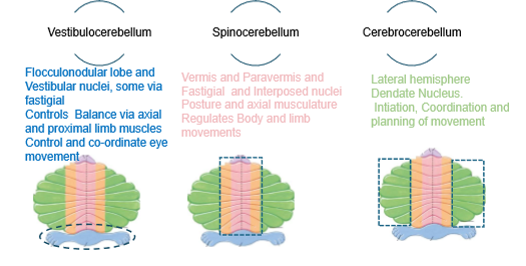
What is the input to vestibulocerebellum?
vesitbular inputs from primary sensory afferents and visual inputs
flocculonodualr love and vestibular nuclei, some via fastigial
What is the output of the vestibulocerebellum?
flocculus to fastigial nucleus and vestibular nuclei
medial and lateral vestibulospinal tracts to neck and back muscles
outputs to ocular motor nuclei
Function of vestibulocerebellum?
primitive part
balance via axial and proximal limb muscles
control and coordination of eye movements
Damage to the vestibulocerebellum
nystagmus
poor or absent smooth pursuit and abnormal vestibulo-occular reflex
What does the spinocerebellum consist of?
the vermis and paravermis
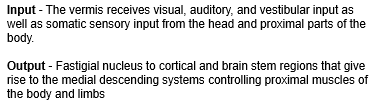
What are the inputs and outputs to the vermis?
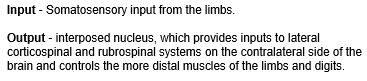
What are the inputs and outputs of the paravermis?
What is the function of the spinocerebellum?
posture and axial musculature
regulates body and limb movements
What does damage to the spinocerebellum do?
ataxia
impaired motor coordination
action tremor
What is the cerebrocerebellum consisted of?
the lateral parts of the hemispheres
most recent and much larger relative to cerebellum comapred to monkeys etc
What is the input to the cerebrocerebellum?
the cerebral cortex
What is the ouput of the cerebrocerebellum?
dentate nucleus which projects via the thalamus to motot, premotor, parietal and prefrontal cortices
Function of cerebrocerebellum?
planning and executing movement
cognitive functions eg language processing
What are cerebellar peduncles?
white matter axon bundles that connect these regions
What is the cytoarchitexture of the cerebellar cortex like?
molecular layer
single cell purkinje layer
granule cell layer
then subcortical white matter
Where do climbing fibres originate from?
the inferior olive
What do the mossy fibre cells do?
major afferent input - comprise input from all other brain regions excpet IO
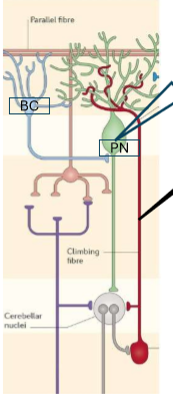
How the circuitry seems to work?
excitatory input from purkinje cells from climbing fibres and granule cells
climbing from IO and granule from mossy fibre
purkinje cell has output to cerebellar nuclei
all other cells mentioned are in the layers of the cerebellar cortex
Circuitry full explained:
two types of afferent input:
mossy fibres
these originate from many sources eg spinal cord and synapse with granule cells in granular layer
granule cells to parallel fibres to purkinje
climbing fibres
these originate from the IO nucleus
synapse directly with Purkinje
purkinje cells are the only output neurons
axons project to deep cerebellar nuclei
they are GABAergic
What features are there in the electrical properties of a Purkinje cell?
simple spikes and complex spikes
seen using electrode and patch clamp
What do parallel fibres do?
granule cell axons ascend from the granule layer into molecular and bifurcate into parallel fibres
pass through dendrites of 450 POurkinje cells and forms synaptic contacts with dendritic spines of 300 Purkinje cells
Eccles et al, 1967
form SIMPLE SPIKES
What do climbing fibres do?
axons from the contralateral IO neurons
each mature Purkinje cell innervated by one climbing fibre
numerous synaptic contacts meaning large EPSP causing COMPLEX SPIKE (calcium dependent)
What pattern and activity does the cerebellar cortex have?
patterned molecular expression and heterogeneity in PC activity
What is a large function of the cerebellum?
compares the intended movement and actual movement
can predict the sensory consequences of commands and act as feedback system
What can looking at Purkinje and deep nuclear cells for example with wrist flexion and extension firing tell us?
shows coordination of ongoing movement
constantly tracking movements and updating it
modulating depending on the change of movement
What is there evidence for PC simple spike doing?
motor learning and coordination
losing the beat: contribution of Purkinje cell firing dysfunction to disease and its reversal
What are climbing fibres viewed as the source of?
instructing signal and regulating cerebellar dependent motor learning
Long term depression also related – complex spike activity
What is a critical mechanism required for cerebellar motor learning?
long term depression of the synaptic input from parallel fibres
stimulate climbing, amplitude of parallel going down, activity in Purkinje decrease
Look at study on next slide to find more info and references
Basic description of LTD - may not be super correct?
coincident activity of input to Purkinje fibres from parallel fibres and climbing fibres
intracellular calcium rises in the Purkinje cell which triggers molecular pathways and parallel fibre synapse is weakened
less excitation of Purkinje - less inhibition of DCN and stronger output from cerebellum
encodes motor error correction
Better more detailed description of LTD?
climbing fibres lead to depolarisation of P neuron causing calcium ion influx
parallel fibres release glutamate which activates AMPA and mGluR1 on P neurons
the combination of signalling from that leads to activation of protein kinase C
this acts as a coincidence detector impacting the AMPA receptor response
diminshes the flow between parallel fibre and P neuron
therefore DCN usually encodes for known movements but this is overridden and codes for motor error correction due to the disinhibition
What is good evidence for role of PKC and also LTD in general in motor error correction for the vestibulo ocular reflex?
De Zeeuw (1998)
selectively inhibted PKC using transgenic mouse
found complete blockade of LTD induction
ability to adapt vestibulo-ocular reflex absent
cerebellar LTD required for motor learning adaptation of VOR
activation of PKC in P cells necessary for LTD induction
What else is critical for motor learning?
PF-PC LTP
climbing fibres play critical role in bi-directional plasticity at these synapses
Coesmans, Weber, De Zeeuw and Hansel, 2004
Another reference:
D’Angelo – the organisation of plasticity in the cerebellar cortex from synapses to control
(really not necessary actually)
What can the cerebellum do with eyes?
contribute to experience-dependent modification of saccadic eye movements
Reference on slide STILL CANT FIND BUT LOOKS USEFUL
What is the study which looks at learning adaptation using prism goggles?
Martin et al, 1996
Other examples of cerebellar function beyond movement control?
emotion processing, word comprehension, language processing
What are two references for how cerebellum function extends beyond motor control?
Schmahmann and Sherman (1998)
describes the cerebellar cognitive affective syndrome and how this is characterised by deficits in executive function, linguistic processing, spatial cognitiion and affect regulation
especially with lesions of the posterior and vermis
Wang, Kloth and Badura (2014)
looks at the connection with autism and social interaction specifically proposing that sensitive-period disruption of such internal brain communication can account for autism’s key features
What are typical symptoms of cerebellar disease?
inaccuracy in range and direction (dysmetria)
inability to stabilise
irregular pattern of repeated movements
Symptoms of cerebellar ataxia?
- Posture and gait deficits
- Lack of coordination of limbs
- Oculomotor and speech deficits – dysarthria
- Cog deficits and subtle autonomic signs
- Inability to learn complex motor skills
What is spinocerebellar ataxia?
neurogenetive disorders affecting cerebellum and connections leading to progressive problems with coordination
degeneration of pathways connecting spinal cord and cerebellum
symptoms eg unsteady gait, poor coordiantion etc
What causes essential tremor?
- Cerebellar cortex circuitry alterations
- Lack of Purkinje neurons?
- More info needed
- Ibrahim et al, 2021
SEARCH UP CIRCUITRY + DEPRESSION, READING, LOOK AT STUDIES MENTIONED
Research shows how cerebellum involved in eye saccades through lesioning of monkeys
Takagi et al, 1998
the oculomotor vermis plays a critical role both in the immediate on-line and in the short-term adaptive control of pursuit
Showed specifically the uvula and vermal pyramid important for smooth eye movements by looking at 28 patients with cerebellar damage, comparing different patients.
Baier et al, 2009