POLS 207- Representation and Redistricting
 Call Kai
 Learn
Learn Practice Test
 Spaced Repetition
 Match
Match Flashcards
 Knowt Play
1/13

There's no tags or description
Looks like no tags are added yet.
Name | Mastery | Learn | Test | Matching | Spaced | Call with Kai |
|---|
No analytics yet
Send a link to your students to track their progress
14 Terms
Political Institutions
State-level political institutions with formal political decision-making authority:
legislatures
executives & state bureaucracy
courts
Functions of Legislatures
US legislatures have an inherent conflict between representative function & lawmaking roles
lawmaking institutions- “wholesale” politics
enacting of statutory laws, referring amendments
confirmation of appointments
budgetary powers
oversight authority
Representative institution- “retail” politics
representing interests of constituents
bringing funds & projects to districts (i.e. pork)
constituent services
Legislation & Representation
individual state legislators represent particular constituency that elected them
but the legislature as a whole makes law for the entire state
Institution ties these together via:
pork-barrel legislation where lawmaking serves constituents particular interests
constituent services to “help out” constituents & bolster public image of incumbents
Legislative redistricting creates uncompetitive legislative districts that protect incumbent lawmakers
State Legislatures: The Ideal Representative Govt
Members sent by smaller constituencies
fewer members per representative
State legislatures remail largely lay bodies
less professionalized, more like “regular folks”
Closer to the ideal of “citizen legislators”
Regular folks with “real jobs”
upwardly-mobile, upper-middle class
75% hold college degrees
overrepresented occupations: business, law, real estate
Representing the People…
Legislature rarely provides descriptive representation
i.e. Members mirroring the politically relevant characteristics of contstituents
It may offer substantive representation, based on communication of constituents interests
legislator connected to constituents by linkage institutions:
interest group
parties
elections
media
Communication both ways may be spotty, biased, or minimal
Geographic basis of representation in the US
representation in geographic districts
often no clear “identity” to heterogeneous constituency
Each level of representative govt has own boundaries
US house of representatives
state senate
state house
Different levels districts can overlap
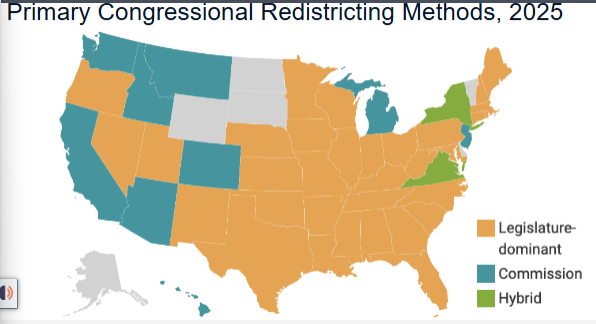
Who gets to draw the lines?
Drawing electoral district boundaries is traditionally done by state legislatures themselves
many state legislature have the primary responsibility for drawing both state legislative districts (34 states) & US congressional districts (33 states)
TX: redistricting done by Tx legislature
TX constitution allows for politician commission as “backup”
Two part process:
apportionment
redistricting
Legislative Apportionment & district size
starting point is the US census (every 10 years)
this count provides the basis for adjustment of population based electoral districts
Congressional districts
must be within 2% of the size of the “ideal district”
State-level districts
looser standards (no absolute numbers)
deviations respecting political subdivisions (e.g. counties, cities) usually upheld
large deviations must be justified
Malapportionment?
Common before 1960s
rural domination of state legislatures & US house despite increased urbanization & suburbanization of US population
TX Constitution required unequal apportionment!
Courts viewed redistricting as a “political question”
This changes w/ Baker v. Carr (1962)
established legal principle of “one person, one vote”
equal representation
Unequal representation (due to unequal districts) violates 14th amendment equal protection
How to draw the boundaries?
Results may or may not reflect make-up population
partisanship
racial & ethnic makeup
other “communities of interest”
e.g. rural v. urban, economic interests
Skewed seats-to-vote ratio not necessarily evidence of impropriety
what kinds of practices and districts are acceptable
Formal Legal Rules for Redistricting
equality of population
one person one vote
Contiguity
all parts of the district must touch
Protected groups
voting rights act protections of minority representation
cant draw map to dilute minority votes
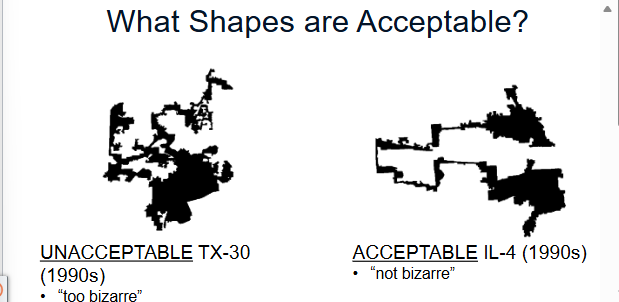
District shape
can be “odd” but not “bizarre” (legally undefined terms)
Odd looking districts may preserve communities of interest
Traditional Redistricting Principles for State Legislative districts
compactness
contiguity
maintaining “communities of interest”
i.e. common political, social or economic interests
Respect for political boundaries
i.e. minimize splitting of counties, towns, precincts, etc
Types of Gerrymandering
partisan gerrymandering
party draws districts in its favor
no prohibition against it
both parties do it
TX republicans AND IL democrats often cited as worst offenders
Racial gerrymandering
“negative”: illegal under the VRA
“affirmative”: legal but controversial
uses redistricting to create minority “opportunity districts”
Accomplished via packing & cracking voting blocs