3. BASIC PRINCIPLES OF PHARMACOKINETICS AND PHARMACODYNAMICS
 Call Kai
 Learn
Learn Practice Test
 Spaced Repetition
 Match
Match Flashcards
 Knowt Play
1/33

There's no tags or description
Looks like no tags are added yet.
Name | Mastery | Learn | Test | Matching | Spaced | Call with Kai |
|---|
No analytics yet
Send a link to your students to track their progress
34 Terms
a baby that needs iv fluids
gentamycin is given
physiologic barriers
Physical, Chemical, Biological barriers
physical: Epithelial lining of GIT
chemical: pH difference between stomach and fundal veins (pH trapping)
Blood brain barrier/ blood placental barrier/ blood testicular
Bi-lipid layer: Phospholipids, Glycolipids
Transmembrane proteins (G proteins)
Hydrophobic core and 2 Hydrophilic surfaces (most drugs are hydro and lipophilic)
Routes of Drug Administration
Oral (PO)
Inhalation
Vapors, gases, smoke
Mucous membranes
Intranasal (drug?)
Sublingual (drug?)
Rectal suppository (drug?)
Vaginal pessary (drug?)
Injection (parenteral)
Intravenous (IV)
Intramuscular (IM)
Subcutaneous (SC)
Intraperitoneal (IP)
Intra-arterial (arteries)
Intra-articular (joints)
Transdermal
Oral Drug Administration: Advantages
Safe, economical, convenient, practical, reversible
Oral Drug Administration: Disadvantages
First pass effect (most is broken down)
Blood levels are difficult to predict due to multiple factors that limit absorption.
Some drugs are destroyed by stomach acids.
Drugs may get inactivated by GI enzymes
Drugs may get activated and then broken down
Drugs may irritate the GI tract
Advantages of Injection Routes
Absorption is more rapid than with oral administration.
Rate of absorption depends on blood flow to particular tissue site (I.V. > I.M. > S.C.).
Advantages specific to I.V. injection
No absorption involved (inject directly into blood)- Does not undergo first pass effect
Rate of infusion can be controlled.
A more accurate prediction of dose is obtained.
Disadvantages/Risks of Injection
A rapid onset of action can be dangerous if overdosing occurs.
If administered too fast, heart and respiratory function could be compromised
Drugs insoluble in water or dissolved in oily liquids can not be given I.V.
Sterile techniques are necessary
BIOAVAILABILITY
The fraction of an administered dose of drug that reaches the blood stream.
what factors affect bioavailability
Physical properties of the drug (hydrophobicity- will not be absorbed, pKa, solubility)
Drug formulation (Sustained release, Troche- lozenge, Pessary)
Fasting state- increased bioavailibility
Gastric emptying rate-
Interactions with other drugs
Age and gender- younger>,
Diet
Genetic, Disease, Ethno cultural, socioeconomic
passive vs active transport *know this slide and examples
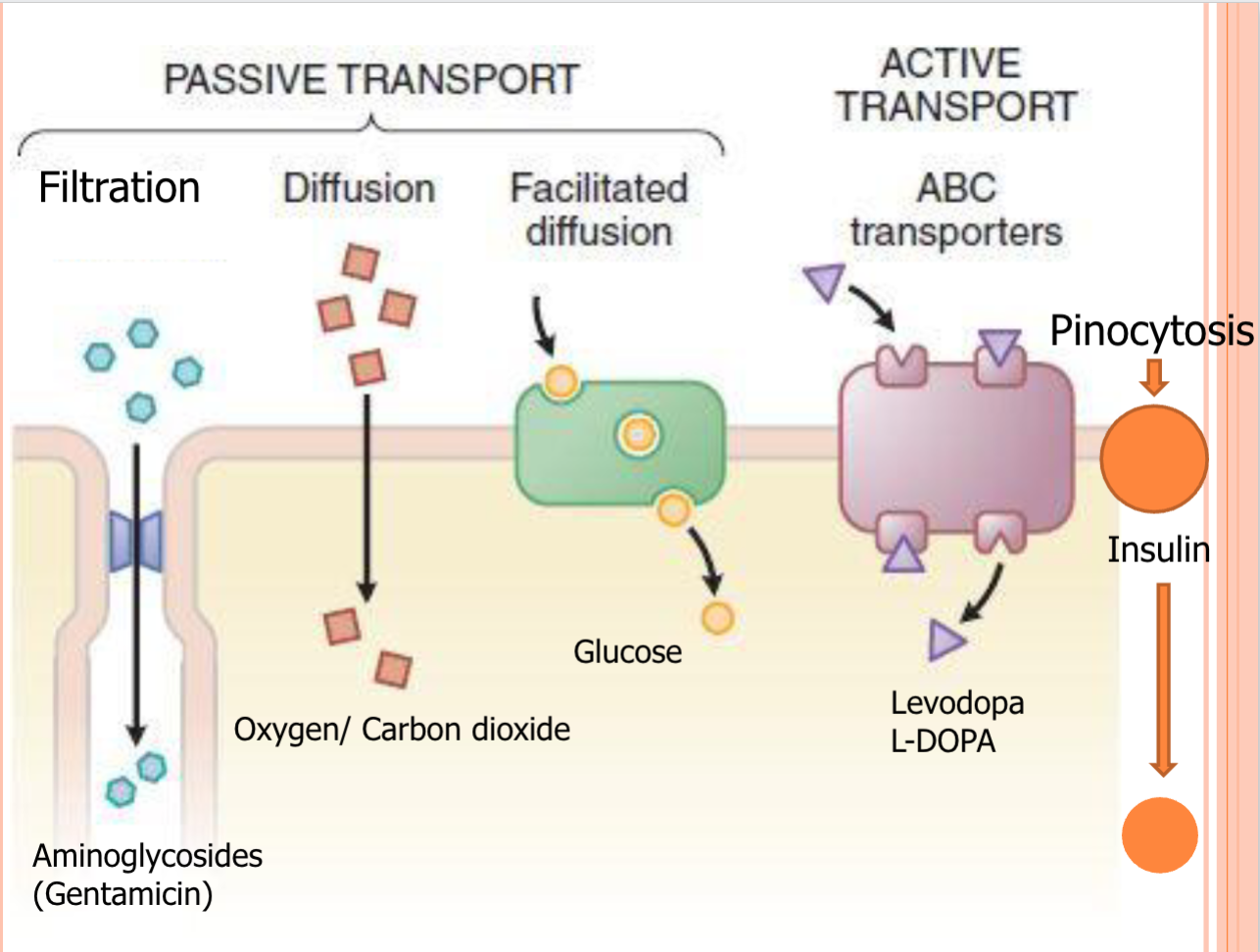
passive = more often than active
kidney = main organ of filtration
ABC= active binding cassett
parkisons = L dopa deficiency