Chapter 4: Extensions of Mendeling Inheritance
 Call Kai
 Learn
Learn Practice Test
 Spaced Repetition
 Match
Match Flashcards
 Knowt Play
1/160

There's no tags or description
Looks like no tags are added yet.
Name | Mastery | Learn | Test | Matching | Spaced | Call with Kai |
|---|
No analytics yet
Send a link to your students to track their progress
161 Terms
What is the Mendelian Inheritance based on?
A single gene with two different alleles
What type of allele relationship is seen in simple Mendelian Inheritance?
A dominant/recessive relationship
What are the two major Mendelian laws mentioned on this slide?
The Law of Segregation and the Law of Independent Assortment
What does the Law of Segregation state?
Alleles separate during gamete formation
-
-
Why does the slide say “Mendel got lucky”?
Because the traits he studied followed simple inheritance patterns
What will this chapter focus on?
Traits that deviate from simple dominant/recessive inheritance
Do more complex inheritance patterns still follow Mendelian laws?
Yes, they still obey Mendelian laws
-
-
What is simple Mendelian inheritance?
Inheritance that follows Mendel’s laws with a strict dominant/recessive relationship
What is the molecular explanation for simple Mendelian Inheritance?
One functional dominant allele produces enough protein for the dominant trait
What is incomplete dominance?
A heterozygote shows an intermediate phenotype between the two homozygotes
-
-
What is an example of incomplete dominance?
Red flowers crossed with white flowers produce pink flowers
Why does incomplete dominance occur molecularly?
One dominant allele does not produce enough protein to fully show the dominant phenotype
What is incomplete penetrance?
A dominant allele is present, but the dominant phenotype is not always expressed
-
-
What is an example of incomplete penetrance?
A person carrying the polydactyly allele but having a normal number of fingers and toes
Why can incomplete penetrance occur?
Environmental factors or other genes may suppress the phenotype
What is overdominance?
The heterozygote has a more beneficial trait than either homozygote
-
-
What are some molecular reasons for overdominance?
Increased resistance to an infection
Better protein dimer function
Proteins function under a wider range of conditions
What is codominance?
Both alleles are fully expressed in the heterozygote
What is an example of codominance?
AB blood type
-
-
Why does codominance occur molecularly?
Each allele produces a functional protein with its own effect
What is X-linked inheritance?
Inheritance of genes located on the X chromosome
Why are males more affected by X-linked traits?
Because males have only one X chromosome
What does hemizygous mean?
Having only one copy of a gene instead of two
What is sex-influenced inheritance?
An allele behaves differently depending on the sex of the individual
What is an example of sex-influences inheritance?
Pattern baldness in humans
What causes sex-influences inheritance molecularly?
Sex hormones affect gene expression
-
-
What is sex-limited inheritance?
Traits expressed in only one sex
What is an example of sex-limited inheritance?
Breast development in mammals
Why does sex-limited inheritance occur?
Certain sex hormones are only present in one sex
What is a lethal allele
An allele that can cause death of an organism
What are prevalent alleles in a population called?
Wild-type alleles
What does wild-type mean?
The most common form of an allele found in a population
How do proteins produced by wild-type alleles usually function?
They function normally and are made in the proper amounts
-
-
What is genetic polymorphism?
When two or more wild-type phenotypes are common in a large population
What does polymorphism mean?
The existence of multiple common forms within a population
Can different appearances still be considered wild-type?
Yes, if they are common in the population
-
-
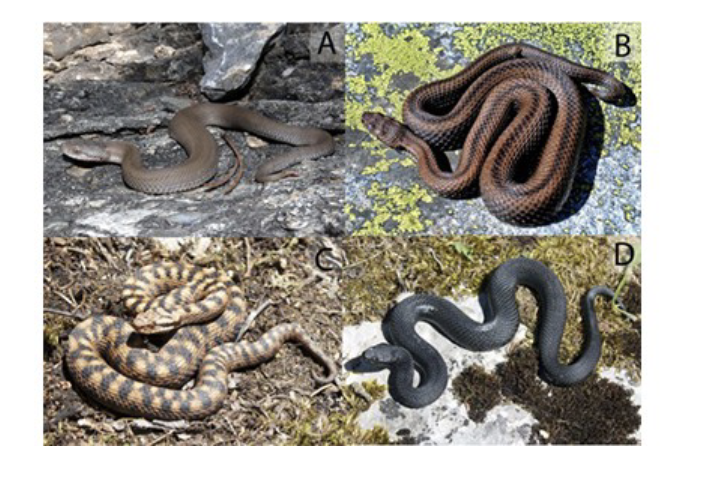
What do the snake pictures demonstrate in this slide?
Different common phenotypes within the same population
Why is genetic polymorphism important?
It increases variation within a population
Does genetic polymorphism always indicate harmful mutations?
No
-
-
What are the most common alleles in a population called?
Wild-type alleles
How do wild-type alleles usually function?
They produce normal functional proteins in the proper amounts
What is genetic polymorphism?
When two or more wild-type phenotypes are common in a large population
What are alleles altered by a mutation called?
Mutant alleles
-
-
How do mutant alleles often affect proteins?
They may reduce or prevent the production of a functional protein
Are mutant alleles usually common or rare in natural populations?
Rare
How are many mutant alleles inherited?
In a recessive fashion
-
-
Why are many harmful mutant alleles recessive?
A normal dominant allele can often still produce enough functional protein
What are some recessive human diseases?
Phenylketonuria (PKU)
Albinism
Tay-Sachs disease
Sandoff disease
Cystic fibrosis
Lesch-Nyhan syndrome
What are some examples of diseases cause by recessive mutant alleles?
Phenylketonuria (PKU)
Albinism
Tay-Sachs disease
Sandoff disease
Cystic fibrosis
Lesch-Nyhan syndrome
-
-
What causes phenylketonuria (PKU)?
Inability to metabolize phenylalanine properly
What can happen is PKU is untreated?
Severe mental impairment and physical degeneration
What disease is associated with defective tyrosinase?
Albinism
-
-
What causes albinism?
Lack of pigmentation in the skin, eyes, and hair
What disease is caused by defective Hexosaminidase A?
Tay-Sachs disease
What happens in Tay-Sachs disease?
Defects in lipid metabolism leading to paralysis, blindness, and early death
What recessive disease is caused by defective Hexosaminidase B
Sandhoff disease
What enzyme is defective in Sandhoff disease?
Hexosaminidase B.
What happens in Sandhoff disease?
Progressive mental and motor deterioration caused by lipid metabolism defects
What recessive disease is caused by defective chloride transport across epithelial cells?
Cystic fibrosis
-
-
What protein is defective in cystic fibrosis?
A chloride transporter
What causes cystic fibrosis symptoms?
Defective chloride transport across epithelial cell
What are common symptoms or cystic fibrosis?
Thick lung mucus and chronic lung infections
What recessive disease is caused by defective hypoxanthine-guanine phosphoribosyl transferase
Lesch-Nyhan Syndrome
What enzyme is defective in Lesch-Nyhan syndrome?
Hypoxanthine-guanine phosphoribosyl transferase
What causes Lesch-Nyhan syndrome?
inability to properly metabolize purines
What are symptoms of Lesch-Nyhan syndrome?
Self-mutilation behavior
Poor motor skills
mental impairment
kidney failure
-
-
Why are enzyme defects commonly discussed in recessive diseases?
Because many recessive diseases result from missing or nonfunctional enzymes
What is the main difference between wild-type and mutant alleles?
Wild-type alleles are common and functional, while mutant alleles are altered and often defective
Why is cystic fibrosis considered recessive?
Two defective alleles are usually required for the disease phenotype to appear
-
-
Why can recessive diseases remain hidden in populations?
Heterozygous carriers often appear normal
In a simple dominant/recessive relationship, does the recessive allele affect the phenotype of the heterozygote?
No, the recessive allele does not affect the heterozygote phenotype
Why can a heterozygote still show the wild-type phenotype?
Because enough functional. protein is produced for normal function
-
-
What is haplosufficiency?
When 50% of the normal protein is enough to accomplish the protein’s cellular function
What percentage of functional protein does a heterozygote (Pp) produce in a simple dominant/recessive relationship?
About 50%
What percentage of functional protein does PP produce?
100%
-
-
What percentage of functional protein does pp produce?
0%
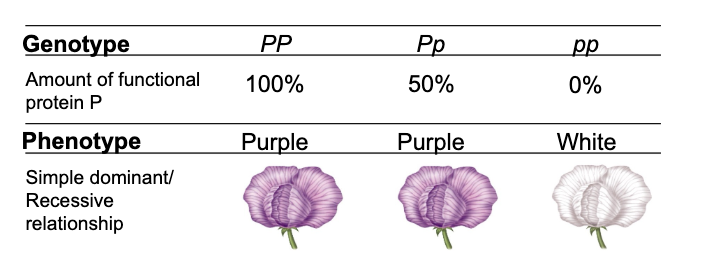
What phenotype does the genotype PP produce in the flower example?
Purple flowers
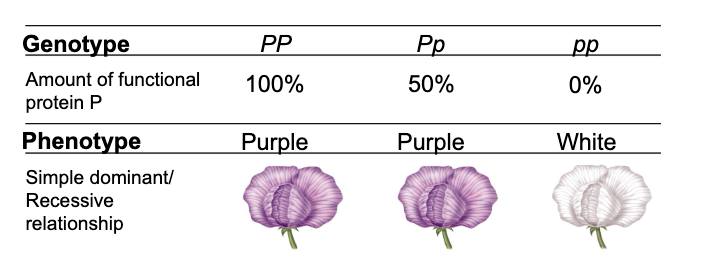
What phenotype does the genotype Pp produce in the flower example?
Purple flowers
-
-
What phenotype does the genotype pp produce in the flower example?
White flowers
Why does Pp still produce purple flowers even though only 50% of the protein is made?
Because 50% of the protein is sufficient for normal function