Cattle Reduced Reproductive Performance 1 (TV4101, Lecture 5, 8 and 9 Notes)
 Call Kai
 Learn
Learn Practice Test
 Spaced Repetition
 Match
Match Flashcards
 Knowt Play
1/42

There's no tags or description
Looks like no tags are added yet.
Name | Mastery | Learn | Test | Matching | Spaced | Call with Kai |
|---|
No analytics yet
Send a link to your students to track their progress
43 Terms
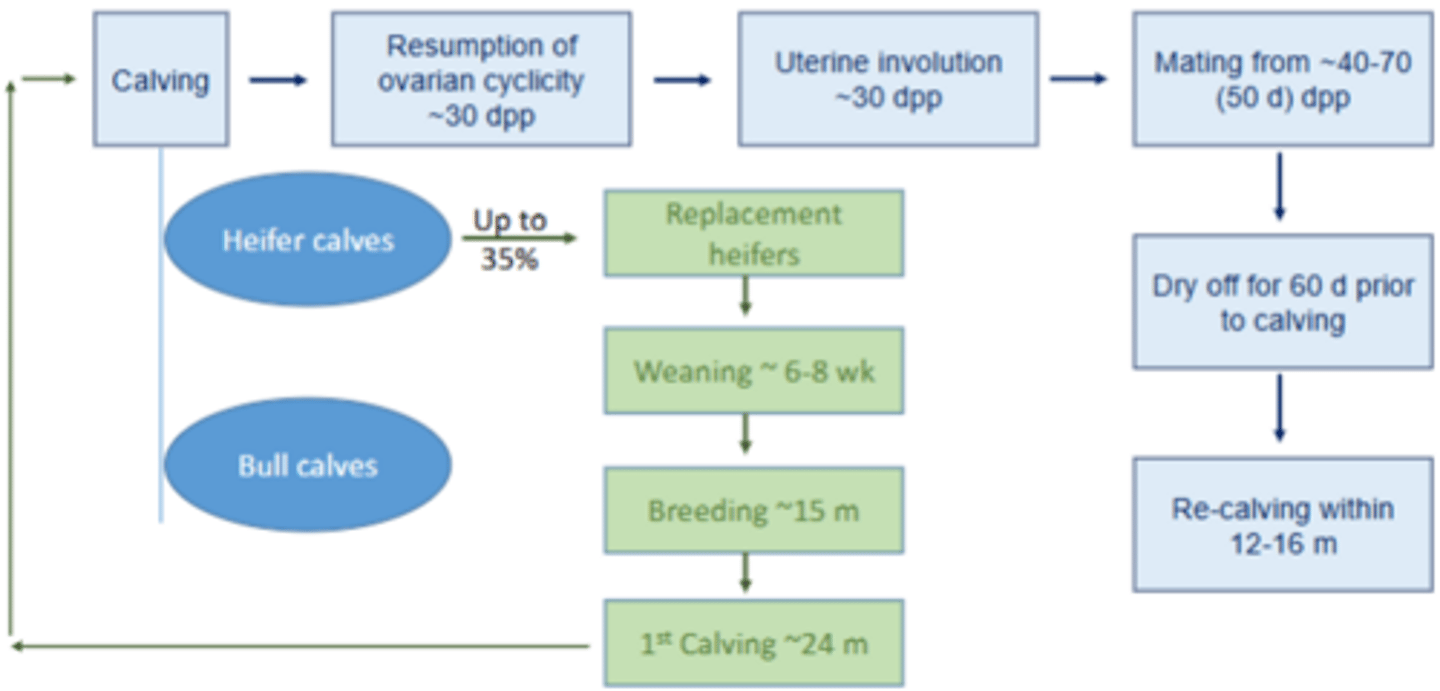
Describe a year-round calving system for dairy herds
Traditional measures of fertility;
- Calving interval 365 d
- Calving to breeding interval 50 d
- Calving to conception interval 70 d
Define the reproductive indices for year-round calving dairies
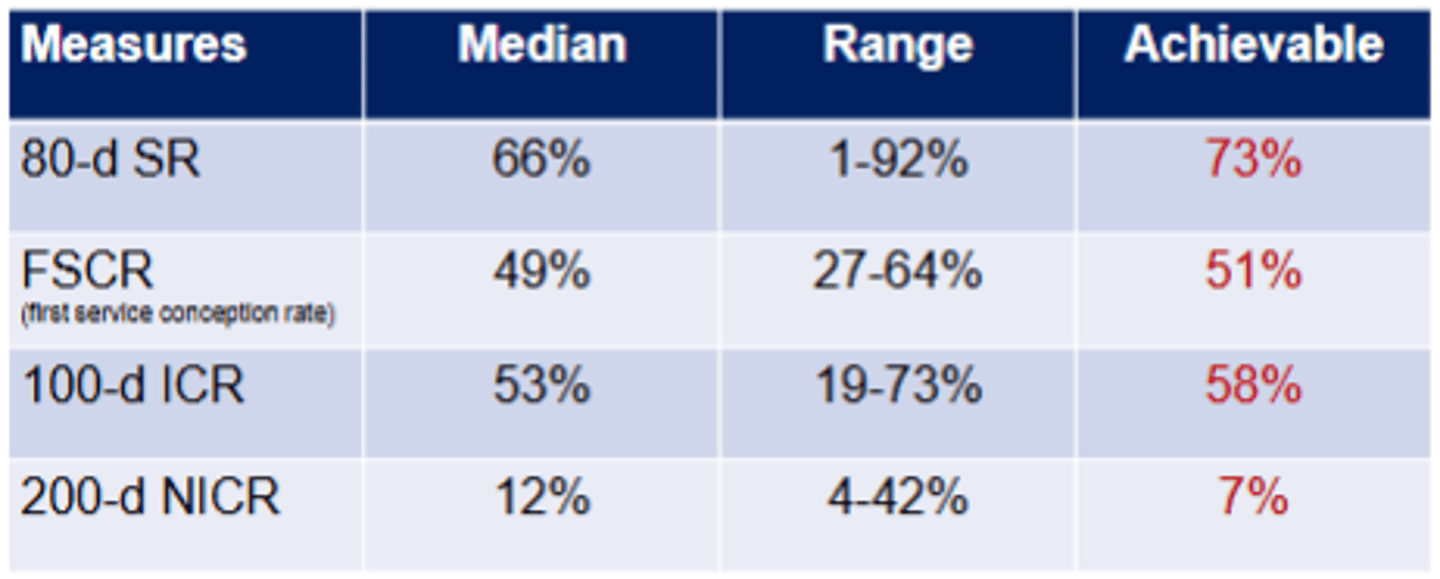
80-d submission rate - % of cows submitted for AI by 80d postpartum (dpp).
First service conception rate - % of cows pregnant to the first AI postpartum out of those submitted to AI.
100-d in-calf rate - % of cows pregnant by 100days after calving.
200-d not-in-calf rate - % of cows not pregnant by 200days after calving.
Provide the benchmarks for year-round calving dairies
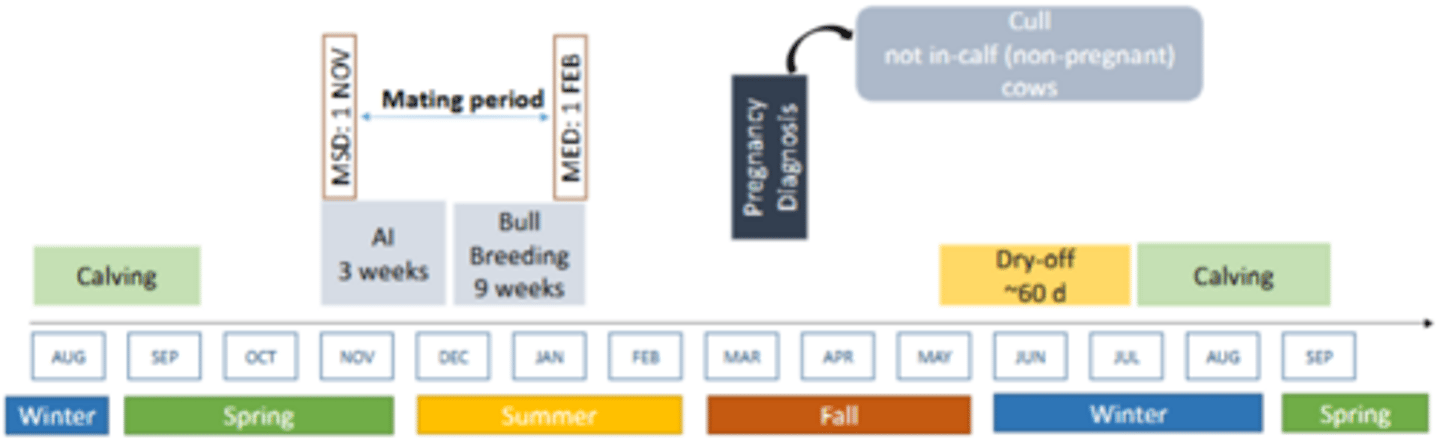
Describe a seasonal calving system for dairy herds
Define the reproductive indices for seasonal calving dairies
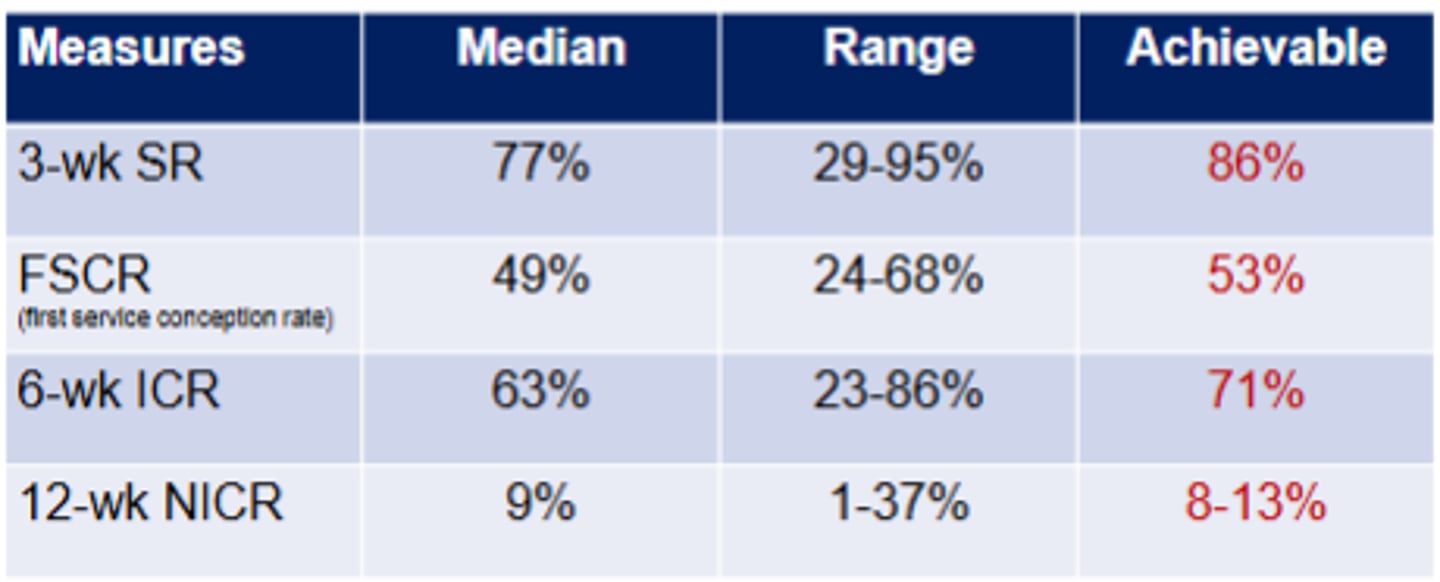
3-wk submission rate - % of cows submitted for AI within 3 weeks from MSD.
First service conception rate - % of cows pregnant to AI out of those submitted to AI.
6 week in-calf rate (ICR) - % of cows pregnant after 6 weeks of mating start date.
Not-in-calf rate (NICR) - % of cows not pregnant by the end of mating period.
Provide the benchmarks for seasonal calving dairies
Discuss controlled-mated beef herds
- 1 bull : 30-50 cows
- 9-week or 16-week breeding window
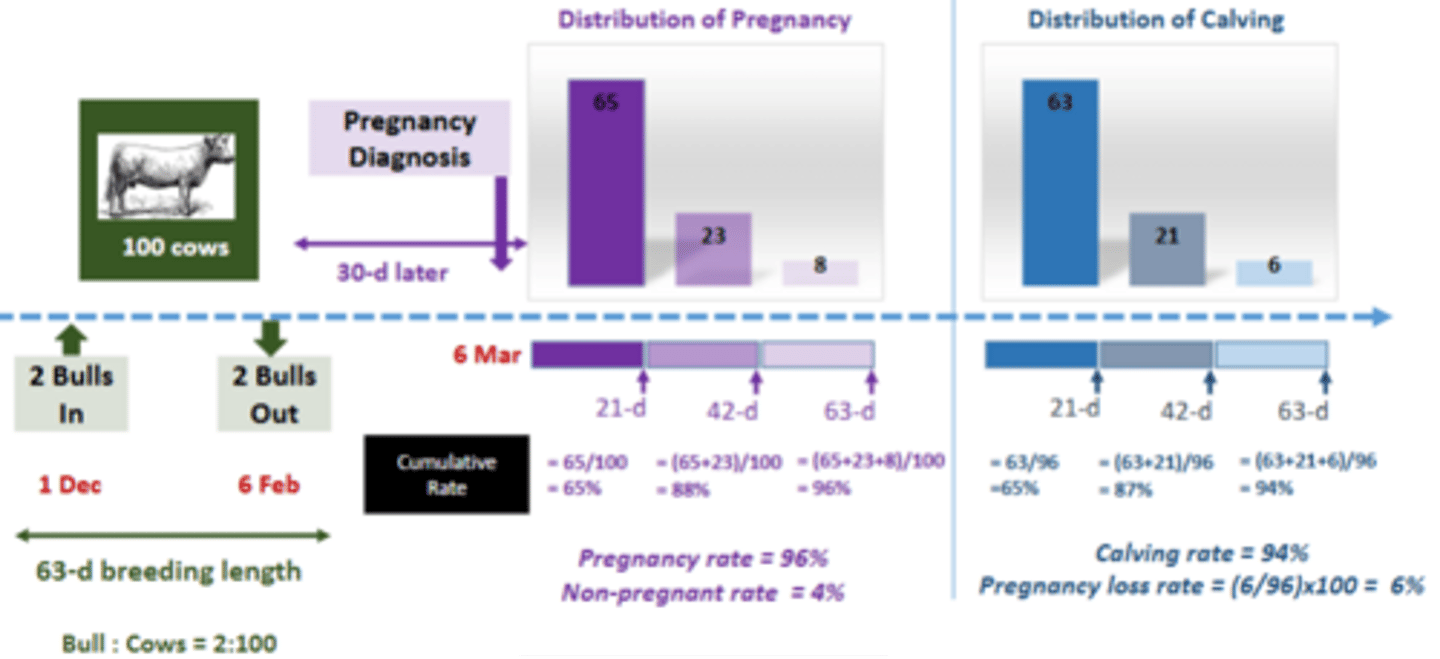
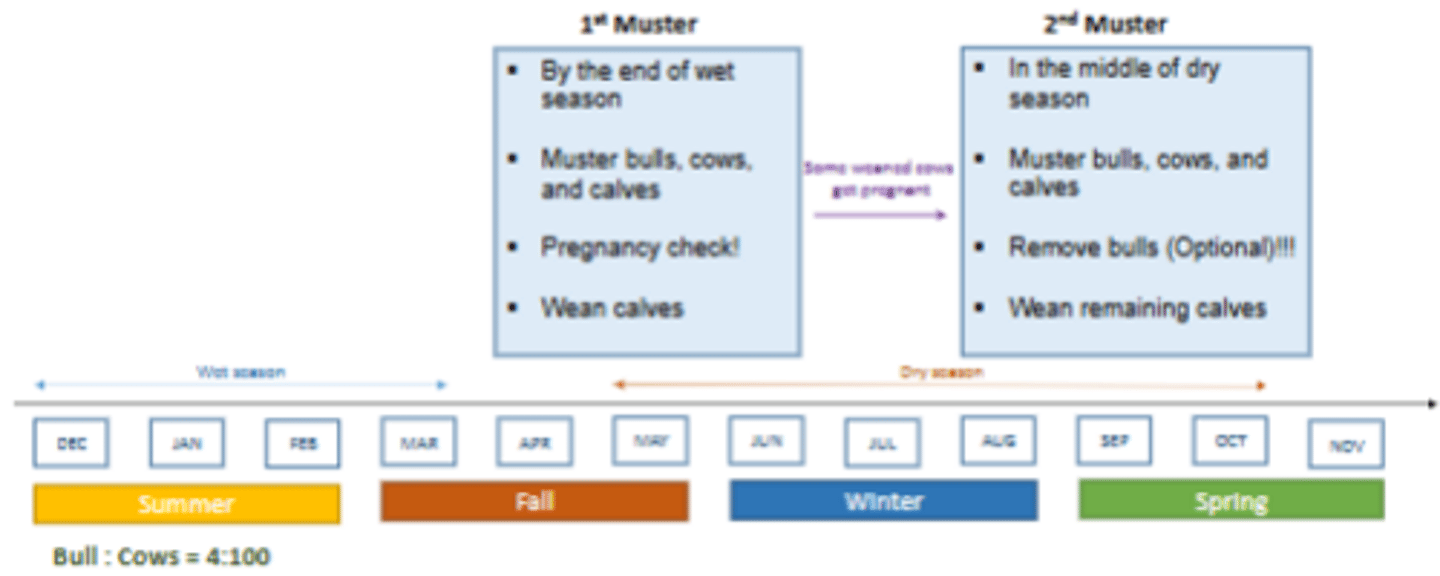
Discuss continuously-mated beef herds
- Consider segregated breeder management
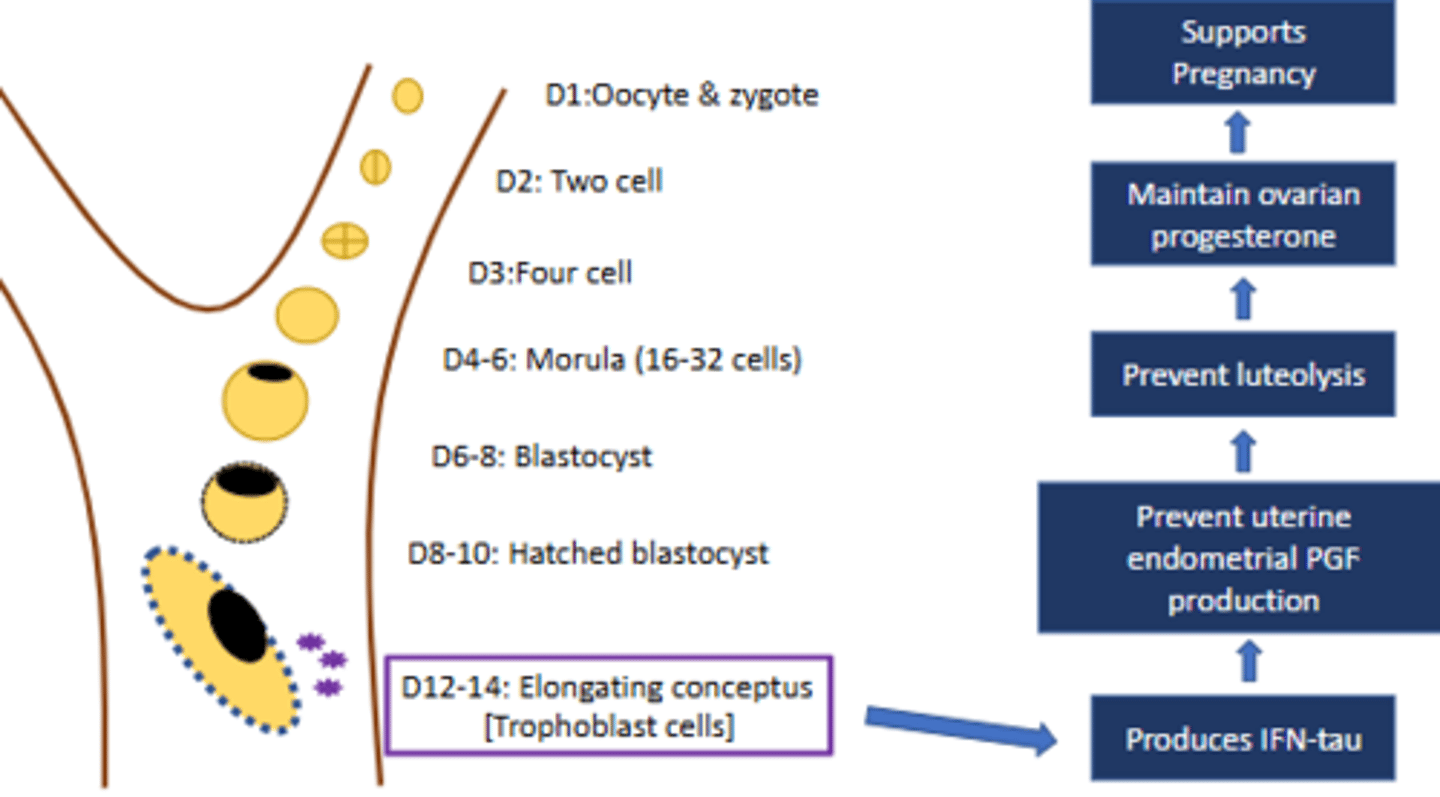
Discuss maternal recognition of pregnancy
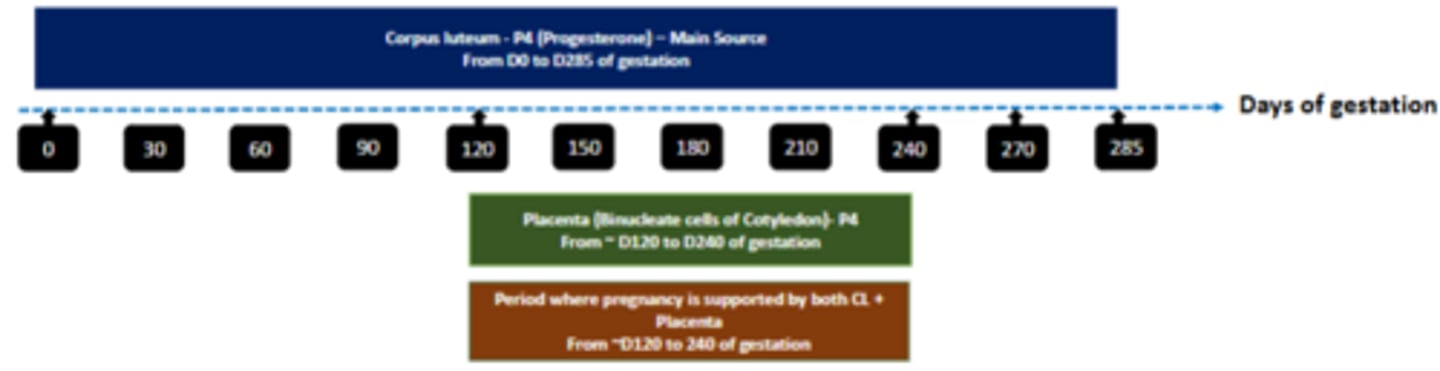
Discuss the maintenance of pregnancy
Discuss causes for pregnancy loss
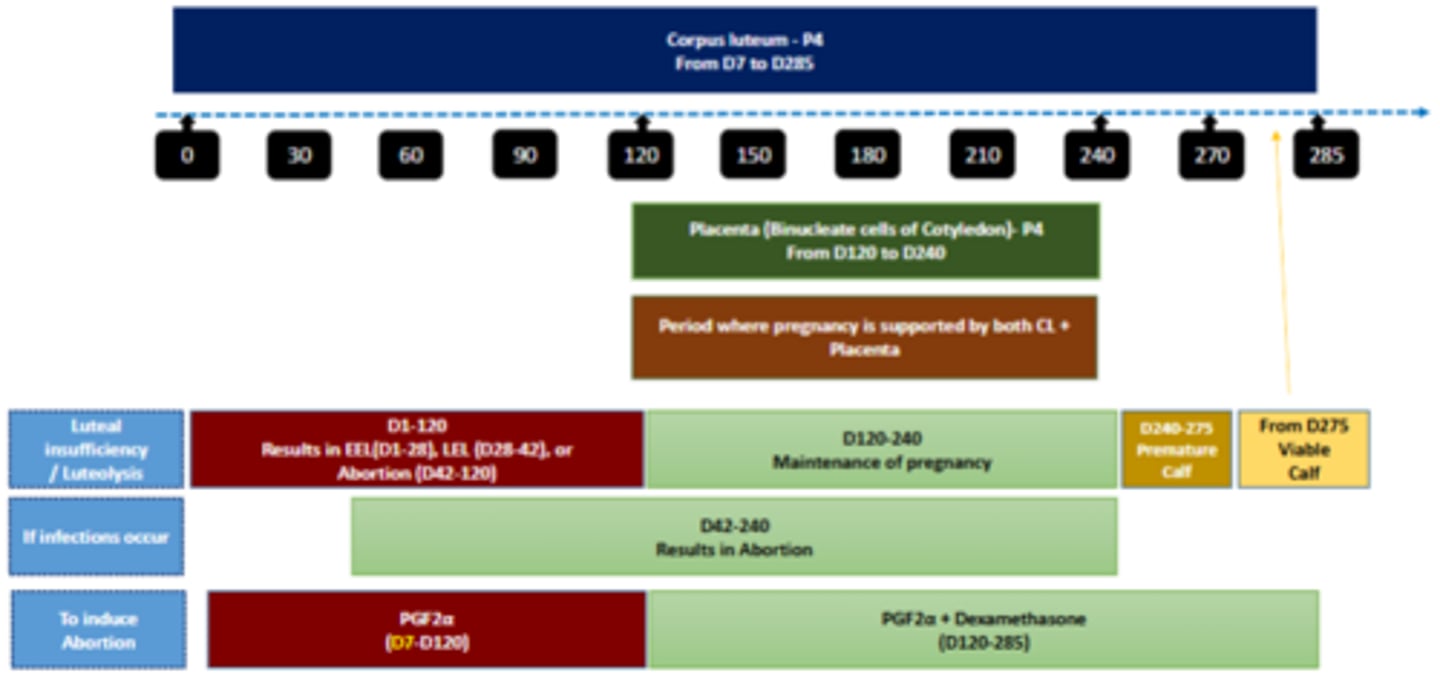
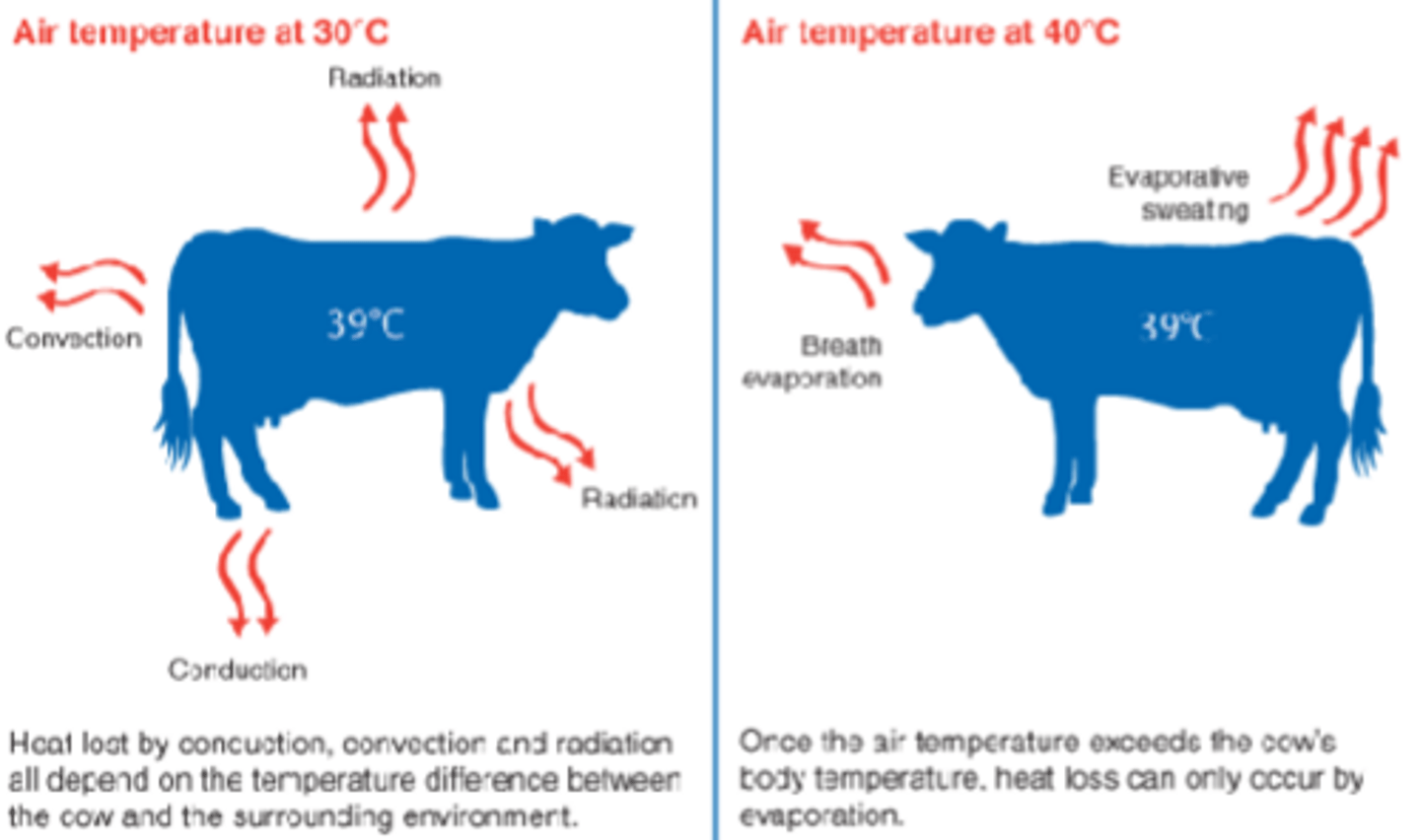
Discuss maintenance of temperature
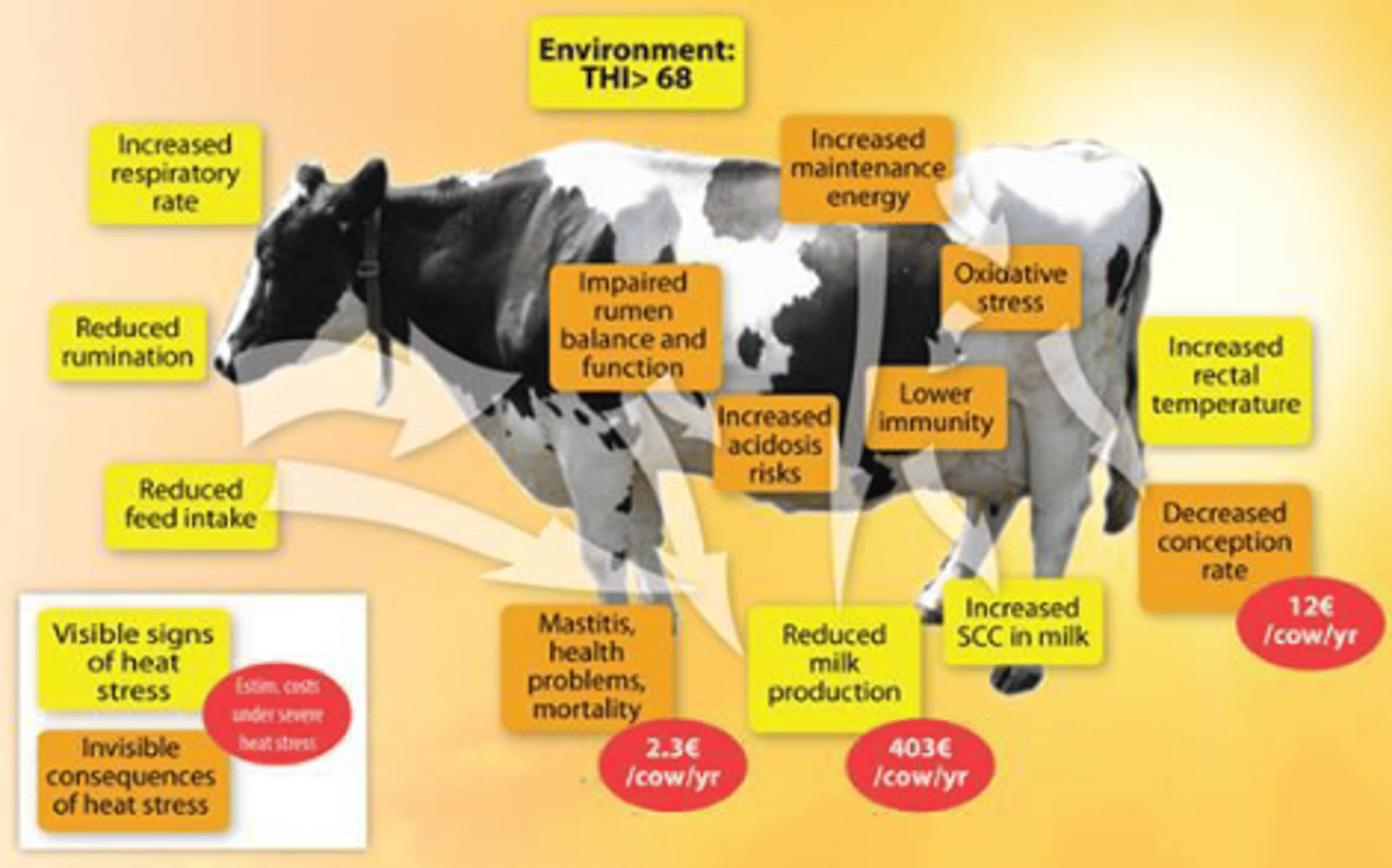
List the consequences of heat stress
i.e. temperature humidity index THI > 68
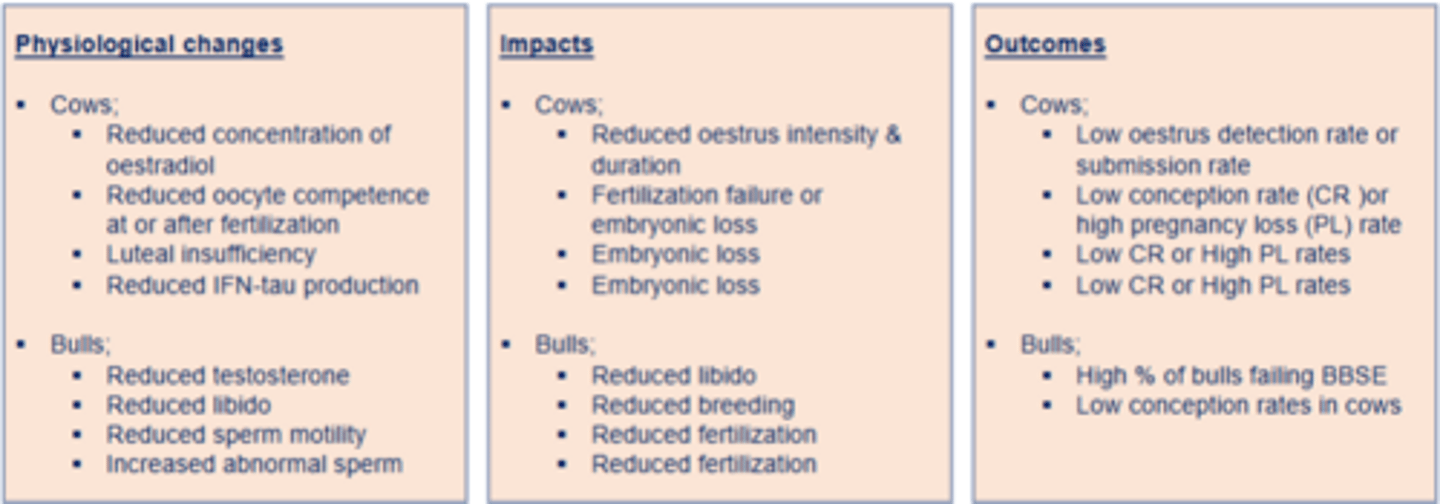
List the consequences of heat stress on reproduction
Discuss management of heat stress
- Cool cows (e.g. provide shade, cool water, ect.)
- Optimise nutrition with forage and supplements
- Increase heat detection efforts
- Fixed-time AI with poor heat detection or bull performance
- Breed heifers in summer (less prone to stress)
- Use tropically adapted animals
- Select heat-tolerant animals according to ABVs
Discuss ABV (dairy industry) for daughter fertility
- Sire's ABV for Daughter fertility is calculated by measuring reproductive performance of their daughters against each corresponding sires
- Average sire's ABV for Daughter Fertility is 100, coinciding with an industry average 71% 6-week in-calf rate in their daughters
- Jerseys have a higher 6-week in-calf rate and lower overall not-in-calf-rate than Holsteins
Discuss ABV (dairy industry)/EBV (beef industry) for calving ease
- Average ABV/EBV for Calving Ease is 100, associated with fewer assisted calvings than a sire with an ABV/EBV below 100
Discuss EBV (beef industry) for scrotal size
- Scrotal circumference of bull calves measured at 400 days of age (at onset of puberty)
- Sire's EBVs for Scrotal Size estimates the genetic differences among their bull calves' scrotal circumferences (compare to breed standards)
- Selecting sires based on high scrotal size results in larger testicles in bull calves and earlier puberty in heifer calves
Discuss EBV (beef industry) for days to calving
- Sire's EBV for Days to Calving negatively (inversely) associated with their daughter's days to conception and calving.
i.e. sire with an EBV of -5 for Days to Calving will produce daughters that conceive and calve 10 days earlier compared to a sire with an EBV of +5 for Days to Calving.
- Cows that conceive and calve earlier will start oestrous cycles earlier and ready to conceive/calve earlier in the subsequent year, increasing the chance to have at least a calf/cow/year
Relate metabolic signals and GnRH production
- Energy status reflected by puberty BW and BCS between calving to breeding
- Adequate carbohydrate, fat, proteins, minerals and vitamins essential
- Undernutrition delays onset of puberty in heifers and postpartum ovarian cyclicity in cows
- Consider spike feeding during pre-pubertal period in heifers and prior to breeing in postpartum cows
Define the period of negative energy balance
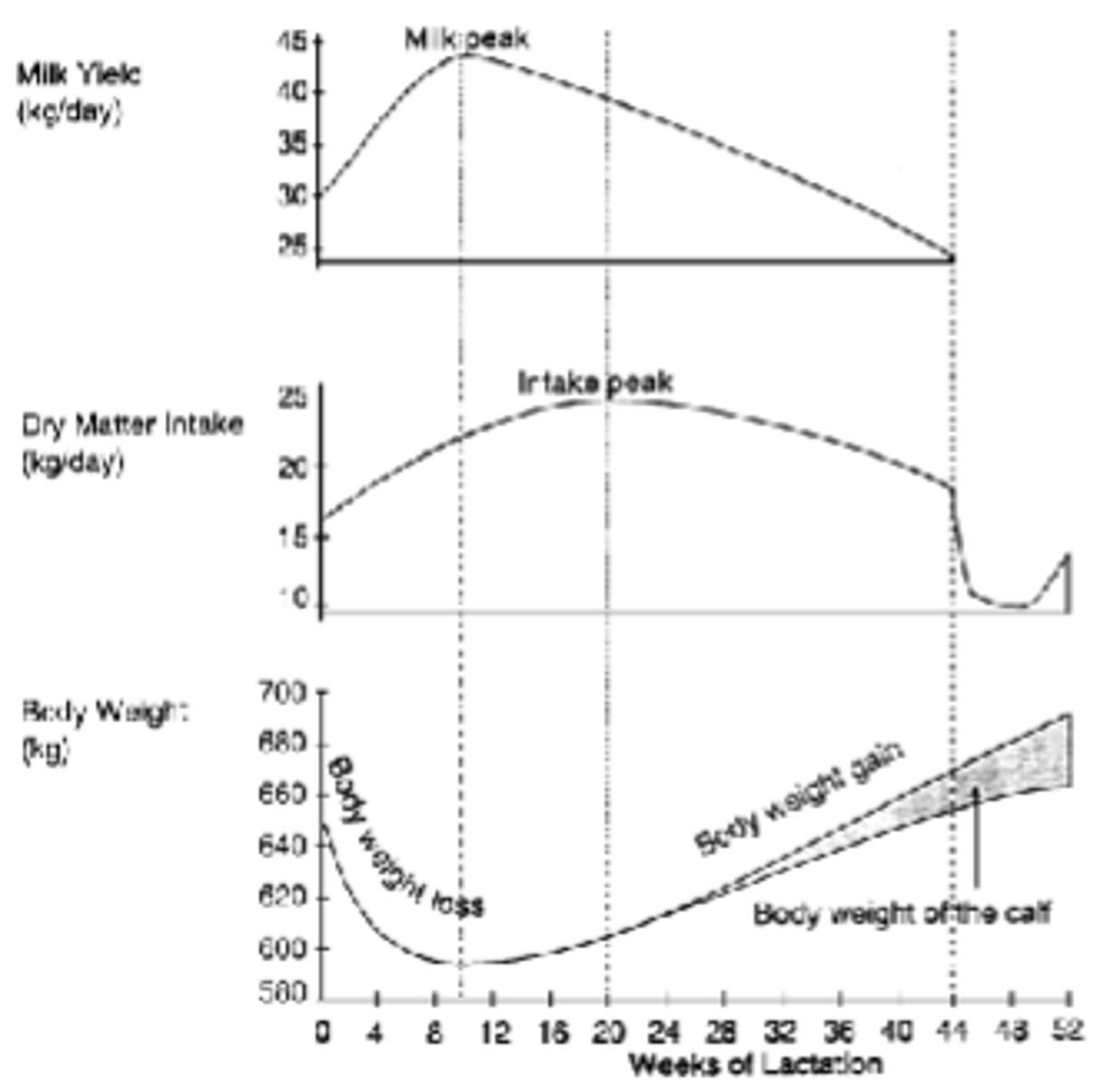
After calving milk yield increases but dry matter intake remains low, peak milk yield occurs well before peak in dry matter intake.
Results in utilisation of body reserves for energy with reduction in body weight and BCS.
Describe the mechanism of negative energy balance
Reduced secretion of GnRH with subsequent reduced secretion of LH and concentration of IGF-1 within follicular fluid (reduces effect of LH4);
- Reduced embryo quality (due to poor quality oocyte, less uterine histotrophs production, less IFN-tau production), leading to early or late embryonic losses
- Delayed uterine involution (uterine remodelling needs energy), less chance to maintain pregnancy
- Reduced immunity, susceptible for postpartum diseases
- Overall, reduced conception rates (due to fertilization failure and/or EEL/LEL) at pregnancy diagnosis
Discuss the impacts of certain nutrients on negative energy balance
High protein diets - increase rumen degradable nitrogen > increase uterine pH > affect embryo development > reduced conception rates.
i.e. use rumen bypass proteins
High concentrate diets - lead to dietary imbalance > alteration in rumen functions > lower rumen pH and laminitis > impact fertility.
Deficiency of P, Se, I, Cu, Mn, Co, Zn, Vitamin A and E – associated with impaired reproductive outcomes such as longer postpartum anoestrus, embryonic losses, poor conception rate, abortion and/or retained placenta.
Discuss the optimum calving interval
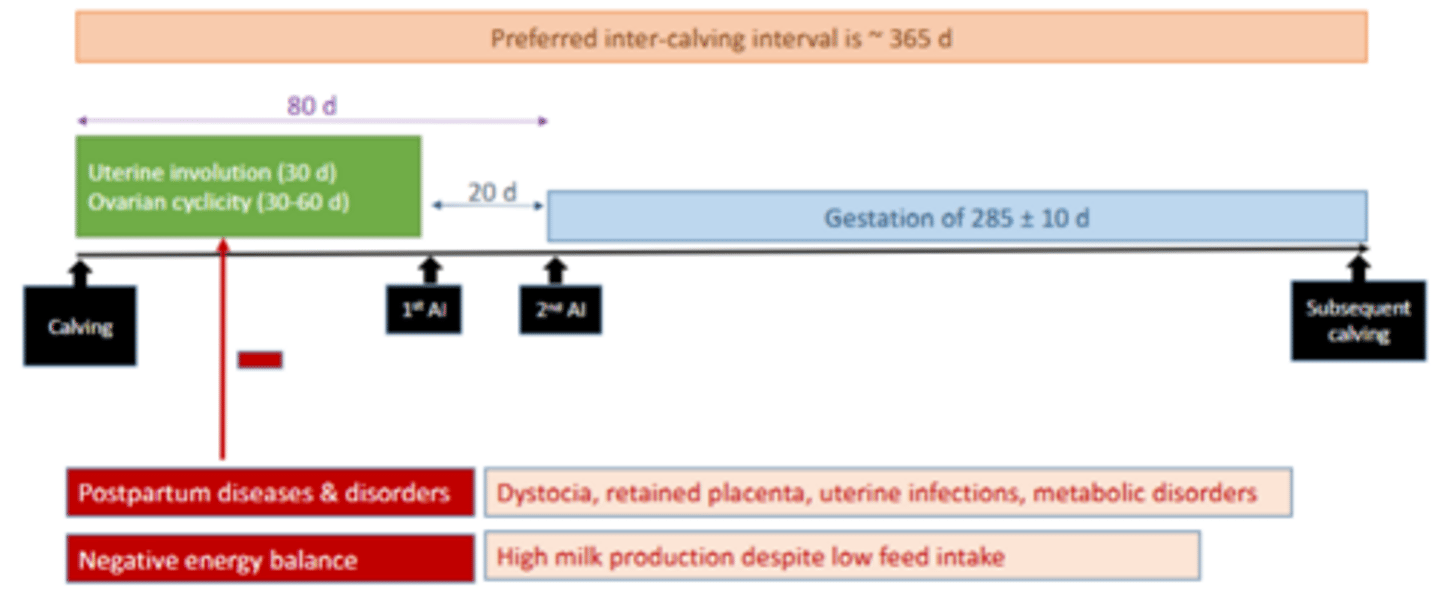
i.e. for an optimum inter-calving interval of 365 days, cows should be pregnant 60-80 days from last calving (VWP allows uterine involution)
Discuss calving to MSD interval
Conception rate (CR) increases with increasing interval from calving to MSD;
- Conception rate becomes optimal when calving to MSD interval is 60-80 days postpartum
- Conception rate becomes poor when calving to MSD interval is < 30 days postpartum, with 100-d in-calf rate higher and 200-d not-in-calf rate lower requiring repeated AIs
Discuss optimisation of calving to MSD interval
Increase the proportion of the herd that calves early and is preferably 60-80 days postpartum at MSD;
- Selective culling of late calvers and replacement with early calving heifers
- Late calvers can be bred later in the year when they have had more time to regain fertility
- Breeding at MSD based on oestrus synchronisation and fixed-timed AI may increase the number of cows pregnant at the start of the breeding season and these cows will calve early and will have longer calving to MSD interval in the subsequent year
- Purchase early calving pregnant heifers and cows for replacements
Relate stocking density and fertility
- 100-110% density optimum
- Associated with decreased pregnancy rate, reduced feeding and rumination, reduced resting, increased lameness, reduced milk production and reduced overall profit
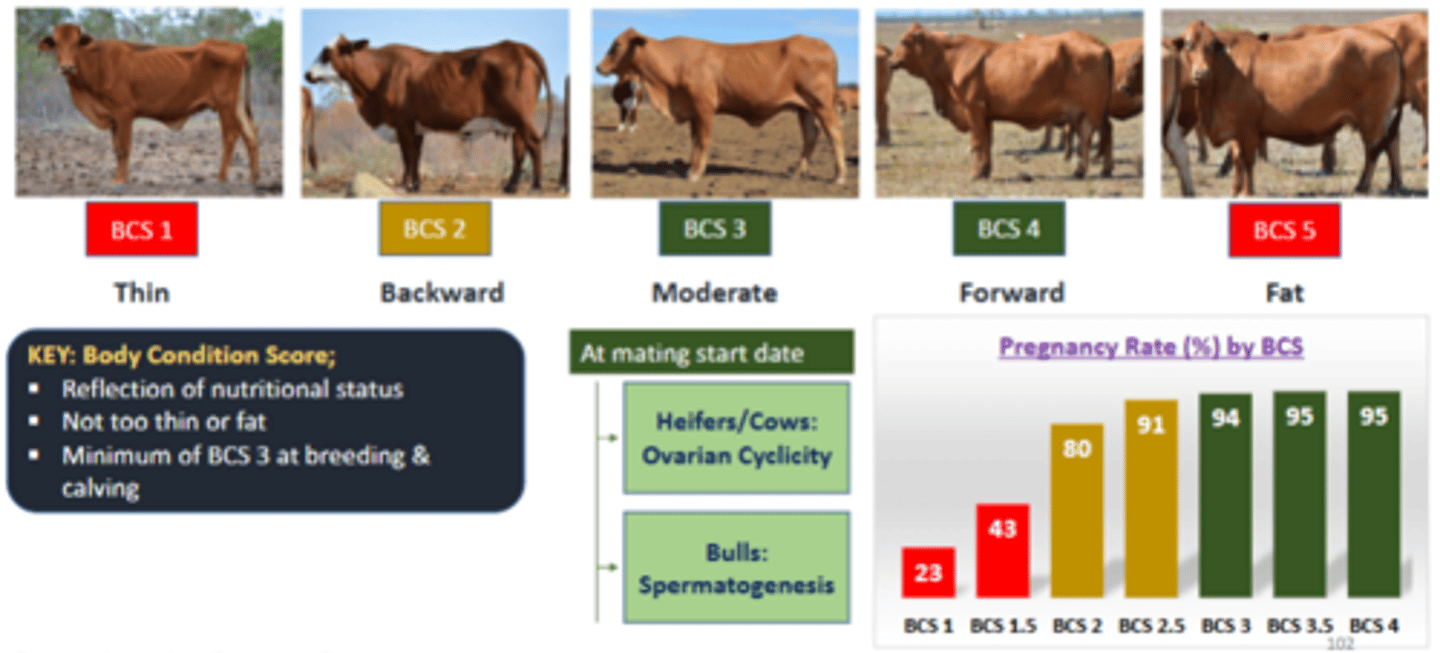
Relate BCS and calving
i.e. optimum BCS = 5/8 (dairy) and 3/5 (beef)
Relate body weight and fertility
- Bos taurus heifers' live weight 55-60% and Bos indicus heifers' live weight should be 65-70% of their mature body weight at breeding
i.e. 300-350 Kg
- Bos taurus and Bos indicus heifers should be at 80-90% of their mature body weight at calving
- Reduced weight results in lifelong poor productivity and profitability
Define critical mating weight
Critical mating weight is the weight when 85% of heifers fall pregnant after breeding for 2 oestrus cycles.
As the body weight of heifers increases the % of heifers in oestrus increase from 50 to 70 to 90%.
List management and selection strategies to improve beef heifer fertility
- Have most heifers at their critical mating weight at start of joining
- Mate more heifers than needed considering 25% of herd replacement each year
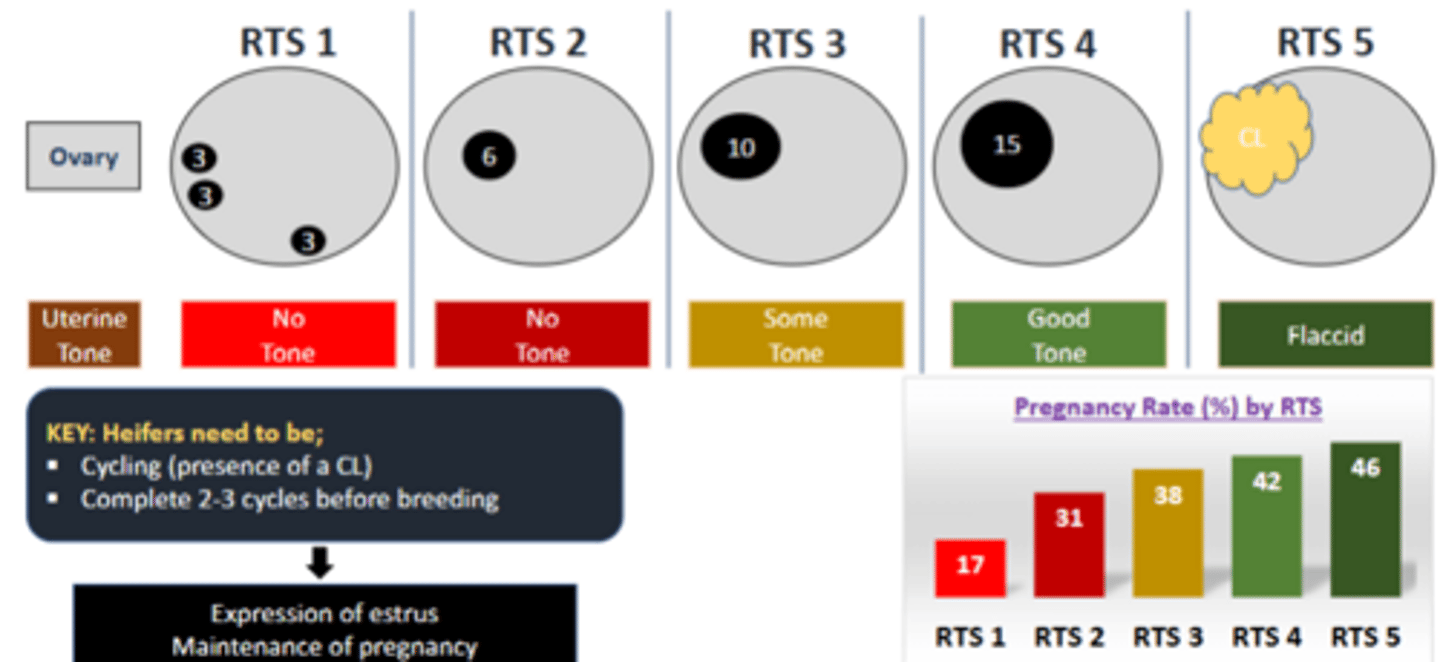
- Use reproductive tract scoring, if possible at 1-2 months before joining
- Mate heifers one month in advance of cows
- Select heifers that got in-calf earliest in the mating period, will have greater productivity and profitability for lifetime
- Select primarily based on foetal ageing and temperament at pregnancy diagnosis
Discuss reproductive tract scoring of heifers
List postpartum diseases effecting fertility
- Hypocalcaemia
- Ketosis
- Left displaced abdomen (LDA)
- Retained foetal membranes/placenta (RFM/RP)
- Pyometra
- Metritis
- Endometritis
- Mastitis
Define anoestrus
- Small ovaries
- Small sized follicles
- Absent CL
- Anovulatory = anoesturs accompanied by failure to ovulate
- Ovulatory = anoesturs accompanied by ovulation
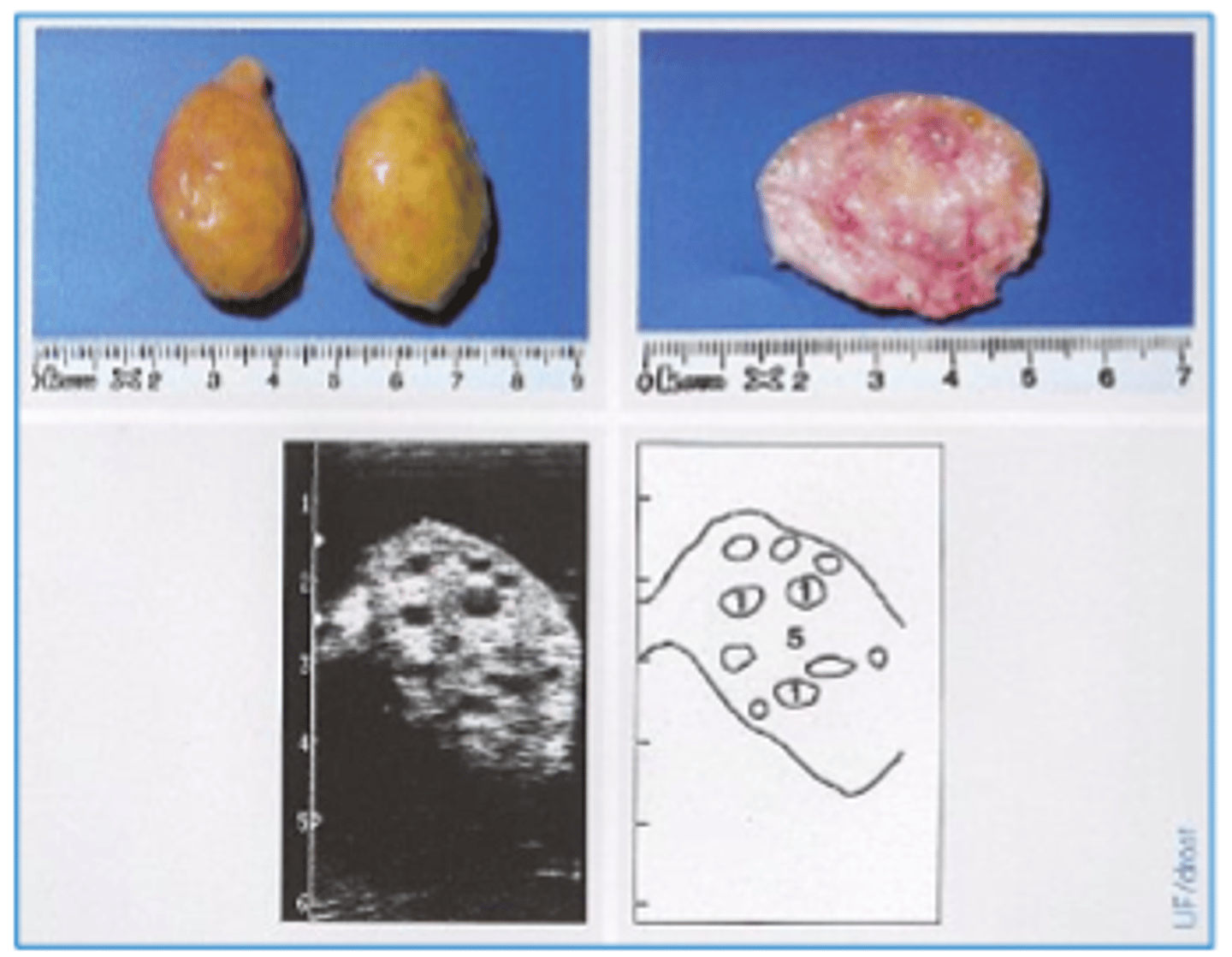
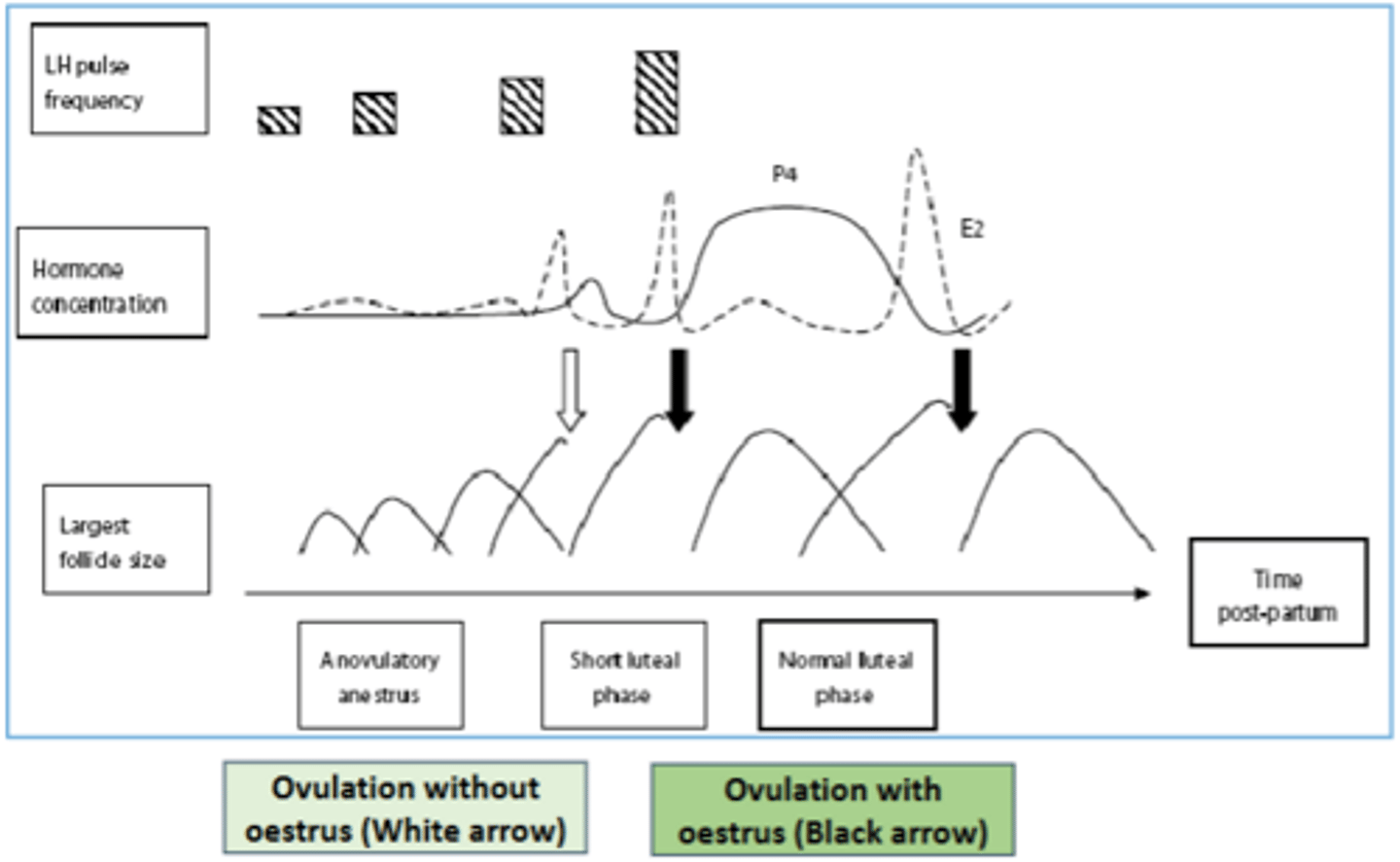
Describe the physiology of anoestrus
- Immediate postpartum, FSH rises small follicles grow
- High E2 at calving and NEB, strong suppression on GnRH induced LH release
- Less LH, growth of DF into POF inhibited with not enough E2 production from POF and no signs of oestrus (anoestrus)
- Absence of LH surge, no ovulation of POF (anovulation)
- First PP ovulation accompanied by absence of oestrus and short luteal phase
List causes for anoestrus
- Lack of appropriate body weight near puberty in heifers
- Poor body condition in postpartum cows
- Nutritional deficiencies such as P deficiency in North QLD
- Nutritional overfeeding (i.e. obese)
- Lactational anoestrus, high milk yield and low DMI
- Suckling in beef cattle (i.e. presence of calf)
- Diseases, including GIT parasites, lameness or uterine diseases
- Ovarian tumors
- Ovarian cysts
- Developmental defect in ovaries
List causes for behavioural anoestrus
- Silent oestrus (heat)
- Extreme environmental conditions (e.g. heat stress)
- Housing conditions (e.g. concrete/mud floor)
- Diseases (e.g. lameness)
List causes for anoestrus due to prolonged luteal function
- Luteal cyst (i.e. increased progesterone)
- Pyometra
- Early embryonic loss
- Pregnancy
Discuss detection of anoestrus
Observe for oestrus behaviours (e.g. observation, tail paint, teaser bull or activity moitor) over a 3 to 4 week period, cows that are not detected in oestrus are classified as being in anestrous or non-cyclers.
Discuss nutritional and body condition management during anoestrus
- Appropriate transitional diet
- Optimise dry matter intake (DMI)
- Supplementary feeding over the dry period (i.e. urea licks or cotton seed)
- Mineral supplementation when and where deficient
- Spike feeding prior to calving and breeding
- Aim to achieve critical mating and pre-calving weights for heifers
- Aim to achieve optimum BCS at breeding and calving for cows
- Prevent excessive BCS loss between calving and breeding
Discuss early weaning during anoestrus
Wean calves when dams BCS falls to 2.5 (out of 5) as long as calves are at least 120 days old (4 months) or at least 100 kg live weight.
Discuss genetic selection during anoestrus
- Heifer selection based on EBV for age at puberty
- Bull selection based on EBV for large Scrotal Size
- Breed selection to account of environmental stressors
Discuss hormonal treatments during anoestrus
- Ineffective in poor conditioned animals
- Ov-Synch56 or Oestradiol protocols may promote oestrus start