bio 1002 Osmoregulation and Excretion
 Call Kai
 Learn
Learn Practice Test
 Spaced Repetition
 Match
Match Flashcards
 Knowt Play
1/57

There's no tags or description
Looks like no tags are added yet.
Name | Mastery | Learn | Test | Matching | Spaced | Call with Kai |
|---|
No analytics yet
Send a link to your students to track their progress
58 Terms
Osmoregulation
The process by which animals :
control solute regulation
balance water gain and loss
partial pressure facilitates diffusion of oxygen
Osmolarity
number of moles of solute per litre of solution
Mammal blood osmolarity
300 mOsm/L
Seawater osmolarity
10000 mOsm/L
Hyperosmotic
solution with higher concentration of solutes
Hypoosmotic
solution with lower concentration of solutes
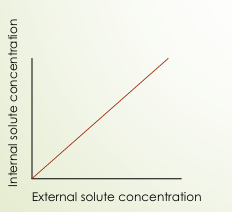
Osmoconformer
lets water flow freely in and out of its body
Internal osmolarity = external osmolarity
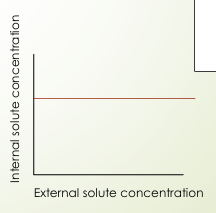
Osmoregulators
Keeps internal osmolarity constant
Osmoregulation balances the update and loss of __
water and solutes
Osmoregulation is based largely on controlled movement of__
solutes between internal fluids and the external environment
The driving force for movement of solutes and water is __
a concentration gradient of one or more solutes across the plasma membrane
***Stenohaline
Very sensitive to changes in external osmolarity
***Euryhaline
Can tolerate large fluctuations in external osmolarity
Marine (salt water) environments
Many marine invertebrates are osmoconformers
Many marine vertebrates are osmoregulators
For osmoregulators the marine environment is a dehydrating environment
For osmoregulators the marine environment is a __environment
dehydrating
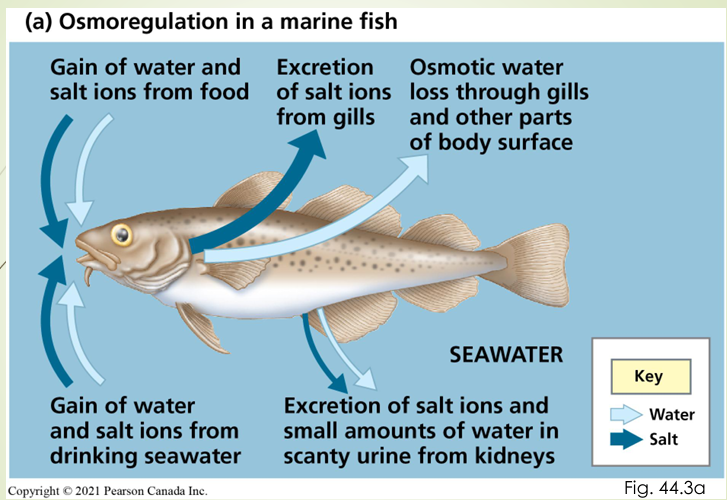
osmoregulation in a marine fish
osmoregulation in freshwater fish
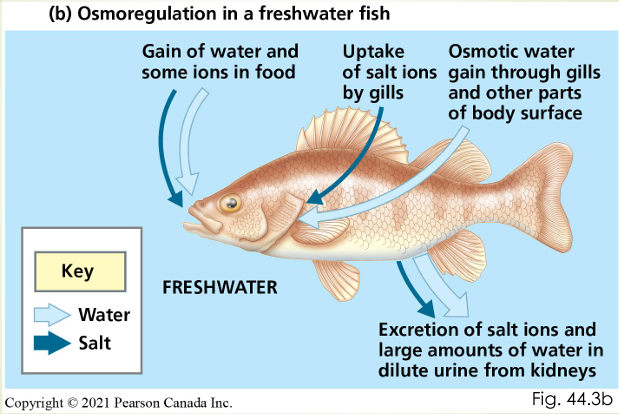
Salt vs. freshwater
salt:
Constantly lose water by osmosis
Drink seawater – intake of salts
Salts removed via gills and kidneys
Have very minimal urine
fresh:
Osmotic gain of water
Drink very little
Take up salts via food/gills
Have very dilute urine
Diadromy (watch lecture capture)
Smoltification
physiological and anatomical changes to the osmoregulatory system
Dehydration in land animals (lecture capture)
Specialized cells
Transport epithelia – one or more layers of epithelial cells that are specialize for moving particles (solutes) in a specific direction
Can face the outer environment in organisms with simple body plans
Can line channels that lead to an opening
E.g., nasal ducts in sea birds
An animal’s nitrogenous wastes reflect its __
phylogeny and habitat.
The type and quantity of an animal’s waste products may greatly affect its __
water balance
Among the most significant wastes are __
nitrogenous breakdown products of proteins and nucleic acids
Some animals convert toxic__ to less toxic compounds prior to excretion
ammonia (NH3)
What is the waste product
Mostly a byproduct of breakdown of proteins and nucleic acids
Nitrogenous molecules
Ammonia (NH3) is very toxic → NH4+ interferes with biochemistry of the body
ammonia
Directly produced waste
Only used in animals which excrete directly into surroundings
e.g., bony fish

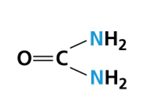
urea
Requires ATP and enzymes
Has to be dissolved in water; so causes water loss
e.g., mammals, amphibians
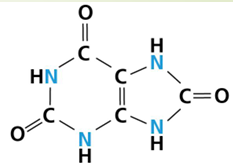
uric acid
Requires even more ATP and enzymes
Conserves water
e.g., birds, reptiles, insects
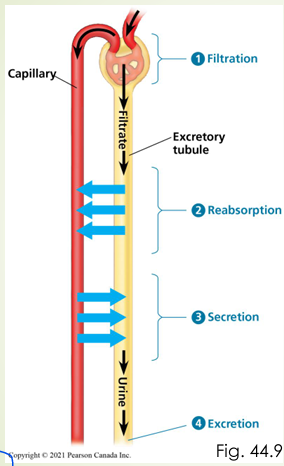
****key steps to the excretory system
1. Filtration: driven by blood pressure. Large cells in blood cannot go through membrane, but water and small solutes can (→ filtrate)
2. Reabsorbtion: a selective process (facilitated by epithelium via active transport) recovers useful molecules from the filtrate and passes them into the blood
3. Secretion: Nonessential molecules left in the filtrate OR actively transported out of the blood
4. Excretion: Processed filtrate is released from the body as urine
Variations across taxa
Protonephirdium
Metanephridia
Malpighian tubules
Protonephirdium
network of dead-end tubules connected to external openings
dilute urine
Metanephridia
tubules that collect coelomic fluid and produce dilute urine for excretion
dilute urine
Malpighian tubules
remove nitrogenous wastes from hemolymph
dry waste (uric acid)
The human kidney - structure
Renal cortex – outer layer of kidney Renal medulla – inner layer of kidney
Renal artery – brings blood that requires filtration to the cortex and medulla
Renal vein – takes filtered blood and recovered substances to the rest of the body
Renal pelvis – collects waste fluid as urine, and carries it out of the kidney (through ureter)
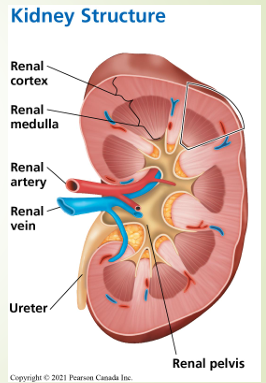
How big is a kidney?
10 cm (length of a popsicle stick)
The nephron
The nephron is organized for stepwise processing of blood filtrate
Filtrate contains salts, glucose, amino acids, vitamins, nitrogenous wastes, other small molecules
How many nephrons are in one kidney?
1 million
How much blood flows through your kidneys daily?
1600 L
85% of the nephrons are __
cortical (short)
15% of the nephrons are
The rest are juxtamedullary – essential for water conservation – produces urine that is hypoosmotic to body fluids
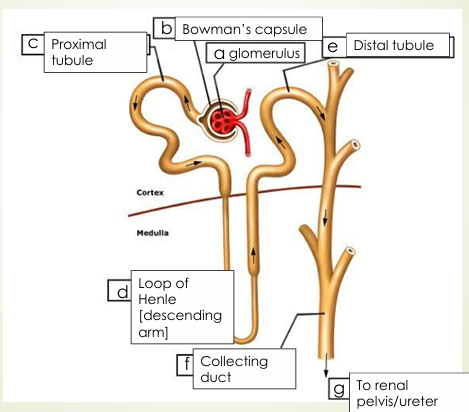
Glomerulus
ball of capillaries branching from the afferent arteriole
Bowman’s capsule
a swollen end of the tube system that surrounds the glomerulus
Filtrate
is formed when the blood pressure forces fluid component from blood into the lumen of Bowman’s capsule
Filtrate passes through the proximal tubule, the loop of Henle, and the distal tubule.
Reabsorption happens in the __
proximal tubule, the loop of Henle, and the distal tubule.
The distal tubule empties into __, which empties into the __, and from there to the __
a collecting duct , renal pelvis , ureter
describe kidney function (lecutre capture)
Ascending limb is __to water
impermeable
As filtrate travels through the nephron, osmolarity __along the descending arm of the loop of Henle
increases
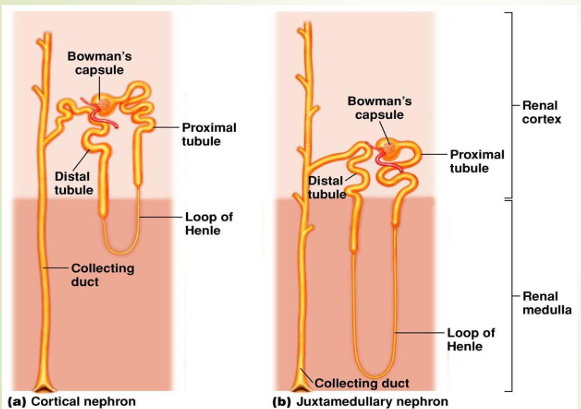
Which nephron is from a desert animal?
how are bats adapted with their kidneys
Vampire bat drinks blood at night – so much volume that it gets too heavy to take off and fly back to roost.
Solution – excrete large volumes of very dilute urine as you feed
At night – processing proteins in the blood creates large quantities of urea, but they do not have drinking water in the cave to dilute it.
Solution – excrete highly concentrated urine
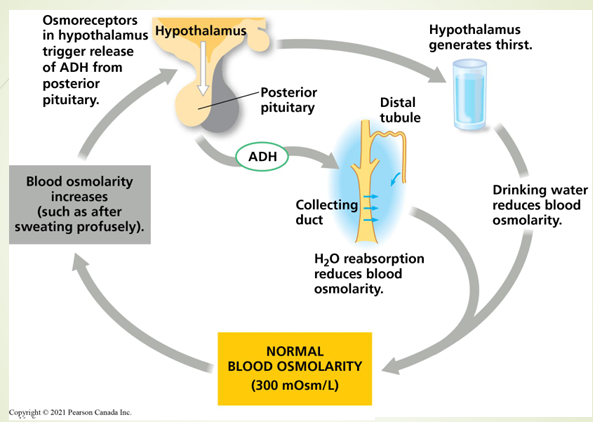
Main hormone regulating osmotic balance is __
antidiuretic hormone (ADH)
another word for antidiuretic hormone (ADH)
vasopressin
ADH signals are triggered by __
osmolarity of blood
what facilitate reabsorption of water
ADH sends signals to receptor molecules on the membrane of the collecting duct
blood osmolarity loop
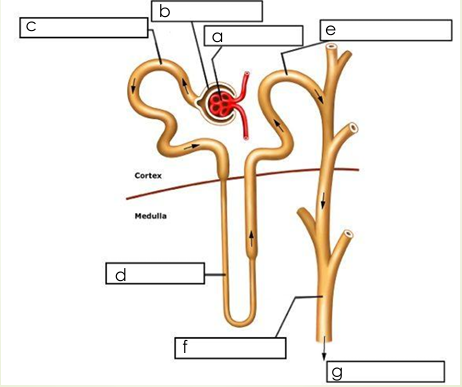
label