(Final Exam) Pt.1 Temperature Regulation and Exercise
 Call Kai
 Learn
Learn Practice Test
 Spaced Repetition
 Match
Match Flashcards
 Knowt Play
1/28

There's no tags or description
Looks like no tags are added yet.
Name | Mastery | Learn | Test | Matching | Spaced | Call with Kai |
|---|
No analytics yet
Send a link to your students to track their progress
29 Terms
What is a normal body temperature?
Skin temperature is closer to that of […]
Internal body temperature remains relatively […]
environment
constant
Humans as Homeotherms
Humans maintain constant body core temperatures.
O2 transport, cellular metabolism, muscle contraction are NOT […] in hot and cold environments if the internal temperature is maintained.
However, abnormal body temperature may have […] effects on the organism.
Cell damage with an internal body temperature >41 Celsius; […] and […] can occur.
Slow cellular metabolism with an internal body temperature
impaired
catastrophic
heat stroke and brain damage
Thermal Balance
Heat gain:
[…] heat:
[…] heat: (radiation + conduction + convention)
Metabolic heat production is the rate of transformation of […] energy into heat
Metabolic
Environmental
chemical
Thermal Balance
Heat loss:
[…] : loss or gain of heat in form of electromagnetic waves
[…]: transfer of heat from the body to an object via direct contact.
[…]: is the conduction of heat to or from air to water
[…]: primary mechanism through which heat is lost during exercise.
Under normal, resting conditions, in a thermoneutral environment, most of the heat is removed by radiation.
Radiation
Conduction
Convection
Evaporation
How is body temperature regulated?
Receptors will send information to […]
which will then analyze and process the information then responds
[…]:
vasodilation
sweating
Cold:
[…]
shivering —» increases metabolic heat production
catecholamine release —» increases heat production
Thyroxine release —» increases [….] rate —» increases heat production
Hypothalamus
Heat
vasoconstriction
metabolic
Prolonged submaximal exercise in cool environment
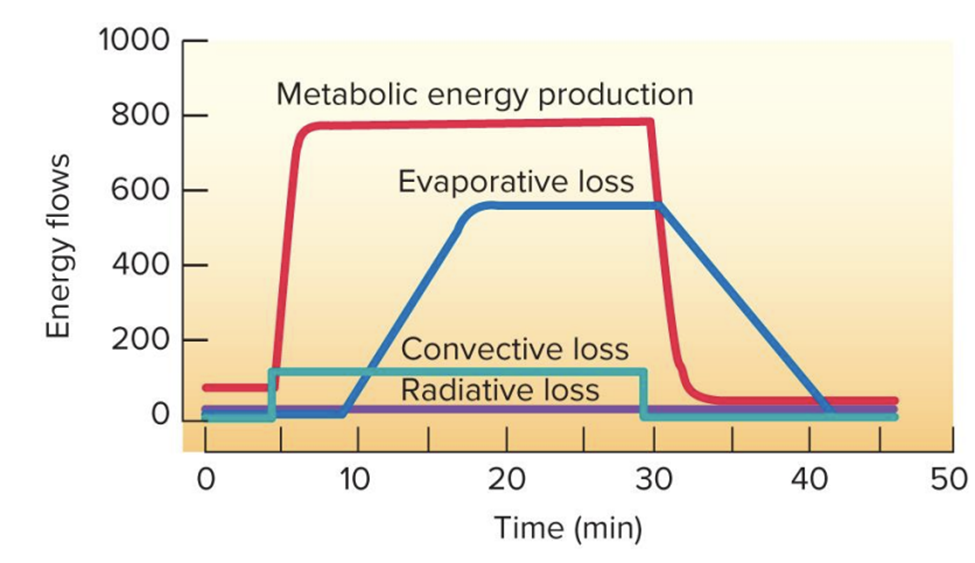
Evaporate heat loss […]
Convective loss […] slightly
radiative loss is […]
increases
increases
constant
Relationship between exercise intensity and core temperature during constant load exercise
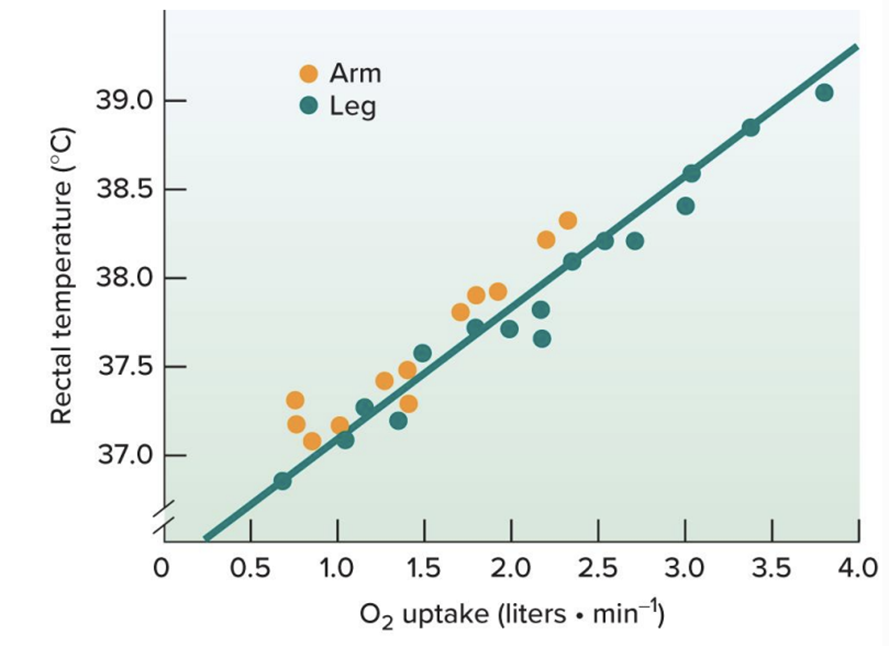
Rectal temperature is our internal temperature
X-axis is our oxygen uptake
Heat index – a measure of how hot it feels
Measure of […] of how hot it feels
interaction between relative […] and […] impacts perception of how it feels
Example
Air temperature = 82 F, relative humidity = 80%
Heat index = 9 F (feels hotter than 82 F)
High relative humidity and high ambient temperature […] body heat loss and […] body temperature
body’s perception
humidity and air temperatures
lowers
increases
Impact of a hot environment on sweat rate and core temperature during exercise
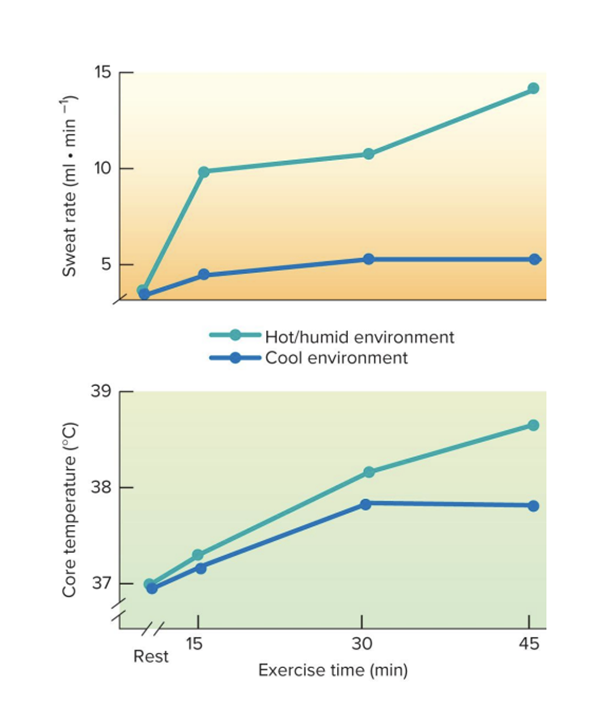
Sweat rate […] (which is a good thing)
Because we retain all that heat in the body, what gonna happen to core temperature is going to increase dramatically.
increases
Dehydration
[…] is excessive lost of body water.
The […] the body water deficit, the higher the increase in physiological strain for a given exercise.
Dehydration may result in further […] in core temperature (0.1 C to 0.2 C with each 1% of dehydration).
[…] mechanisms of heat loss (e.g., decreased sweating rate and cutaneous blood flow)
May negatively affect exercise endurance performance.
Dehydration
higher
increases
Impaired
Consequences of Dehydration
Dehydration by 3.5% before endurance exercise leads to:
Greater […] response
why because of cardiovascular drift
Exaggerate […] response
[…] performance
Dehydration before […] exercise leads to:
a reduction in total work
a reduced buffer capacity
Full recovery of work occurs with rehydration
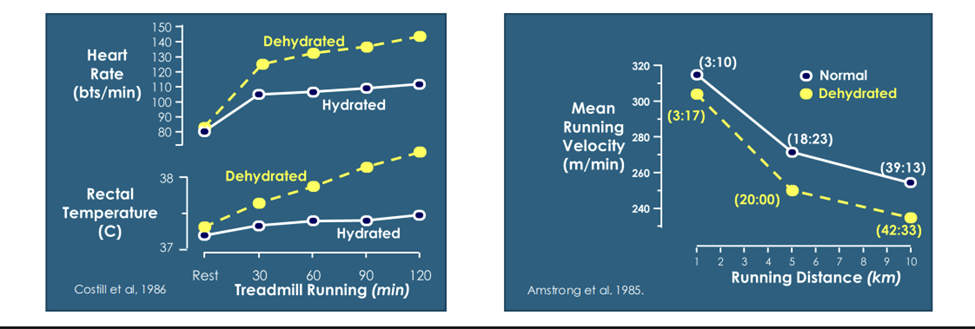
HR
Tre
Reduced
anaerobic
Assessment of Hydration Status
Morning weight, urine, and thirst perception
If you lost more than 1% of day to day weight (indication of […] )
Urine color:
Pale urine = adequate hydration
Dark yellow urine = dehydration
sometimes vitamins can change color or urine
you feel thirsty —» […]
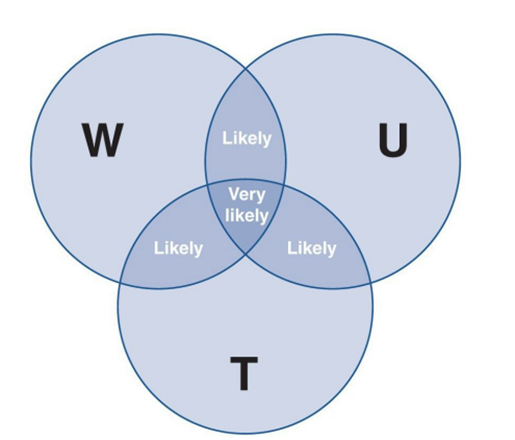
dehydration
dehydration
Counteracting Dehydration
- […] of fluid is recommended for each pound of body weight lost.
- During prolonged exercise: […] and […] with 5% to 10% of carbohydrates
- Drinking water
0.5 L
water and Sodium potassium
Fluid Replacement – Type of fluid
- […] water can lead to exercise-associated hyponatremia.
- […] can lead to nausea, vomiting, headache, extremity edema, and other severe symptoms.
- More common in […] duration physical activities.
- It can be prevented by a hydration plan.
Overdrinking
Hyponatremia
long
Fluid Replacement
Fluid intake in […] duration exercise does not influence body temperature
After ~45 min, limiting fluids causes a rise in […]
[…] occurs around 40oC regardless of hydration status
doesn’t really matter during first half an hour.
short
Tre
Fatigue
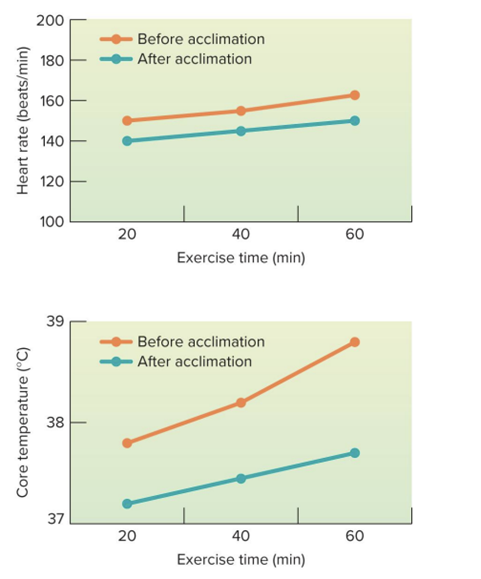
Heat acclimatization
[….] is the improvement in heat tolerance that comes from gradually increasing the intensity or duration of work performed in a hot setting
Heat acclimatization results in (compared with unacclimated):
Increase plasma volume
No change in plasma electrolytes
Lower body temperature
Lower exercise HR
Earlier onset of sweating and greater sweat rate Lower lactate during submaximal exercise
Improved exercise performance
Increased cellular heat shock proteins (prevent cellular damage due to heat)
Heat acclimatization
Impact of heat acclimation on heart rate and core temperature during exercise
Exertional Heat Cramps
Exercise-associated muscle cramps (EAMCs)
Painful [….] muscle contractions or spasms.
Possible contributing factors: fatigue, […] , hydration status, or electrolyte concentration.
[…] and dietary sodium chloride may prevent or mitigate EAMCs.
involuntary
neuronal excitability
Oral hydration
Heat Syncope
- Is temporary loss of […], to heat, typically those who are physically unfit.
- Temporary […] failure.
- Physical unfit, sedentary, unacclimatized individuals are at risk.
- Symptoms may vary from light-headedness to loss of consciousness.
- […] recovery once individuals lay supine.
consciousness
circulatory
Rapid
Heat Exhaustion
- […] to exercise in a hot environment.
- Most common form of serious heat illness.
- Heat exhaustion is defined as the incapacity to perform exercise in the heat due to a combination of factors, such as […]
- Body core temperature (usually <40.5 C).
o Very close to […]
- Oral fluid for conscious individuals who are not losing fluid (vomiting or diarrhea).
- IV fluid administration is recommended for those unable to ingest oral fluids or have severe dehydration.
Inability
cardiovascular insufficiency, hypotension, energy depletion, and fatigue.
hyperthermic
Exertional Heat Stroke
Exertional heat stroke is caused by […] (body temperature >40oC), profound CNS dysfunction, multiple organ system failure that result in delirium, convulsion, or coma.
Delirium is acute changes in cognition
[…] describes uncontrolled body movements and controlled muscle movements or muscle contraction
coma
Greater risk with high-intensity exercise of short duration or prolonged exercise when WBGT > 28oC (82oF).
Immediate and effective whole-body cooling is required (e.g., cold water, ice water immersion therapy).
Supplements that contain stimulus:
It can increase […]
Risk factors: low physical fitness, excess adiposity, improper clothing, incomplete heat acclimatization, illness, and supplements that contain stimulants.
hyperthermia
Convulsion
metabolic heat production
Exercise in Cold Environments
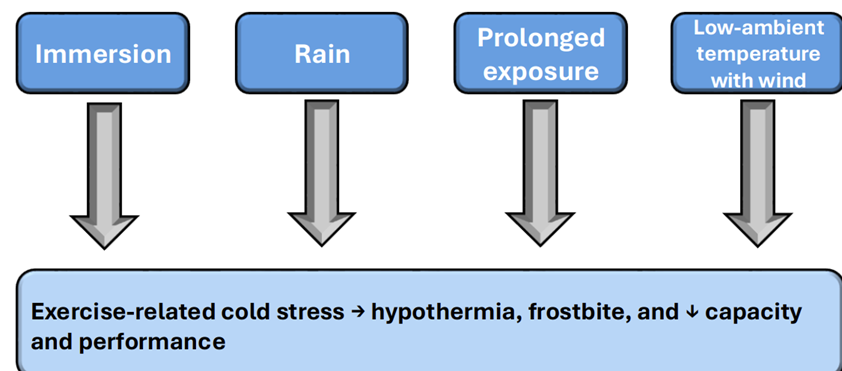
Cold Stress and performance
Cold temperatures can […] impact sports performance
Hands exposed to cold temperatures often become […] due to reduced blood flow and depressed rate of neural transmission
Reduction in […] transmission and blood flow to hands results in loss of dexterity and negatively impacts motor skills
In general, cold temperatures can lead to […]
negatively
numb
neural
hypothermia
Hypothermia
[…] develops when heat loss exceeds heat production causing a negative heat balance (core temperature)
Occurs when temperatures drops below 34-35 degrees Celsius
Conditions that predispose individuals to hypothermia:
Water immersion
Rain
Wet clothing
Prolonged exposure L
Low-ambient temperature with wind
Inappropriate clothing
Hypoglycemia
Advanced age (>60y)
Low body fat
Hypothermia
Hypoglycemia
§ Risk for kids with […]
§ Decreased in glucose you become hypoglycemic
§ […] shivering
§ So you lose that involuntary physiological mechanism by which you increase metabolic heat production.
§ It also causes […] and promotes sweating.
§ Cold environment vessels are supposed to constrict because we want to retain
§ Hypoglycemic promotes vasodilation and sweats
Bad because sweat = losing heat from body.
diabetes
Impairs
vasodilation
Advanced age (>60y)
§ Because lower metabolic rate = […] heat production
§ Losing muscle = […] metabolic rate
lower
lower
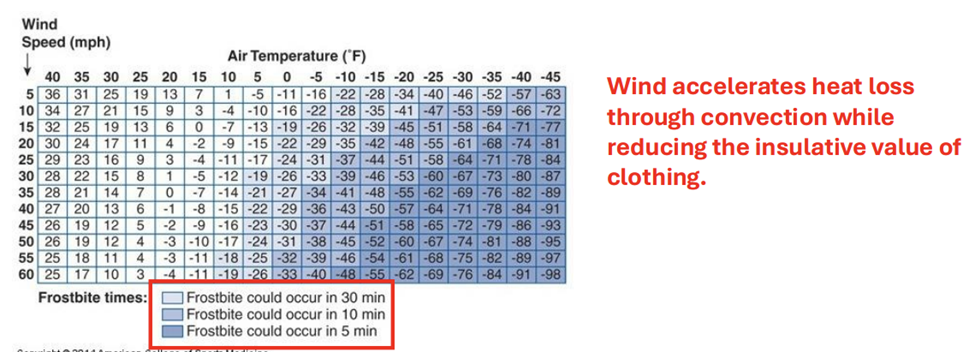
Wind Chill temperature (WCT)
- WCT integrates wind speed and air temperature to provide an estimate of […] of the environment.
- FOR FROSTBITES
- Don’t pop the blisters, but rewarm the tissues is recommended so that most of the tissue survives.
- Sometimes tissues do not […].
cooling power
survive
Cardiac and Respiratory Considerations
- […]
o Condition that provoked only by exercise
o Those who have EIB at baseline their respiratory function is fine.
o 90% of people with asthma also experience EIB.
- […] respiratory tract viral infections
Exercise-induced bronchoconstriction (EIB)
Upper
Acclimation to cold environments
- […] ability to maintain a higher hand and foot temperature during cold
o Improved peripheral blood flow
- […] adaptations occur rapidly (within first 7 days of chronic cold exposure).
Improved
Cold