East Asia Quiz: World History 1
 Call Kai
 Learn
Learn Practice Test
 Spaced Repetition
 Match
Match Flashcards
 Knowt Play
1/24

There's no tags or description
Looks like no tags are added yet.
Name | Mastery | Learn | Test | Matching | Spaced | Call with Kai |
|---|
No analytics yet
Send a link to your students to track their progress
25 Terms
Confucianism
A system of philosophical and ethical teachings founded by Confucius and developed by Mencius. It consists of 5 relationships and a variety of virtues.
Daoism
A belief that human life is really only a small part of a larger process of nature, the only human actions which ultimately make sense are those which are in accord with the flow of Nature — the Dao or the Way.
Buddhism
Religion that focuses on personal spiritual development and the attainment of a deep insight into the true nature of life-nirvana. The path to Enlightenment is through the practice and development of morality, meditation and wisdom.
Cultural Diffusion
The spread of cultural beliefs and social activities from one group of people to another.
Overall impact of Geography on East Asian Countries
Separation through bodies of water in East Asia, allowed for things such as trade and cultural diffusion, however also offered an extent of protection from invasion between civilizations. Being near bodies of water resulted in many, regular natural disasters that strongly influenced peoples' way of life.
Sui Dynasty
short-lived Chinese dynasty at which the country was unified after 4 centuries of fragmentation. In Dynasty the Grand Canal was accomplished, however through much suffered labor, and mistreatment of "subjects", which led to revolt.
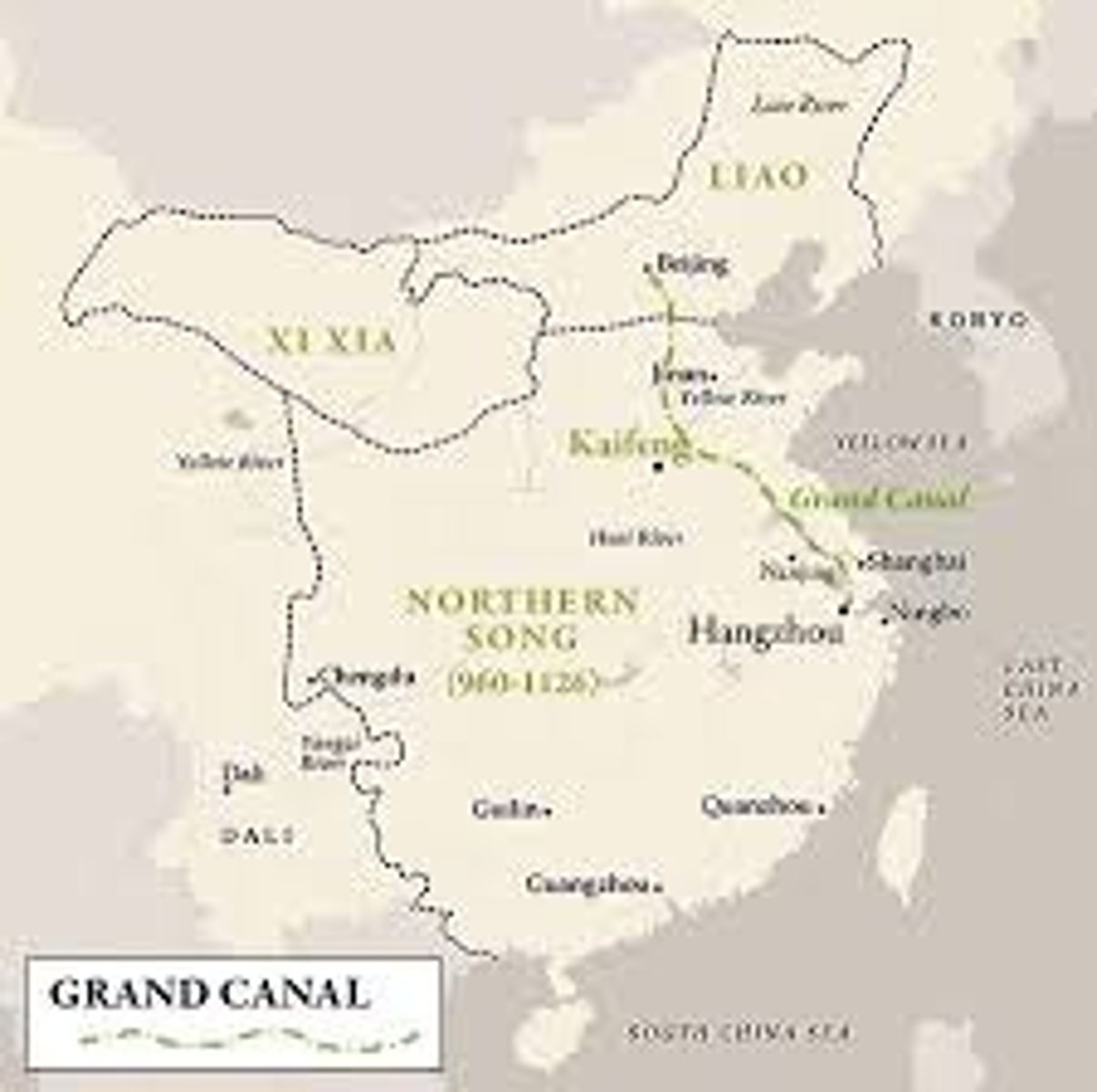
Grand Canal
Huge Canal that required years and years of suffered, hard labor by people. It was an ambitious building project connecting the Huang He and Chang Jiang rivers that allowed them to take advantage of the geography.
Tang Dynasty
Dynasty that developed a successful form of government and administration on the Sui model, and stimulated a cultural and artistic flowering that amounted to a golden age. Also had only/first female ruler. They worked to establish a strong central bureaucracy to govern China's large territory.
Song Dynasty
Dynasty's technology was highly advanced in fields such as agriculture, iron-working, and printing.
The population grew rapidly during this time, and the Song system of government was also advanced for its time. The upper-levels of the government were staffed by highly educated scholar-officials selected through competitive written examinations (Civil Service Exams).
Chinese Golden Age of Invention
Said to have taken place over course of Song and Tang Dynasty and consisting of the use of paper money, the introduction of tea drinking, the invention of gunpowder, the compass, printing,etc.
Civil Service Exam
Exams were restored from the Han Dynasty, and were used to asses people. In order to serve in high government positions, one had to pass these tough exams. This changed the idea of stupid, rich people in power, and rather educated people.
Silk Road
Ancient network of trade routes, established during the Han Dynasty of China, which linked the regions of the ancient world in commerce (trading).
Scholar-Gentry
Politicians and government officials appointed by the emperor of China to perform day-to-day political duties (from the Han dynasty to the end of the Qing dynasty)
Gender Roles in East Asia
Royal Family
Gentry (new)
Urban Middle Class
Laborers, Soldiers, Servants
Rural Peasants
Marco Polo
Marco was an explorer whose adventures are debated among historians as to whether he ever really made it to China. There is no evidence outside his book that he traveled so far east. Yet, his knowledge of the culture and its customs are hard to dismiss. It is said Khan accepted the Polos and offered access to his empire. Marco's immersion into the Chinese culture resulted in him mastering four languages.
Genghis Khan
Khan rose from humble beginnings to establish the largest land empire in history. After uniting the nomadic tribes of the Mongolian plateau, he conquered huge chunks of central Asia and China. The topic of the Mongols, the huge civilization of people who violently conquered Asia, however also brought in a number of advancements in their empire.
Kublai Khan and the Yuan Dynasty Golden Age
Kublai Khan was a Mongolian general and statesman, who was the grandson and greatest successor of Genghis Khan. As the fifth emperor of the Yuan dynasty, he completed the conquest of China started by Genghis Khan thus became the first Yuan ruler of the whole of China. Under his rule, China had a Golden Age.
Pax Mongolica
After the Mongols conquered many lands and created their enormous empire there came a peaceful time called the Pax Mongolica. It was a period of time where peace, stability, economic growth, cultural fusion and cultural development were happening around the Mongol's occupied territories.
Neo-Confucianism
Neo-confuscianism was a response to both Daoism and Buddhism, and was about "updating" confuscian terms
Definition:
Step 1: The world is real, not an illusion
Step 2: Fufillment in life comes from participation
Side Note: They wanted to devide the world into 2 categories: material/spiritual
Positive and Negative Impacts of Mongol Conquest/Rule
Positive:
- Golden Age after conquering
- Great Advancements in many areas
Negative:
- Extensive slaughter, many many killed
- No Mercy
- Controlling
Shinto
A religion meaning "the way of the gods" that clans followed in early Japan. It formed from combined customs and beliefs to honored gods. *Divine creatures w/ nature
Japanese Social Structure
1. Emperor:
2. Shogun:
3. Daimyo:
4. Samurai:
5. Peasants: (divided into sub-classes)
Farmers were highest peasent ranking, Craftsmen/Artisans after, last were Merchants
Daimyo
Divided territories of Japan were given to Daimyo to rule by shogun. They had a lot of power, and ruled as independent kingdoms (as they wished). They had an agreement with Samurai: they gave land to Samurai for exchange for protection and they pledged loyalty to emperor and shogun.
Samurai and Bushido
Samurai were members of new Japanese warrior class; body guard for lords; loyal warriors who lived according to Bushido. The Bushido was a code of behavior followed by the Samari warriors. Known as the "way of the warrior"
Shogun and Emperor
After 30 yrs. Of war, Minamoto family was victorious and gained power, a Minamoto leader was given the title Shogun. Had all the power, loyalty to him along w/ emperor.