Orgo Exam II Things to Know

0.0(0)
Studied by 0 people
call kaiCall Kai
learnLearn
examPractice Test
spaced repetitionSpaced Repetition
heart puzzleMatch
flashcardsFlashcards
GameKnowt Play
Card Sorting

1/55

flashcard set

Earn XP

Description and Tags

BALRIGHT

Last updated 8:01 PM on 10/18/26
Name
Mastery
Learn
Test
Matching
Spaced
Call with Kai
Chat

No analytics yet

Send a link to your students to track their progress

56 Terms

1
New cards

Aldehydes are reduced to what?

Primary Alcohols

2
New cards

Ketones are reduced to what?

Secondary Alcohols

3
New cards

Why are sodium borohydride and Lithium Aluminum Hydride important?

They are the source of Hydride Ion (Powerful Nucleophile) in Nucleophilic Acyl Addition

<p>They are the source of Hydride Ion (Powerful Nucleophile) in Nucleophilic Acyl Addition</p>
4
New cards

What can LiALH4 Reduce?

Anything up to Carboxylic Acids

5
New cards

What does a reduction of an aldehyde or ketone look like?

Using either NaBH4 or LiAlH4 with Water

<p>Using either NaBH4 or LiAlH4 with Water </p>
6
New cards

Mechanism of Reduction of Aldehydes and Ketones

  1. Electron transfer from double bond to Oxygen

  2. Bonding of Metal Hydride with Oxygen

  3. Workup with water gives alcohol


<ol><li><p>Electron transfer from double bond to Oxygen</p></li><li><p>Bonding of Metal Hydride with Oxygen</p></li><li><p>Workup with water gives alcohol</p></li></ol><p></p>
7
New cards

What is an Imine?

C=N

8
New cards

How does reductive amination work?

  1. Imines are reduced by H in the presence of Ni or another transition metal catalyst to a C-N bond.

  2. 2 step rxn → Primary amine converted to secondary amine by imine


9
New cards

Mechanism of Reductive Amination

  1. H+ goes into reaction and water comes out

  2. Imine formed

  3. Can react with H2/Ni OR NaBH3CN with MeOH


<ol><li><p>H+ goes into reaction and water comes out</p></li><li><p>Imine formed </p></li><li><p>Can react with H2/Ni <strong>OR </strong>NaBH3CN with MeOH</p></li></ol><p></p>
10
New cards

What is the Clemmensen reduction?

Reduction of aldehyde or ketone to carbonyl group

  • Using Zn (Hg), HCl


<p>Reduction of aldehyde or ketone to carbonyl group</p><ul><li><p>Using Zn (Hg), HCl</p></li></ul><p></p>
11
New cards

What is the Wolff-Kishner Reduction?

Converting an aldehyde or ketone to a carbonyl group using a Hydrazine (H2N-NH2)

12
New cards

Mechanism of Wolff-Kishner Reduction

  1. Form Imine (C=N) and water as products

  2. Add OH- to take a Hydrogen from Imine

  3. With extra electrons, form a double bond between Nitrogens which then removes double bond between C and N

  4. Bring in another water to get rid of extra electrons

  5. With the OH- left from previous rxn, take last H from N=N to make water, and N triple bond N breaks from rxn

  6. With the floating water, take a hydrogen to stabilize charge on Carbon

  7. Final Products made


<ol><li><p>Form Imine (C=N) and water as products</p></li><li><p>Add OH- to take a Hydrogen from Imine</p></li><li><p>With extra electrons, form a double bond between Nitrogens which then removes double bond between C and N</p></li><li><p>Bring in another water to get rid of extra electrons</p></li><li><p>With the OH- left from previous rxn, take last H from N=N to make water, and N triple bond N breaks from rxn</p></li><li><p>With the floating water, take a hydrogen to stabilize charge on Carbon</p></li><li><p>Final Products made</p></li></ol><p></p>
13
New cards

How to do desulfurization of Thioacetal

  1. Add H+ and remove Water to form cylic compound from dithiol

  2. Add Rarey NI to break cyclic compound and replace with Hs
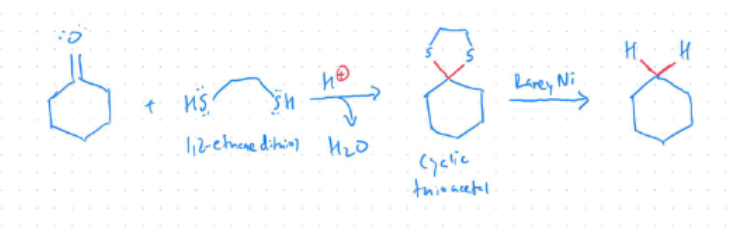

<ol><li><p>Add H+ and remove Water to form cylic compound from dithiol</p></li><li><p>Add <u>Rarey NI</u> to break cyclic compound and replace with Hs</p></li></ol><p></p>
14
New cards

How does nomenclature work with Carboxylic Acids?

-e → +oic acid

<p>-e → +oic acid</p>
15
New cards

How does nomenclature work with other functional groups with Carboxylic Acids?

Carboxylic Acids always take Priority

  • -OH is hydroxy

  • H2N is Amino


<p>Carboxylic Acids always take Priority</p><ul><li><p>-OH is hydroxy</p></li><li><p>H2N is Amino</p></li></ul><p></p>
16
New cards

How do you name when there are more than one Carboxylic Acids?

Chain + dioc acid
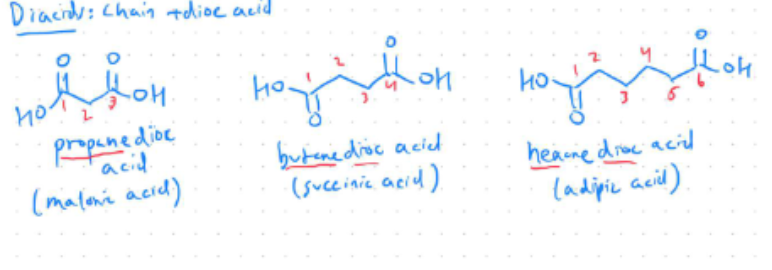
<p>Chain + dioc acid</p>
17
New cards

How to name rings with carboxylic acids?

  1. Cyclohexane as itself with carboxylic acid

  2. Benzene -ene + oic acid


<ol><li><p>Cyclohexane as itself with carboxylic acid</p></li><li><p>Benzene -ene + oic acid</p></li></ol><p></p>
18
New cards

How to name Carboxylic acids with ketones/aldehydes?

Oxo + Carboxylic Acid Name

<p>Oxo + Carboxylic Acid Name</p>
19
New cards

Are carboxylic acids strong or weak acids?

Weak

  • Groups that stabilize negative charge on carboxylate decreases pka


<p>Weak</p><ul><li><p>Groups that stabilize negative charge on carboxylate decreases pka</p></li></ul><p></p>
20
New cards

How do you rank acidity of carboxylic acids with Halogen? and Why?

More halogens, more acidic

  • Why? Delocalization of charge over a larger areas is stabilizing


<p>More halogens, more acidic </p><ul><li><p>Why? Delocalization of charge over a larger areas is <u>stabilizing</u></p></li></ul><p></p>
21
New cards
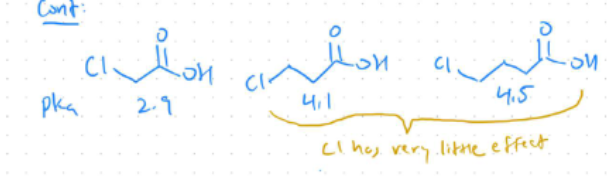
<p>Why is the first compound more acidic than the second compound?</p>

Why is the first compound more acidic than the second compound?

It is because the Cl is closer to the Carboxylic Acid in the first one compared to the other ones where it is farther away

22
New cards
<p>Why is the last group more acidic than the first group?</p>

Why is the last group more acidic than the first group?

  1. More resonance

  2. More stabilizing creates better leaving group


23
New cards

How do you prepare a carboxylic acid?

  1. from Aldehydes

  2. from Grignard Reagent


24
New cards

How do you prepare a carboxylic acid from an aldehyde?

  1. Using HrCrO4

  2. Using HClO2


<ol><li><p>Using HrCrO4</p></li><li><p>Using HClO2</p></li></ol><p></p>
25
New cards

How do you prepare a carboxylic acid from a Grignard Reagent?

  1. Using CO2 and H+ workup


<ol><li><p>Using CO2 and H+ workup</p></li></ol><p></p>
26
New cards

Mechanism of Grignard Reagent prep of Carboxylic Acid

  1. Carbon from Carbon Dioxide bonds to Grignard as one double bond gets lost to become a lone pair

  2. Now there is a negative charge on O and H+ is added to make the Carboxylic Acid


<ol><li><p>Carbon from Carbon Dioxide bonds to Grignard as one double bond gets lost to become a lone pair</p></li><li><p>Now there is a negative charge on O and H+ is added to make the Carboxylic Acid</p></li></ol><p></p>
27
New cards

How does a Carboxylic Acid react with a Base?

  1. Water formed as product

  2. Sodium bonded with O


<ol><li><p>Water formed as product </p></li><li><p>Sodium bonded with O</p></li></ol><p></p>
28
New cards

What does a carboxylic acid get reduce to?

Primary Alcohol

<p>Primary Alcohol</p>
29
New cards

What is used to reduce Carboxylic Acids?

LiAlH4

30
New cards

How is Fischer Esterification done?

It is prepared by treating Carboxylic Acid with alcohol in the presence of an acid catalyst (H2SO4, ArSO3H, Gaseous HCl)

<p>It is prepared by treating Carboxylic Acid with alcohol in the presence of an acid catalyst (H2SO4, ArSO3H, Gaseous HCl)</p>
31
New cards

How is a SN2 esterification done?

  1. Carboxylic Acid

  2. NaOH catalyst

  3. Na reacts with Br catalyst

  4. Ester formed


<ol><li><p>Carboxylic Acid </p></li><li><p>NaOH catalyst</p></li><li><p>Na reacts with Br catalyst</p></li><li><p>Ester formed</p></li></ol><p></p>
32
New cards

What is made from a reaction with a carboxylic acid and diazomethane?

Ester

33
New cards

Mechanism of Diazomethane esterification

  1. Diazomethane takes H from Carboxylic acid

  2. Carboxylate anion takes CH3 from Diazomethane

  3. Product made with N triple bond N product


<ol><li><p>Diazomethane takes H from Carboxylic acid</p></li><li><p>Carboxylate anion takes CH3 from Diazomethane </p></li><li><p>Product made with N triple bond N product</p></li></ol><p></p>
34
New cards

How is an acid chloride formed?

  1. Add Carboxylic acid with SOCl2

  2. Ether catalyst

  3. Product with SO2 + HCl


<ol><li><p>Add Carboxylic acid with SOCl2 </p></li><li><p>Ether catalyst</p></li><li><p>Product with SO2 + HCl</p></li></ol><p></p>
35
New cards

What is decarboxylation?

Loss of CO2 from carbonyl group

36
New cards

What is the overall reaction of decarboxylation?

Beta carbon stays the same , everything after alpha gets turned down

<p>Beta carbon stays the same , everything after alpha gets turned down</p>
37
New cards

Mechanism for decarboxylation

  1. 6-membered transition state created with double bond transfer

  2. Carbon Dioxide Splits and Enol Form created

  3. H+ transfer to create keto form


<ol><li><p>6-membered transition state created with double bond transfer</p></li><li><p>Carbon Dioxide Splits and Enol Form created</p></li><li><p>H+ transfer to create keto form</p></li></ol><p></p>
38
New cards

What are the Carboxylic Acid Derivatives?

  1. Acid Chloride

  2. Anhydrides

  3. Esters

  4. Amide

  5. Nitrile


<ol><li><p>Acid Chloride</p></li><li><p>Anhydrides</p></li><li><p>Esters</p></li><li><p>Amide</p></li><li><p>Nitrile</p></li></ol><p></p>
39
New cards

How do you name acyl halides?

Acyl group is bonded to halogen

  1. Replace “ic” from the acid name with “yl halide”


<p>Acyl group is bonded to halogen</p><ol><li><p>Replace “ic” from the acid name with “yl halide”</p></li></ol><p></p>
40
New cards

How do you name ring containing acyl halides?

Ring Name + Carbonyl Halide

<p>Ring Name + Carbonyl Halide</p>
41
New cards

How do you name anhydrides?

Replace Acid with Anhydride

<p>Replace Acid with Anhydride</p>
42
New cards

How do you name esters?

Name R1 first then the acyl group

  • Replace “ic acid” with “ate”


<p>Name R1 first then the acyl group</p><ul><li><p>Replace “ic acid” with “ate”</p></li></ul><p></p>
43
New cards

How do you name Amides or Imides

Replace “-ic” or “oic acid” with “Amide”

  • If a groups is N-substituted, N group comes first


<p>Replace “-ic” or “oic acid” with <u>“Amide”</u> </p><ul><li><p>If a groups is N-substituted, N group comes first</p></li></ul><p></p>
44
New cards

How do you name Nitriles?

Use alkanenitrile or drop “ic” or “oic acid” from parent carboxylic acid and replace it with

“-onitrile”

<p>Use alkanenitrile or drop “ic” or “oic acid” from parent carboxylic acid and replace it with </p><p>“-onitrile”</p>
45
New cards

In the order of Most reactive to least, rank Carboxylic Acid derivatives

  1. Acid halide

  2. Anhydride

  3. Ester = Acid

  4. Amide


<ol><li><p>Acid halide</p></li><li><p>Anhydride</p></li><li><p>Ester = Acid</p></li><li><p>Amide</p></li></ol><p></p>
46
New cards

In order of best to worst leaving group, rank them

  1. Acid Halide

  2. Anhydride

  3. Ester = Acid

  4. Amide


<ol><li><p>Acid Halide</p></li><li><p>Anhydride</p></li><li><p>Ester = Acid</p></li><li><p>Amide</p></li></ol><p></p>
47
New cards

What is the mechanism for the hydrolysis of acid chlorides?

  1. Water is added to carbonyl carbon which then moves the electrons from C=O bond to O

  2. Then another water is added to the mixture to take a hydrogen from the bonded H20

  3. Now C=O bond is reformed and Cl is booted out of the rxn

  4. Final product is created.


<ol><li><p>Water is added to carbonyl carbon which then moves the electrons from C=O bond to O</p></li><li><p>Then <strong>another </strong>water is added to the mixture to take a hydrogen from the bonded H20</p></li><li><p>Now C=O bond is reformed and Cl is booted out of the rxn</p></li><li><p>Final product is created. </p></li></ol><p></p>
48
New cards

What is the overall reaction for the hydrolysis of anhydrides and what is the mechanism?

  1. 2 Carboxylic Acids are formed

  2. Mechanism is the same as Acid Chlorides
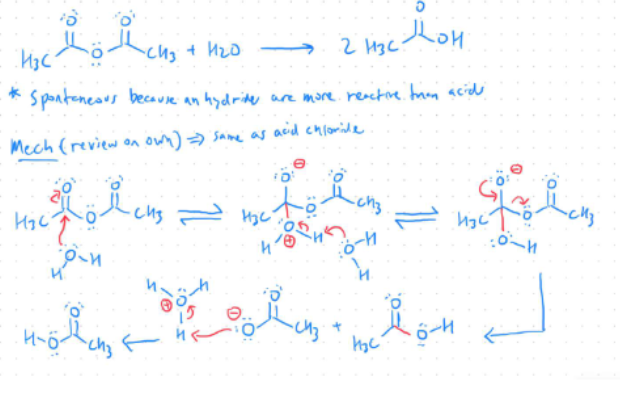

<ol><li><p>2 Carboxylic Acids are formed</p></li><li><p>Mechanism is the same as Acid Chlorides</p></li></ol><p></p>
49
New cards

What is the overall reaction for the hydrolysis of Esters and what is the mechanism?

  1. Carboxylic Acid Formed

  2. OR1 + H formed

Accomplished by adding Acid or Base


<ol><li><p>Carboxylic Acid Formed</p></li><li><p>OR1 + H formed</p></li></ol><p>Accomplished by adding Acid or Base</p><p></p>
50
New cards

Mechanism for Acid-Catalyzed Ester Hydrolysis

  1. Acidic Conditions so C=O picks with a H+ to bind with

  2. Water added to carbonyl group and double bond is converted into lone pair

  3. H+ transfer occurs to move H+ to OR1 group O

  4. C=O bond reforms and boots OR1 group

  5. Hydrogen is removed

  6. Carboxylic Acid product is made


<ol><li><p>Acidic Conditions so C=O picks with a H+ to bind with</p></li><li><p>Water added to carbonyl group and double bond is converted into lone pair</p></li><li><p>H+ transfer occurs to move H+ to OR1 group O</p></li><li><p>C=O bond reforms and boots OR1 group </p></li><li><p>Hydrogen is removed </p></li><li><p>Carboxylic Acid product is made</p></li></ol><p></p>
51
New cards

Mechanism for Hydrolysis of Ester in Aqueous Base (Saponification)

  1. OH- group (instead of water) adds to carbonyl group and electrons from C=O bond move to O

  2. C=O bond reforms and OR1 group is booted

  3. OR1 group gets its get back by robbing H from Carboxylic Acid made

  4. Final Products made


<ol><li><p>OH- group (instead of water) adds to carbonyl group and electrons from C=O bond move to O</p></li><li><p>C=O bond reforms and OR1 group is booted</p></li><li><p>OR1 group gets its get back by robbing H from Carboxylic Acid made </p></li><li><p>Final Products made</p></li></ol><p></p>
52
New cards

How does the hydrolysis of Cyclic esters/anhydrides work?

Cyclic Esters

  1. Water catalyst with NaOH to get rid of ring

  2. NaO bonded to carbonyl group

  3. H+ added to make carboxylic acid

Cyclic Anhydrides

  1. Water added with H+ as well

  2. Dioic Acid Made after ring unraveled


<p>Cyclic Esters</p><ol><li><p>Water catalyst with NaOH to get rid of ring</p></li><li><p>NaO bonded to carbonyl group</p></li><li><p>H+ added to make carboxylic acid</p></li></ol><p>Cyclic Anhydrides</p><ol><li><p>Water added with H+ as well</p></li><li><p>Dioic Acid Made after ring unraveled </p></li></ol><p></p>
53
New cards

How are Hydrolysis of Amides done?

By adding an Acid or Base with Water
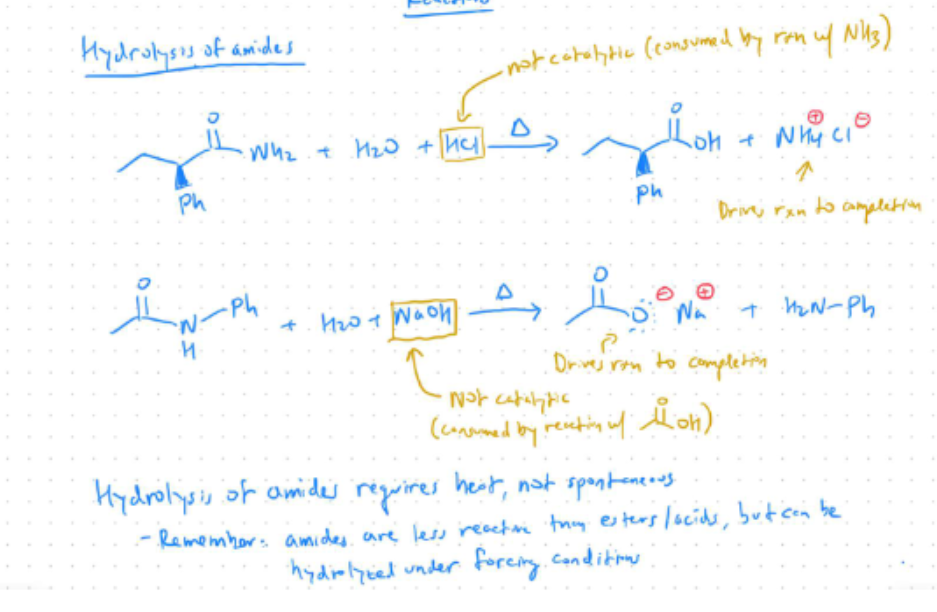
<p>By adding an Acid or Base with Water</p>
54
New cards

How do you do the hydrolysis of nitriles?

Either under acidic or basic conditions

55
New cards

Mechanism for Hydrolysis of Nitriles under Acidic Conditions

  1. Water added to Carbon of triple bond and Nitrogen gets turned into a C=N bond with H

  2. H+ transfer happens to make a more stable compound by making a C=O bond and C-NHH bond.

  3. Second Equivalent of Water and H+ are added to create carboxylic acid


<ol><li><p>Water added to Carbon of triple bond and Nitrogen gets turned into a C=N bond with H</p></li><li><p>H+ transfer happens to make a more stable compound by making a C=O bond and C-NHH bond. </p></li><li><p>Second Equivalent of Water and H+ are added to create carboxylic acid</p></li></ol><p></p>
56
New cards