alkanes
 Call Kai
 Learn
Learn Practice Test
 Spaced Repetition
 Match
Match Flashcards
 Knowt Play
1/53

There's no tags or description
Looks like no tags are added yet.
Name | Mastery | Learn | Test | Matching | Spaced | Call with Kai |
|---|
No analytics yet
Send a link to your students to track their progress
54 Terms
why do alkanes do not dissolve in water
this is because they are non polar (the electronegativity of carbon and hydrogen is similar). Because the water molecules are held together by H-bonds, and alkanes by vdW forces, they do not interact with each other
boiling points of alkanes - trend 1
increasing chain length
higher boiling points due to more electrons which means stronger van der Waals’ forces between molecules
boiling points of alkanes - trend 2
More branching → lower boiling points due molecules not packing as close together and so weaker van der Waals’ forces between molecules
Petroleum/crude oil
formed by the slow decay of marine animals and plants, over millions of years, under heat and pressure in the absence of oxygen
composition of crude oils is a complex mixture consisting mainly of alkanes (including cycloalkanes, some aromatics and other compounds containing some S and O).
components are separated by fractional distillation for useful products
why is Crude oil is often called a fossil fuel
because it is made from the break down of organic matter, such as plants and animals
Burning fossil fuels releases..?
carbon dioxide – a greenhouse gas.
Further more, impurities in the fossil fuels such as sulphur react with oxygen on combustion releasing sulphur dioxide.
is crude oil non renewable/renewable
non renewable fuel as, although crude oil is being formed – it takes millions of years.
process of fractional distillation
1. Crude oil is heated into vapour
2. Temp gradient in column tower or / cooler at top of column & hotter at bottom
3. Vapour cools as it rises
4. Fractions/hydrocarbons or compounds condense at different points as they have different boiling points - depends on size/ Mr
5. Longer chained molecules condense at bottom and vice versa
label the diagram of which hydrocarbons are separated in fractional distillation
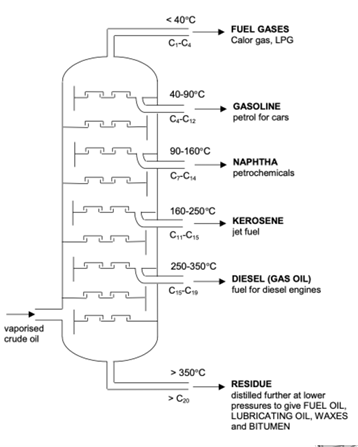
what is a fraction
a mixture of hydrocarbons with similar boiling points
Boiling point:
The temperature at which something boils
• Volatility:
How easily a substance vaporises into a gas
• Flammability
The ease at which a substance ignites
• Viscosity:
How easily a substance flows
difference of hydrocarbons properties at top compared to bottom
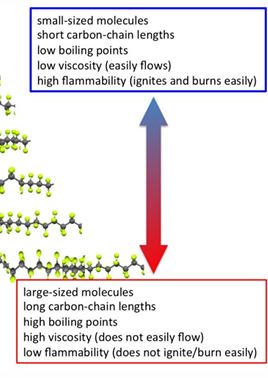
trends down the column
as chain length increases
higher boiling point
less volatile
more viscous
harder to ignite
cracking
Cracking is a thermal decomposition reaction of long chain alkanes to
shorter alkanes
alkenes
.• C-C bonds are broken in the alkanes
why crack hydrocarbons?
1. High demand for short chain alkanes short supply so cracking creates more useful short chain alkanes
2. Creates ethene, an extremely useful precursor to making polyethene – polymer synthesis
Catalytic cracking Conditions
Temp: 450oC
Pressure: 1-2atm
Zeolite catalyst
what is a zeolite catalyst
Zeolite catalysts are honeycombed structure to give enormous surface area, they consist of silicon dioxide an aluminium oxide.
Catalytic cracking:Products
The products are also a mixture of alkanes mainly of short chains, used in motor fuels.
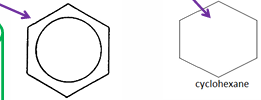
These are branched alkanes,
cycloalkanes
and aromatic compounds.
Thermal cracking:Conditions
Temp: 900oC
Pressure: 70atm
Products:
The carbon chain can break in any number of places, and hydrogen may be produced. This means that there is a high proportion of alkenes created
describe the process of thermal cracking at a molecular level
a C-C covalent bond spilts equally (homolytic fission)
each carbon atom recieves one electron, forming free radicals
these radicals form a shorter alkane and an alkene
Free radicals
highly reactive species with and unpaired electron
Complete combustion + equation
When hydrocarbon fuels are burnt (combustion) in enough oxygen (COMPLETE COMBUSTION) we produce carbon dioxide and water.
FUEL + OXYGEN → CARBON DIOXDE + WATER
Incomplete combustion + equation
If there is insufficient oxygen present combustion is incomplete – CO2 is not produced!
FUEL + OXYGEN (insufficient) → CARBON MONOXIDE + WATER
what is carbon monoxide in terms of incomplete combustion
Carbon monoxide, CO, is a toxic gas and replaces O2 in your red blood cells causing death by asphyxiation (Oxygen deficiency).
Incomplete combustion 2
FUEL + OXYGEN (insufficient) → CARBON + WATER
Carbon/soot is a carbon particulate, which can cause asthma and cancer/global dimming
Greenhouse gases
molecules with polar bonds absorb IR radiation to make bonds vibrate
• H2O, CO2 and CH4 (C-H is slightly polar)
• greenhouse gases do not absorb the sun’s higher frequency UV/visible radiation
• O2 and N2 do NOT have polar bonds so are NOT greenhouse gases
Flue Gas Desulfurisation Why is it needed?
Many fossil fuels (especially coal) contain sulfur impurities.
When sulfur burns:
S + O_2 \rightarrow SO_2
Sulfur dioxide (SO₂) is released into the atmosphere.
Problems caused by SO₂
1. Acid Rain
SO₂ dissolves in rainwater:
SO_2 + H_2O \rightarrow H_2SO_3
Sulfurous acid can then be oxidised further to sulfuric acid
what does acid rain do
Acidifies lakes and rivers
Kills fish and aquatic life
Damages forests
Erodes limestone buildings
2. Human Health affect on SO2
SO₂ irritates:
Lungs
Airways
Can worsen:
Asthma
Bronchitis
How Flue Gas Desulfurisation Works
Flue gases from power stations are passed through a scrubber.
The scrubber contains alkaline substances which neutralise acidic SO₂
Method 1: Using Calcium Oxide flue gas desulfurisation
Calcium oxide is alkaline.
Reaction:
CaO + SO_2 \rightarrow CaSO_3
What happens?
SO₂ is acidic
CaO is basic
Neutralisation occurs
Product:
Calcium sulfite (CaSO₃)
Sulfur dioxide gas is an acidic oxide. Reacts with a wet mixture of calcium carbonate solid calcium sulfite and Carbon dioxide
a. CaCO 3 + SO2→CaSO3+ CO2
Method 2: Using Calcium Carbonate flue gas desulfurisation
Reaction:
CaCO_3 + SO_2 \rightarrow CaSO_3 + CO_2
Why use calcium carbonate?
Cheap
Readily available as limestone
Product:
Calcium sulfite
Carbon dioxide
Calcium sulfite then further oxidises to calcium sulfate by atmospheric oxygen, which is then dumped/used.
b. 2CaSO3 (s) + O2 (g) → 2CaSO4 (s)
[gypsum – make plasterboard
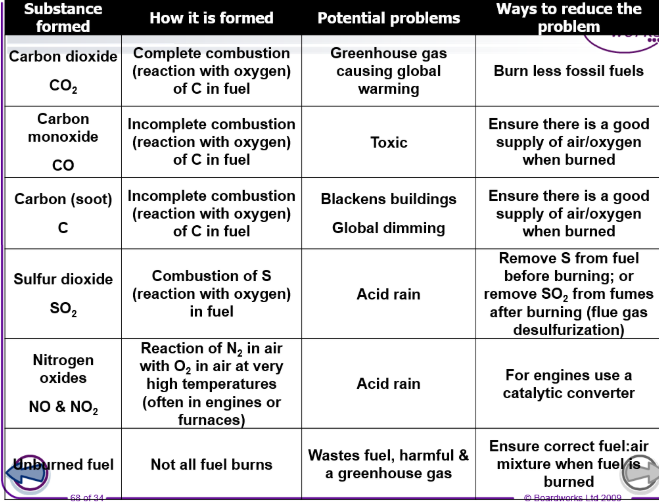
table of how substances are formed- the harms - and how to remove
Explain why calcium oxide removes sulfur dioxide.
Calcium oxide is basic and sulfur dioxide is acidic. They react in a neutralisation reaction to form calcium sulfite.
Catalytic Converters
Purpose
Used in car exhaust systems.
Reduce harmful emissions from petrol engines
have a ceramic honeycomb coated with a thin layer of catalyst metals (Pt, Pd, Rh) – to give a large surface area.
Pollutants Removed Catalytic Converters Carbon Monoxide (CO)
Produced by incomplete combustion.
Dangerous because:
Toxic gas
Binds strongly to haemoglobin
Reduces oxygen transport in blood
Pollutants Removed Catalytic Converters Nitrogen Oxides (NO and NO₂)
Produced at high temperatures in engines:
N_2 + O_2 \rightarrow 2NO
Problems:
Acid rain
Respiratory problems
Photochemical smog
Pollutants Removed Catalytic ConvertersUnburned Hydrocarbons
Produced when fuel doesn’t burn completely.
Problems:
Air pollution
Smog formation
Reactions in Catalytic Converters Carbon Monoxide Oxidation
Carbon monoxide is oxidised:
2CO + O_2 \rightarrow 2CO_2
What happens?
Toxic CO converted into less harmful CO₂
Why Are Catalysts Needed?
Without catalysts:
Reactions would be too slow
Pollutants would leave through the exhaust
Catalysts:
Lower activation energy
Increase reaction rate
Are not used up
Reactions in Catalytic Converters Nitrogen Oxides Reduction
Example:
2NO \rightarrow N_2 + O_2
Or:
2CO + 2NO \rightarrow 2CO_2 + N_2
What happens?
Harmful NO converted into harmless nitrogen gas
Reactions in Catalytic Converters Hydrocarbon Oxidation
Example:
C_xH_y + O_2 \rightarrow CO_2 + H_2O
What happens?
Unburned fuel converted into carbon dioxide and water
free radical
a species with an unpaired electron.
This is energetically unfavourable, so free radicals are VERY reactive.
Free Radical – formation
Free radicals are formed if a bond splits evenly - each atom getting one of the two electrons. The name given to this is homolytic fission
Free Radical representation
A free radical is represented as follows with the unpaired electron explicitly shown on the molecule/atom: E.g. Cl● , H●, CH3●
Reactions of alkanes to form Haloalkanes
Alkanes are very unreactive and will generally not react with halogens (these are diatomic! e.g. Cl2 etc) to form haloalkanes.
However under certain conditions they will - when exposed to UV light.
• A hydrogen UV light CH4 + Cl2 CH3Cl + HCl
on the alkane is replaced • This is called substitution reaction . by a Cl/halogen atom. • Since we are using free radicals it is more specifically called a free radical substitution reaction
Why bother? free radical susbstitiution
Chlorofluorocarbons (CFCs) are used refrigerants. But can also cause environmental damage. CCl4 used in fire extinguishers, as a precursor to refrigerants, and as a cleaning agent
Problems with Free Radical Substitution
1. Further Substitution
Products can continue reacting.
Example:
CH₃Cl → CH₂Cl₂ → CHCl₃ → CCl₄
2. Mixture of Products
Difficult to separate.
Common 2-mark question.