NSC Language
 Call Kai
 Learn
Learn Practice Test
 Spaced Repetition
 Match
Match Flashcards
 Knowt Play
1/39

There's no tags or description
Looks like no tags are added yet.
Name | Mastery | Learn | Test | Matching | Spaced | Call with Kai |
|---|
No analytics yet
Send a link to your students to track their progress
40 Terms
What is so important about the Superior Olivary Nucleus?
First place with bilateral inputs
What is Langague?
Generation and understanding of written, spoken, and gestural communication
Phonemes are
Basic Speech Sounds
Semantics are?
Meaning of words or sentences
Syntax are?
Grammatical rules for constructing phrases and sentences
From birth, babies can distinguish?
Phonemes in any language
Language development depends on?
Experience during a sensitive period - our first few years
Speech refers to how we?
Say sounds and words
Language refers to ?
Words we use in a sentence to convey our message
The scientific study of language is called linguistics which includes?
Phonology, Morphology, Semantics, Syntax, and Pragmatics
Phonology represents the?
Sound system and linguistic rules of sound combinations, pronunciation, and perception
Morphology represents the?
Linguistic rules of word structure and construction
Pragmatics represents the rule for?
Maintaining a conversation in terms of responsiveness, relevance, and so on
Go back to slide 6 and grab Phonation to variations stuff
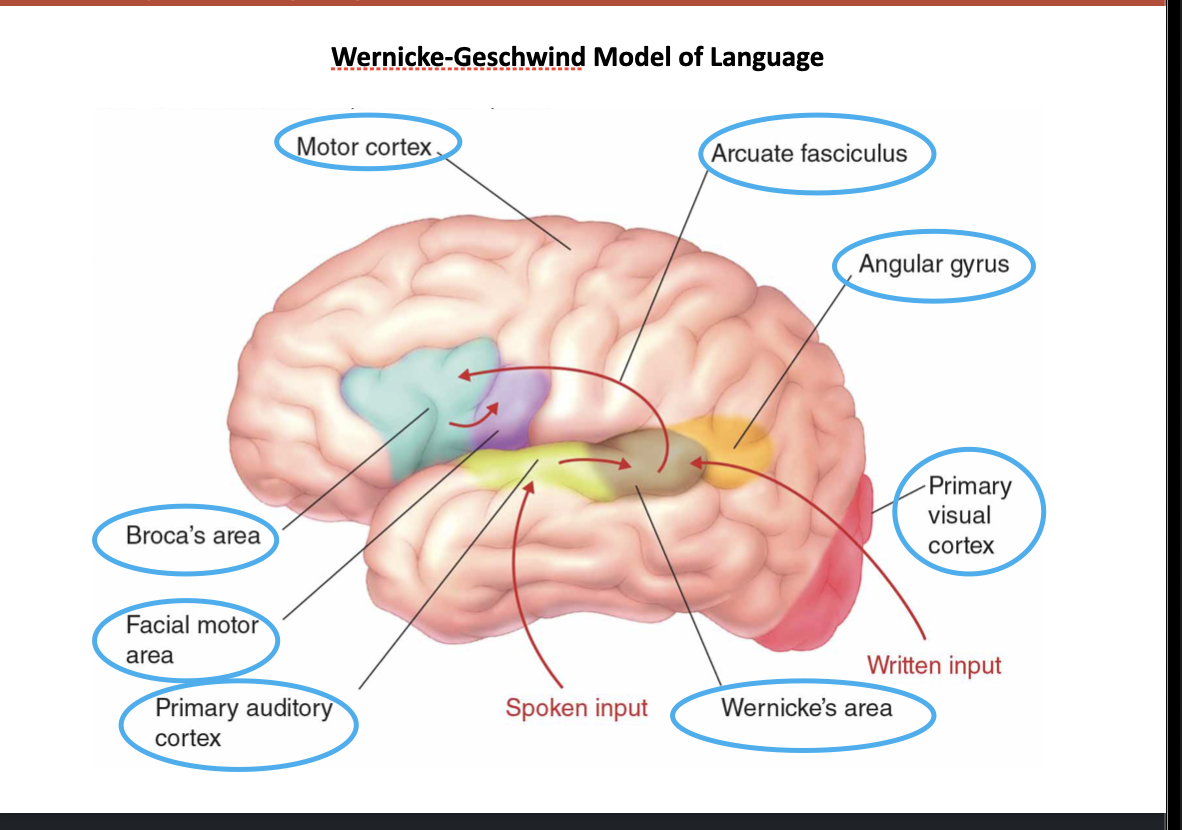
What are key structures in the Diagram?
. Primary Auditory Cortex
First stop for spoken language input.
Processes raw sound before meaning is extracted.
2. Wernicke’s Area
Critical for language comprehension.
Assigns meaning to words and sentences.
3. Arcuate Fasciculus
White‑matter fiber tract connecting Wernicke’s area → Broca’s area.
Essential for repeating words, integrating comprehension with production.
4. Broca’s Area
Responsible for speech planning and production.
Converts linguistic ideas into motor plans.
5. Motor Cortex / Facial Motor Area
Executes the motor commands for speech (mouth, tongue, larynx).
______________________________________________________
Primary Visual CortexFirst processing site for written words.
Angular Gyrus
Converts visual symbols → linguistic meaning.
Bridges reading and language comprehension.
Spoken Input Pathway
Primary Auditory Cortex → Wernicke’s Area → Arcuate Fasciculus → Broca’s Area → Motor Cortex
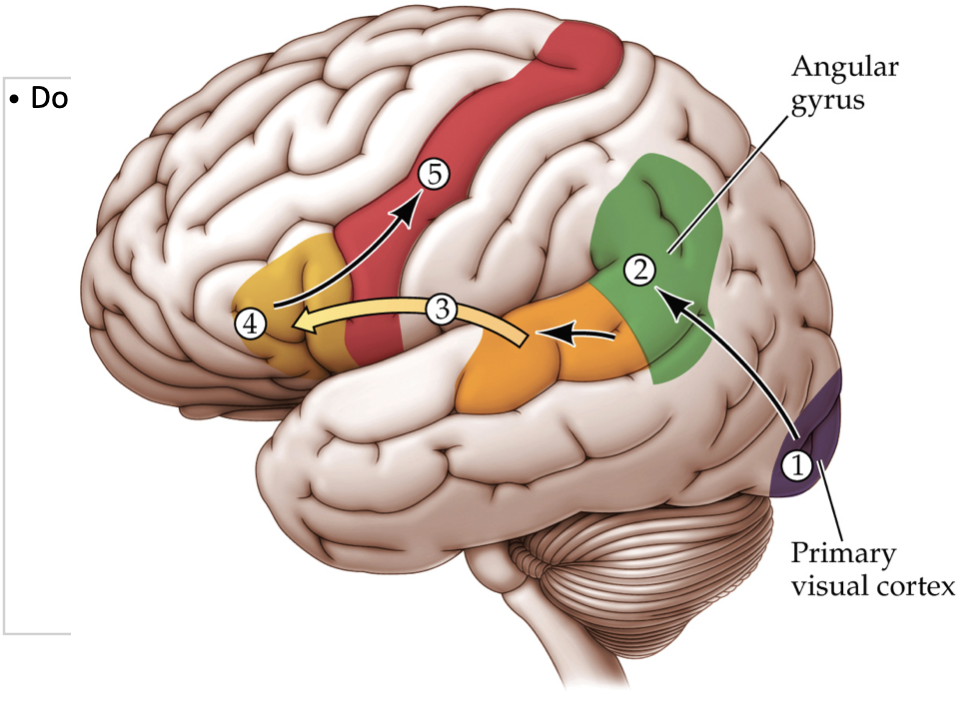
Written Input Pathway
Primary Visual Cortex → Angular Gyrus → Wernicke’s Area → Arcuate Fasciculus → Broca’s Area → Motor Cortex
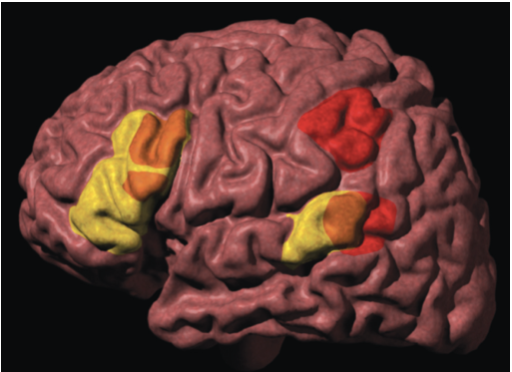
What is so special about the brown areas in this image?
The brown areas are called Mirror Neurons, which may be critical to develop language, as they are active during imitation of others actions
(They overlap Broca and Wernicke’s area, which are yellow)
Aphasia represents the?
Impaired language ability due to damage in the dominant left hemisphere language areas.
Which is the Primary Hemisphere for Language
Left Hemisphere is dominant for language in about 95% of right‑handed people and ~70% of left‑handed people
Broca’s Aphasia (Non‑fluent / Expressive): Key features
Non‑fluent, effortful, broken speech
Good comprehension
Impaired repetition
Patient aware of deficit (frustrated)
Lesion: left inferior frontal gyrus (Broca’s area)
“Broken speech, good comprehension.”
Broca’s Aphasia may occur with?
Anomia - inability to name persons or objects
Wernicke’s Aphasia (Fluent / Receptive): Key features
Fluent but nonsensical speech (“word salad”)
Poor comprehension
Impaired repetition
Patient unaware of deficit
Lesion: left superior temporal gyrus (Wernicke’s area)
“Fluent nonsense, poor comprehension.”
Conduction Aphasia: Key features
Fluent speech
Good comprehension
Severely impaired repetition (hallmark)
Frequent phonemic paraphasias (sound substitutions)
Patient aware of errors and tries to correct them
Lesion: arcuate fasciculus (connection between Broca + Wernicke)
Memory phrase:
➡ “Can speak and understand, but can’t repeat.”
Global Aphasia: Key features
Non‑fluent speech
Poor comprehension
Impaired repetition
Severe impairment across all language domains
Often only a few words or stereotyped utterances
Lesion: large left MCA stroke affecting both Broca + Wernicke regions
Memory phrase:
➡ “Everything is impaired.”
Following Left-hemisphere damage, if injury occurs early in life, what can occur?
Right hemisphere can take over language
If damage was to occur later, the language control is more likely to?
Shift into bordering areas in the left hemisphere
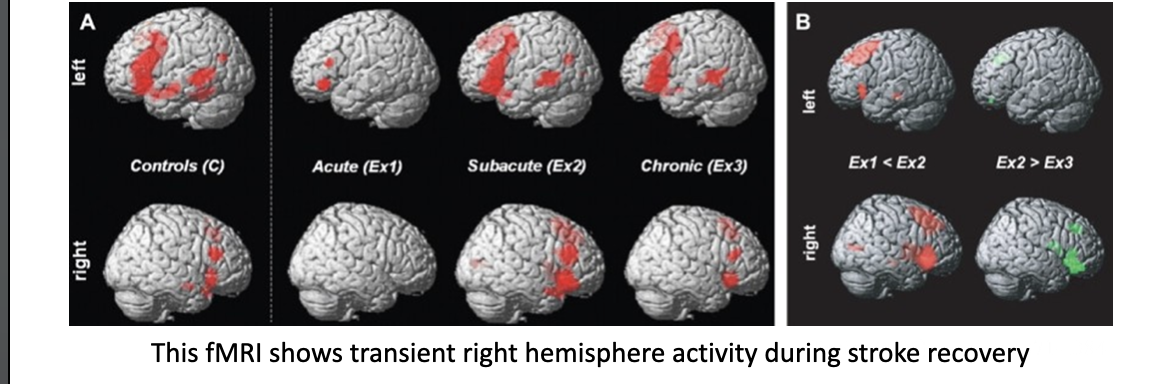
This fMRI shows transient right hemisphere activity during stroke recovery
Ability of other areas to take over language functions may be due to their?
Normal participation in language
Go back to slide 15-16
Dichotic listening is when we?
Present different sounds to each ear at different or the same time
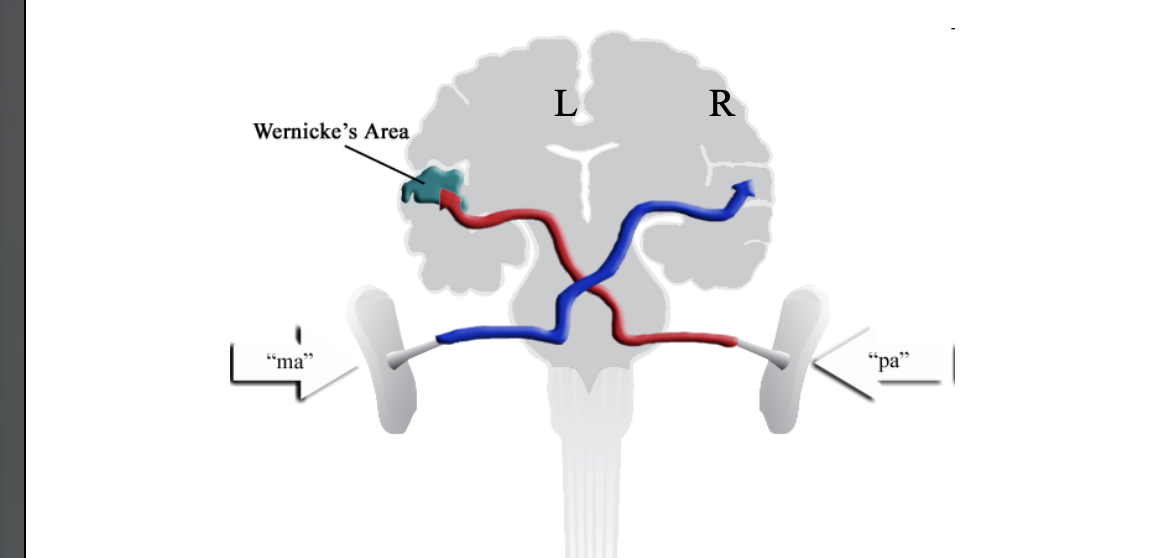
What does this image show?
Crossed Auditory Pathways
Left ear → right hemisphere
Right ear → left hemisphere
This crossing is shown by the colored pathways
Left Hemisphere Language Dominance
Wernicke’s area (shown in the left hemisphere) processes language.
Because the right ear projects directly to the left hemisphere, people usually report the right‑ear sound first or more accurately.
This is called the right‑ear advantage.
Meaning the left hemisphere is dominant for language
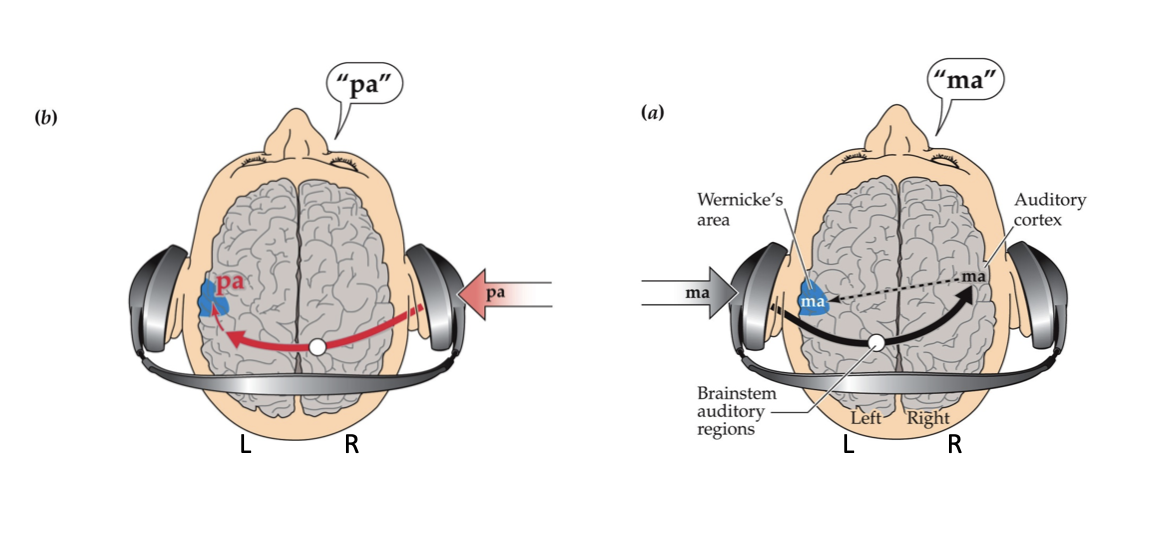
Right-Handers identify stimuli delivered to right ear?
More easily - right ear advantage
Some left-handers have left-ear advantage though implying some left-handers?
Have language in their right hemisphere
Wada test is the injection of?
Amobarbital into carotid artery briefly that sedates that hemisphere
For Right-Handers
Language restricted to left in 95%
For left handers?
Only 70% have left lateralization, 15% have right lateralization, 15% mixed dominance
The brain uses two language systems to read, where?
One focuses on sounds of letters, the other on meaning of words
Suface dyslexia represents?
Errors in reading restricted to details and sounds of letters
Pretty (pritty) read as pretty
For Surface Dyslexia error will be
Early in auditory processing