Operations Management
 Call Kai
 Learn
Learn Practice Test
 Spaced Repetition
 Match
Match Flashcards
 Knowt Play
1/50

There's no tags or description
Looks like no tags are added yet.
Name | Mastery | Learn | Test | Matching | Spaced | Call with Kai |
|---|
No analytics yet
Send a link to your students to track their progress
51 Terms
Operations Management
Involves coordinating and organising the activities involved in producing the goods and services that a business sells to customers.
responsibility of implementing strategies that improve a business’s operations system and contribute to the achievement of various business objectives
plays a key role in achieving business objectives by optimising resources and improving productivity without negatively affecting the overall quality of the final product
Productivity
Is the number of goods or services produced compared to the number of resources used in the production process.
Efficiency
Is how well a business uses its resources (inputs) when producing a good or service - maximising output with minimal input.
Effectiveness
The extent to which a business achieves its stated objectives.
Relationship between operations management and business objectives
Operations managers can contribute to the achievement of business objectives by improving levels of efficiency and effectiveness in a business’s production process. Additionally, they are in charge of implementing strategies that optimise operations, improve business performance, and achieve business objectives.
To make a profit
Strategy: Implementing technology into the production process.
How it assists the achievement of business objectives: Reduces the number of employees required in the operations system, which can reduce expenses associated with labour and therefore increase profit.
To increase market share
Strategy: Checking that the products produced are not faulty.
How it assists the achievement of business objectives: Can improve the quality of a business’s product, increasing customer satisfaction and the business’s proportion of sales within its industry.
To meet shareholder expectations
Strategy: Creating a website for customers to purchase goods and services online.
How it assists the achievement of business objectives: Increases online sales, which can lead to higher levels of profit and increase dividends for shareholders.
To fulfil a market need
Strategy: Using technology to design new products.
How it assists the achievement of business objectives: Can design innovative products to fulfil customer needs that are currently unmet or underserved in the market.
To fulfil a social need
Strategy: Ensuring that any waste is recycled in the production process.
How it assists the achievement of business objectives: Reduces the amount of waste produced by a business, allowing it to meet the social need of environmental preservation.
To improve efficiency
Strategy: Using technology to automate the production process.
How it assists the achievement of business objectives: Can increase a business’s productivity in terms of production speed, as well as reducing the amount of resources discarded in the production process.
To improve effectiveness
Strategy: Implement strategies that improve the quality of the business’s product.
How it assists the achievement of business objectives: Can improve levels of customer satisfaction, which may increase the business’s sales and revenue. Increased financial performance can assist the business in achieving its objectives.
Inputs
The resources used by a business to produce goods and services.
Examples:
• Raw materials (essential components for production. Eg flour, iron)
• Labour resources (skilled employees to manage operations)
• Capital resources (equipment and technology, machinery and digital tools)
• Time
• Utilities (electricity, water, gas)
• Information
Processes
the actions performed by a business to transform inputs into outputs.
Examples:
• mixing
• designing
• baking
• computing
• cutting
• washing
• assembling
• constructing
Outputs
The final goods or services produced as a result of a business’s operations system.
Outputs should meet customer expectations in relation to quality, price and availability of the product
Goods: Tangible products manufactured for consumers.
Services: Intangible experiences provided to customers.
Customer satisfaction: Delivering quality outputs ensures repeat business.
Feedback and improvements: Businesses refine operations based on customer input.
Key elements of operations system at Yakult
Inputs:
6.5 billion live Lactobacillus casei strain Shirota
flavouring
water
plastic
machinery
employees’ labour
skim milk powder
Processes:
Yakult performs various processes to transform its raw materials and resources into 65ml bottles of probiotic milk. Processes include:
fermenting the milk solution
blending milk
moulding plastic bottles
filling bottles
sealing bottles
packaging bottles into packs of 5 and 10
Outputs:
The outputs are 65ml bottles of Yakult Original and Yakult Lite, packaged in packs of five or ten and wrapped in polyethylene film. These two types of probiotic milk are the final products that retailers purchase and provide to customers.
Operations in Manufacturing Businesses
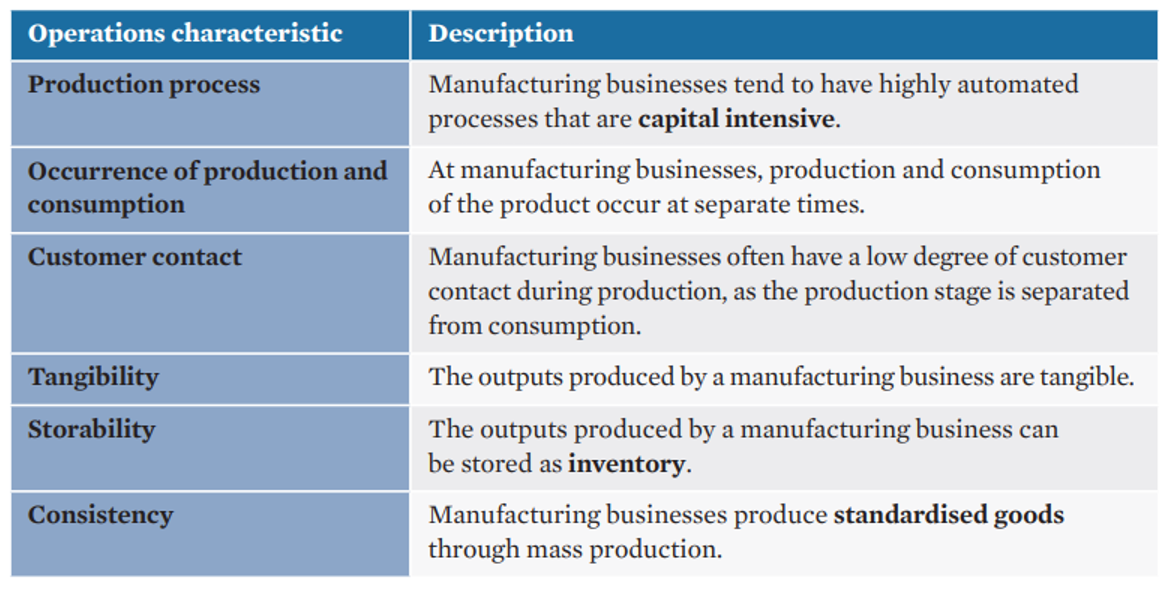
Manufacturing businesses use resources to produce a final physical product.
Operations in Service Businesses
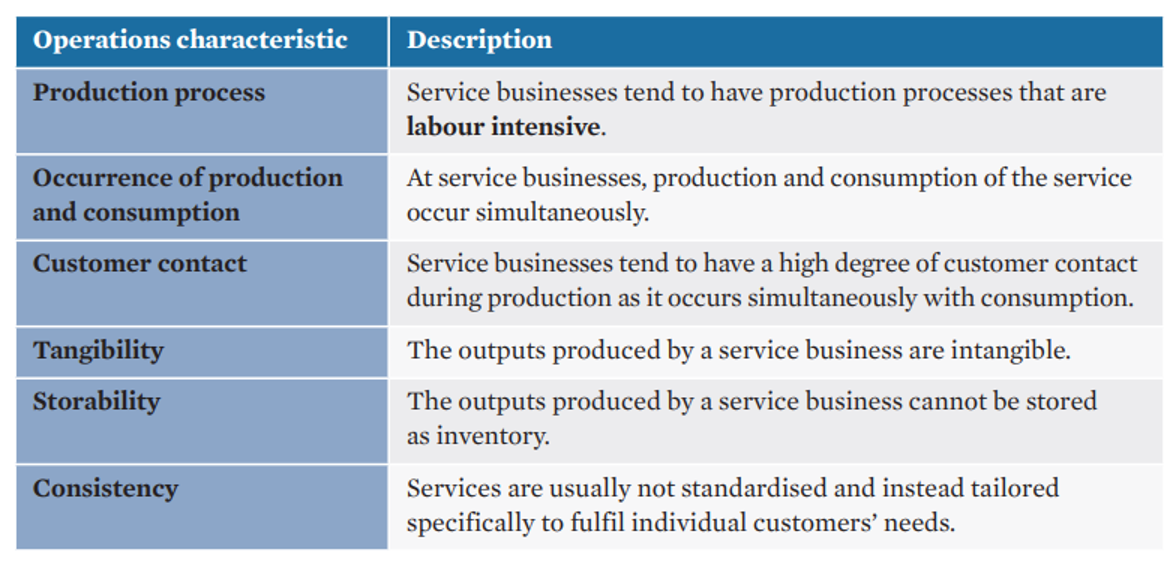
Provide intangible products usually with the use of specialised expertise.
Similarities and Differences between Manufacturing and Service businesses
Similarities:
both businesses aim to optimise their operations to produce high quality outputs at a low cost of production '
both businesses have to deal with suppliers during the process of managing operations
both businesses can utilise forms of technology in their operations system
both businesses aim to optimise efficiency and effectiveness in their operations
Differences:
Manufacturing business
Labour or capital intensive: capital intensive
Occurrence of production and consumption: occurs separately
Degree of customer contact during production: low degree of customer contact during production
Tangibility of output: tangible output
Storability of output: yes
Standardised or tailored production: standardised production
Service business
Labour or capital intensive: labour intensive
Occurrence of production and consumption: occurs simultaneously
Degree of customer contact during production: high degree of customer contact during production
Tangibility of output: intangible output
Storability of output: no
Standardised or tailored production: tailored production
Optimising operations
To improve the effectiveness and efficiency of operations to make the best output possible.
Computer aided design (CAD) - Technological developments
Definition: A digital design tool that allows businesses to generate and modify technical illustrations of a product.
How is CAD efficient?
Reduces time and people involved in designing something - this improves productivity
How is CAD effective?
Can allow a business to develop different product designs and choose the best one to produce. Choosing the best option to ensure the highest quality to meet objectives, such as increasing customer satisfaction.
Real world example - Toyota
Toyota’s engineers use CAD to create visual designs of their cars
They also use CAD to perform simulations of their cars, such as cars crashing into walls, to see if the airbags will go off
Advantages:
product designs can be produced at a faster time
the designer can produce a two- or three- dimensional computerised version of a product
Disadvantages:
computer software can crash, resulting in the possible loss of work
costs of software can be expensive
Computer-aided manufacturing (CAM) - Technological developments
Definition: A software used to control and direct the production process by controlling machinery and equipment through a computer.
How is CAM efficient?
It does not need machines to be functioned by people, which takes away labour costs and time, improving productivity.
How is CAM effective?
It is accurate, allows for consistency and can increase sales.
Real world example - Toyota
Toyota uses CAM to begin to manufacture its products
Also, individual parts of Toyota’s vehicles are manufactured through CAM using the specifications of CAD.
Advantages:
allows a business to produce at faster rates, at a reduced cost
allows a business to produce with greater consistency and greater accuracy
Disadvantages:
computer software can crash, resulting in production stopping
CAM - enabled machinery is generally designed for a specific task, and is not typically versatile
Automated production lines - Technological developments
Definition: Machinery and equipment that are arranged in a sequence where the product being made goes through each step of the sequence.
Why is it efficient?
Usually performed tasks at a high speed, quicker than humans
Why is it effective?
Allows for accuracy, decreases errors, and improves the overall quality of the product for customers
Real world example - Toyota
Toyota uses automated production lines to assemble its cars
There are stations set up down the conveyor belt, one for putting in doors, one for adding mirrors, one for putting windscreen wipers in, etc, and the car moves down the production line
Advantages:
minimises waste
can improve standardisation
allows a business to produce at faster rates - this will result in higher outputs and increased productivity
Disadvantages:
robotics can break down, halting production
robotics can be costly to maintain or replace
Online Services - Technological developments
Definition: online platforms provided via the internet
Why is it efficient?
Removes the need for employees to do certain tasks, which means labour resources can be better used elsewhere
Why is it effective?
improves convenience for customers, thereby increasing customer satisfaction, sales and market share.
Real world example - Toyota:
Toyota allows Australian customers to book a vehicle service on the Toyota website
Advantages:
online services, such as booking platforms, can process bookings faster than employees.
Employees may experience increased job satisfaction if the online service removes tedious tasks from their workloads
Disadvantages:
The process of a business developing its own platform that provides online services may be time consuming
if the platform providing the online service experiences technical difficulties, it may disrupt the business’s operations
Robotics - Technological developments
Definition: are programmable machines that are capable of performing specific tasks
Why is it efficient?
Performs tasks quickly and accurately, reducing the time and resources wasted in production, and resources are being used optimally, which improves productivity
Why is it effective?
Tasks can be completed quickly, precisely and accurately, which minimises errors leading to a better quality product, which can increase customer satisfaction, sales, and market share
Real world example - Toyota:
At Toyota, robotic machinery is used to perform tasks such as assembling components, welding and painting a vehicle.
Advantages:
tasks can be performed much faster than human labour
performing tasks precisely and accurately can ensure products are consistently produced at a high standard, which can improve the business’s reputation
Disadvantages:
it can be expensive for a business to repair and update robotic technologies
there may be expenses associated with training employees to use robotic technologies
Artificial Intelligence (AI) - Technological developments
Definition: involved using computerised systems to stimulate human intelligence and mimic human behaviour
Why is it efficient?
can reduce the time and labour needed to complete difficult tasks that would normally require human intelligence, resources are being used more optimally, which increases productivity
Why is it effective?
can complete difficult tasks like providing timely and high quality customer assistance, which can improve customer satisfaction, which can increase sales and market share
Real world example - Toyota:
Toyota has implemented new software powered by AI that enables robots to be automated for vehicle assembly processes and learn, adapt and execute tasks on Toyota’s production lines
Advantages:
AI can perform functions much faster than humans
AI can provide prompt customer service 24/7, improving customer satisfaction and the business’s reputation
Disadvantages:
it may be costly to recalibrate and maintain AI
There are high initial setup costs associated with purchasing and installing AI
Materials
Anything required for the production of a good and anything required to complete a service.
Forecasting - Materials Strategies
Definition: A materials planning tool that guesses customer demand for a product/service for an upcoming period using past data and market trends.
Why is it efficient?
Avoids the chances of over ordering
Why is it effective?
Allows a business to meet customer demand, meeting the objectives of increasing profit and consumer satisfaction
Advantages:
allows business to make better judgments and decisions
allows businesses to meet consumer demands
Disadvantages:
always a chance of getting it wrong
may not be able to meet customer demands, especially when demand for a good is unexpected
Master Production Schedule (MPS) - Materials Strategies
Definition: When a business creates a plan that identifies what they plan on producing, how much they plan to produce, over a specific time period
Why is it efficient?
helps businesses avoid over ordering and wasting materials, which makes the production process more organised and productive
Why is it effective?
A business can produce an amount of goods or services that meets customer demand, which will increase sales
Advantages:
MPS allows businesses to not over produce their goods, reducing waste
can increase sales and profits if customer demands are met
Disadvantages:
time consuming to organise MPS
MPS is not good for businesses who always change their operations systems
Materials Requirement Planning (MRP)
Definition: a more detailed plan of the exact items and materials needed to meet production targets set out in MRP
Why is it efficient?
Increases productivity because you have the exact materials ready to go
Why is it effective?
Meets customer demands, which meets the objective of increasing customer satisfaction and sales
Advantages:
businesses have the exact materials needed, reducing waste
production will continue smoothly
stronger reputation, as they don’t impact the environment by being wasteful
Disadvantages:
time consuming to update this plan
costly to implement
Just In Time (JIT) - Materials Strategies
Definition: A stock control strategy, where the right amount of materials is delivered as soon as it is needed for production
Why is it efficient?
do not need to store materials, can focus on production
Why is it effective?
Reduce expenses associated with waste and eliminate storage space, and can meet the objectives of increasing sales
Advantages:
positive reputation, no waste, no impact on the environment
money isn’t wasted on storing stock
Disadvantages:
delivery costs, as the business tends to have more frequent deliveries
production may stop if you don’t have enough stock
Real world example - Yakult - Materials Strategies
most materials Yakult uses in the production process are ordered and delivered utilising a just in time (JIT) process
The skim milk powder and sugar are ordered and delivered at the time they are needed for injection into the production process
the bottles are made on site, also using the just in time (JIT) process
Quality
Definition: Is defined as a good or service that fully meets customer expectations.
Increased levels of quality → better product reputation → more sales
Quality Control (QC)
Definition: inspecting different points in the production process to make sure products meet expected standards in terms of quality, and those that don’t are disposed of
Why is it efficient?
checking and fixing errors means that they do not happen again, reducing waste because items won’t need to be disposed of
Why is it effective?
customers don’t get faulty products, which means customers are happy, increasing customer satisfaction and sales
Real world example - Yakult:
all parts of the production process are randomly checked and inspected
They test the drink to see if it’s up to quality
They check the bottles for printing errors and seal checking
Advantages:
ensures customers get a good quality product that is not faulty
doesn’t have to be costly if it is run by the business
Disadvantages:
time consuming process
doesn’t reduce waste as products that are faulty are thrown away
Quality Assurance (QA)
Definition: when an independent body, a third party or someone outside the business, assesses a business’s operations system and certifies the standard of quality in its production
Why is it efficient?
putting a stop to errors before they occur means that faulty products are less likely to occur, minimising waste and doesn’t stop production
Why is it effective?
Customers are probably more likely to purchase something that is quality assured, meeting the objective of increasing sales
Real world example - Yakult:
Their operations have gained quality assurance by HAACP
They check that Yakult’s operations are safe
Advantages:
reduces waste
less errors
production flows better
Disadvantages:
documentation could take time
can be expensive to get an independent body to assess business operations
Total Quality Management (TQM)
Definition: ensuring all employees are committed to continuously improving the business operations system to strengthen and improve the quality for customers
Why is it efficient?
Ongoing improvements of quality in the production processes prevent errors from occurring, ultimately reducing waste, meaning resources are being used effectively
Why is it effective?
TQM is customer focused and aims to meet the needs of customers, meeting the objectives of meeting customer satisfaction and sales
all of their employees participate in how they implement TQM
customer focus - they prioritise their service to customers
continuous improvement - they always train their employees to understand why the operations system and strategies to improve quality are important
employee empowerment - each person in every process is a quality inspector to ensure quality meets their set standards.
Advantages:
reduces waste
prevents errors by being proactive
TQM can be adapted to the specific needs of a business
Disadvantages:
Employees may feel confused if the TQM strategy is not relayed to them
may be costly if employees need to be trained
Similarities
QC & QA:
both aim to stop faulty products from reaching customers
both require goods or services to meet specific, set benchmarks
QC & TQM:
both lead to visible improvements in the final product
both are managed internally by employees assessing quality
QA & TQM:
both focus on preventing errors rather than just finding them
both work on improving the actual process, not just product
Differences
QC & QA:
QC is reactive, QA is proactive
QC is internal, QA involves getting external certification
QC & TQM:
QC uses predetermined standards, TQM focuses on continuous improvement and evolving these standards
QC is reactive, TQM is proactive
QA & TQM:
QA aims for external certification, TQM focuses on internal culture
QA requires an external body to sign off, TQM doesn’t involve external certification
Waste minimisation meaning
Is the process of reducing the amount of unused material, time, or labour within a business. This may include the amount of defective, unused, returned or discarded materials.
Waste
Materials or services being thrown away because they are no longer needed in the production process
Waste Minimisation Process
decreases the chance of faulty goods being produced
generally is a main focus for businesses that aim at lowering their costs
Strategies:
Reduce: decreasing the number of products, labour and time thrown away during the production process
Reuse: repurpose items that would have been thrown away
Recycle: turning items that would have been thrown away into something else
Why is it efficient?
By businesses only using the materials that they need, there is no waste, making production quicker
Why is it effective?
Reducing waste lowers costs, meeting the objective of meeting customer satisfaction and sales
Real world example - Yakult:
Yakult minimises waste by recycling its packaging
They also recycle their plastic bottles into other plastic products, such as chairs
Advantages:
improves reputation
decreases the chances of faulty goods being produced
Disadvantages:
Implementing new systems can cause disruptions to productivity and workflow
requires time, planning and management effort to identify and implement strategies
Lean Management
Process of reducing waste in all areas of production while improving customer value.
A business can apply lean management through four principles, ‘POTZ’:
Pull: involves the production process being led by customer demand
Why is it efficient?
Why is it effective?
Real world example - Toyota:
Toyota produce cars when there is a customer order
One piece flow: involves products moving one unit through each stage of the production process
Why is it efficient?
Why is it effective?
Real world example - Toyota:
One car gets manufactured at a time
Takt: involves synchronising production steps
Why is it efficient?
Why is it effective?
Real world example - Toyota:
At Toyota, the production process is coordinated
once the body parts have been attached, the car moves to the next stage, which may be painting
Zero defects: involves aiming to continuously improve the quality of a product by stopping errors from occurring in the production process
Why is it efficient?
Why is it effective?
Real world example - Toyota:
employees check and test parts and the car at each stage of production
If errors occur, they are fixed straight away
Advantages:
low costs
business reputation improves
quality is improved
Disadvantages:
time consuming to train employees on continuous improvement production processes
materials need to be delivered on time, however can’t always rely 100% on suppliers
CSR considerations in an operations system
Include the environmental sustainability of inputs and the amount of waste generated from processes and production of outputs
Corporate social responsibility (CSR)
The ethical conduct of a business beyond legal obligations to improve the social, economic and environmental outcomes of stakeholders.
Environmental Sustainability
Definition: Refers to a business making decisions that will allow it, and the rest of society, to continue to interact with the environment
CSR considerations for inputs
Sourcing from local suppliers instead of overseas suppliers to reduce transport emissions
Purchasing energy-efficient machinery used in production
Sourcing from suppliers who use environmentally sustainable methods and materials
Inputs should be environmentally sustainable (eg using recyclable materials)
Real world example - ASOS:
ASOS was investigated for “greenwashing” by the UK competition watchdog.
ASOS claimed some products were made from recycled materials, but provided little evidence or information to support these claims
Some clothing advertised as recycled only contained around 20% recycled fabric.
Businesses should market products honestly and transparently. CSR requires businesses to use ethical, sustainable inputs and provide truthful information to consumers.
CSR considerations for processes
Try to reduce waste as much as possible and to dispose of waste in a way not harmful to the environment
Try to recycle excess inputs
Conduct processes locally – looks after the local community by doing so
All employees should have ongoing access to training, fair work conditions and fair pay
Facilities and technology should contribute to the health and welfare of staff
Real world example:
The fashion industry has invested in technological solutions to minimise wasteful and harmful practices, particularly in their operations processes.
CSR considerations for outputs
Developing a product that is environmentally friendly, safe and reliable
Creating recyclable products
Getting rid of plastic (e.g making packaging recyclable)
Provide high quality products that are fit for purpose – provide real value
Real world example - Great Wrap
Great Wrap uses eco-friendly materials, the wrap is made from potato waste
The outputs are 100% compostable and are designed to break down in less than 180 days.
The primary goal of the output is to eliminate plastic from supermarkets and reduce plastic waste entering the environment
Global sourcing of inputs
Definition: getting raw materials needed in the production process from overseas suppliers
When choosing to source its inputs globally, a business should consider several factors that may affect its expenses and reputation, including:
• how the price of materials and resources differs in each country.
• how the delivery costs vary when supplies are travelling different distances between countries.
• how the environment is impacted by different methods used by suppliers to extract inputs.
• how suppliers treat and pay their workers and whether they operate in an ethical and socially-responsible manner.
• how the government regulates the import and export of materials and resources, including the use of tariffs and quotas.
Real world example - Toyota:
Manufacture their cars in Japan but get their touch screens supplied from an American company
Advantages:
Lower input and production costs are usually found overseas
Able to source materials not available in your country
Disadvantages:
Hidden costs related to time zones and language barriers
Delivery time may be time consuming, depending on where supplies come from
Overseas manufacture
Definition: producing goods or services in a location outside of a business’ country
A business may utilise overseas manufacturing to produce goods in greater quantities for a lower price, as the cost of natural, labour, and capital resources is often significantly cheaper.
When initiating production overseas, a business will set up its own manufacturing plant in an overseas country, meaning it retains complete control over its operations system and ensures business processes and quality standards are maintained.
Real world example - Toyota:
Toyota produces some of its vehicles and car parts in overseas countries. For example, the Toyota Corolla is made in Thailand
Advantages:
Cheaper labour
Can lower prices for products
Disadvantages:
Hidden costs related to time zones and language barriers
Loss of Australian jobs
Global outsourcing
Definition: moving part of your business activities to another business in another country.
A business may choose to outsource its activities to improve the efficiency of its operations system and gain specific expertise.
By implementing global outsourcing, a business gains access to a large number of external businesses worldwide that can provide a higher quality of work for a particular task or process.
Real world example - Toyota:
Toyota outsource their IT services to an Australian based company
Advantages:
Can save costs as local employees have higher costs
The external business may have the expertise to complete the tasks, and allows the business to allocate resources elsewhere
Disadvantages:
Poor quality of service from overseas businesses
Local jobs are lost