Chem topic 3 -> Halogens + qualitative tests
 Call Kai
 Learn
Learn Practice Test
 Spaced Repetition
 Match
Match Flashcards
 Knowt Play
1/9

There's no tags or description
Looks like no tags are added yet.
Name | Mastery | Learn | Test | Matching | Spaced | Call with Kai |
|---|
No analytics yet
Send a link to your students to track their progress
10 Terms
What is the trend in bp for halogens
Bp increases down the group
London forces get stronger as the molecules have more electrons → need more energy to be overcome → bp increases
What is the trend in reactivity for halogens
Reactivity decreases down the group → nuclear charge increases but sheilding and atomic radius increases so nuclear attraction to the outermost electron decreases so it is harder for them to gain an electron
Chlorine > Bromine > Iodine in terms of reactivity
Can be tested using a displacement reaction → a halogen displaces a less reactive halogen from its compound
What are the colour changes for halogen displacement reactions in aqueous solution
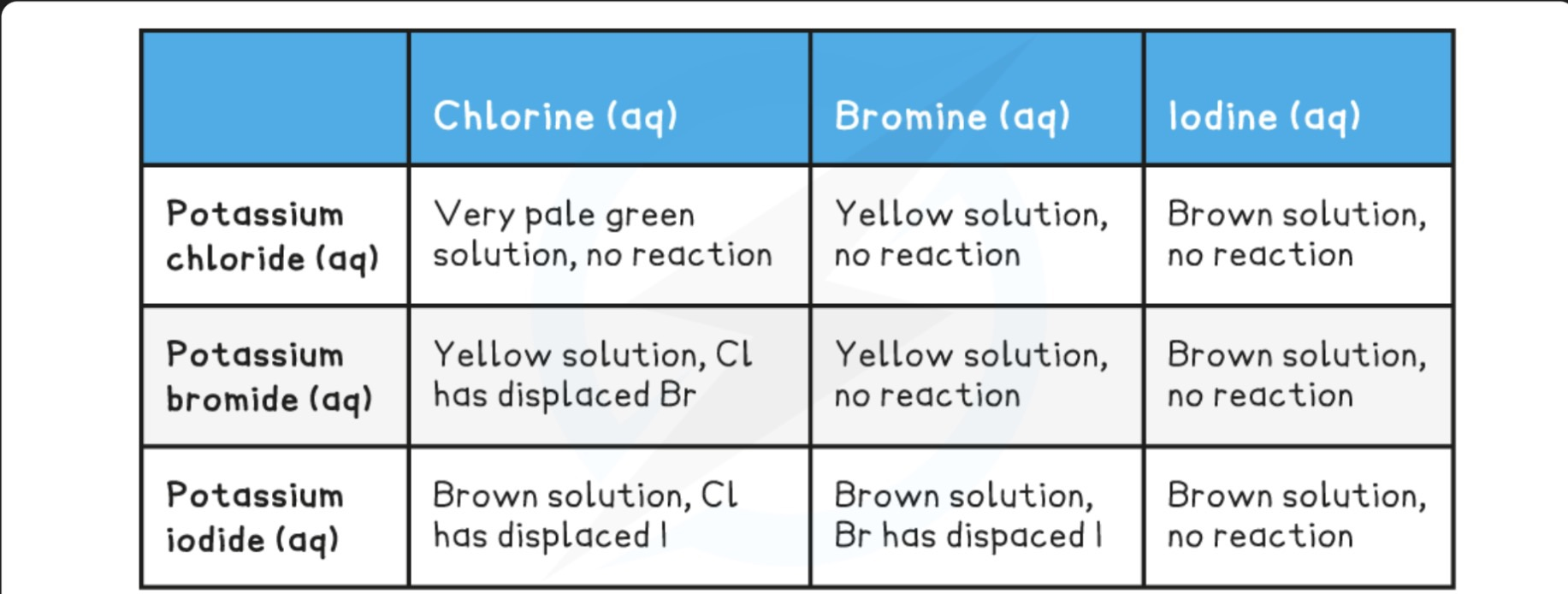
What are the colour changes for halogen displacement reactions in organic solution
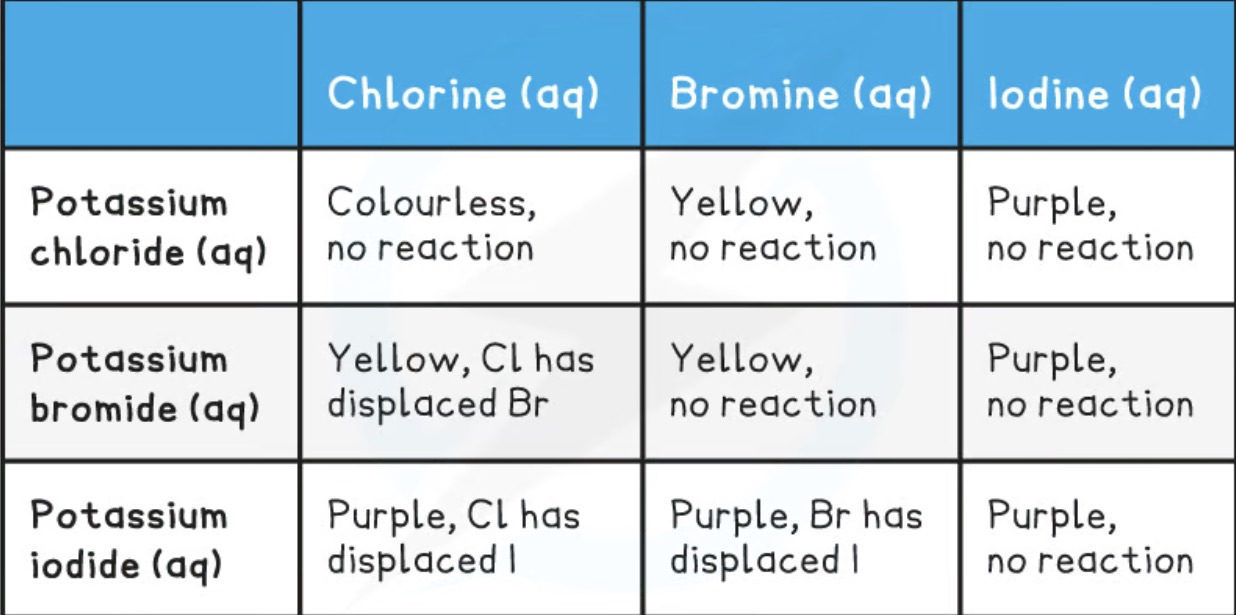
What is a disproportionation reaction
When the same element is both oxidised and reduced
What are the uses of chlorine
Chlorine + water → used to kill bacteria
Chlorine + water is a disproportionation reaction
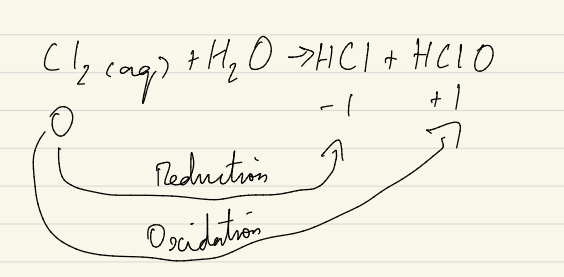
Oxygen is both reduced and oxidised
HCLO → sterilises water
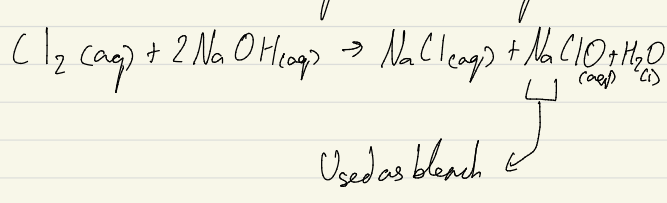
Chlorine + cold, dilute aqueous NaOH → produces NaClO → used as bleach
What is the test for Halide ions
Add silver nitrate
Chlorine → white precipitate
Bromine → Cream precipitate
Iodine → Yellow precipitate
Chlorine and Bromine precipitates look too similar
Add dilute ammonia
Chlorine’s white precipitate dissolves
Bromine’s cream precipitate does not dissolve
To confirm the cream precipitate is bromine
Add conc ammonia → dissolves
What is the test for carbonate ions
Add HCl
Fizzing/effervescense can be observed
Attach a delivery bung to the test tube and bubble it thru limewater → turns cloudy
Test for sulfate ions
Add Barium chloride
Forms Barium Sulfate → white precipitate
Test for ammonium ions
Add warm NaOH → forms ammonia gas
turns damp red litmus paper blue