10 - Acid and Bases
 Call Kai
 Learn
Learn Practice Test
 Spaced Repetition
 Match
Match Flashcards
 Knowt Play
1/76

Earn XP
Description and Tags
Proverbs 16:3
Name | Mastery | Learn | Test | Matching | Spaced | Call with Kai | Chat |
|---|
No analytics yet
Send a link to your students to track their progress
77 Terms
TRUE
[ACIDS AND BASES]
TRUE OR FALSE:
We need acid and bases sometimes for titration as titrants
TRUE
[ACIDS AND BASES]
TRUE OR FALSE:
There are some excipients that rely on their acidic or basic properties to import some effect.
TRUE
[ACIDS AND BASES]
TRUE OR FALSE:
For our Active Pharmaceutical Ingredient (API), our medicinal drugs are also weak acid and bases. Altering the basicity of a solution can make them ionized or unionized , which is almost the entire deal of pharmacokinetics
Arrhenius Acid
[ACIDS AND BASES]
Hydrogen ion donor
a. Arrhenius Acid
b. Bronsted-Lowry Acid
c. Lewis Acid
d. Arrhenius Base
e. Bronsted-Lowry Base
f. Lewis Base
TRUE
[ACIDS AND BASES]
TRUE OR FALSE:
An acid/base cannot be an acid/base just with the H⁺; it is just like the personality or trademark of an acid, but you must partner it with someone else.
![<p>[ACIDS AND BASES]</p><p>TRUE OR FALSE:</p><p class="ds-markdown-paragraph">An acid/base cannot be an acid/base just with the H⁺; it is just like the personality or trademark of an acid, but you must partner it with someone else.</p>](https://assets.knowt.com/user-attachments/d553c9dd-6cbc-4199-8f0e-72cef492ce7d.png)
Bronsted-Lowry Acid
[ACIDS AND BASES]
Proton donor
a. Arrhenius Acid
b. Bronsted-Lowry Acid
c. Lewis Acid
d. Arrhenius Base
e. Bronsted-Lowry Base
f. Lewis Base
Proton
[ACIDS AND BASES]
______ is the positively charged particle
Hydrogen
[ACIDS AND BASES]
This is the first element of the periodic table and has an atomic number of 1."
TRUE
[ACIDS AND BASES]
TRUE OR FALSE:
For a species to be called an atom (as opposed to an ion), it must have an equal number of protons and electrons, resulting in a neutral net charge.
TRUE
[ACIDS AND BASES]
TRUE OR FALSE:
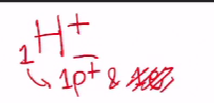
Proton refers to the H⁺. Remember, hydrogen has an atomic number of 1, which refers to the number of protons. When we say the word 'atom,' it means neutral, so we have to cancel that one proton with one electron. You know how to get the H⁺? You need to kick the electron out so that the proton will be left."
TRUE
[ACIDS AND BASES]
TRUE OR FALSE:
A proton (p⁺) is indeed synonymous as an H⁺ ion (a hydrogen atom that has lost its single electron).
Lewis Acid
[ACIDS AND BASES]
Electron acceptor
a. Arrhenius Acid
b. Bronsted-Lowry Acid
c. Lewis Acid
d. Arrhenius Base
e. Bronsted-Lowry Base
f. Lewis Base
Arrhenius Base
[ACIDS AND BASES]
Hydroxide donor
a. Arrhenius Acid
b. Bronsted-Lowry Acid
c. Lewis Acid
d. Arrhenius Base
e. Bronsted-Lowry Base
f. Lewis Base
Bronsted-Lowry Base
[ACIDS AND BASES]
Proton acceptor
a. Arrhenius Acid
b. Bronsted-Lowry Acid
c. Lewis Acid
d. Arrhenius Base
e. Bronsted-Lowry Base
f. Lewis Base
Lewis Base
[ACIDS AND BASES]
Electron donor
a. Arrhenius Acid
b. Bronsted-Lowry Acid
c. Lewis Acid
d. Arrhenius Base
e. Bronsted-Lowry Base
f. Lewis Base
Amphoteric
[ACIDS AND BASES]
_______ is a molecule or ion that can react both as an acid and as a base
TRUE
[ACIDS AND BASES]
TRUE OR FALSE:
Nonmetals have high electronegativity; therefore, that explains why nonmetals are acidic than metals because of their high attraction for electrons.
TRUE
[ACIDS AND BASES]
TRUE OR FALSE:
Electronegativity explains acidity
TRUE
[ACIDS AND BASES]
TRUE OR FALSE:
Metals are not electronegative; they can become positive, and positive is what we are looking for in an element that is basic.
TRUE
[ACIDS AND BASES]
TRUE OR FALSE:
Most of our acids and bases use water (aqueous solution) as the solvent.
TRUE
[ACIDS AND BASES]
TRUE OR FALSE:
If we isolate water molecules and think that they react or force them to react together, we will get a REVERSIBLE REACTION that we can gain two species.
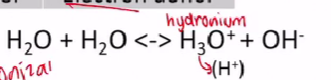
theoretical dissociation of water (H₂O ⇌ H⁺ + OH⁻).
[ACIDS AND BASES]
The Arrhenius definition was influenced by the______
Kw=1.00×10⁻¹⁴ (when converted to pKw=14 )
[ACIDS AND BASES]
Water dissociation constant (Autoionization constant)
Autoionization constant
[ACIDS AND BASES]
Water dissociation constant is also known as ______
0 to 14
[ACIDS AND BASES]
The standard pH and pOH ranges span from ______
7.0
[ACIDS AND BASES]
The standard pH and pOH ranges span from 0 to 14 (neutral point = ______ ).
TRUE
[ACIDS AND BASES]
TRUE OR FALSE:
In order to maintain the value of 14, pH and pOH must be inversely related.
TRUE
[ACIDS AND BASES]
TRUE OR FALSE:
Higher [H+] = lower pH / higher pOH = more acidic
TRUE
[ACIDS AND BASES]
TRUE OR FALSE:
Higher [OH−] = lower pOH / higher pH = more basic
Strong acid/base
[Classification of Acid and Bases based on Strength]
Enough to convert all reactants to 100% products (i.e. irreversible reactions, no equilibrium)
a. Strong acid/base
b. Weak acid/base
Strong acid/base
[Classification of Acid and Bases based on Strength]
Strong electrolytes
a. Strong acid/base
b. Weak acid/base
Strong acid/base
[Classification of Acid and Bases based on Strength]
Irreversible reactions
No equilibrium
a. Strong acid/base
b. Weak acid/base
Strong acid/base
[Classification of Acid and Bases based on Strength]
Do not have Ka and Kb
a. Strong acid/base
b. Weak acid/base
Strong acid/base
[Classification of Acid and Bases based on Strength]
Cannot be used for buffers
a. Strong acid/base
b. Weak acid/base
Strong Acids |
|---|
HCl — Hydrochloric |
HClO4 — Perchloric |
HBr — Hydrobromic |
HI — Hydroiodic |
HNO3HNO3 — Nitric |
H2SO4H2SO4 — Sulfuric |
[ACIDS AND BASES]
Most Commonly Known Example of Strong Acids
TRUE
[ACIDS AND BASES]
TRUE OR FALSE:
The more electronegative → the more acidic
TRUE
[ACIDS AND BASES]
TRUE OR FALSE:
The least electronegative → the more basic
Strong Bases |
|---|
LiOH — Lithium hydroxide |
NaOH — Sodium hydroxide |
KOH — Potassium hydroxide |
Ca(OH)2 — Calcium hydroxide |
Sr(OH)2 — Strontium hydroxide |
Ba(OH)2 — Barium hydroxide |
[ACIDS AND BASES]
Most Commonly Known Example of Strong Bases
Weak acid/base
[Classification of Acid and Bases based on Strength]
Did not make 100% products and has leftover reactants
a. Strong acid/base
b. Weak acid/base
Weak acid/base
[Classification of Acid and Bases based on Strength]
Weak electrolytes
a. Strong acid/base
b. Weak acid/base
Weak acid/base
[Classification of Acid and Bases based on Strength]
Has reversible reactions
Has equilibrium
a. Strong acid/base
b. Weak acid/base
Weak acid/base
[Classification of Acid and Bases based on Strength]
Have Ka and Kb
a. Strong acid/base
b. Weak acid/base
Weak acid/base
[Classification of Acid and Bases based on Strength]
Have the eligibility to have buffers
a. Strong acid/base
b. Weak acid/base
conjugates
[ACIDS AND BASES]
Many weak acids and bases following the Bronsted-Lowry definition give rise to _______
TRUE
[ACIDS AND BASES]
TRUE OR FALSE:
The strength of an acid/base depends on the stability of its conjugate, because if the conjugate is stable, it may not want to go back.
TRUE
[ACIDS AND BASES]
TRUE OR FALSE:
The strength of a base depends on the stability of the conjugate acid
TRUE
[ACIDS AND BASES]
TRUE OR FALSE:
The strength of an acid depends on the stability of the conjugate base.
Conjugate bases
Conjugate acids
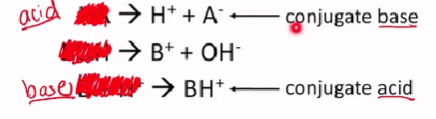
[CLUE]
To identify the Conjugate Acid / Base
A- + H → ____
B + H+ → _____
a. Conjugate acids
b. Conjugate bases
TRUE
[ACIDS AND BASES]
TRUE OR FALSE:
Acids can remove H+ to become conjugate bases
Conjugate bases
[ACIDS AND BASES]
The Acid which become negative after kicking the H+ is called _____
a. Conjugate acids
b. Conjugate bases
Conjugate acids
[ACIDS AND BASES]
The base after absorbing the proton is called ______
a. Conjugate acids
b. Conjugate bases
Conjugate bases
[ACIDS AND BASES]
Gives rise to the acid dissociation constant (Ka) and its corresponding pKa
a. Conjugate acids
b. Conjugate bases
TRUE
[ACIDS AND BASES]
TRUE OR FALSE:
Bases can receive H+ to become conjugate acids
Conjugate acids
[ACIDS AND BASES]
Gives rise to the base dissociation constant (Kb) and its corresponding pKb
a. Conjugate acids
b. Conjugate bases
TRUE
[ACIDS AND BASES]
TRUE OR FALSE:
Buffers involve a combination of a weak acid/base and their conjugate
FALSE
📌Rationale: Strong acids/bases dissociate completely, so their conjugates are too weak to resist pH changes. Buffers require weak acids/bases and their conjugates.
[ACIDS AND BASES]
TRUE OR FALSE:
Buffer is a mixture of a strong acid and its conjugate base, or a mixture of a strong base and its conjugate acid.
TRUE
[ACIDS AND BASES]
TRUE OR FALSE:
Buffer is a mixture of a weak acid and its conjugate base, or a mixture of a weak base and its conjugate acid.
Buffers
[ACIDS AND BASES]
________ is a mixture that resist changes in pH , meaning if I add an acid /base you don’t expect the pH to immediately change
Buffers
[ACIDS AND BASES]
They withstand drastic changes in pH
TRUE
[ACIDS AND BASES]
TRUE OR FALSE:
Whether something is "weak" or "strong" depends on how much the reaction favors the products.
TRUE
[ACIDS AND BASES]
TRUE OR FALSE:
In the reaction below, the products are the proton (H+) and conjugate base (A-):
HA ↔ H+ + A-
Thus, the more stable the conjugate base is, the more the product side is favored (= more protons = more acidic).
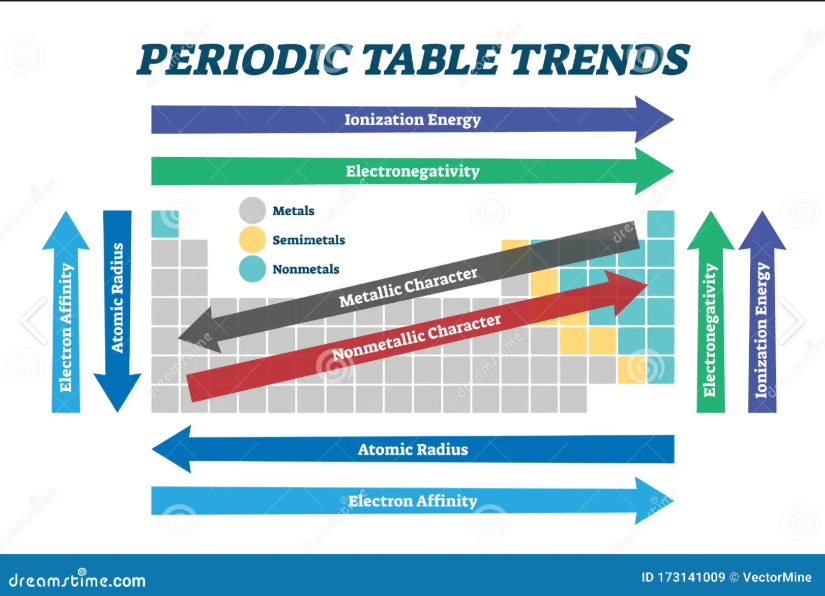
[ACIDS AND BASES]
Periodic Table Trend:
left to right
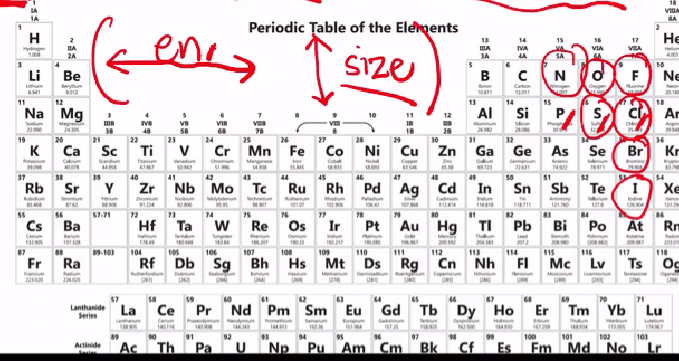
[ACIDS AND BASES]
Acidity increases from ______ by virtue of electronegativity because electronegative atoms more readily carry the conjugate base's negative charge. (thus, more stable).
Example: HCl>H2S
a. left to right
b. right to left
conjugate base's negative charge
[ACIDS AND BASES]
Acidity increases from left to right by virtue of electronegativity because electronegative atoms more readily carry the ______ (thus, more stable).
![<p>[ACIDS AND BASES]</p><p>Acidity increases from left to right by virtue of electronegativity because electronegative atoms more readily carry the ______ (thus, more stable).</p>](https://assets.knowt.com/user-attachments/8fb8d079-42d9-4245-82c9-4c3245021231.png)
top to bottom
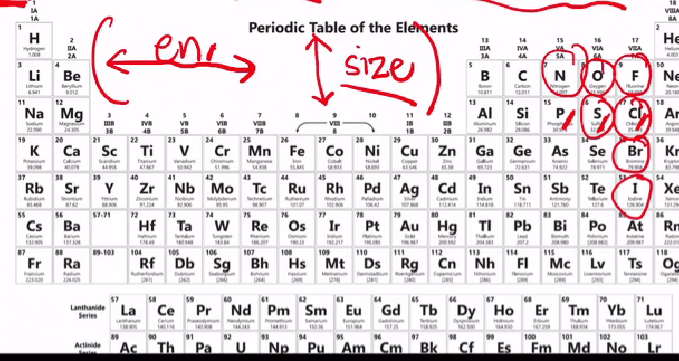
[ACIDS AND BASES]
Acidity increases from ______ by virtue of atomic size because the electrons are more scattered in larger atoms (which means less repulsions, thus, more stable).
Example:
HI > HBr > HCl > HF
H2S > H2O
a. top to bottom
b. bottom to top
less repulsions
more stable
[ACIDS AND BASES]
Acidity increases from top to bottom by virtue of atomic size because the electrons are more scattered in larger atoms which means less _______ , thus, more ______
![<p>[ACIDS AND BASES]</p><p>Acidity <strong>increases from top to bottom</strong> by virtue of atomic size because the electrons are more scattered in larger atoms which means less _______ , thus, more ______</p>](https://assets.knowt.com/user-attachments/9356070c-0234-4d7d-9f16-585180ea9ebb.png)
Acid
[ACIDS AND BASES]
Sour taste
a. Acid
b. Base
Base
[ACIDS AND BASES]
Bitter taste
a. Acid
b. Base
Base
📌NOTE: Soap is classified as a base. It is formed through the saponification process, where fats or oils react with a strong base (like sodium hydroxide) to create soap salts.
[ACIDS AND BASES]
Soap
a. Acid
b. Base
Acid
[ACIDS AND BASES]
Low pH means below 7.0
a. Acid
b. Base
Base
[ACIDS AND BASES]
High pH means above 7.0
a. Acid
b. Base
Acid
[ACIDS AND BASES]
Litmus - red
a. Acid
b. Base
Base
[ACIDS AND BASES]
Litmus - blue
a. Acid
b. Base
Acid
[ACIDS AND BASES]
Phenolphthalein - colorless
a. Acid
b. Base
Base
[ACIDS AND BASES]
Phenolphthalein - pink
a. Acid
b. Base
Acid
[ACIDS AND BASES]
Methyl orange - red
a. Acid
b. Base
Base
[ACIDS AND BASES]
Methyl orange - yellow
a. Acid
b. Base