Crisis, Socrates, Aristotle, Plato Week 9
 Call Kai
 Learn
Learn Practice Test
 Spaced Repetition
 Match
Match Flashcards
 Knowt Play
1/58

There's no tags or description
Looks like no tags are added yet.
Name | Mastery | Learn | Test | Matching | Spaced | Call with Kai |
|---|
No analytics yet
Send a link to your students to track their progress
59 Terms
Economic consequences after Peloponnesian war
Disruption of farming and commerce
High death toll
Whole cities destroyed
Enmity and mistrust
The March of the 10,000 (aka. Anabasis)
Autobiography by Xenophon
What is the March of the 10 000 (summary)?
The retreat of 10 000 greek mercenaries after a failed revolt due to death of Cyrus
What happened in the March of the 10 000 (detailed)?
Persian Prince, Cyrus, hired thousands of Greek mercenaries to help him overthrow his brother, King Artaxerxes II.
The revolt failed and Cyrus died in battle which caused his Greek army to be stranded in the Persian Empire
Xenophon led the army back home to the black sea through a treacherous route (hence the march back)
What did this March of 10 000 symbolize?
Showed that if Greeks set aside their differences, they could be very strong and fight against Persia
What is a mercenary?
Soldier who fights for payment rather than loyalty to a country
Spartan policy throughout Greece
What are Dearchies?
Dearchies: ten (30 in Athens) pro-Spartan, but Athenian, officials designed to ensure oligarchy government and loyalty to sparta
Created camps of Garrison
What is a Garrison?
Group of soldiers who enforce laws and authority
The 30 Tyrants in Athens
Abused their power
What happened between Theramenes and Critias (two of the 30 tyrants)?
Theramenes criticized Critias policies
Critias called for trial but then executed Theramenes by forcing him to drink hemlock
What happened to the 30 tyrants after this event?
An attempt to retake Athens was made
In the process, Critias (“leader” of the thirty) was killed
How were the tyrants driven out of power?
The rulers were so brutal that throughout Greece, people harbored sympathy for the Athenian exiles and they were driven out of power
What is amnesty and its relation to the thirty tyrants?
A political decision where a state agrees to forgive past political crimes
Many Athenians were suing other Athenians who helped the tyrants in any form if they had suffered from loss
The Trial of Socrates
Why were the true/deeper reasons as to why 3 Athenians wanted to put Socrates on trial?
Some of his former students were linked to the harming Athens
He identified drawbacks in democracy
What did the three Athenians claim against Socrates to put him on trial?
He did not believe in the gods of the state
He taught new gods
He corrupted the young
How did Socrates' trial end?
The accusers proposed death penalty and Socrates proposed he receive the highest honours as reward for his benefactions, or a small fine
Many voted for execution and he died by drinking hemlock
The Corinthian War
Who fought in the Corinthian war?
Thebes, Corinths, Athens (and Persia) vs Sparta
Why did the Corinthian war start?
Greek states became unhappy with Sparta's harsh control of Greece and wanted to resist sparta
What is the Kings Peace?
Persian King, Artaxerxes, imposed terms to end the war
Greeks cities in Asia minor were recognized as belonging to persia
Each greek city state was now autonomous (self governing)
What is the Second Athenian League?
Athens allied w/ Thebans for mutual protection against sparta
Established a new naval confederacy known as the second athenian league
What was a mercenary's role in this period?
Military manuals were developed \
mercenaries, often trained military commanders, would be hired to train soldiers
What innovation did hiring mercenaries in this time period create?
Phalanx tactics were evolving
What is the Peltast?
Someone who used missiles for fighting
Would use a bow and arrow/ javelin/ and would be lightly armed
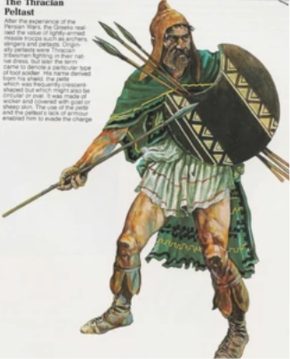
Who does Persia support in the battle between Sparta vs Athens and Thebes?
Sparta
What battle ended Spartan dominance over greece?
The battle of Leuktra
What helped Thebes win the Battle of Leuktra?
Developed new phalanx tactic
Incredibly successful during battle of leuktra
What happened to the helots after the Spartans lost the battle of leuktra?
Helots successfully gained freedom
Sparta went into massive decline
Why do federations collapse and the 2nd Athenian League dissolves?
Greeks no longer trust one another
Document 9.1 - A Democratic Decree at Eretria
An example of a democratic assembly decreeing itself into economic difficulties in Eretria
Example of how direct democracy could create financial strain because citizens made decisions collectively, even when those decisions were unrealistic.
Decree: official decision made by the government
How did discasteries function?
Male citizens over the age of 30
Jurors chosen by lot from those who volunteered
Odd number of dicasts to prevent a tie (201, 501, etc.)
Secret ballot
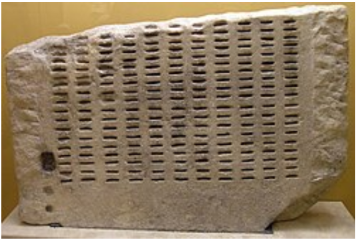
What is this?
Kleroterion
An allotment device used to randomly assign jurors to law courts
How was time observed in trial cases?
Minutes were measured out by a klepsydra aka water clock
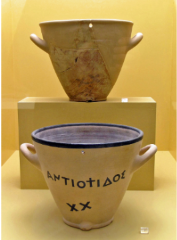
Document 9.2 - Disability at Athens
Athens offered a pension to disabled soldiers
The speaker in this particular context was denied the continuance of his benefits because he had his own shop and could ride a horse (compared to a mule which poor people rode)
Stasis definition
Term used to describe civil war
Means that society is “frozen” (nothing is getting done because they are fighting)
How were marginalized workers put in the economy?
Commerce and banking was put in the hand of slaves, ex slaves and metics due to lack of manpower
Who is Nicarete?
A formerly enslaved person who purchased young girls from slaveholders and trained them for the life of a prostitute
She owned Neaera
What is the story of Neaera?
She was purchased from Nicarete to be an enslaved labourer
Was offered opportunity to buy her freedom
She then moved to athens and got married
Pretended to be an Athenian citizen
Apollodorus, an enemy of her husband, brought her to trial for pretending to be a citizen
Outcome of trial is unknown
Who popularized the term philosophizing?
Socrates
Who is the student of Socrates?
Plato, an aristocrat
Why did Plato leave Athens?
Because Socrates died
What is the Academy?
A school founded by Plato
Named after the greek hero Academus
Refers to “Higher Learning”
What is the theory of forms?
Plato's idea that perfect, eternal realities (Forms) exist beyond the physical world, while the objects we see around us are imperfect copies of those Forms.
Example: a circle
You can draw a circle, but:
It will never be perfectly round.
There will always be tiny imperfections.
Yet you understand what a perfect circle is.
Plato argued that this perfect circle exists as a Form, while every drawn circle is just an imperfect copy.
What is the Allegory of the Cave?
describes prisoners chained inside a cave who can only see shadows on a wall. They believe the shadows are reality because they have never seen anything else. One prisoner escapes and discovers the outside world, realizing that the shadows were only illusions. When he returns to tell the others, they reject and mock him.
Supposed to describe the job of a philosopher and why philosophy matters
What is the Socratic Method?
A form of questioning used by Socrates to challenge assumptions and guide people toward clearer and more accurate understanding of ideas.
Raise a question, get an answer, critique the answer
Constantly refining your thinking
Why is Socrates wiser than everyone else?
He knows that he knows nothing
What did Socrates believe about good and evil?
Believed that evil did not exist
He believes that no one intentionally does something bad
What is the important question from Euthyphro
-> What is piety?
Is the pious or holy beloved by the gods because it is holy, or holy because it is beloved of the gods? AKA is something good because the gods approve it or do the gods approve it because it is good?
Why are Euthyphro and Socrates outside of Athenian court?
Euth. is there for prosecuting his father for murder
Socrates is on trial for impiety
What does Socrates respond with to every answer of Euthyphros to this question?
He challenges every answer
What is impiety? What is piety?
Disrespect towards gods or religion
Showing respect/praying to gods
Who is Aristotle?
Student of Plato in the Academy
What institution Aristotle find?
His own institution called the Lyceum
What is taxonomy?
To classify
Aristotle driven
What are the 4 ways to define something according to Aristotle?
What is its form?
What is it made of?
What purpose does it serve?
Who or what caused it?
He believes there are many definitions for one object
What does telos mean? What is teleology?
Purpose
The study of discovering the purpose of various things
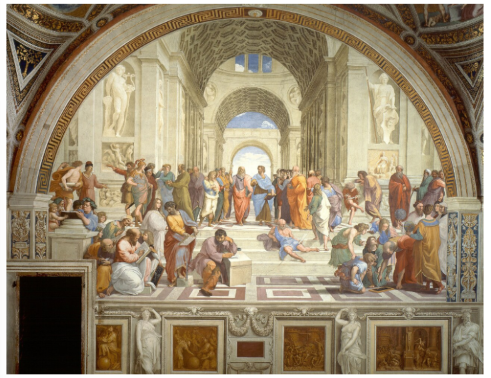
What is this painting called?
The School of Athens
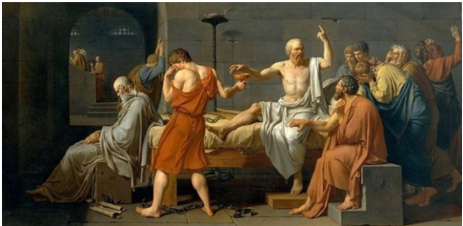
What is this painting depicting?
Trial of Socrates
Document 9.3 - Socrates on the Guardians
In the Republic, Socrates and Glaucon discuss guardians of the ideal city. Socrates argues that women are generally physically weaker but not naturally inferior, so they can also become guardians if they receive the same training as men.
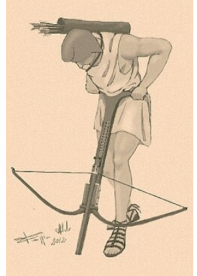
What is this device?
Gastraphetes: military innovation deployed by ruler of Syracuse
Document 9.4 - Diodorus on Dionysius II of Syracuse
Diodorus of Siciliy didn’t like Dionysus but admired his energy and determination
He recounts the eagerness with which workmen tried to make the best contributions to the war effort
Also stresses the force of Dionysius personality