Evolutionary Bio Final
 Call Kai
 Learn
Learn Practice Test
 Spaced Repetition
 Match
Match Flashcards
 Knowt Play
1/18

There's no tags or description
Looks like no tags are added yet.
Name | Mastery | Learn | Test | Matching | Spaced | Call with Kai |
|---|
No analytics yet
Send a link to your students to track their progress
19 Terms
What are the different categories in the hierarchical taxonomic classification system?
Domain= Dear
Kingdom= King
Phylum= Philip
Class= Came
Order= On
Family= Five
Genus= Guys
Species= Simultaneously
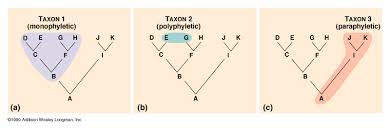
Monophyletic, Paraphyletic, Polyphyletic:
Monophyletic: Most recent common ancestor and ALL of its descendants
Paraphyletic: Most recent common ancestor but excludes SOME of descendants
Polyphyletic: A group that NOT include most recent common ancestor
-any group at any level can be referred to as a taxon
Cladogram and phylogram:
Cladogram: shows branching patterns
Phylogram: shows rate of evolutionary changes
Homologous and Analogous:
Homologous: appears once in phylogeny and is shared due to common ancestry
Analogous: appears multiple times in phylogeny and similar due to convergent evolution
Sex paradox and its challenges and benefits:
- sexual reproduction is more common than asexual reproduction even though from the perspective of selective it would be greatly more inefficient
Challenges:
-only 50% of your genes get passed down
-finding a mate isn’t promised and costs time and energy
-cost of sex, meaning asexual reproduction produces more offspring than sexual reproduction
-two fold cost of sex: sexual population grow half the rate than an asexual population
Benefits:
-Genetic variation
-better defense against diseases
-cancels out or removes harmful mutation
-adaption occurs faster
Mullers ratchet:
In asexually reproducing organisms there is a steady and irreversible accumulation of deleterious (harmful) mutations that can reduce fitness in the population and will keep collecting more without removing or cancelling them out
Fisher muller hypothesis:
Sex allows advantageous alleles that arise in different individuals to be combined into the same individual (accelerates adaptive evolution)
-recombination can bring together beneficial mutations
Red queen hypothesis:
Populations must constantly adapt and evolve to survive while pitted against co-evolving species (evolutionary arms race)
-asexual populations a4e more prone to go extinct since generate genetic variation and fend off certain environmental threats/adapt
Sexual reproduction:
A form of natural selection that acts on an organisms ability to successfully obtain a mate and reproduce
Why is reproductive success is generally more variable in males than females?
Anisogamy: females produce larger and fewer gametes (eggs) made for lasting long while males produce smaller and lots of gametes (sperm)
-females put a lot of energy into reproduction and are limited biologically
-males do not put as much energy and are limited to how many mates they can reproduce with
-many males have few mates with low reproductive success, while few have lots of mates and have high reproductive success
What is intrasexual and intersexual and some examples?
Female: choosing males who appear more fit (indirect benefit) or contribute more resources (direct benefit) for reproduction (intersexual selection)
-resource acquisition (nuptial gifts): providing females with resource to increase reproductive success
-resource acquisition (sexual cannibalism): female consumes males to increase reproductive success
-good genes: females choose males who look better to produce “sexy sons”
-sensory bias: females choose a certain male that develops a preference she already had (choosing a orange colored male because it looks like food, which is something that attracts her)
-runaway sexual selection: male trait and female preference create a cycle of creating offspring with these aspects even if it is harmful
Male: competes with other males to gain access to and reproduce with more females (intrasexual selection)
-intimidation and direct combat
-infanticide: male kills infant that aren’t their own to increase reproductive success
-Mating plugs, sperm scoops, sperm competition: stops rival sperm from entering females, remove or displace rival sperm, sperm competes to fertilize egg
-sneakers an impersonators: males will sneak or impersonate to gain reproductive success
How does conflicting male and female fitness strategies lead to sexual dimorphism within a population?
Female: choosing males who appear more fit or contribute more resources for reproduction (intersexual selection)
Male: competes with other males to gain access to and reproduce with more females (intrasexual selection)
-in order to compromise with these different desired fitness strategies for both sexes, through sexual selection they diverge to produce sexual dimorphism to increase their OWN fitness
Reasons for female choice:
Direct benefits: females benefit from increased nutrition, provisioning, or parental care that increases reproductive output or quality of offspring
-Indirect benefits: females benefit by choosing genetically superior mates that produce fitter offspring (“good genes” hypothesis) or choosing attractive mates who will pass on preferred phenotypes to male offspring (“sexy sons” hypothesis)Intersexual Selection
Female choice leads to runaway sexual selection because…
when a preference for a male trait and the trait itself become genetically linked and start reinforcing each other over generations
-female offspring inherit preference for certain traits
-make inherits that trait
-they both benefit and this “runs away” by being reinforced throughout generations even if it is costly for survival
What is the “species problem” (ontological versus epistemological)?
Ontological: What is a species? (Reality)
Epistemological: How do we know ( recognize) a species? (Method)
Phenetic Species:
A species is the smallest group of organisms distinguished by a set of observable phenotypic features
Problems: is arbitrary and not always repeatable
Phylogenetic species:
a species is the smallest monophyletic group distinguished by unique, shared evolutionary traits.
Problem: it can be arbitrary, unrepeatable, and result in over splitting
Biological species concept:
a species is a group of populations whose members:
• have the potential to interbreed in nature
• produce viable, fertile offspring
• do not produce viable, fertile offspring with members of other such groups
Problem: emphasizes gene flow and reproductive isolation
Prezygotic and postzygotic barriers:
Prezygotic: Two species that occupy different habitats within the same area rarely if ever encounter each other (no mating, habitat isolation)
Postzygotic: