8- control of heart rate in mammals
 Call Kai
 Learn
Learn Practice Test
 Spaced Repetition
 Match
Match Flashcards
 Knowt Play
1/14

There's no tags or description
Looks like no tags are added yet.
Name | Mastery | Learn | Test | Matching | Spaced | Call with Kai |
|---|
No analytics yet
Send a link to your students to track their progress
15 Terms
Why is the heart called myogenic?
Because each heart beat is initiated by the sinoatrial node (SAN) in the heart itself, not by nerve impulses from the CNS.
Cardiac output (the volume of blood flowing out of the heart each minute)=
heart rate x stroke volume
What does the central nervous system control (in relation to the heart)?
It doesn’t initiate heartbeats but it regulates the cardiac output of the heart by controlling both the heart rate and the stroke volume.
The cardiac output is not maintained at a constant level, but it is actively changed by the CNS in order to maintain other factors (e.g. blood pressure and blood gas concentration) at a constant level.
How does the cardiac centre also change the stroke volume by controlling blood pressure?
It can increase the stroke volume by sending nerve impulses to the arterioles to cause vasoconstriction, which increases blood pressure so more blood fills the heart at diastole.
But it can decrease the stroke volume by causing vasodilation and reducing the blood pressure.
What part of the brain controls heart rate?
A part of the medulla oblongata called the cardiac (or cardiovascular) centre.
The cardiac centre can send impulses to the SAN of the heart either through sympathetic neurones or parasympathetic neurones.
What do impulses which travel through the sympathetic neurone release and trigger?
They release the neurotransmitter noradrenaline at the SAN, which cause the heart rate to increase.
What do impulses which travel through the parasympathetic neurone release and trigger?
They release the neurotransmitter acetylcholine at the SAN, causing the heart rate to decrease.
How are changes in arterial blood pressure detected?
By the stretch receptors in the wall of certain arteries called baroreceptors.
The baroreceptors are found in the walls of the aortic arch as it leaves the heart and in the walls of the carotid arteries as they enter the head.
What happens when blood pressure increases?
The artery wall is stretched which is detected by the baroreceptors.
Which send more frequent impulses through sensory neurones to the cardiac centre.
The cardiac centre then sends impulses through the parasympathetic neurones to the SAN of the heart to reduce the heart rate.
The cardiac centre also sends impulses through the parasympathetic neurones to arterioles around the body, causing them to dilate.
These responses both reduce blood pressure and is an example of a called the baroreflex.
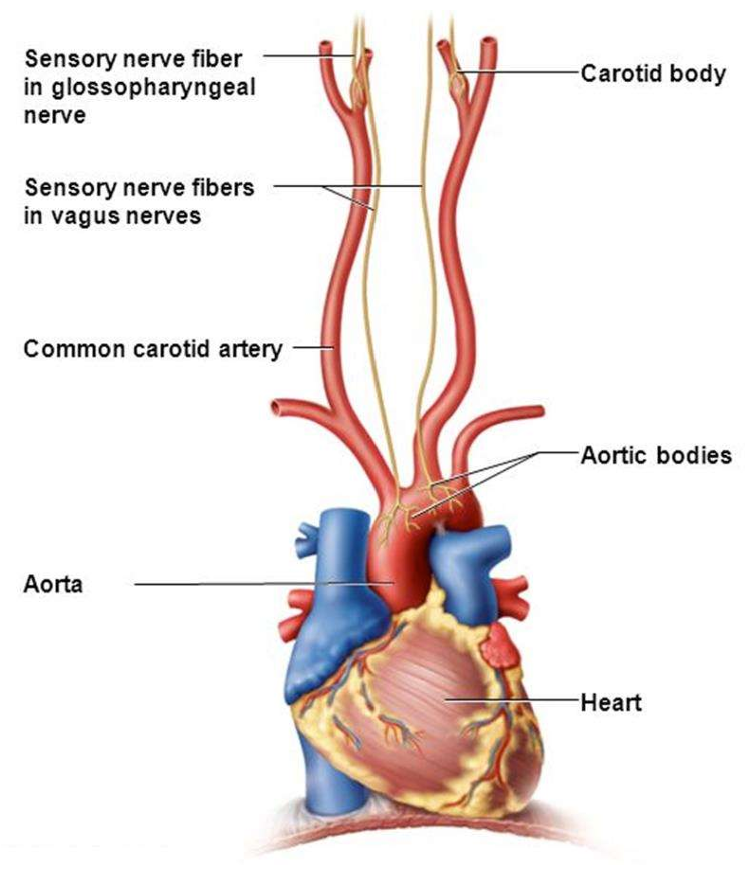
What receptors detect pH changes and where are they found?
Chemoreceptors found in the aortic and carotid bodies.
What happens (in relation to blood gas homeostasis) during exercise?
Exercise.
More cellular respiration in muscles.
Low blood pH.
Detected by chemoreceptors in aortic and carotid bodies.
Impulses to cardiac centre.
Sympathetic impulses to sino-atrial node.
Increased heart rate.
Another part of the medulla called the ventilation centre, controls the breathing rate and causes it to increase during exercise. Which helps to provide more oxygen for the muscles to respire.
Explain what happens in response to stress.
The stimulus is detected and the response is coordinated by the cerebral cortex, which send impulses through the sympathetic system to various organs, especially the adrenal glands.
Once the adrenaline is secreted the SAN responds to it by increasing the heart rate.
Arterioles respond to adrenaline by constricting.
Which increases the blood pressure.
Which also increases the heart stroke volume.
The cardiac centre in the medulla responds by increasing the frequency of sympathetic impulses to the heart.
These responses to adrenaline also allows faster respiration and contraction by skeletal muscles.
What does excretion mean?
The removal of metabolic waste products from cells.
What are the five important excretory organs in humans?
Skin
Lungs
Liver
Gut
Kidneys
What do the five important excretory organs secrete?
Skin- excretes sweat, containing water, ions and urea.
Lungs- excrete carbon dioxide and water.
Liver- excretes bile, containing bile pigments, cholesterol and mineral ions.
Gut- egested gut mucosa cells, water and bile in faeces (egested instead of excreted because the bulk of faeces comprises plant fibre and bacterial cells, which have never been absorbed into the body).
Kidneys- excrete urine, containing urea, mineral ions, water and other toxins from the blood.