ARCH249 exam 3
 Call Kai
 Learn
Learn Practice Test
 Spaced Repetition
 Match
Match Flashcards
 Knowt Play
1/61

There's no tags or description
Looks like no tags are added yet.
Name | Mastery | Learn | Test | Matching | Spaced | Call with Kai |
|---|
No analytics yet
Send a link to your students to track their progress
62 Terms
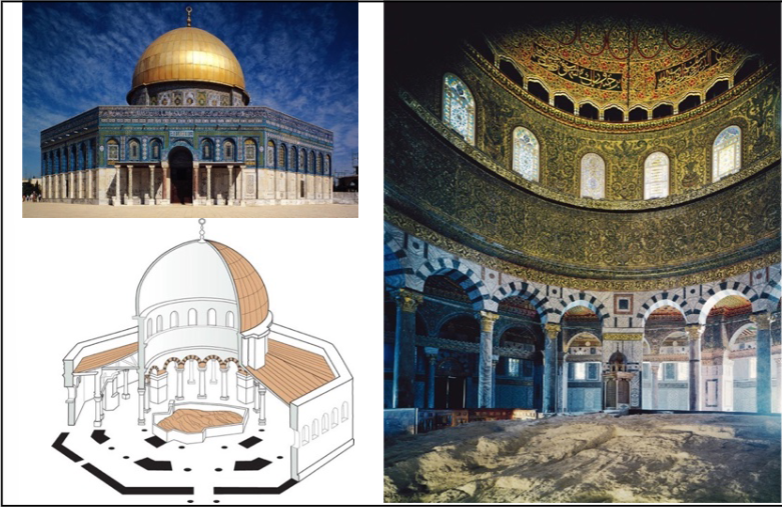
Dome of Rock
Jerusalem, Israel
Where is the Dome of the Rock? Why is that location so significant for three major religions (Islam, Christianity, Judaism)?
Judaism: site of the First and Second Temples, most sacred location
Christianity: closely tied to events in Jerusalem central to Jesus’ life and early Christian history
Islam: believed to be where Prophet Muhammad ascended to heaven during the Night Journey
What is the architectural form of the Dome of the Rock?
What are some architectural precedents that are related to this form?
What is culturally significant about the choice of this type of building?
octagonal building with a central dome over a rock, a classic central-plan shrine.
Precedents:
Byzantine martyria (central shrines over holy relics)
Roman domed mausolea and churches like the Holy Sepulchre tradition
Cultural significance: It adopts a familiar sacred building type but gives it Islamic meaning, asserting Islam’s presence in Jerusalem and linking it to earlier Abrahamic traditions.
How does the interior and exterior decoration of the Dome of the Rock compare and/or contrast with Early Christian and Byzantine architectural decoration?
Or with Buddhist and Hindu architectural decoration?
Compared to Early Christian/Byzantine:
Similar: rich, shimmering decoration (like mosaics in churches such as Hagia Sophia)
Different: Islamic design avoids figural imagery, using calligraphy and geometric/vegetal patterns instead of saints or Christ
Compared to Buddhist/Hindu architecture:
Similar: highly decorative, symbolic surfaces that create a sacred, immersive space
Different: Buddhist/Hindu art often includes human and divine figures, while the Dome of the Rock uses non-figurative ornament and text only
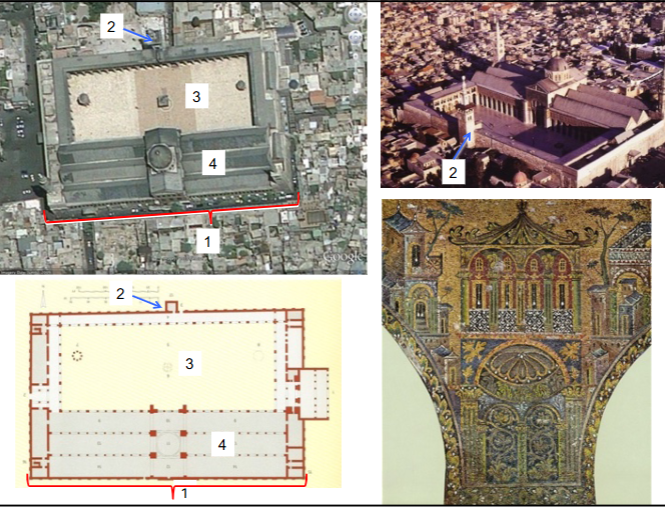
What are the main types of mosque plans we studied?
What are the common architectural elements? What are the architectural precedents and sources of inspiration of each type?
Hypostyle: column hall
Four-iwan: courtyard with vaulted halls
Central dome: unified domed space
Common features: mihrab, minbar, courtyard, minaret, dome.
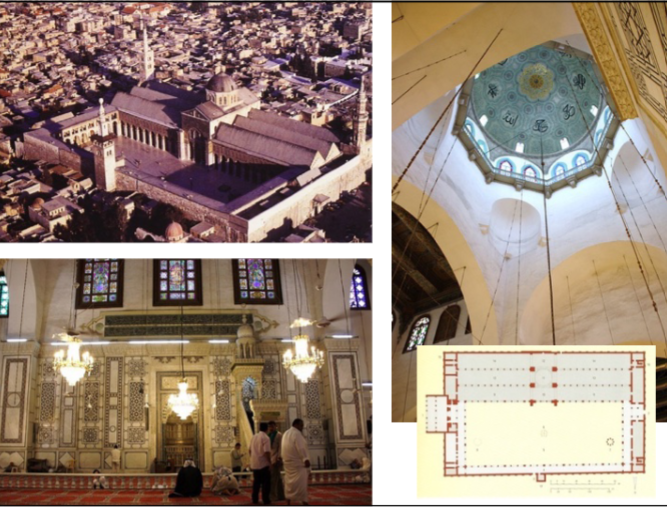
great Mosque
Damascus, Syria
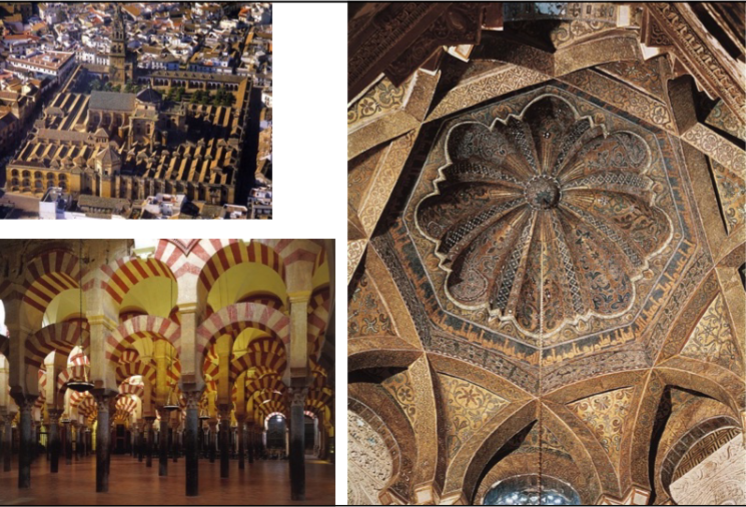
Great Mosque
Cordoba, Spain
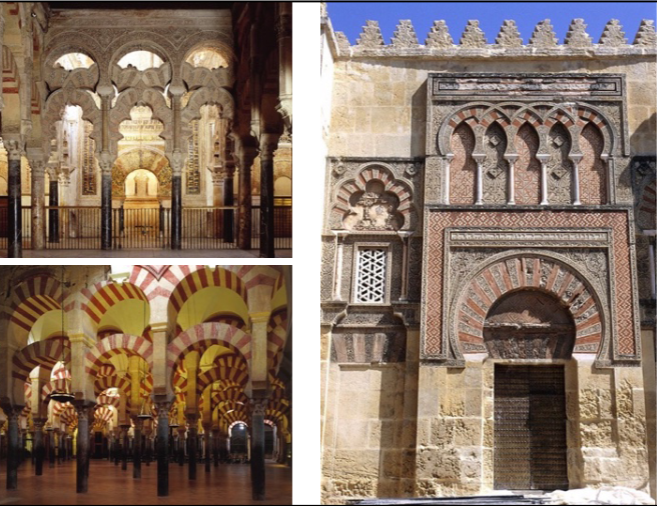
Great Mosque Chapel
Cordoba, Spain
Using the Great Mosque of Damascus as a model, identify and EXPLAIN the function and significance of each element: minaret, sahn, courtyard fountain, hypostyle prayer hall, qibla wall, mihrab, mirhab dome.
Minaret: calls to prayer
Sahn: courtyard for gathering/prayer
Fountain: washing before prayer
Hypostyle hall: columned prayer space
Qibla wall: faces Mecca
Mihrab: niche showing direction
Mihrab dome: highlights the mihrab as focal point
What is a maqsura?
screened or enclosed space near the mihrab in a mosque, originally reserved for the ruler or elite to pray safely.
Explain the architectural and decorative forms of the mihrab dome at the Great Mosque at Cordoba:
What engineering device is used to support the dome (pendentive or squinch)?
Who were the artists who created the mosaics that decorated the dome?
How does the inscription (calligraphy) depicted in the dome relate to the decorative brickwork we studied at the Theotokos church at the Monastery of Hosios Loukas in Greece?
Hagia Sophia dome:
Supported by pendentives (curved triangular supports). Hagia Sophia
Mosaic artists:
Created by anonymous Byzantine workshop artists (court-sponsored craftsmen).
Inscription vs. Hosios Loukas:
Both use calligraphy/ornament as decoration, blending text and pattern into architectural design (like the brick patterns at Monastery of Hosios Loukas).
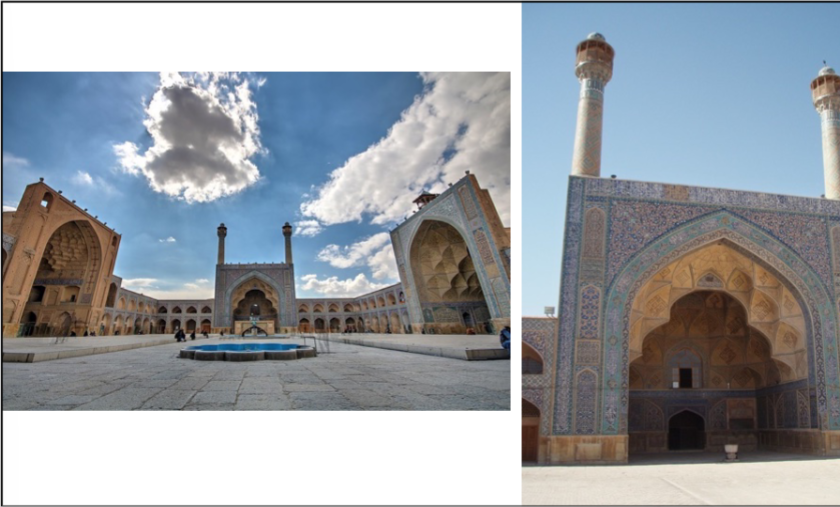
Friday Mosque
Isfahan, Iran
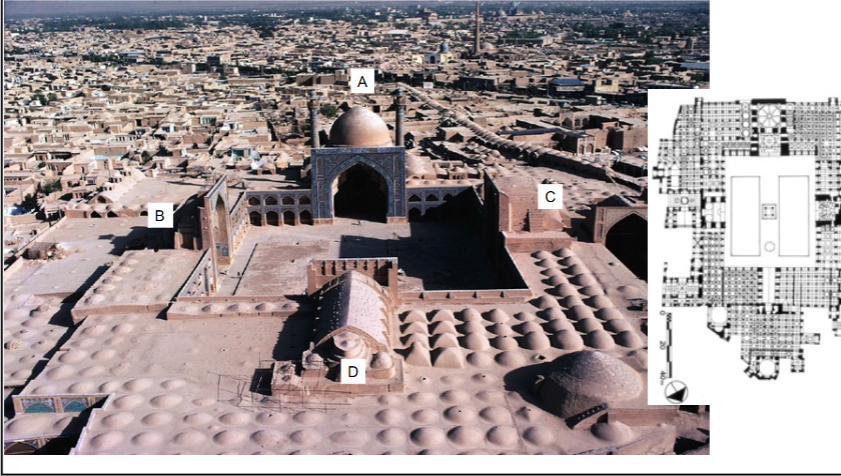
How is an “iwan” plan mosque different from a hypostyle-plan mosque?
What is an iwan?
Using the Friday Mosque at Isfahan as an example, how can we tell which iwan points toward Mecca?
Hypostyle: large prayer hall filled with rows of columns
Iwan plan: courtyard-centered with large vaulted halls (iwans) on each side (A vaulted space open on one side to a courtyard.)
The south iwan is the qibla iwan—it faces Mecca and is usually largest, most decorated, and aligned with the mihrab
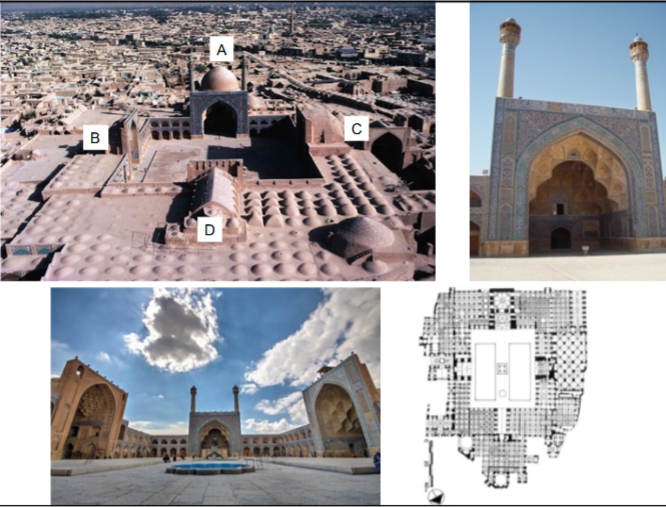
What are "muqarnas" both in architectural and decorative terms?
A form of Islamic architectural decoration made of stacked, niche-like geometric units that create a honeycomb or stalactite effect.
Architecturally: They are used to transition between structural elements (like a square room and a dome).
Decoratively: They serve as intricate surface ornament that breaks up light and space into complex, patterned forms, often in domes, arches, and entrances
What are some of the Byzantine influences on Islamic architecture in Iran?
Turkey?
Byzantine influence (Iran & Turkey): Domes, arches, and large interior spaces and rich decorative surfaces (mosaics/tilework)
Turkey: direct influence from Hagia Sophia → big domes + central plans
Iran: more blended with Persian styles, but still uses domes and ornate interiors
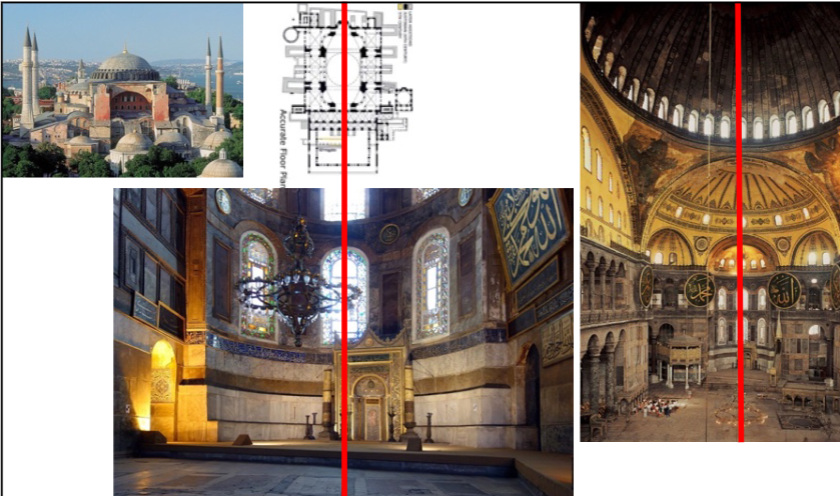
What modifications were made to the Hagia Sophia that allowed it to function as a mosque after the Ottoman conquest of Constantinople in 1453?
Added a mihrab (to indicate direction of Mecca)
Added a minbar (pulpit for sermons)
Built minarets for the call to prayer
Covered or removed some Christian imagery (mosaics)
Adjusted interior space for Islamic worship practices (like prayer orientation and carpeted floors)
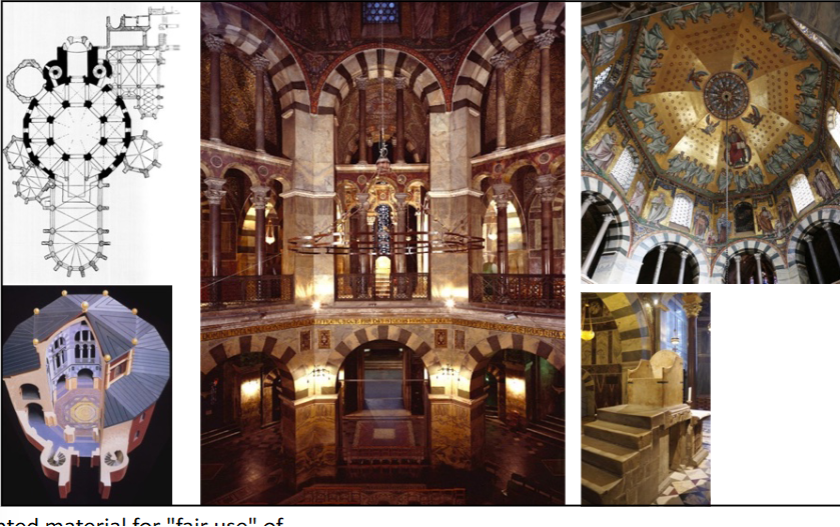
Palantine Chapel
Aachen, Germany
Who was Charlemagne and what did he accomplish?
How can we explain his concern with "renewing the Roman empire"?
Charlemagne was a Frankish ruler crowned Emperor in 800 CE. Unified much of Western Europe, promoted education and church reform, and strengthened centralized rule.
He aimed to restore the authority, order, and prestige of ancient Rome by combining Christian leadership with imperial Roman-style governance in Western Europe.
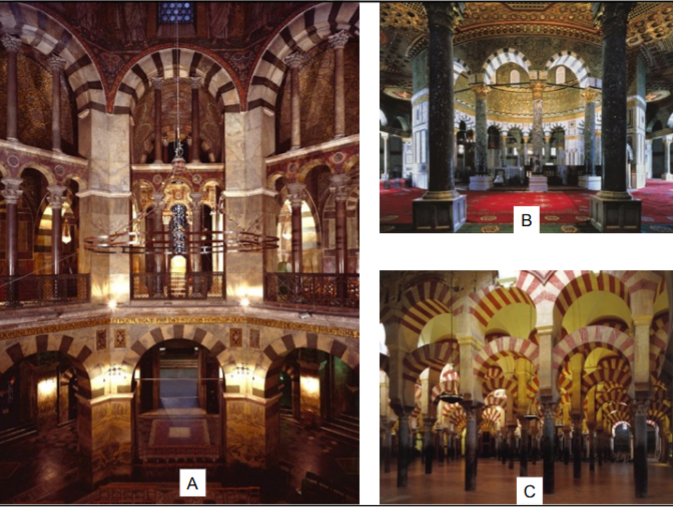
How does the design (plan, but also elevation and decorative details) of Charlemagne’s Palatine Chapel recall elements of Roman, Byzantine, and possibly even Islamic architecture?
Roman: central domed plan and use of classical columns/spolia, recalling Roman imperial buildings.
Byzantine: centralized octagonal design, dome, and rich interior mosaics, similar to churches like San Vitale.
Islamic (possible influence): geometric decoration, rhythmic arches, and an emphasis on ornamental pattern and light-filled interior effects.
What is the "westwork" seen at the Palatine Chapel?
Why is this element important for the history of European church architecture?
A monumental western entrance block with towers, upper chapel, and imperial throne space.
Importance: It becomes a key model for later medieval churches, linking church architecture with political power
What is meant by the term "Romanesque"?
When did the Romanesque style develop?
What were the some of the motivating factors that influences the builders?
How is the architecture of this period different from the architecture of the earlier Medieval period?
What is distinctive about it?
Growth of monasteries and pilgrimage route, need for larger, more durable churches, and rising religious devotion and stability after chaos of earlier centuries
Difference from earlier Medieval architecture:
Earlier buildings were smaller, simpler, and less standardized; Romanesque is larger, more engineered, and more unified in style.
Distinctive features: Thick stone walls, rounded arches, barrel/groin vaults and small windows for dim interiors
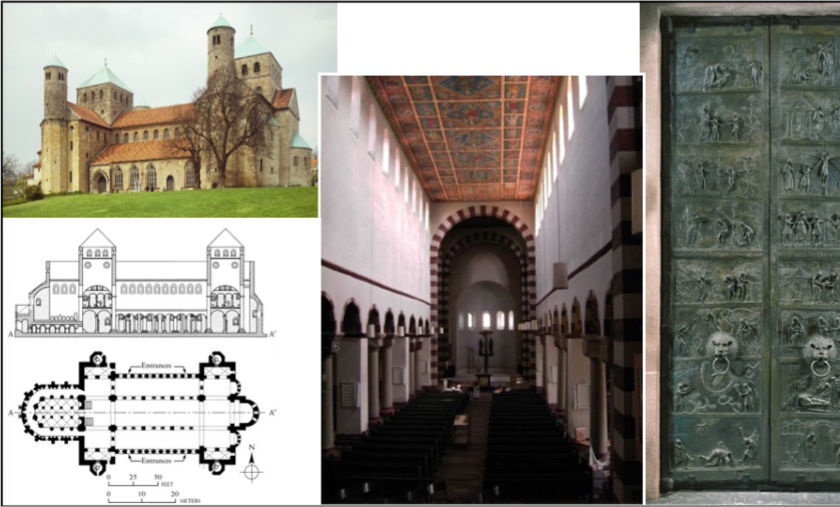
St. Michaels
Hildesheim, Germany
Which elements of St. Michael's were inspired by Roman architecture?
What may have been the inspiration(s) and architectural precedents for the polychrome voussoirs of the arches?
How was the roof constructed?
Roman-inspired elements:
Basilica-like symmetrical plan with double apses
Arcades, columns, and rhythmic arches
Clear, ordered interior space like Roman basilicas
Polychrome voussoirs inspiration: drawn from late Roman and early Christian decoration, especially alternating colored stone/brick arches seen in Roman buildings.
Roof construction: A timber roof system with a flat, painted wooden ceiling (not stone vaulting).
Who was the clergyman who oversaw the construction of St. Michaels and commissioned the bronze doors that led from the cloister to the church?
What is the decorative and symbolic program of these doors?
What may have been the design inspiration for these doors?
Bernward of Hildesheim.
Bernward Doors program:
Bronze panels showing Old and New Testament scenes, read as a story of sin (Fall) and redemption (Christ’s salvation).
Inspiration:
Likely based on Roman triumphal columns/doors, especially classical narrative relief sculpture like the Column of Trajan.
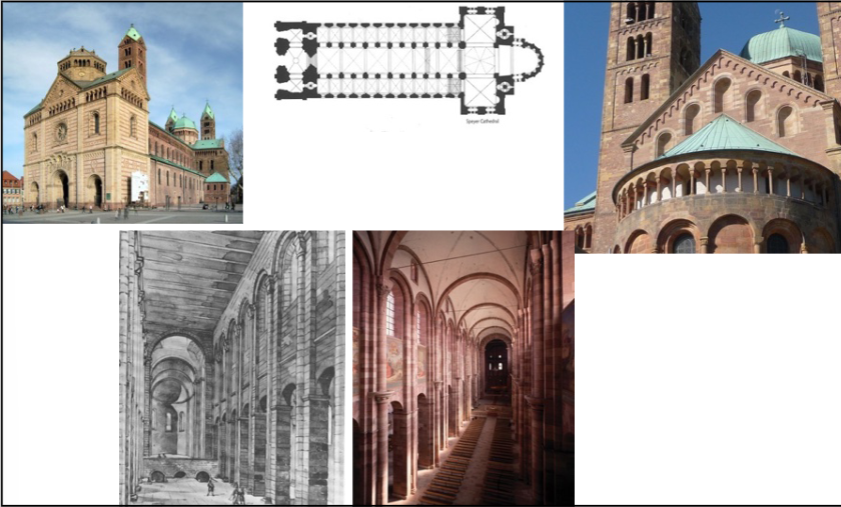
Speyer Cathedral
Germany
How is early Romanesque architecture in northern Italy different from contemporary Romanesque architecture in Germany?
What is 'Roman-like" about the architectural facade of the church of San Miniato in Florence?
What are some visible design elements that appear to have been inspired by Roman architecture?
By early Christian basilicas?
Northern Italy vs Germany (Romanesque):
Italy = lighter, brick/marble, classical influence, open arcades; Germany = heavier stone, thicker walls, fortress-like massing.
San Miniato al Monte “Roman-like” features:
Classical proportions, marble geometric patterns, columns, and temple-like facade.
Inspired by Roman architecture:
Arches, columns, pediments, and decorative classical orders.
Inspired by early Christian basilicas:
Long nave plan, timber roofs, and simple rectangular layout with side aisles.
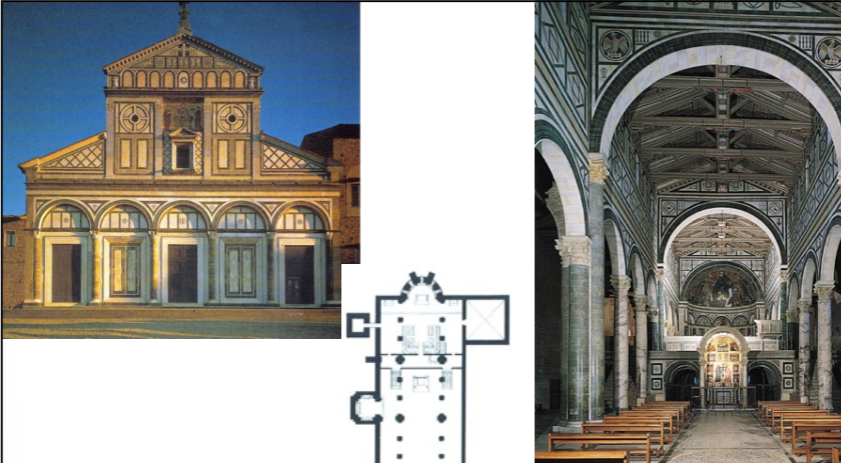
San Miniato al Monte
Florence, Italy
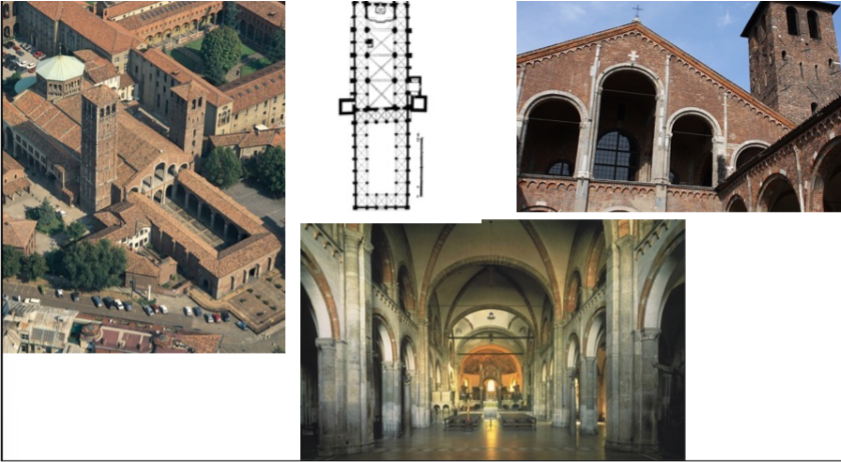
Sant’ Ambrogio
Milan, Italy
What is significant, in terms of architectural history, about the use of ribs to mark the groin vaults at Sant’ Ambrogio in Milan?
ribbed groin vaults are important because they show an early move toward Gothic design—using ribs to support and organize weight more efficiently, making vaults lighter and more structured.
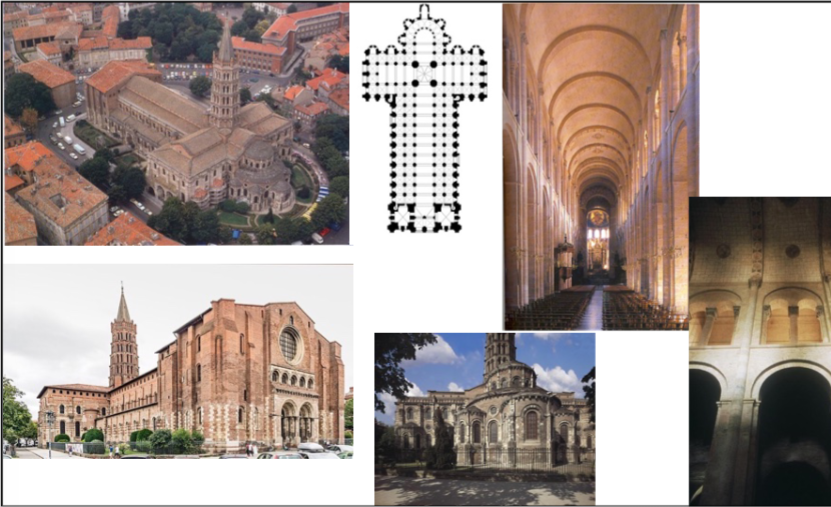
St. Sernin
Toulouse, France
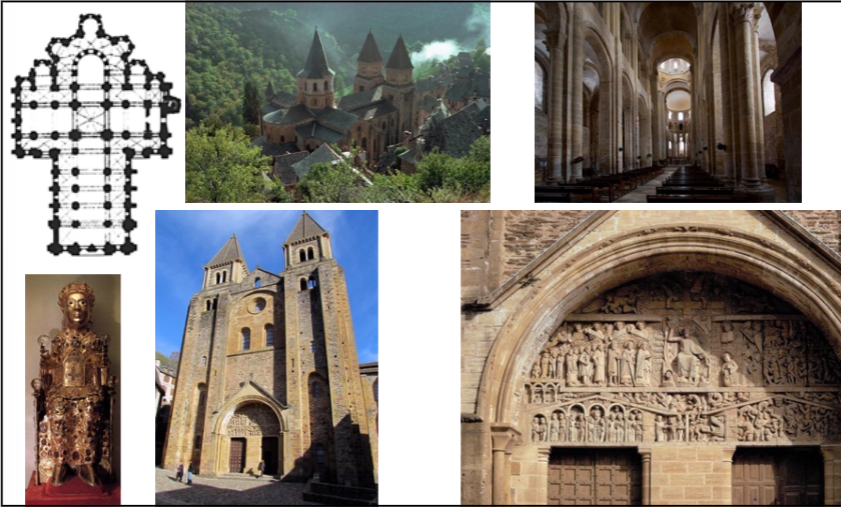
St. Foy
Conques, France
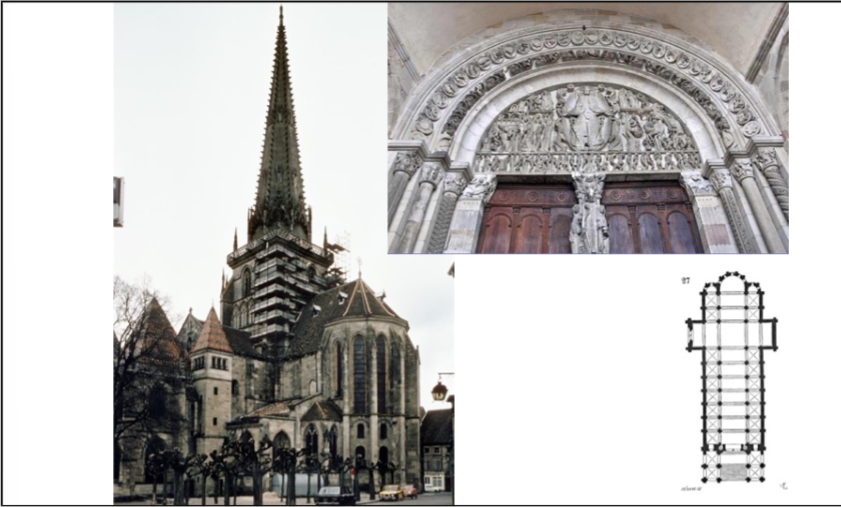
St. Lazare
Autun, France
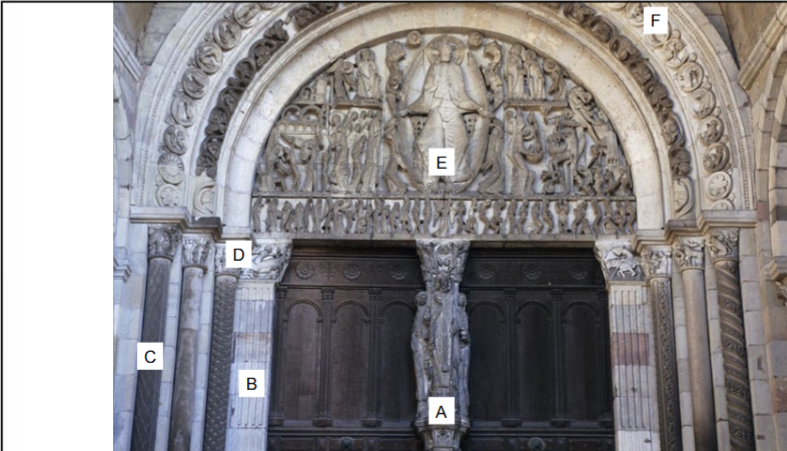
What are the key elements ("anatomy") of a Romanesque portal?
What are the subjects depicted at Saint Lazare in Autun?
What kind of information is contained in the Latin inscriptions that accompany the sculptures at Autun?
What is the "message" of this architectural decoration?
Who was the artist - and how do we know his name?
Romanesque portal “anatomy”:
Tympanum (main scene), lintel, jamb figures, archivolts (arched frames), and sometimes a trumeau (central post).
Autun Cathedral subjects:
Last Judgment—Christ in glory, angels, saved vs. damned souls.
Latin inscriptions:
Identify figures and explain moral warnings about salvation and sin.
Message:
A vivid warning about Judgment Day—reward for the righteous, punishment for sinners.
Artist:
Gislebertus, known because his name is carved directly into the tympanum inscription.
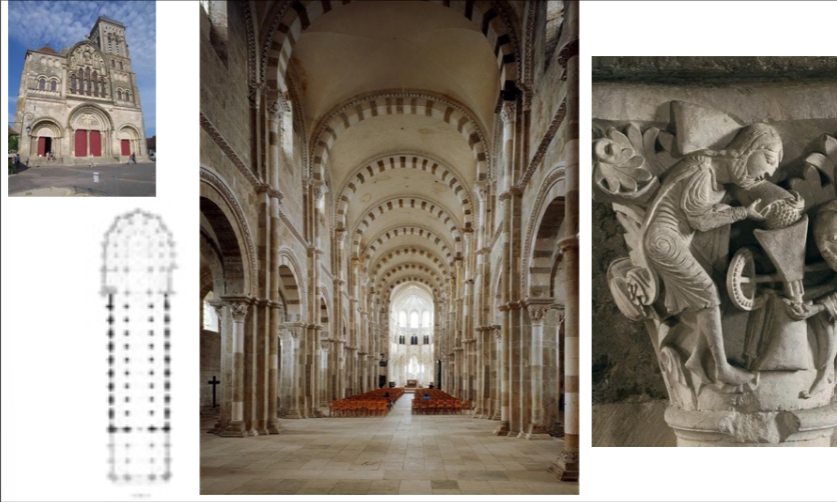
Ste. Madeleine
Vezelay, France
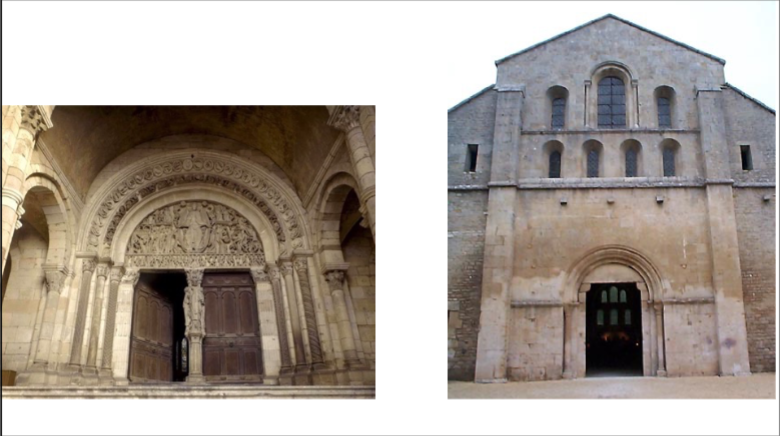
Abbey of Fontenay
France
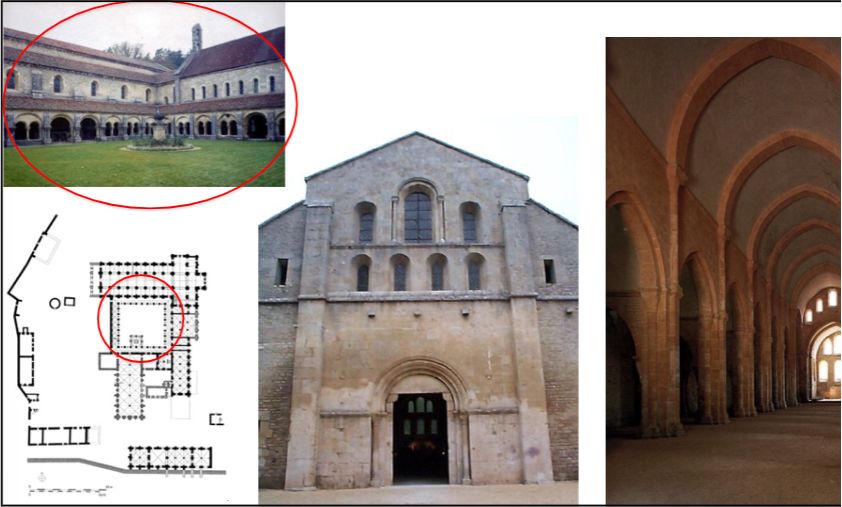
How does the architectural decoration of a Cistercian monastery differ from a Cluniac monastery in terms of design and decoration?
Why was there such a big difference between the 2 different orders of Benedictine monasteries?
Cluniac monasteries: very ornate and elaborate
Cistercian monasteries: simple and austere
Both were Benedictine, but the Cluniacs emphasized liturgical splendor and wealth in worship, while the Cistercians reacted against that, promoting strict monastic reform, humility, and simplicity.
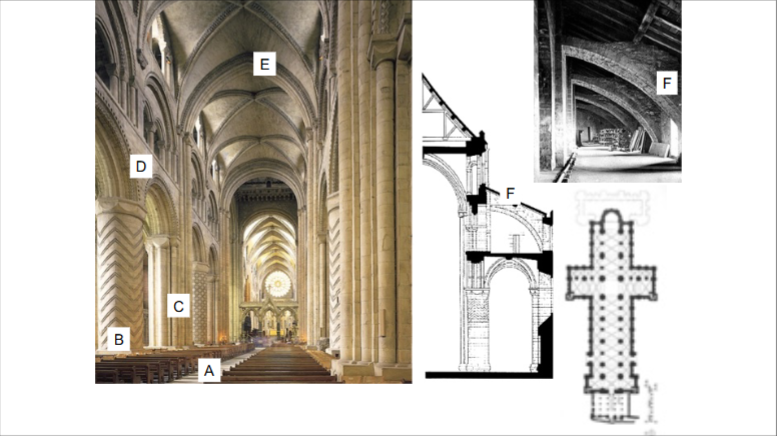
Durnham Cathedral (Cathedral of St. Cuthbert)
England
What are the structural benefits of pointed arches and ribbed vaults?
Direct weight more downward (less outward thrust) and allows taller, more flexible designs.
Ribbed vaults: Use a skeletal framework of ribs to carry weight and makes ceilings lighter, stronger, and easier to build in complex shapes.
How does a flying buttress differ from a "simple" buttress?
From a "quadrant arch" (as seen, for example at Durham Cathedral)?
Flying buttress: An arched support that transfers weight away from the wall to a separate pier, allowing thinner walls and big windows.
Simple buttress: A solid mass attached directly to the wall for support
Quadrant arch: A curved arch built into/against the structure, not fully detached like a flying buttress.
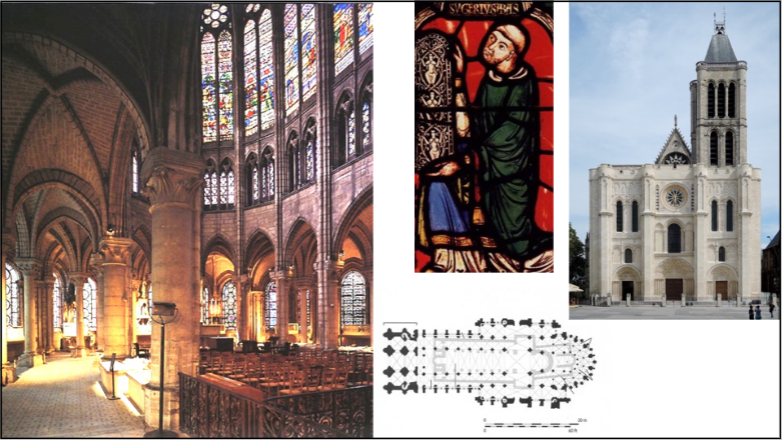
Abbey Church
St. Denis, Frnace
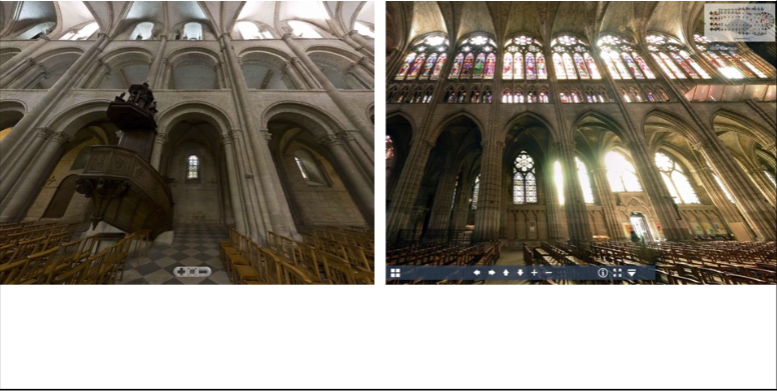
What role did/does stained glass play in creation of "place" at St. Denis (and other Gothic churches)?
How is the effect and appearance of stained glass similar to or different from mosaic decoration in contemporary Byzantine churches?
Creates a sacred atmosphere with colored light and tells biblical stories.
Similarities: both create a glowing, spiritual space
Differences: stained glass = light through; mosaics = light reflecting
Who was St. Denis & what miraculous story was told about him? What does the term "cephalophoria" mean?
Saint Denis was a 3rd-century Christian bishop of Paris who was executed during Roman persecution. Legend says after being beheaded, he picked up his own head and walked several miles while preaching.
Cephalophoria: From Greek, “head-carrying”, used to describe saints (like Denis) depicted carrying their own severed heads.
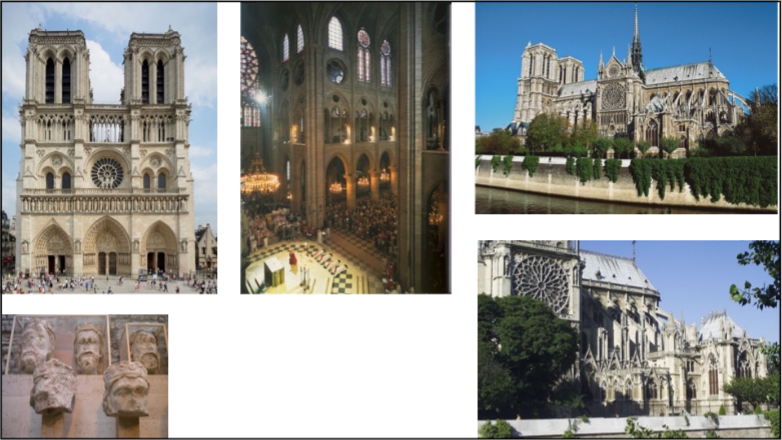
Notre Dame Cathedral
Paris, France
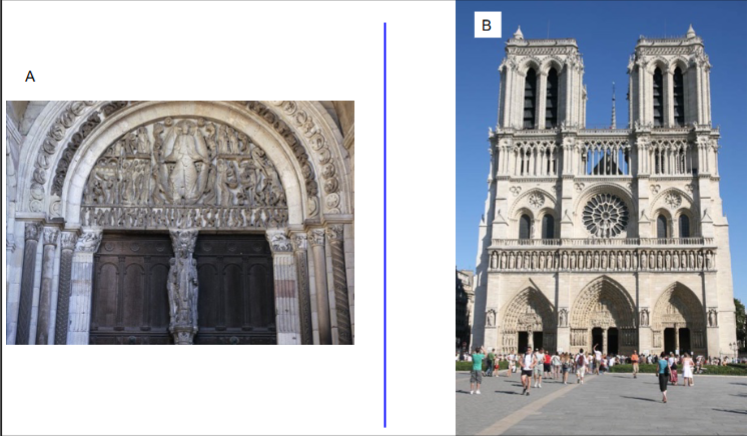
Why were some of the architectural sculptures of the church of St. Denis and the Cathedral of Notre Dame in Paris deliberately mutilated during the French Revolution?
they were seen as symbols of royal and religious power
Revolutionaries opposed the monarchy and the Catholic Church and they defaced statues of kings, biblical figures, and saints, often mistaking them for French monarchs.
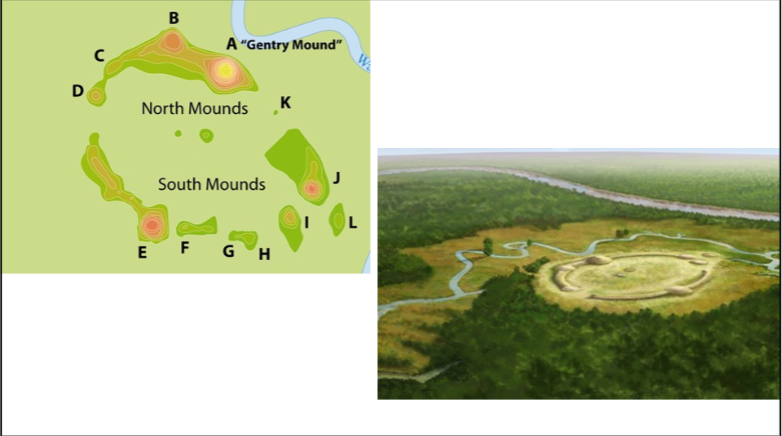
Watson Break
Louisiana
According to current archaeological evidence, when did human being first arrive in the Americas?
What is the oldest site in Texas where evidence for human habitation has been found?
Current evidence: 15000-20000 years ago
Gault Site shows habitation over 16000 years ago
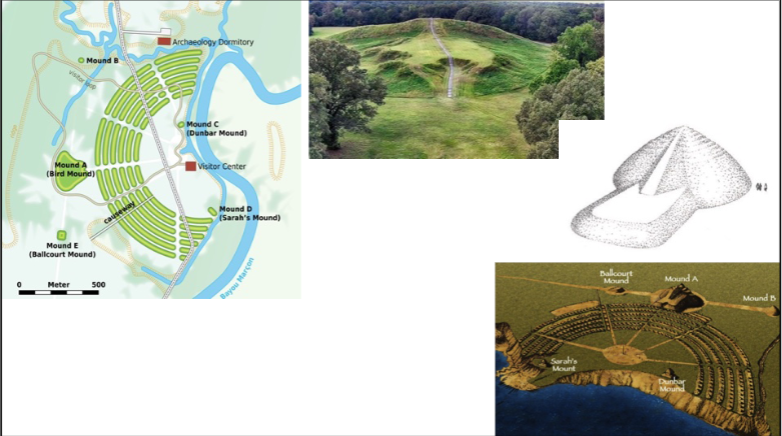
“Bird Mound” Poverty Point
Louisiana
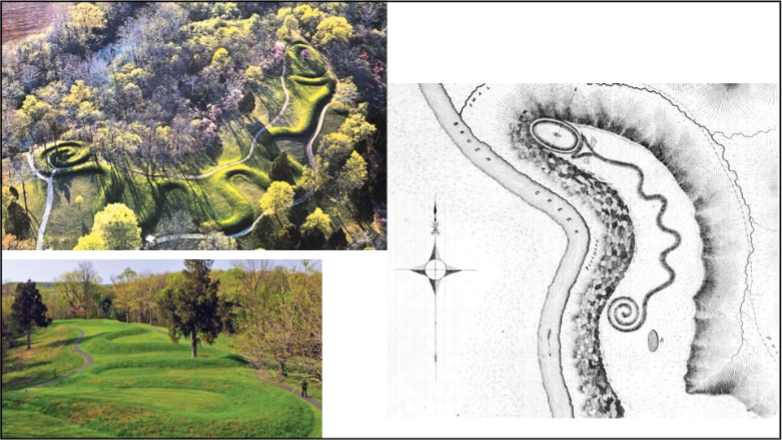
Great Serpent Mound
Adams County, Ohio
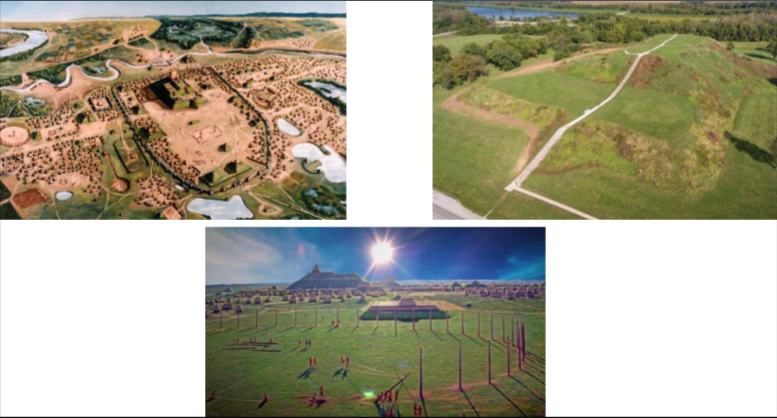
Cahokia
Illinois
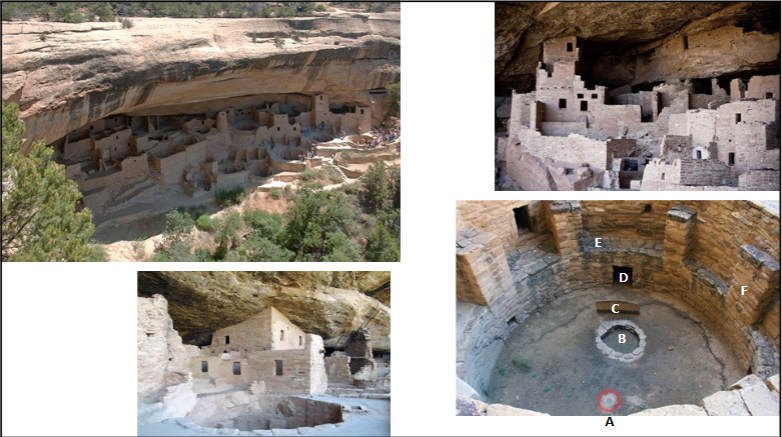
Cliff Palace
Mesa Verde, Colorado
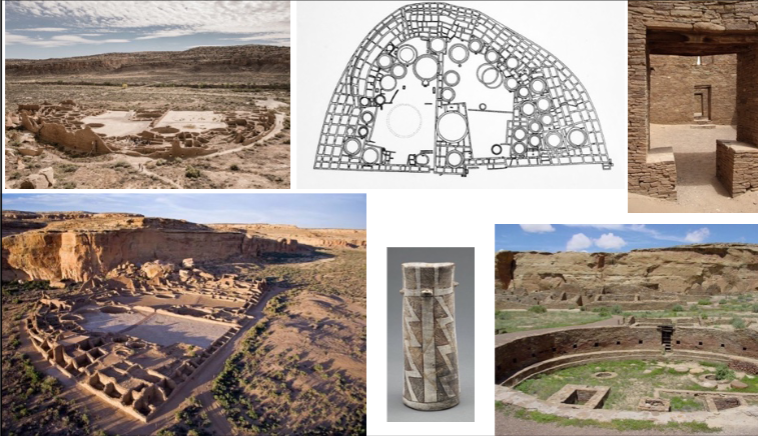
Pueblo Bonito
Chaco Canyon, New Mexico
Compare and contrast the Ancestral Pueblo site of the “Cliff Palace” at Mesa Verde in Colorado and Pueblo Bonito in the Chaco Canyon in New Mexico.
What is similar in terms of materials used, structure, form and organization?
What does this monument tell us about the people who created it?
Cliff Palace and Pueblo Bonito both use stone masonry + adobe, have multi-room complexes with ceremonial spaces and show planned layouts for community living and ritual.
Cliff Palace is built into a cliff for protection (compact, defensive), while Pueblo Bonito is a huge freestanding complex (more open, possibly administrative/ceremonial center).
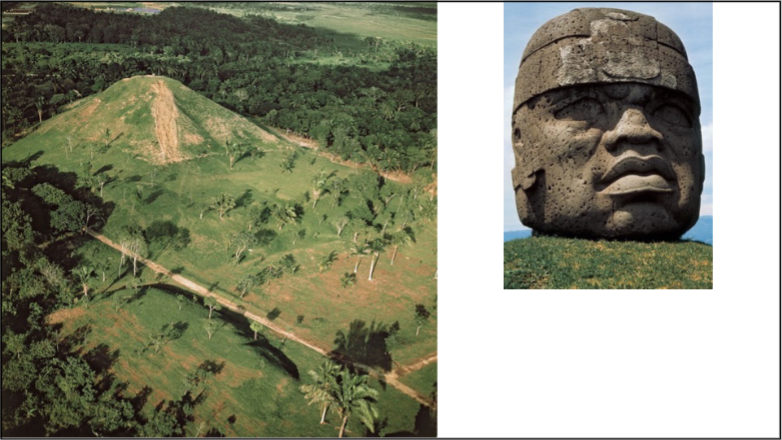
Great Pyramid and Ballcourt
La Venta, Tabasco, Mexico
What are some of the important design elements at Olmec sites, such as La Venta, that will be repeated throughout the region by later cultures?
Pyramids + central plazas, city layouts aligned to directions, monumental ruler art, and shared religious symbols (like the jaguar).
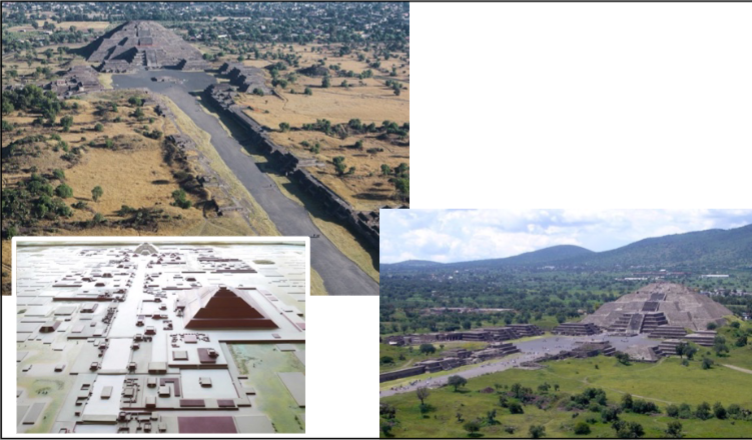
Pyramid of the Moon
Teotihuacan, Mexico
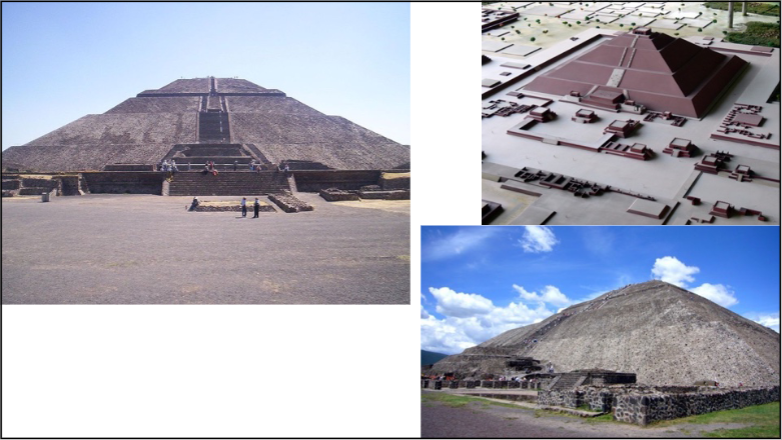
Pyramid of the Sun
Teotihuacan, Mexico
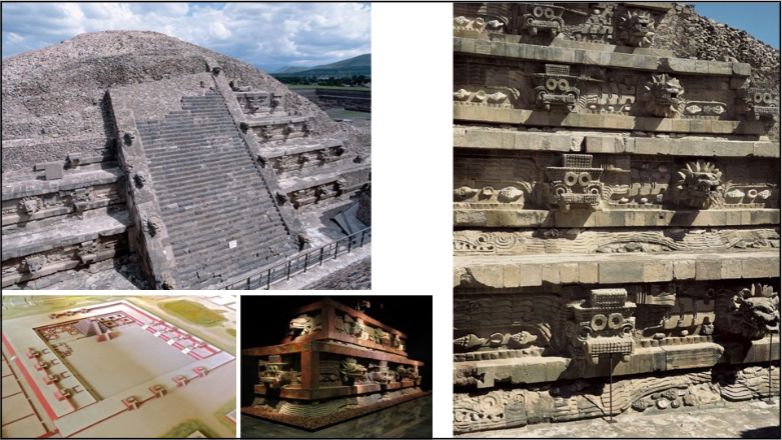
Temple of the Feathered Serpent (Quetzalcoatl)
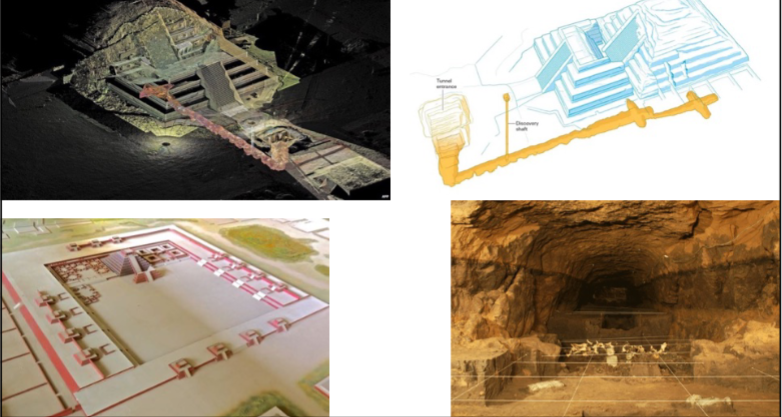
What are some of the significant design elements of the ancient city of Teotihuacan?
What does the architecture of Teotihuacan share in common with earlier Olmec remains or later Maya construction?
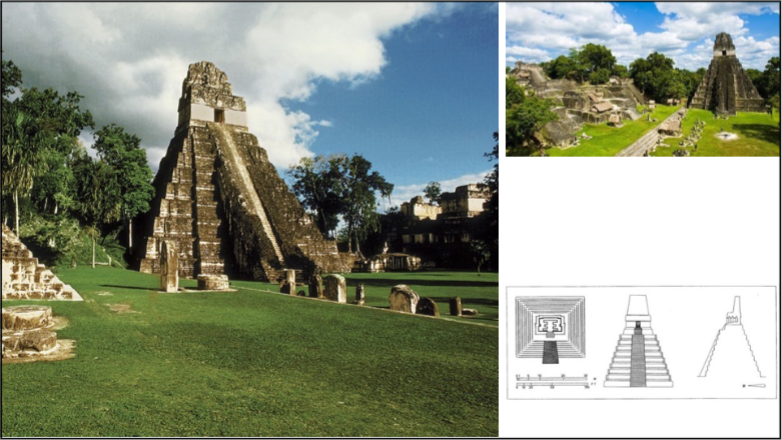
Temple I of Tikal
Peten, Guatemala
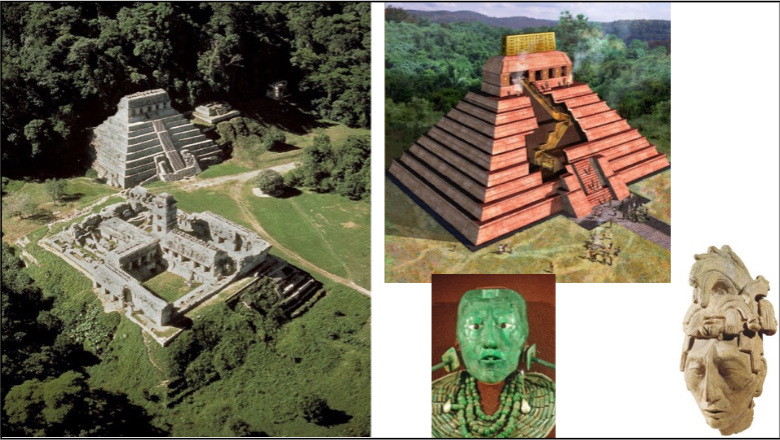
Temple of Inscriptions
Palenque, Mexico
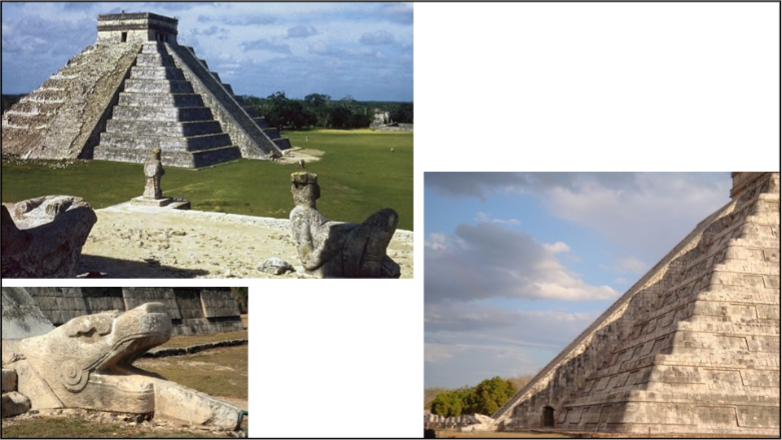
Temple of Kukulkan, El Castillo (the Castle)
Yucatan, Mexico
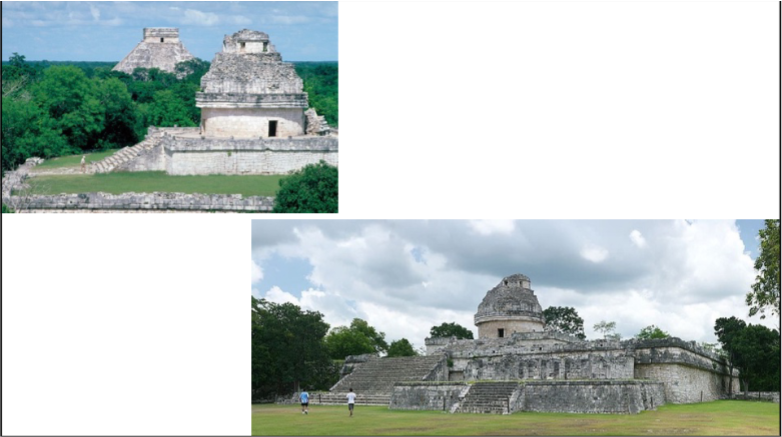
Chichen Itza, El Caracol (The Snail)
Yucantan, Mexico