PSYCH 202 Memory
 Call Kai
 Learn
Learn Practice Test
 Spaced Repetition
 Match
Match Flashcards
 Knowt Play
1/55

There's no tags or description
Looks like no tags are added yet.
Name | Mastery | Learn | Test | Matching | Spaced | Call with Kai |
|---|
No analytics yet
Send a link to your students to track their progress
56 Terms
HM - The Person Who was Henry Gustav Molaison (HM) and why is he important in neuroscience
Most famous amnesiac patient in neuropsychology
Demonstrated that memory consists of multiple, dissociable systems
Showed that medial temporal lobes (hippocampus) are critical for forming certain types of memory
His case revolutionised memory research
HM - The Person What was HM’s medical history before surgery
Age 9: Bicycle accident with brief loss of consciousness.
Age 10: Minor seizures began.
Age 16: Grand mal seizures developed.
By age 27: Severe epilepsy uncontrolled by medication.
Unable to work due to seizure severity.
HM - The Person Why did HM undergo bilateral temporal lobectomy
EEG showed seizures originated from both medial temporal lobes
Unilateral surgery has previously helped other epilepsy patients
Surgeons removed tissue from both medical temporal lobes to reduce seizures
HM - The Person What brain structures were removed during HM’s surgery
large portions of both hippocampi
most of the entorhinal cortex
much of the amygdala
other surrounding medial temporal structures
posterior hippocampus remained partially intact
HM - The Person Bilateral Temporal Labectomy successes
seizures became less frequent and less severe
intelligence remained largely intact
emotional stability remained intact
HM - The Person Bilateral Temporal Labectomy unexpected consequences
Profound global amnesia
Unable to form most new long-term memories
HM - The Person Which major memory problem did HM develop after surgery
Severe anterograde amnesia
coudn’t form new long-term explicit memories
could remember information only while actively rehearsing it
Dissociability of Memory Systems How did H.M. demonstrate that short-term memory and long-term memory are separate systems?
Normal digit scan (5-6 items)
could maintain information indefinitely through rehearsal
Information disappeared immediately if distracted
could not transfer information into LTM
Dissociability of Memory Systems H.M. digit scan implications
STM and LTM are dissociable systems because his STM was unaffected while LTM was impaired
Dissociability of Memory Systems What was intact in HM’s memory system
Working Memory
sensory register
Dissociability of Memory Systems What was impaired in HM’s memory system
LTM encoding
info never successfully entered permanent storage
Dissociability of Memory Systems What key principle did HM establish
Damage to the MTL can severely impair LTM formation while leaving STM relatively intact
Types of STM/Working Memory
Explicit memory (declarative)
facts
events
Types of LTM
Implicit (Non-declarative)
skills and habits
priming
simple classical conditioning
nonassociative learning
Explicit vs Implicit Memory What is explicit (declarative) memory
Memory involving
conscious awareness
recall or recognition
facts and events
Explicit vs Implicit Memory What is implicit (non-declarative) memory
Memory expressed through performance rather than conscious recollection
e.g. riding a bike
Explicit vs Implicit Memory How did HM demonstrate intact implicit memory
Mirror Drawing Task
Improved steadily with practice
Retained improvements across days
Learned at the same rate as healthy controls
Yet he insisted he had never done the task before
Explicit vs Implicit Memory What did the mirror drawing experiment demonstrate
Learning can occur without conscious memory
Implicit memory was intact despite profound explicit memory loss
Explicit vs Implicit Memory What brain structures are important for explicit memory
hippocampus and medial temporal lobe
What is procedural memory
a type of long-term, implicit memory that guides the execution of skills and physical actions
Explicit vs Implicit Memory What brain structures are important for procedural memory
basal ganglia
Explicit vs Implicit Memory What brain structures are important for motor skill learning
Basal ganglia corcuits
Semantic vs Episodic Memory What is semantic memory
Memory for
facts
concepts
general world knowledge
Semantic vs Episodic Memory What is episodic memory
memory for personally experienced events, inclusing
time
place
thoughts
feelings
sensory details
Semantic vs Episodic Memory What does semantic memory play during episodic recollection
According to Irish & Piguet (2013):
Semantic memory provides schemas and meaning.
Helps fill gaps during memory retrieval.
Supports reconstruction of episodic memories.
Semantic vs Episodic Memory According to Addis (2020), why is memory not like a video recording?
Memory is not stored as a complete, high-fidelity recording.
Instead:
Different elements of experience are stored across different brain regions.
Memory is distributed throughout the brain.
Semantic vs Episodic Memory How does remembering occur according to Addis (2020)
Remembering involves
reactivating distributed memory elements
recombining those elements
simulalating the remembered event
Memory is reconstructed rather than replayed.
Semantic vs Episodic Memory What role does the hippocampus play in memory retrieval
pulls memory elements together
binds sensory, emotional, conceptual, and semantic info
enables conscious recollection
allows a person to relive the event
Semantic vs Episodic Memory Why are episodic memories prone to distortion
memories are reconstructed, not replayed
elements are stored seperately
Recombination can introduce errors
Semantic vs Episodic Memory What is the key feature of episodic memory according to Tulving
Mental time travel and autonoetic consciousness
the ability to mentally relive past experiences
Semantic vs Episodic Memory How was HM’s sensory semantic memory affected
older semantic knowledge mostly preserved
could not acquire much new semantic knowledge
Semantic vs Episodic Memory How was HM’s episodic memory affected
Profoundly impaired.
Could not:
Form new autobiographical memories
Remember meeting people after surgery
Recall recent life events
Semantic vs Episodic Memory What is anterograde amnesia
Inability to form new memories after brain injury or illness
HM’s most severe impairment
Semantic vs Episodic Memory What is retrograde amnesia
Loss of memories acquired before injury
Semantic vs Episodic Memory What evidence suggested HM has extensive retrograde amnesia
Autobiographical Interview
could recall only one specific autobiographical memory
produced mostly vague, script-like descriptions
lacked detailed episodic recollections
Semantic vs Episodic Memory What is double dissociation between episodic and semantic memory
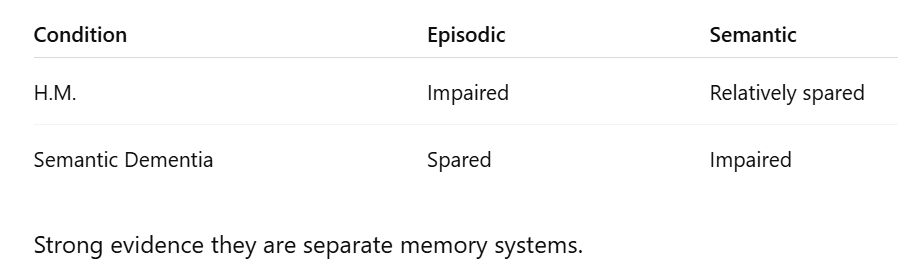
Semantic vs Episodic Memory What causes semantic dementia
Damage to the anterior temporal cortex
Semantic vs Episodic Memory What does semantic dementia produce
loss of factual knowledge
naming deficits
difficulty describing objects and people
Semantic vs Episodic Memory What are major causes of severe memory loss
Stroke
Traumatic brain injury
Brain tumour
Cerebral hypoxia
Herpes simplex encephalitis
Korsakoff's syndrome (Vitamin B1 deficiency)
Alzheimer's disease
Mental Time-Travel and Future Thinking Why is episodic memory described as a mental time-travel system?
Because it allows conscious movement through subjective time:
Re-experiencing the past.
Simulating the future.
Mental Time-Travel and Future Thinking According to Suddendorf, what may be the evolutionary advantage of episodic memory?
The ability to accurately predict and prepare for the future.
Future simulation may be more important than remembering the past.
Mental Time-Travel and Future Thinking What finding supports the link between remembering and imagining?
Remembering the past and imagining the future activate a common core neural network
Mental Time-Travel and Future Thinking What is the Constructive Episodic Simulation Hypothesis?
(Schacter & Addis)
The same system:
reconstructs past experiences
simulates future experiences
Memory and imagination rely on shared mechanisms.
Mental Time-Travel and Future Thinking What evidence suggests H.M. had difficulty imagining the future?
When asked “what do you believe you would do tomorrow”, his responses lacked specific future events
Mental Time-Travel and Future Thinking What evidence links MTL damage to impaired future thinking
Patients with MTL amnesia
cannot imagine future detailed events Race et al. (2011)
cannot imagine fictional scenes (Hassabis et al 2007)
Mental Time-Travel and Future Thinking What was unique about Case K.C.?
severe episodic amnesia
could not recall persona events
could not imagine his future
strong evidence episodic memory supports future simulation
Memory and Sense of Self How is Alzheimer's disease commonly portrayed in society?
A gradual loss of self
Memory and Sense of Self What alternative perspective exists regarding selfhood in dementia?
People may lose memories but retain a strong sense of self
Memory and Sense of Self What are the three major components of self?
Self-knowledge: Traits, beliefs, preferences
Narratives: Personal life stories
Core self: Subjective experience of being you
Memory and Sense of Self What is self-continuity
“I am the same person over time despite change”
Memory and Sense of Self What is the I-Self
core essense
subjective self
often unchanged in AD
Memory and Sense of Self What is the Me-self
content of identity
personal facts and roles
most likely to change
Memory and Sense of Self What did Self-Continuity Interview studies find in Alzheimer's disease?
Most individuals with AD believed they were still the same person they had been in early adulthood.
Memory and Sense of Self What did the IDEAL cohort study find about self-continuity?
Sample:
1465 people with mild-moderate dementia.
Results:
79% agreed they were still the same person.
21% reported discontinuity.
Memory and Sense of SelfWhat was associated with loss of self-continuity in dementia?
Those reporting discontinuity had:
Lower psychological wellbeing.
Poorer quality of life.
Lower "living well" ratings.
What is the major conclusion regarding memory and self?
eople with Alzheimer's disease can retain a strong sense of core self despite severe autobiographical memory loss.
This suggests memory contributes to identity, but is not the sole basis of selfhood.