Biology - A1.1 Water
 Call Kai
 Learn
Learn Practice Test
 Spaced Repetition
 Match
Match Flashcards
 Knowt Play
1/24

There's no tags or description
Looks like no tags are added yet.
Name | Mastery | Learn | Test | Matching | Spaced | Call with Kai |
|---|
No analytics yet
Send a link to your students to track their progress
25 Terms
Hydrogen bonds
Water is a polar covalent molecule. Two hydrogen atoms form covalent bonds with an oxygen atom.
Water is a polar covalent molecule with weak charges at the poles.
Water is attracted to other polar molecules forming hydrogen bonds.
The hydrogen bonds that form between water molecules explain many of water’s properties.
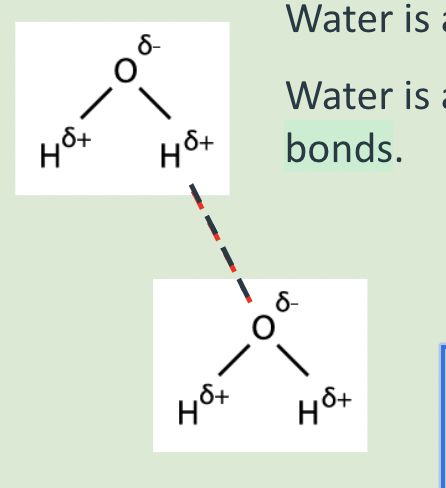
Note: If asked to draw two water molecules and a hydrogen bond, the hydrogen bond should be a dashed line. The covalent bonds between the oxygen and hydrogens in a water molecule should be solid lines.
Polar covalent bonds
the type of bonds in water molecules
Cohesion
attraction between the same kind of molecules,
Water molecules are attracted to other water molecules. The negatively charged oxygen of one water molecule is attracted to the positively charged hydrogens of another water molecule, forming a hydrogen bond.
Adhesion
is attraction between different kinds of molecules.
The polar water molecules are attracted to other polar molecules, forming hydrogen bonds.
Solvent
water is a solvent
able to dissolve other substances.
the dissolving agent
Water is often called the universal solvent, as it allows a wide variety of hydrophilic substances to dissolve in it, because of its polarity.
Hydrophilic substances are charged substances that mix and dissolve with water.
Most metabolic reactions will only occur when the reactants are dissolved in water.
Metabolism
the complex network of interdependent and interacting chemical reactions occurring in living organisms.
Water is the Medium for Metabolism
Enzymes are biological catalysts which speed up the rate of chemical reactions. Enzymes are involved in controlling metabolism.
Metabolic reactions occur in aqueous solutions, with the reactants and enzymes dissolved in water.
Xylem
vessels are thin narrow tubes which transport water (and dissolved minerals) from the roots to the leaves of plants.
Cohesion and Transport in the Xylem
The cohesive nature of polar water molecules allows water to form a continuous column of water molecules moving up the xylem/stem of plants.
Surface tension
the property of a substance to resist an external force.
Cohesion and Surface Tension
A relatively strong surface tension forms at the surface of water due to the cohesive nature of water molecules.
Surface tension allows animals like water striders to walk on water, and the surface of a lake becomes their habitat.
Capillary action
Capillary action describes the ability of water to flow against gravity in a narrow space.
Adhesion - Capillary Action in Soil
Soil tends to be porous, as the clay and organic matter in the soil is polar.
Water adheres to the polar soil particles and moves up the soil towards the roots of plants.
Capillary action is greater in fine clay soils, and weaker in porous sandy soils.
Adhesion - Capillary Action in the Cell Wall
The apoplast pathway allows water and dissolved nutrients to move through the cell walls of plants.
Cellulose in the cell walls of plants is porous and polar.
Water can move from cell to cell by capillary action, as the polar water adheres to the polar cellulose.
Hydrophobic
hydrophobia substances are not charged and do not readily mix with water.
Some molecules found in living organisms are hydrophobic, and do not dissolve in water. The functions of these substances depend on them being hydrophobic.
examples
Lipids are hydrophobic, allowing them to be used as an energy store without significantly changing the water potential of cells.
Lipid hormones are hydrophobic, and are able to pass through the phospholipid bilayer of cell membranes.
Hydrophilic
Hydrophilic substances are charged substances that mix and dissolve with water.
Water is often called the universal solvent, as it allows a wide variety of hydrophilic substances to dissolve in it, because of its polarity.
Most metabolic reactions will only occur when the reactants are dissolved in water.
Buoyancy
physical property of water
Buoyancy is the upward force exerted by a fluid (liquid or gas) on an object immersed in the fluid.
Liquid water is a denser fluid than air, providing greater buoyancy for aquatic animals and allowing them to float or swim more easily.
This helps many aquatic animals conserve energy and allows them to stay afloat without expending a lot of effort.
The ringed seal has a layer of blubber that provides buoyancy and helps it float on the surface of the water.
also blackthroated loon
Viscosity
Physical Properties of Water: Viscosity
Viscosity is the measure of a fluid's resistance to flow. The higher the viscosity, the more difficult it is for animals to move through the fluid.
Water has a higher viscosity than air, and many aquatic animals, such as the black-throated loon, have a streamlined body shape which allows them to smoothly move through water.
seal and loon
Thermal conductivity
Physical Properties of Water: Thermal Conductivity
Thermal conductivity is a measure of a material's ability to conduct heat.
Water has a much higher thermal conductivity than air. Aquatic animals are more likely to lose heat to the environment, and must be adapted to reduce heat loss.
Ringed seals have a layer of insulating blubber to prevent heat loss. Seals will huddle together out of the water (on land), decreasing overall exposed surface area and reducing heat loss.
Black-throated loons are insulated by feathers which are coated with a hydrophobic oil to keep the feathers dry, which reduces heat loss.
seal and loon
Specific heat capacity
Physical Properties of Water: Specific Heat Capacity
Specific heat capacity is the energy required to raise the temperature of 1g of a substance by 1 K (or 1°C).
Water has a very high specific heat capacity (4.186 J/g°C), as energy is required to break the hydrogen bonds between water molecules. The specific heat capacity of air is much lower than water.
The temperature of large bodies of water is much more stable than air temperature, as the water can absorb or release much more heat energy without experiencing significant temperature change.
Animals cells (which are primarily composed of water) are also resistant to temperature change, which helps maintain constant body temperature in endotherms such as birds and mammals.
seal and loon
Apoplast pathway
The apoplast pathway allows water and dissolved nutrients to move through the cell walls of plants.
Extraplanetary
extraplanetary generally refers to being outside any planet or outside the region of planetary orbits.
Extraterrestrial
Extraterrestrial specifically means outside Earth or its atmosphere
Exoplanet
a planet that orbits a star outside the solar system.
Goldilocks Zone
the habitable zone
Planets are in the habitable zone (Goldilocks zone), when their orbit around their star allows liquid water.
The planet is not too hot and not too cold for liquid water to exist.
Asteroid
An asteroid is a rocky object that orbits the Sun. Asteroids are smaller than a planet, but they are larger than the pebble-size objects we call meteoroids
Comet
Comets are small icy dirtballs that orbit the Sun; comets are made of ice and dust while asteroids are made of rock).
2. Explain how the Earth gained its oceans
Water formed solid particles in the outer solar system as a result of low temperatures, due to the distance from the sun.
The ice formed objects such as comets and asteroids. Earth's water probably arrived from the asteroids (carbonaceous chondrites) , which have similar ratios of heavy hydrogen atoms as Earth’s water.
The water probably arrived during the Late Heavy Bombardment, four billion years ago.
Explain why water was not present on Earth when the planet formed.
Earth and the other rocky planets of the inner solar system formed by the clumping together of solid particles.
Water, in the form of ice, was not present, as the temperatures were too high for water to exist as a solid (ice). Any gaseous water would have been moved away by the solar winds.
3. Explain why the Earth does not lose its water.
Planet Earth’s large mass creates enough gravity to retain the liquid water and water vapor on the planet. Earth’s much smaller moon has less gravity and cannot retain water vapor.
The Earth is in a habitable zone of the solar system where water can exist as liquid water.
The temperature of Earth is suitable for the water cycle, as water vapor condenses to liquid water, and falls back to the Earth as precipitation.