VI. Regulation and Discipline (8.5%)
 Call Kai
 Learn
Learn Practice Test
 Spaced Repetition
 Match
Match Flashcards
 Knowt Play
1/11

Earn XP
Description and Tags
6.1 Discipline Procedures, 6.2 Practice Review of Individuals, 6.3 Practice Review of Firms, 6.4 Continuing Professional Development
Name | Mastery | Learn | Test | Matching | Spaced | Call with Kai |
|---|
No analytics yet
Send a link to your students to track their progress
12 Terms
Unlicensed Practioners
Prosecuted in courts.
Each Act typically states that it is an offence for an unlicensed person to:
practice professional engineering or professional geoscience
use a term or title to give the belief that the person is licensed
use a seal that leads to the belief that the person is licensed
Licensed Practitioners
Six causes for disciplinary action:
Professional misconduct (unprofessional conduct)
Incompetence
Neligence
Breach of the Code of Ethics
Physical or mental incapacity
Conviction of a serious offense
Professional Misconduct
Any matter or conduct if:
It is harmful to the best interest of the public or members
Tends to harm the standing of the profession
Is a breach of the act or bylaws
Is a failure to comply with an order of the investigation committee, the discipline committee, or the council
Professional Incompetence
Display of:
A lack of knowledge, skill, or judgement;
A disregard for the welfare of members of the public served by the profession;
of a nature or to an extent that demonstrates that the member is unfit to continue in the practice of the profession.
Common when switching fields if you are not properly trained.
Stages of the Disciplinary Process
Gathering Evidence: Complaint is made.
Investigation Committee.
Discipline Hearing: Public. Prosecuted by the investigation committee. professional is entitled to legal counsel. Final judgement is made by the discipline committee.
Investigation Committee
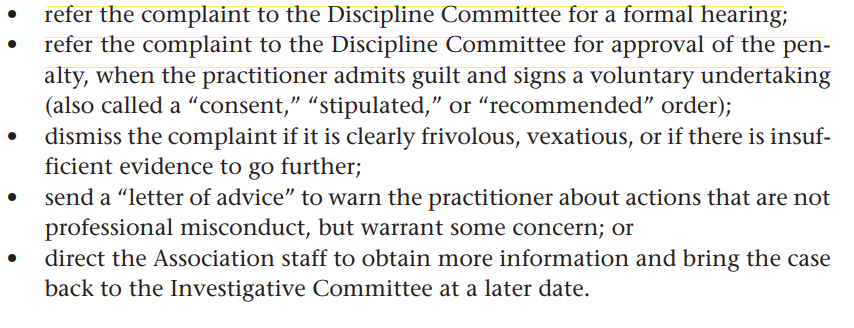
Responsible for the investigation of allegations of professional misconduct or professional incompetence.
Their actions are listed in the photo. They can also suggest an alternative dispute resolution between the complainant and professional to settle (mediation, arbitration, etc.).
Investigation Process Trigger
A request from council to consider a complaint, or a written complaint.
Discipline Committee
Separate from the investigation committee.
Provides an inquiry and judgment capability to enable the association to meet its responsibilities under the discipline sections of the act.
Hears and determines formal complaints referred to it by the investigation committee.
Disciplinary Penalties
On a finding of professional incompetence or misconduct, the panel may issue an order:
Expelling the member and striking their name from the register
Suspending the member
Suspending the member subject to conditions
Reprimand/restriction/penalty
A fine not exceeding $1500
That the member pay costs of investigation and discipline hearing
Require course/examination
Professional Development
Professionals are expected to engage in lifelong learning to ensure the protection of public health, safety, and welfare.
Professional Obligation:
Stay informed
Maintain competence
Demonstrates knowledge, credibility and competence to the public
Requirements:
Verifiable credits
Other categories
Ethics credits
Scope of practice (must be within it)
Maintain a detailed record
Report to regulator
Practice Reviews
Some associations conduct practice reviews to ensure that continuing competency programs are effective. Each year, a small, random sample of members undergoes a practice review. Practice reviews are confidential and occur with the full knowledge and cooperation of the professional.
Recommended by Engineers Canada for ensuring competence & compliance with CPD programs.
Ethics in Foreign Consulting
Observe the rules of professional conduct that apply in that country and if there are no such rules, observe those established by your own code of ethics. This is not always possible, so use the golden mean and follow these factors if needed:
Avoid exploitation
Avoid paternalism/making decisions for others without consulting them
Avoid bribery
Respect human rights
Respect cultural norms and laws
Promote the country’s welfare
Protect health and safety
Protect the environment
Promote the society’s legitimate institutions