Astronomy
 View linked note
 Call Kai
 Learn
Learn Practice Test
 Spaced Repetition
 Match
Match Flashcards
 Knowt Play
1/41

There's no tags or description
Looks like no tags are added yet.
Name | Mastery | Learn | Test | Matching | Spaced | Call with Kai | Chat |
|---|
No analytics yet
Send a link to your students to track their progress
42 Terms
Gibbous
Like a 3/4 moon.
Crescent
Like a 1/4 moon.
Waxing
The phase where the moon is increasing in illumination (↑).
Waning
The phase where the moon is decreasing in illumination (↓).
Eclipses
A celestial event where a celestial body is covered up.
Lunar Eclipse
An eclipse where the Earth covers the moon.
Solar Eclipse
An eclipse where the moon covers the sun.
Cone-shaped shadow
The shadow cast during a solar eclipse.
Moon's orbit
The path the moon follows around the Earth, which is tilted relative to Earth's orbit.
Zenith
The highest point above you in the sky.
Circumpolar stars
Stars that never set because they are positioned near the poles.
Half stars
Stars located near the equator.
Gigaton
An American billion, equivalent to the weight of the sun (1.9x10^30 kg or 1 solar mass).
Luminosity
The brightness of a star, measured by its energy output.
Celestial sphere
A sphere that encompasses the stars, rotating around the Earth once every 24 hours.
Altitude
The angle above the horizon.
Circumpolar stars
Stars that never set, close to the poles.
Stars in motion
The daily motion of the sky caused by the rotation of the Earth.
Time conversion
1 billion years equals 1 gigayear.
Cosmological positioning
Related questions based on whether one is at the equator, near a pole, or in between.
Celestial sphere
The location of the stars in the sky as it rotates around the earth (24 hrs) w/ the sun. So as sun moves, so do stars (why Gemini is closet to sun at noon and sunset)
Ptolomey
Almagest - first earth central model
Collection of math, tables, physics to predict planetary positions
Made motions (epicycles) of the heavens perfect (circular motion/constant speed)
*not accurate to actual planetary motion.
epicycle- a small circle within a larger circular pattern (revolution vs rotation)
Tycho Brahe
" de nova stella” (on the new star)
Saw a new star - wrote a book- star goes away (was a supernova- star explosion - bright)
Convinced dutch king to fund observatory
Uses Almagest - does not work - uses uraniborg (observatory) to make better system
Geo-helio system: the sun and moon orbit the earth, all else orbits the sun
Copernicus
Heliocentric theory - sun is at the center (religiously risky - Catholic backlash)
johannes Kepler
Orbits of planets are ellipses w/ sun as foci
- eccentricity - how squished an ellipse is
As planets move around the sun, sweeps out equal orbits at equal times
-as you move farther away from what you orbit, you more slower
Longer it takes a planet to complete its orbit, the further it is from the sun
equ: p^2=a^3
Where p is planet’s orbit in yrs (time), and a is semi-major axis (distance) (AU) ( mass is negligible)
Galileo Galilei
Sidereal messenger (book-what do you see in a telescope)
There are lots of stars in the sky
Jupiter has moons!!
Discovers that the sun rotates, sun spots, and sphere
Moon has mountains/valleys
Saturn has rings
Dialogue on the two chief word systems: heliocentric is best
Heliocentric vs geocentric
Sun is at the center of universe is the earth
Solar luminosities
how to measure luminosity
Light wavelength vs frequency vs energy
Short wavelength=high energy/frequency (blue)
long wave Is vice versa (red)
Spectral lines
different atoms have different spectral lines (atomic fingerprints)
Light is energy & conserved
Energy is passed too/from electrons
as electrons ↓, light is released, photons ↑
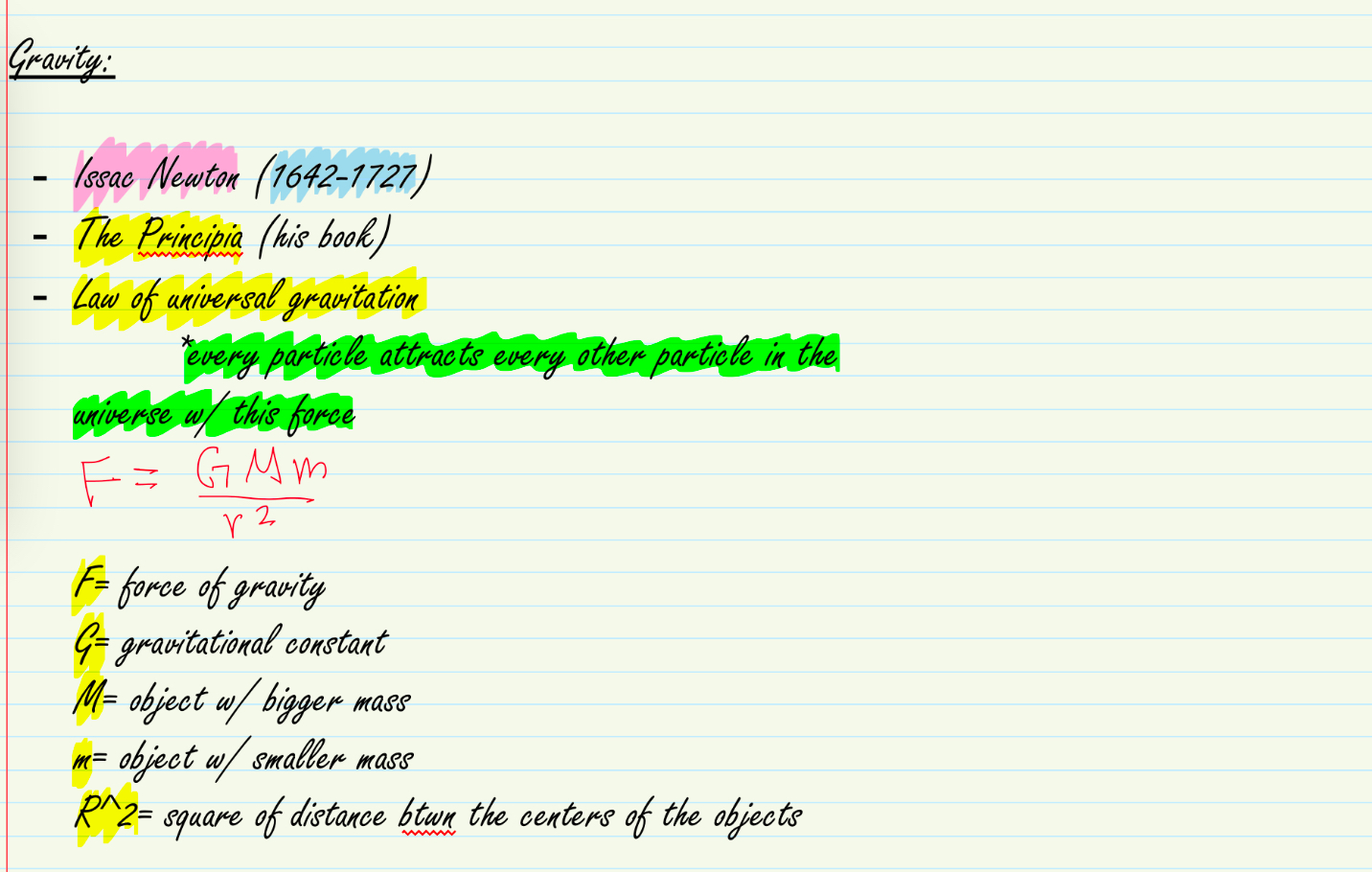
Issac Newton and gravity
Mathematical proof of kepler’s laws
Cannonball experiment
If an object fall sideways as fast as 8 km/s it will orbit the earths
Escape velocity
Speed needed to break out of earths orbit
Speed of light
3.0×10^8 m/s (as c)
Black hole
An object w/ an escape velocity of greater than speed of light (large mass in tiny space)
Newton and prisms
Shone a white light through one prism and funneled a particular light into another-the color of light remained the same-proved white light is a collection of all colors
How to make light
Hot and opaque (stars) (blackbody radiation-continous spectrum)
Clouds of gas/dust (not opaque)(nebula)
Emission vs absorption
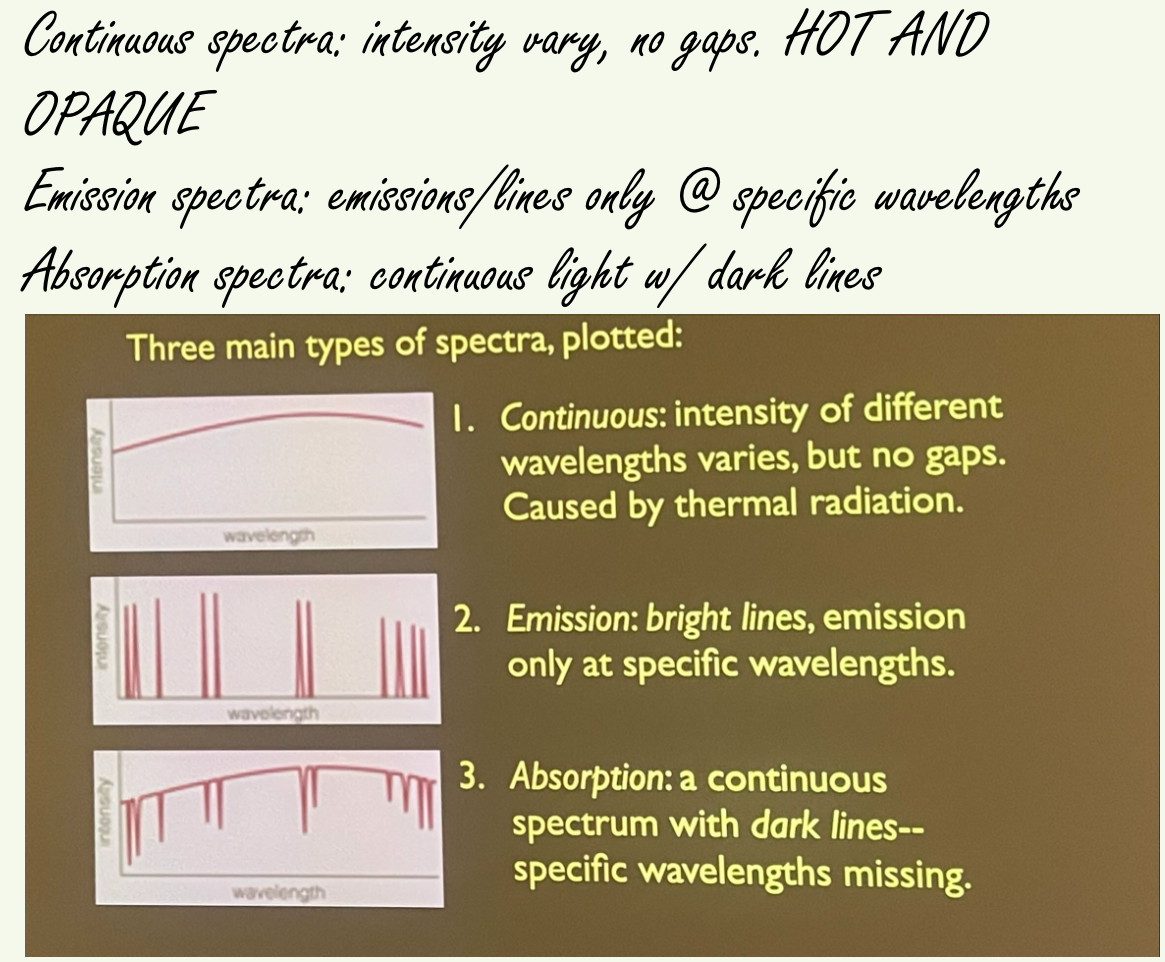
Continuous spectra: intensity vary, no gaps. HOT AND OPAQUE
Emission spectra: emissions/lines only @ specific wavelengths
Absorption spectra: continuous light w/ dark lines
Looking @ a graph and relating color and energy
Peak of graph (determined by temp, akin to a certain color)
Red → blue. Low → high temp
Stars are diff colors due to temp!
as temp ↑, energy ↑
*look at graph x axis to sere color emission amounts
William Herschel
Infrared light
Fraunhofer
Spectral lines
Kirchoff and Bunsen
Can observe spectral lines as elemental emissions
-elements have certain orbitals that are filled in accordance to the specific permitted energies of each orbital. Thus, each specific element emits different lights w/ diff energies