RC1 - Risk society (keyterms, mp + scenario questions)
0.0(0)
Studied by 7 people Call Kai
 Learn
Learn Practice Test
 Spaced Repetition
 Match
Match Flashcards
 Knowt Play
Card Sorting
1/40

Earn XP
Description and Tags
Last updated 12:10 PM on 5/30/26
Name | Mastery | Learn | Test | Matching | Spaced | Call with Kai |
|---|
No analytics yet
Send a link to your students to track their progress
41 Terms
1
New cards
What is risk according to Spiegelhalter (2017)?
Undesirable things that might happen
2
New cards
What is risk according to Gigerenzer (2023)?
The objective likelihood of experiencing negative events, calculated as a number
3
New cards
What is the formula for calculating risk?
Probability (likelihood of unwanted event) x Severity (magnitude of consequences)
4
New cards
What is risk according to Aven & Renn (2009)?
Uncertainty about and severity of the consequences of an activity with respect to something that humans value
5
New cards
What are the two dimensions of risk according to Slovic (2016)?
Controllability (can we manage the risk?) and knowability (do we understand the risk?)
6
New cards
What are the two factors used to map risks in Slovic's risk perception model?
Factor 1: Dread risk (how much fear a risk evokes) and Factor 2: Unknown risk (how little is known about the risk)
7
New cards
What is a hazard?
A potential source of harm that exists regardless of action or exposure — it becomes a risk only when interaction or exposure occurs (e.g. a bottle of bleach is a hazard; drinking it is the risk)
8
New cards
What is the difference between a hazard and a risk?
A hazard is a potential source of harm (possibility); a risk arises when exposure/action occurs (probability). Hazard → action (exposure) → risk
9
New cards
What is aleatory uncertainty (first-order uncertainty)?
Things we cannot know — irreducible randomness inherent to a situation
10
New cards
What is epistemic uncertainty (second-order uncertainty)?
Things we don't know but could know — gaps in current knowledge that can in principle be reduced
11
New cards
What are the three types of unknowns according to Rumsfeld (2002)?
Known knowns (things we know we know), known unknowns (things we know we don't know), and unknown unknowns (things we don't know we don't know)
12
New cards
What is risk communication?
The interactive process of exchanging knowledge, perceptions, attitudes, and opinions related to risks between individuals and institutions
13
New cards
What is the key question of risk communication?
Who communicates what, in what form, to whom, and to what effect?
14
New cards
What characterizes the first age of modernization (industrial modernity)?
Started with the Enlightenment; focused on production of material wealth, avoidance of scarcity, control over nature; risks were short-term, physically bound, visible, and fixable
15
New cards
What characterizes the second age of modernization (reflexive modernity)?
Started at end of the Cold War; focused on production of safety and knowledge; risks are evolving, global, less visible, and irreversible
16
New cards
What are the four elements of a VUCA world?
Volatility (unexpected, fluctuating events), Uncertainty, Complexity, Ambiguity
17
New cards
What does each element of VUCA mean for risk communication?
Volatility = risks fluctuate unpredictably; Uncertainty = no clear knowledge about causes/outcomes; Complexity = many interrelated factors at play; Ambiguity = no shared language or understanding (e.g. people disagree on what climate change means)
18
New cards
What is risk management?
The process of minimizing risks as much as possible while acknowledging that zero risk is rarely achievable
19
New cards
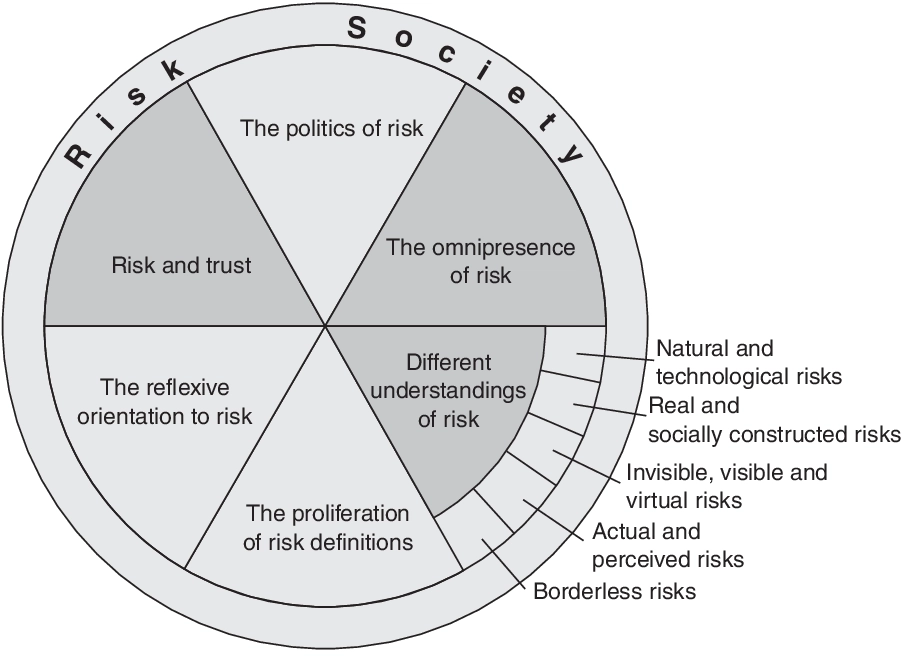
What are the 6 parameters of the risk society?
1. Omnipresence of risk 2. Different understandings of risk 3. Proliferation of contested risk definitions 4. Reflexive orientation to risk 5. Risk and trust 6. Politics of risk
20
New cards
What is the omnipresence of risk (parameter 1)?
Risks are everywhere and constantly in the news; risk management aims to minimize risks as much as possible; in reflexive modernity, the loss of traditional certainties creates risky freedoms and collective vulnerability
21
New cards
How did understandings of risk change across three eras (parameter 2)?
Pre-modernity: fatalistic, no risk awareness. 1st modernity: strong belief in science and technology. 2nd modernity: subjective perception, intersubjective communication, and social experience of risk
22
New cards
What is the gap between actual and perceived risks?
People often overestimate risks that are statistically small; perceived risks are shaped by emotions and media rather than probability
23
New cards
What is the proliferation of contested risk definitions (parameter 3)?
There is no shared definition of risk; concepts like threat, hazard, danger, crisis, and disaster overlap and are debated, complicating risk communication and shared understanding
24
New cards
What is organized irresponsibility?
The structural unwillingness of institutions and insurers to take formal responsibility for large-scale technological hazards they helped create
25
New cards
What is reflexivity in the context of risk (parameter 4)?
A continuous process of monitoring, surveillance, and adjustment as new information and revised knowledge become available; both individuals and institutions use it to manage their risk environment
26
New cards
Explain why more scientific knowledge can paradoxically increase unawareness
More knowledge undermines absolute certainty and reveals new, unexpected risks — so the more we know, the more we realize what we don't know
27
New cards
What is facework commitment vs. faceless commitment (parameter 5)?
Facework commitment = trust in known persons; faceless commitment = trust in abstract expert systems. Modern society has shifted to faceless commitment, which produces anxiety and doubt when expert systems fail
28
New cards
Why does increasing reliance on expert systems produce the opposite of security?
When expert systems fail to predict or control technological disasters, trust in scientists and institutions collapses — producing anxiety and doubt instead of reassurance
29
New cards
What is the politics of risk (parameter 6)?
Risk management is inherently political; decision-making power has shifted from democratic bodies to an authoritarian technocracy of unelected experts, undermining democracy
30
New cards
What is life politics in the context of risk?
A shift from ideological class politics to practical concerns about quality of life, health, and environment — citizens deciding on acceptable risk levels
31
New cards
What are borderless risks?
Risks that transcend national borders, social classes, and generations — characteristic of manufactured risks in reflexive modernity (Beck, 1995)
32
New cards
What distinguishes natural risks from manufactured risks?
Natural risks arise from external, physical forces (e.g. earthquakes); manufactured risks are unintended consequences of human scientific and technological progress
33
New cards
What is a risk society according to the paper?
A modern society characterized by collective awareness of and deep vulnerability to unpredictable, invisible, human-made technological and scientific dangers
34
New cards
What is faceless trust (faceless commitment)?
The blind trust citizens must place in abstract expert systems (e.g. medicine, the economy) as a replacement for trust in personal, local communities
35
New cards
What are invisible risks?
Risks that exist at a molecular or subatomic level and only become visible once science makes them measurable
36
New cards
What is the shift from class politics to life politics?
A move away from ideological debates about wealth distribution toward practical concerns about quality of life, health, and environmental protection
37
New cards
What is a manufactured risk?
A threat that does not arise naturally but is the unintended result of human intervention, scientific knowledge, and technological decision-making
38
New cards
What is authoritarian technocracy?
A system in which decision-making power over critical issues is removed from democratic processes and held by a small group of unelected scientific and technical experts
39
New cards
What did the paper 'The parameters of the risk society' find about the definition of risk?
The definition has expanded from a purely statistical calculation to a subjective, social experience
40
New cards
What is the key critique of risk society theory?
It overemphasizes risk avoidance and focuses too much on Western technological threats, neglecting traditional dangers like poverty, inequality, and infectious diseases; it also ignores that taking positive risks can benefit technological progress
41
New cards
Explain why the risk society theory argues that fundamental democratic values are under threat
Manufactured risks and technocratic decision-making erode freedom, equality, justice, and democracy — not just public health and the environment