Organization Behavior Exam 3
 Call Kai
 Learn
Learn Practice Test
 Spaced Repetition
 Match
Match Flashcards
 Knowt Play
1/76

There's no tags or description
Looks like no tags are added yet.
Name | Mastery | Learn | Test | Matching | Spaced | Call with Kai |
|---|
No analytics yet
Send a link to your students to track their progress
77 Terms
How email has altered communication?
Preferred channel for coordinating work, often increases communication volume, significantly alters communication flow, reduces some use of telephone and face-to-face, somewhat reduces status differences and stereotyping
What are problems with email?
Communicates emotions poorly, reduces politeness and respect (more flaming), inefficient for ambiguous, complex, novel situations, increases information overload
Ranks communication channels based on their ability to transmit information, resolve ambiguity, and provide immediate feedback
Media richness
Active Listening Process & Strategies
Sensing, responding, evaluating
View conversations more as power, status, functionality (give advice quickly, dominate conversation)
Gender communication differences men
Consider more interpersonal relations
Gender communication differences women
Researchers, led by Philip Zimbardo, created a fake prison at Stanford University. College students were randomly assigned roles as either “guards” or “prisoners” to study how people behave in positions of power.
Stanford prison experiment
The “guards” became increasingly controlling and abusive, while the “prisoners” became stressed, anxious, and submissive. The situation got so intense that the experiment had to be stopped early (after only 6 days).
Stanford prison experiment students
The participants’ behavior became harmful and emotionally damaging. The guards misused their power, and the prisoners showed signs of severe distress.
Stanford prison experiment ended
What can we learn from the Stanford Prison Experiment?
People can change their behavior based on roles and authority, power can strongly influence actions, sometimes in harmful ways, situations and environments can shape behavior more than personality.
What is the main lesson about power from this experiment?
Power can control people more than people control power. It can “take on a life of its own,” so it’s important to be aware of how dangerous unchecked power can be.
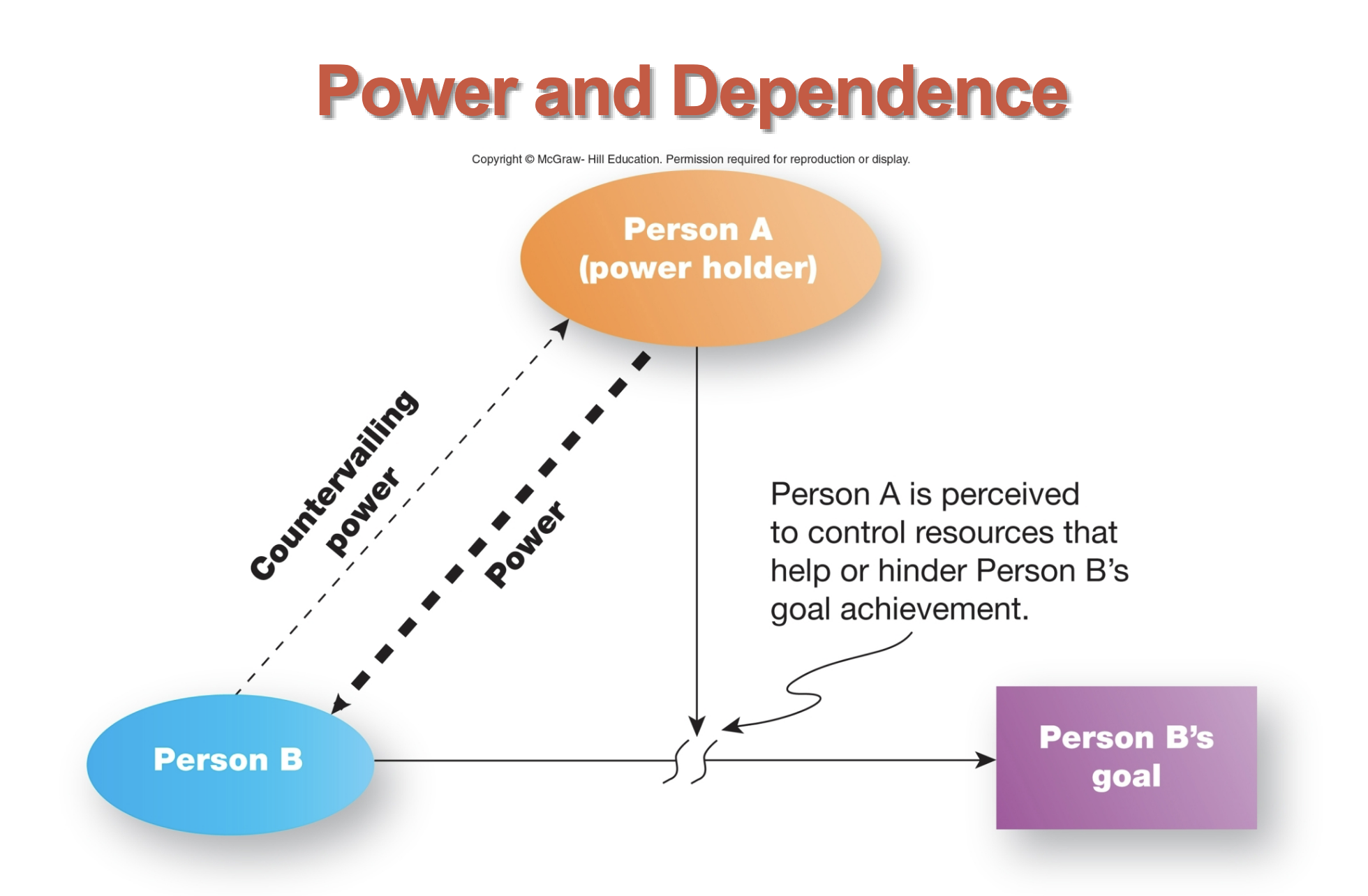
Power and Dependence Diagram
What are the 5 bases of power?
Reward, coercive, legitimate, expert, referent
The ability to give something valuable (like money, praise, promotions).
Reward power
The ability to punish or threaten.
Coercive power
Power based on a person’s role or position (like a boss or teacher).
Legitimate power
Power from knowledge or skills.
Expert power
Power based on respect, admiration, or charisma.
Referent power
What are the three consequences of influence?
Resistance, compliance, commitment
When someone refuses or pushes back against influence.
Resistance
When someone does what is asked but doesn’t truly agree.
Compliance
When someone fully agrees and is motivated to help.
Commitment
Trading something for cooperation.
Exchange
Using logic or emotions to convince someone.
Persuasion
Trying to make yourself look good or likable.
Impression management
Influence through presence or position without saying much.
Silent authority
Using support from higher authority.
Upward appeal
Controlling or limiting information.
Information control
Getting others to support you.
Coalition formation
Directly demanding or insisting.
Assertiveness
When one person believes another person has negatively affected (or will affect) something they care about.
Conflict
Why is conflict called a “perception”?
Because it’s based on what people think is happening—not always reality.
What are the positive effects of conflict?
Better decisions, more ideas and creativity, questions assumptions, improves team thinking, can strengthen teams (vs other groups)
What are the negative effects of conflict?
Stress and dissatisfaction, lower performance, poor communication, wasted time/resources, can hurt teamwork (within group)
Disagreements about the work itself (ideas, decisions).
Task conflict
Personal issues and emotions between people.
Relationship conflict
Disagreements about how work should be done.
Process conflict
What level of task conflict is good and why?
Moderate levels
Ignoring or withdrawing from conflict.
Avoiding style
Pushing your solution no matter what
Forcing style
Giving in to the other person.
Yielding style
Working together to find the best solution.
Problem solving style
Each side gives up something.
Compromising style
How do you use the problem-solving style?
Listen to the other side, focus on the issue, not the person, share information, find a win-win solution
What are the 5 stages of negotiation?
Preparation, relationship Building, information Exchange, persuasion, concessions & Agreement
Research the other side, set goals, understand your strategy.
Preparation stage
Build trust and get to know the other party.
Relationship building
Share positions, ask questions, discuss options.
Information exchange
Try to influence the other side and support your position.
Persuasion
Both sides give something and reach a final deal.
Concessions & agreement
What are the three levels of organizational culture?
Artifacts, shared values, shared assumptions
Visible and observable parts of culture.
Artifacts
What the organization says is important.
Shared values
what they say
Espoused values
what they actually do
Enacted values
Deep, unconscious beliefs that guide behavior.
Shared assumptions
What are physical structure artifacts?
Buildings, office layout, design, and objects.
What do symbols show in culture?
What the organization values.
Daily routines or repeated behaviors.
Rituals
Formal events to celebrate achievements.
Ceremonies
What is language in organizational culture?
How people speak and communicate
Shared stories about real people or events
Stories and legends
What makes stories powerful in organizations?
Based on real people, believed to be true, widely known, teach lessons (right vs wrong behavior)
Explains how organizations develop strong cultures by hiring and keeping similar people.
Attraction-selection-attrition theory
People are attracted to organizations that match their values.
Attraction in ASA
Companies hire people who fit their culture.
Selection in ASA
People who don’t fit the culture leave or are removed.
Attrition in ASA
What is the main result of ASA theory?
Organizations become more similar over time.
Change that is intentional and planned in advance by managers (change agents) to improve the organization.
Planned change
Change made before a problem happens.
Proactive change
Change made after a problem occurs.
Reactive change
Big, dramatic change that transforms the organization.
Radical change
Small, gradual improvements over time
Incremental change
Fixing small problems quickly
Put out small fire
Making small adjustments to improve things.
Tweaking
Fixing serious problems before they get worse.
Stop the bleeding
Completely changing the organization.
Transformation