Comms Final PLNU
 Call Kai
 Learn
Learn Practice Test
 Spaced Repetition
 Match
Match Flashcards
 Knowt Play
1/76

There's no tags or description
Looks like no tags are added yet.
Name | Mastery | Learn | Test | Matching | Spaced | Call with Kai |
|---|
No analytics yet
Send a link to your students to track their progress
77 Terms
Types of Nonverbal Communication: Proxemics
Spacial Communication (high/low context cultures)
Types of Nonverbal Communication: Paralinguistics
Tone, Volume, Pitch
Types of Nonverbal Communication: Chronemics
Use of time
Types of Nonverbal Communication: Physical Appearance
How you dress/present yourself
Types of Nonverbal Communication: Haptics
Study of touch
Types of Nonverbal Communication: Oculesics
Study of eye movements
The Halo Effect
Attractive people often get unwanted credit for high intelligence and better job performance.
Proxemic Categories (close to far)
Intimate (18in), Personal (4ft), Social (12ft), Public (25ft)
Intrapersonal Communication
he internal dialogue, self-talk, and cognitive processing that occurs within an individual's mind, acting as a "voice-over" to life
Forms of Self Talk
Journaling, Daydreaming, Inner Dialogue, Thinking Aloud, Imagining Conversations
Antidotes to negative self-talk
Recognize your self putdowns, compliment yourself, compliment others, replace negative with positives
Cognitive dissonance
Imbalance between your actions and values, attitudes, and beliefs
Usually creates a guilt conscience
Listening Process - HURIER: H
Hearing - A physical, passive action
Listening Process - HURIER: U
Understanding - Placing meaning to the sounds that were heard
Listening Process - HURIER: 1st R
Remembering - Finding a way to store info in your brain (ex. stories, connections, acronyms)
Listening Process - HURIER: I
Interpreting - Consider verbal and nonverbal meaning
Listening Process - HURIER: E
Evaluating - Assess the value of the message in context
Listening Process - HURIER: 2nd R
Responding - Can be verbal or nonverbal
Purpose of feedback
to ensure the message was understood as intended, turning one-way communication into a two-way process
Types of speeches by speaking style
Scripted, Memorized, Extemporaneous, and Impromptu
Three p's of avoiding speech anxiety
Purpose -> Care about your content
Preparation -> Create outlines and visual aids
Practice -> In front of a buddy, mirror, or camera
Characteristics of a good speech
Conversational tone
Eye contact and scanning
Comfortable pace
Consistent projection and clarity of voice
Use of appropriate gestures
No distracting phrases or movements
Ethical speech writing
Not plagiarizing speeches, as well as citing every source we use
Audience analysis
Situation, Demographics, and Attitudes/Beliefs
Code switching
Changing the way you speak/appear to match your audience/context
Types of good hooks
Stories, Relevant Humor, Illustrations, Rhetorical Questions, Action Questions, Dramatic Devices, Relevant Quotations
Types of supporting material
Stories, Exposition, Statistics, Analogies, Research Conclusions (Cite), Testimonials
What makes a reliable source
Recent, Relevant, Reliable
Basic speech parts
Intro (Hook, Thesis [Preview], Credibility Statement), Body (Main Points and Examples), Conclusion (Review Main Points and Final Thoughts)
Informative speech
Way of disseminating, managing, and dealing with information.
Informative Speech Types
Descriptive (all about), Explanatory (causes of), Exploratory (collab and findings), and Demonstrative (how to)
Distracting Mannerisms
bodily movements that allow a speaker to discharge nervous energy, serve no relevant purpose in the presentation, and often divert attention from the message
Attraction Types: Physical
Drawn to how someone looks
Attraction Types: Social
Based on actions and personality
Attraction Types: Task
Desire to work with someone (group project)
Attraction Types: Sexual
Desire to engage in sexual acts
Attraction Types: Fatal
Attracted to a specific quality (reason for breaking up)
Model of Interaction Stages
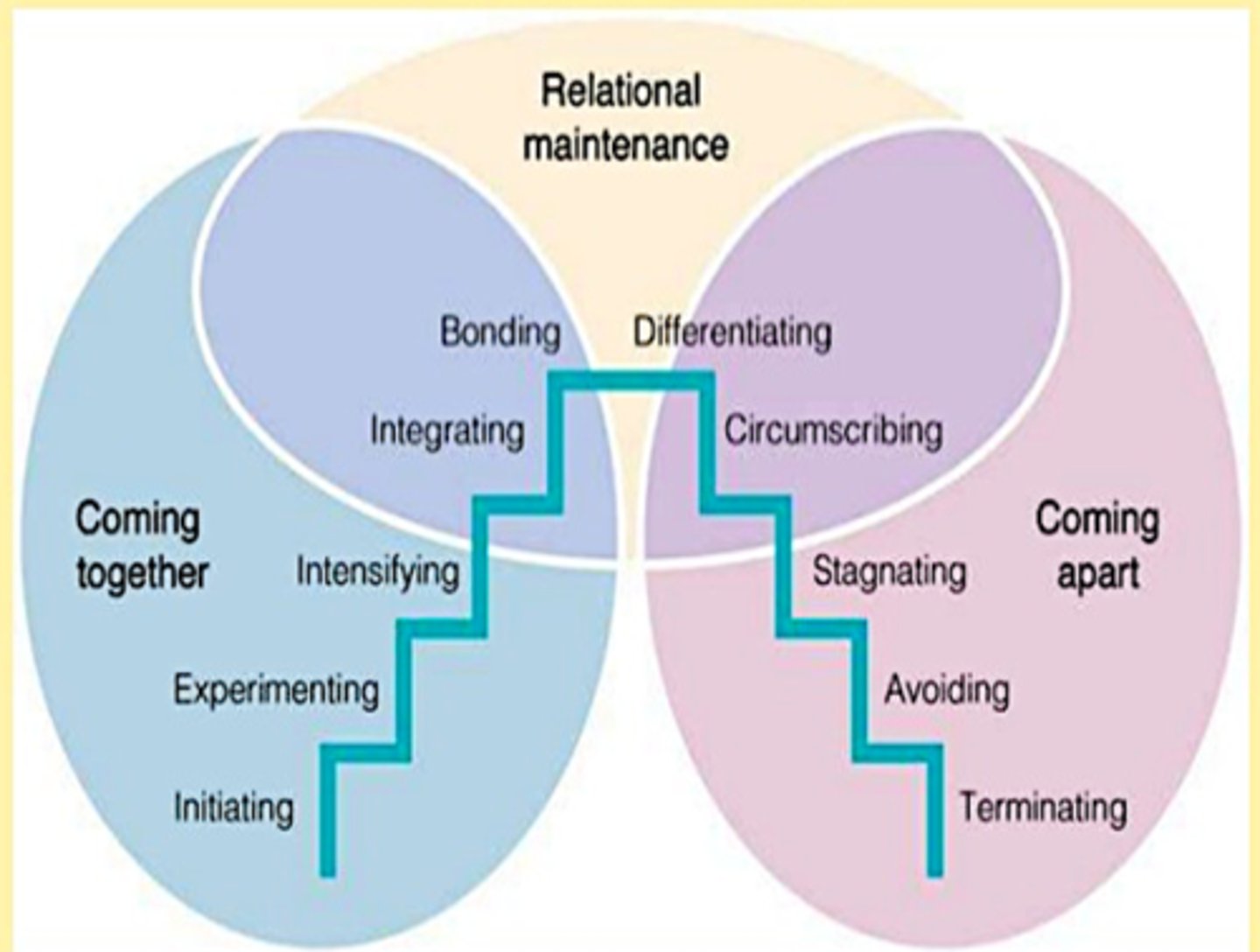
Social exchange theory
the theory that our social behavior is an exchange process, the aim of which is to maximize benefits and minimize costs
Turning points
perception of events that transform the relationship
Why we form relationships
Proximity and Attraction
3 types of defensive communication
Attacking the critic, distorting critical info, avoiding critical info
Interpersonal Communication
communication between people in the context of a relationship (usually 2-3)
Self Disclosure
revealing intimate aspects of oneself to others
Social Penetration Theory
theory that proposes relationships develop through increases in self-disclosure (both depth and breadth)
Empathy vs sympathy
In empathy, we understand the feelings of others.
In sympathy, we feel the feelings of others.
What is empathy and how can we use it?
Empathy is feeling with someone, experiencing emotions with them to understand their perspective.
Persuasive Speech
A presentation intended to influence the opinion or behavior of an audience
Micro-Changes
asking an audience to adopt and make small changes in behavior instead of one or more large behavioral changes
Moral reframing
A technique in which a position an individual would not normally support is framed in a way that is consistent with that individual's moral values
Rhetorical appeals
ethos (credibility), pathos (emotion), logos (logic)
Monroe's Motivated Sequence
Attention, Need, Satisfaction, Visualization, and Action
The science of persuasion- 6 shortcuts
reciprocity, scarcity, authority, consistency, liking, consensus
Before interview steps
1. research on company/interviewer
2. Prepare for questions/tests
3. Prepare resume and cover letter
4.Be early (5-7 mins)
During interview
1. Practice engaging and professional nonverbal (eye contact, posture, nodding, smiling, and avoiding fidgeting)
2. Turn off cell phone
3. Take notes with a professional pen/pad
4. Thank interviewer for time and consideration
STAR method
Situation, Task, Action, and Result
STAR Method: Situation
Explain the context (1-3 sentences)
STAR Method: Task
What was your responsibility (1 sentence)
STAR Method: Action
What did you do? (50% of your answer)
STAR Method: Result
Positive outcomes and what did you learn (1-2 sentences)
Questions to ask at end of interview
Company Specific, Role Specific, and Wrap up's
Illegal questions
Any inappropriate topics, includes mostly about personal life (marriage, age, religion, etc.)
Communication
A process in which feelings and ideas are expressed as verbal and/or nonverbal messages sent, received, and comprehended
Characteristics of Communication
Dynamic, Continuous, Irreversible, Interactive, Contextual, Accidental, Expressive, Rhetorical
Perception Influencers
Culture, Experiences, Atitudes, Memory, Expectations, Physical/Emotional State, Communication Skills
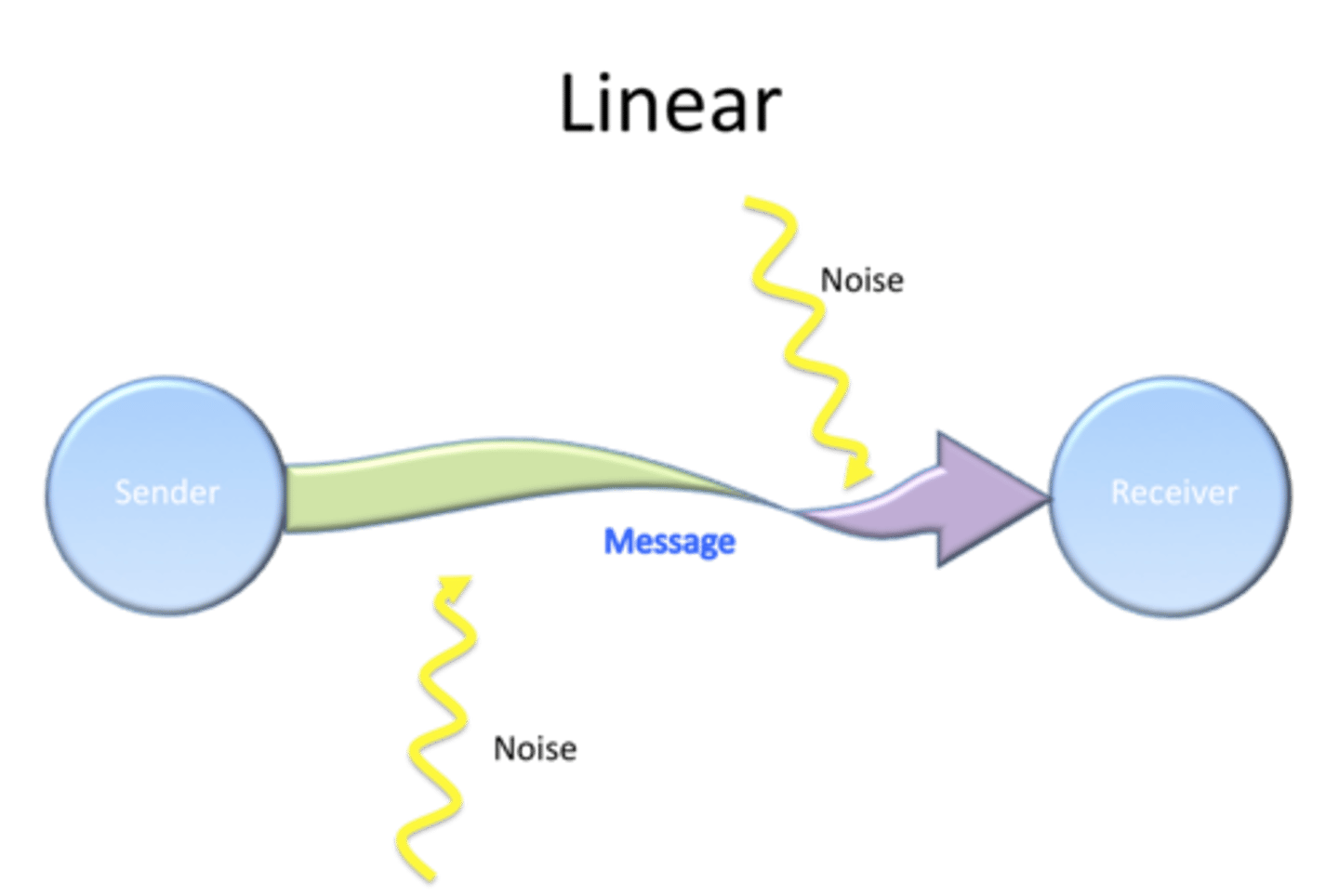
Communication Model: Transmission
Communication Model: Interaction
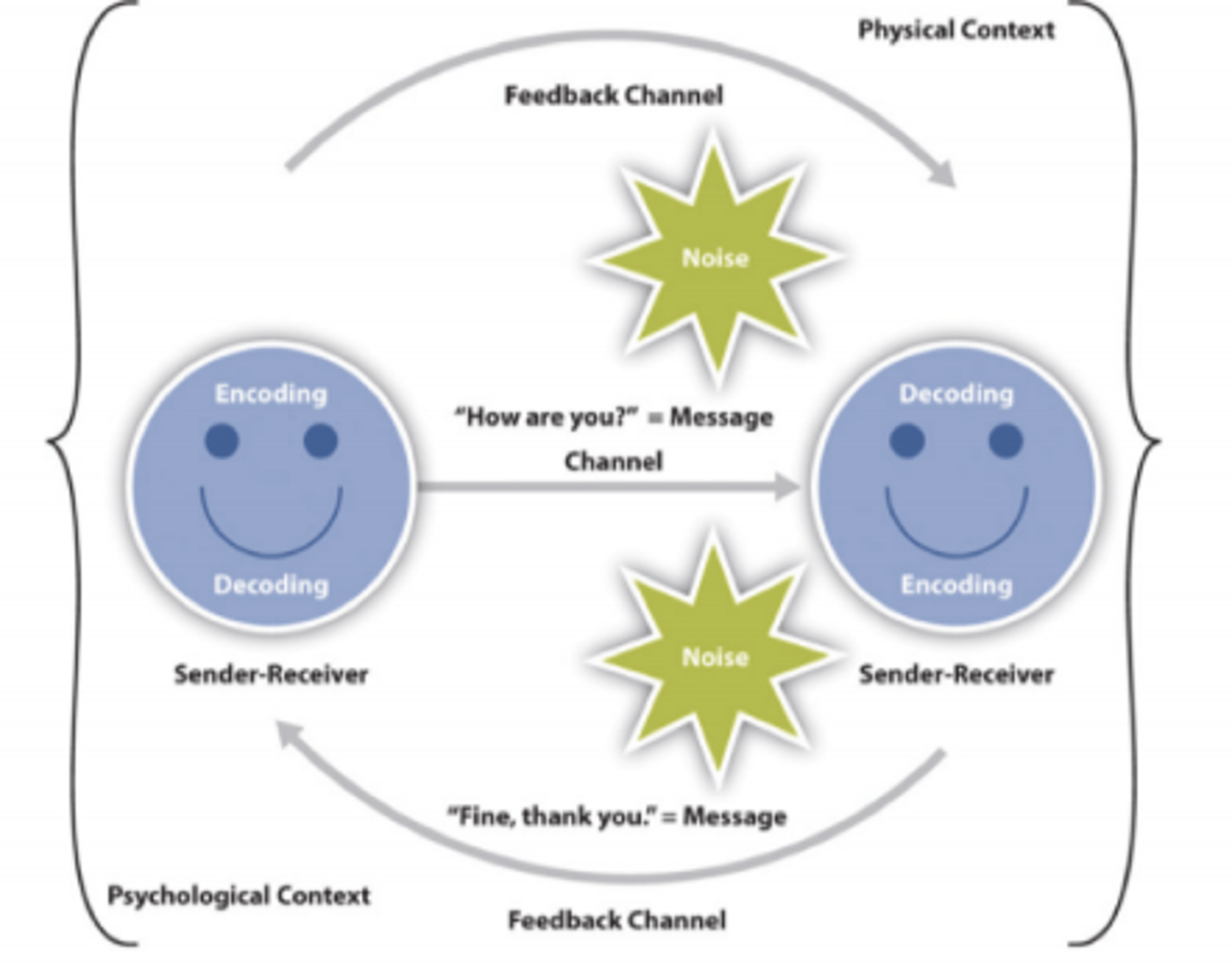
Types of Communication Noise
Environmental: External Noise (ex. construction)
Physiological - impairment: Inability to hear (deafness)
Psychological: Internal Noise (ex. monologue, hunger cues)
Semantic: misunderstandings (ex. language, sarcasm)
Communication Context
When and where the communication takes place including the audience (ex. size of room, demographics of audience, etc.)
Culture
Any groups/labels that contribute to your identity: Race/Ethnicity, Sex/Gender, Sexual Orientation, Religion, Generation, Socioeconomic Status, Disabilities
Filler Words
Unnecessary words or phrases that create pauses and disrupt the flow in a speech.
Nonverbal Communication
The non-word message. (ex. body language, eye contact, gestures, tone, posture, etc.)
EVT (Expectation Violation Theory)
Analyzes how individuals respond to unexpected violations of social norms, such as personal space, nonverbal behavior, or communication styles
Types of Nonverbal Communication: Kinesics
Body Movement
Types of Nonverbal Communication: Gestures
Movements of hands and arms
Types of Nonverbal Communication: Affect Displays
Gestures/Posture/Facial Expressions that show emotion
Still learning (62)
You've started learning these terms. Keep it up!