Final Exam Review Flashcards - CIS 458
 Call Kai
 Learn
Learn Practice Test
 Spaced Repetition
 Match
Match Flashcards
 Knowt Play
1/52

Earn XP
Description and Tags
This set of flashcards covers normalization principles, SQL commands and syntax (DDL, DML, DCL), and Transaction Management concepts based on the course lecture notes.
Name | Mastery | Learn | Test | Matching | Spaced | Call with Kai |
|---|
No analytics yet
Send a link to your students to track their progress
53 Terms
What is defined as an anomaly in a database table?
is a problem caused by redundant data in a table.
Three types of anomalies
Insertion
Deletion
Modification
Composite key
A primary key made up of two or more attributes that together uniquely identify a row in a table.
Functional dependency
Occurs when one attribute uniquely determines another attribute
Student ID → StudentName; One StudentID determines exactly one student name
Full dependency
A non-key attribute depends on the entire composite key.
(StudentID, CourseID) → Grade; Grade depends on both attributes together
Requirements for First Normal Form (1NF)?
Having no repeating groups and having atomic values (one value per cell).
Requirements for Second Normal Form (2NF)?
The table must be in 1NF and have no partial dependencies.
Requirements for Third Normal Form (3NF)?
The table must be in 2NF and have no transitive dependency for non-key attributes.
What are the three major functions of SQL?
Data Definition Language (DDL)
Data Manipulation Language (DML)
Data Control Language (DCL)
Which SQL commands belong to Data Definition Language (DDL)?
CREATE, ALTER, and DROP.
Which SQL commands belong to Data Manipulation Language (DML)?
SELECT, INSERT, UPDATE, and DELETE.
Which SQL commands belong to Data Control Language (DCL)?
GRANT and REVOKE.
What elements are required when creating a table in SQL?
Each table must have a name and several attributes, and each attribute must have a name and a data type.
What is Structured Query Language (SQL)?
The language we use to create, manipulate, and maintain a relational database
What is Data Definition Language (DDL)?
Used to create, modify, and delete database objects
What is Data Manipulation Language (DML)?
Used to manipulate data
What is Data Control Language (DCL)?
Used to control user permissions
What is the DEFAULT constraint?
Provides automatic value if non entered
What is the NOT NULL constraint?
Must have a value
Transaction
A logical unit of work that must be entirely completed or aborted.
ACID properties of a transaction
Atomicity
Consistency
Isolation
Durability
What is the UNIQUE constraint?
Value must be unique and not duplicate
What are the types of locks used in concurrency control? —
Shared Lock
Exclusive Lock
What are the phases in Two-Phase Locking (2PL).
Growing Phase
Shrinking Phase
What is a deadlock?
Two transactions wait forever for each other's resources.
Partial dependency
A non-key attribute depends on only part of a composite key
(StudentID, CourseID) → StudentName; StudentName depends only on StudentID
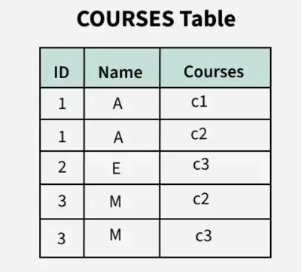
Which form is this?
1NF
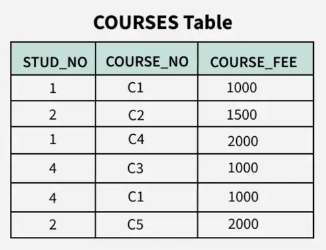
Which form is this?
2NF
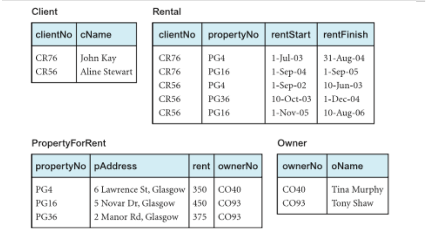
Which form is this?
3NF
What is the PRIMARY KEY constraint?
Uniquely identifies each row
What is the FOREIGN KEY constraint?
References a primary key from another table
How to change the definition of tables?
ALTER table
What is the solutions for a deadlock?
Deadlock detection and recovery
Timeouts
Deadlock prevention.
Deadlock detection and recovery
Allows deadlocks occurs but detect them and recover
Timeouts
If transaction exceeds the time limit, it aborts/roll back
Deadlock prevention
Lock all records at the beginning at the transaction
Growing Phase
When the transaction acquires locks only (Lock Only Mode)
Shrinking Phase
When the transaction releases locks only (Unlock Only Mode)
Insertion Anomaly
Inconsistency when adding data
Deletion Anomaly
Inconsistency when removing data
Modification Anomaly
Inconsistency when updating data
Atomicity Property
All operations happen or nothing happens
Consistency Property
Database remains valid
Isolation Property
Transactions do not interfere
Durability Property
Committed changes are permanent.
Shared Lock
Allows reading but no updating and prevents exclusive locks
Exclusive Lock
No access permitted, used when preparing updates.
Alias
Temporary name for a column or table
Subquery
A query inside another query
Concurrency Control
Managing simultaneous transactions safety
Problems from simultaneous transactions?
Lost update
Dirty Read
Unrepeatable Read
Solutions to simultaneous transactions
Serializability
Serializability
Ensures transaction behave as if executed one at a time