Astronomy
 Call Kai
 Learn
Learn Practice Test
 Spaced Repetition
 Match
Match Flashcards
 Knowt Play
1/46

There's no tags or description
Looks like no tags are added yet.
Name | Mastery | Learn | Test | Matching | Spaced | Call with Kai |
|---|
No analytics yet
Send a link to your students to track their progress
47 Terms
what is the universe made of?
stars
planets
moons (satellites)
asteroids
comets
solar (star) systems
galaxies
universe
what are stars
large, glowing balls of gas that generate heat and light through nuclear fusion
stars are fully plasma
hot enough to fuse, nuclear fusion is how they generate their energy
all stars are mostly hydrogen and helium producing their energy by fusing hydrogen into helium
sun is 99% of the solar system by mass
what are planets
moderately large objects that orbit a star; they don’t glow they shine by reflected light
if there is no star to illuminate them it is hard to see them
planets may be rocky, icy, or gaseous in composition
what are moons (satellites)
an object that orbits a planet
Ganymede is the moon of Jupiter which is the biggest moon in our solar system
moons are also called satellites because satellites are anything that orbits
not all planets have moons
it is a natural satellite not artificial
what are asteroids?
come in a variety of sizes
relatively small and rocky objects that orbit a star
they don’t have a lot of gravity so they don’t really look like a sphere
what are comets?
relatively small and icy objects that orbit a star
what are solar (star) systems
another name for the sun is sole
a star and all the material that orbits it, including its planets, moons, asteroids, and comets
what are nebulae
can get very dense; basically gas clouds but they are very very huge
interstellar clouds of gas and/or dust where stars are born
what are galaxies
great islands of stars in space, all held together by gravity and orbiting a common center
what is the universe
the sum total of all matter and energy
that is, everything within and between all galaxies
Organization of the Universe
universe →
supercluster of galaxies (thousands of galaxies held together by gravity; super big) →
groups of galaxies (smaller amount of galaxies held together by gravity) →
galaxies (groups of stars, around 100 billion stars in each) →
solar system (planets, asteroids, comets orbiting around one star) →
planets and moons (all very diverse)
foundations of astronomy
astronomy is the study of the universe: the totality of all space, time matter and energy
it is a subject like no other, we need to change our pespective of size, scales and time unfamiliar to us
powers of 10: large numbers
a positive exponent on the number 10 tells us how many zeros there are
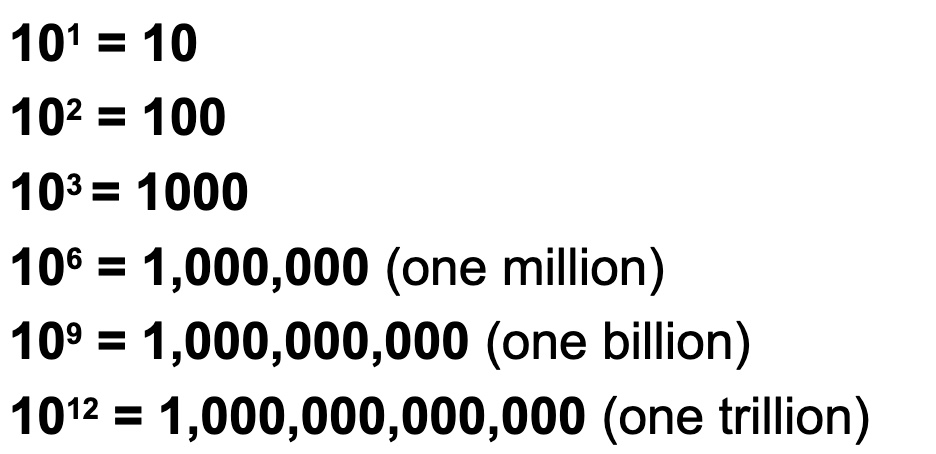
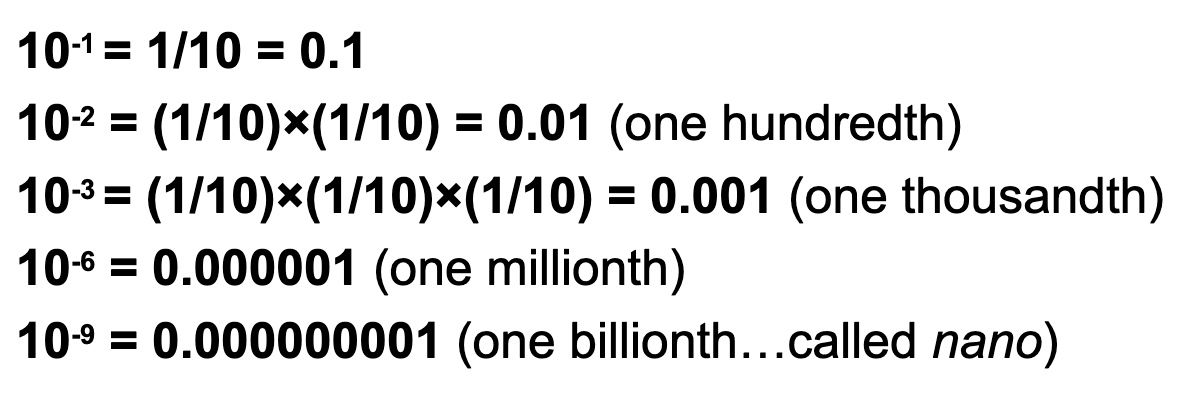
power of 10: small numbers
negative exponent tells us how many decimal places are in the number
scientific notation
a way of expressing large or small numbers
2,230,000 = 2.23 × 10^6
0.0095 = 9.5 × 10^-3
basic unit of length in astronomy
meters (m)
astronomical unit (AU)
is the average earth-sun distance: 1 AU = 149.6 million km
→ example is that Jupiter is 5 AU away from the sun which means it is 5 times further from the sun than earth is, Mars is 1.5 AU, Neptune is 30 AU
→ 1 AU = 1.5 × 10^8km
light year (ly)
is the distance light travels in a year 1 ly = 9.461 trillion km = 63, 000 AU
→ it would take light 100,000 years to cross the milky way
→ where we are is 6,000 light years
→ to get to andromeda it is 2 million light years away
→ virgo cluster is 60 million light years away
parsec (pc)
an astronomical unit that is about 3.26 ly
units in space
on the earth we use km
in the solar system we use astronomical units
once we leave the solar system its best we start talking about light years
the nearest star to us is 4 light years away
our galaxy is 100,000 light years across
the local group is million of light years
and the universe is billions of light years
speed of light
light has a finite speed so it takes time for light to travel great distances
the speed of light is 300,000km per second
when something sends out light it takes time for it to arrive
for example, usually you see lightning before you hear thunder because light travels much faster than sounds
how can we know what the universe was like in the past?
we see objects as they were in the past
the farther away we look the farther back we see in time
we see objects in the sky as they were some time agi
we see the moon as it was 1 second ago
we see the sun as it was 8 minutes ago
we see proxima centauri as it was four years ago
many distant galaxies are billions of light-years away or more, so we can see what the universe was like billions of years ago when the universe was newly born
light travel time to moon
1 second
light travel time to sun
8 minutes
light travel time to sirius (the dog star, brightest star in our sky)
8 years
light travel time to andromeda galaxy
2.5 million years
why do we need to understand light?
in astronomy, light is the only way we get information about whats happening in the universe
astronomers are passive observers of what is going on, light is the messenger so we need to understand it
light is a wave
what is a wave
if a lead is sitting on the ponds surface, it will bob up-and-down as the wave ripples, but the leaf only moves up-and-down, not sideways
this shows that the water is not moving past, the wave is
a wave is a pattern of motion that can carry energy without carrying matter (stuff) along with it
wave terminology
when describing waves we often speak of their:
wavelength
frequency
wavelength
the distance between two wave peaks
frequency
the number of times per second that a wave bops up and down
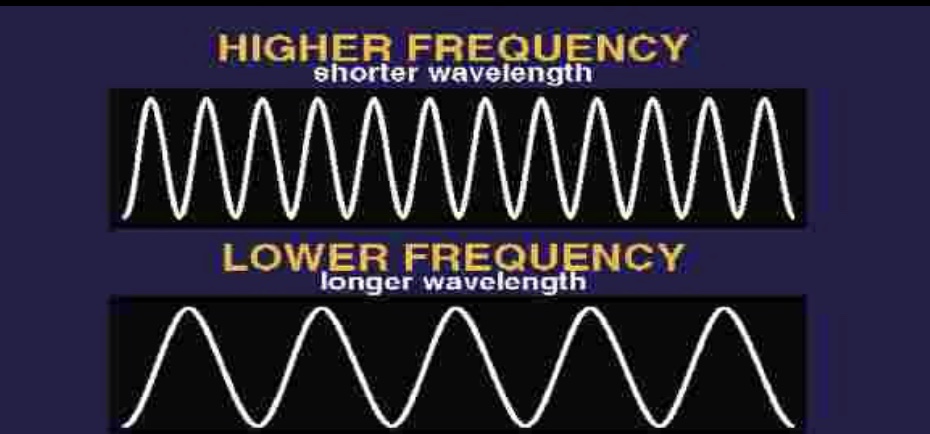
frequency and wavelength
inverse relationship:
higher frequency → shorter wavelength
lower frequency → longer wavelength
speed of a wave
waves have speed and they can transmit energy
example: every time you make a phone call, invisible radio waves (and microwaves) are depositing energy into the receivers phone
the speed with which a wave moves depends on both its: frequency and wavelength
how to determine the speed of a wave
for any wave:
speed of wave = (frequency) x (wavelength)
a common convention is to denote:
frequency as f
wavelength as λ
speed as c
so what written using words above is seen as c=fλ
how to use this wave equation
frequency as f, is measured in Hertz (Cycles/sec)
wavelength as λ, is measured in Meters (m)
speed as c, is measured in meters/sec (m/s)
what is a light (radiation)
light is a wave
why isnt it more obvious that light is a wave? → because the wave length of light is tiny
depending on the vibration (frequency and wavelength), light comes in many forms
humans can only see one form of light called the ‘visible’ form
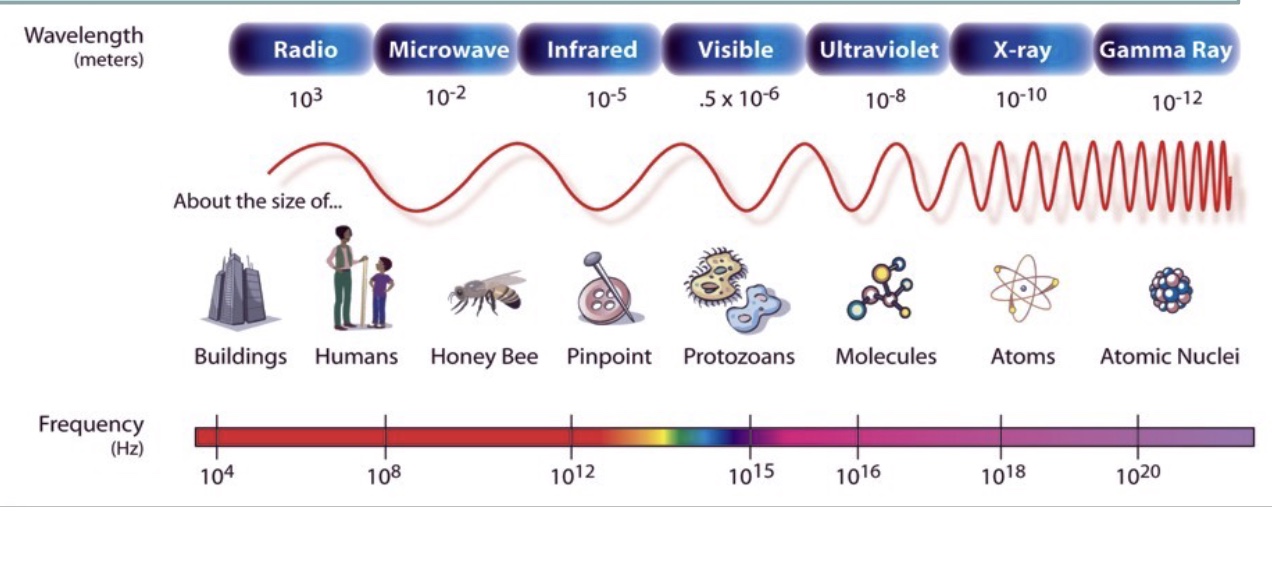
the electromagnetic spectrum
the term “light” or “radiation” refers to any electromagnetic (EM) wave listed
the human eye is sensitive to a small part of the electromagnetic spectrum (visible)
but we are familiar with ‘invisible light’: mobile phones use radio waces, microwave oven uses microwaves, TV remote uses infrared light, tanning booths use ultraviolet light, medical imaging uses x-rays, cancer radiotherapy uses gamma rays
colour and visible light
visible light is really made up of different colour from red to violet (combine all these colour and we get white light)
visible light = colour = wavelength
what we see as different colours are in fact different wavelengths of light
the range of colours the human eye is sensitive to is from violet to red, or in wavelengths, from 400nm to 700 nm
each type of EM radiation travels at exactly the same speed (300,000 km/s)
relationship between frequency and energy
the higher the frequency of light, the more energy it has, and the more powerful the light source
light and temperature
a piece of metal thrown into a fire will glow first red, then orange, if the fire is really hot, it may even glow yellow
the colour of the metal object depends on the temperature
as an object is heated, it emits light at different wavelengths (depending on the temperature)
any object emits light (radiation)
the type of light (radiation) depends on the temperature of the oject
the hotter the object, the shorter the wavelength of light (radiation) emitted
do humans emit light
yes, but not visible light → infrared light
a special camera is needed for our eyes to detect infrared light
blackbody radiation
all objects emit light in the form of electromagnetic radiation
a blackbody is a theoretical or model object which absorbs all radiation falling on it, reflecting or transmitting none, it is a hypothetical object which is a ‘perfect’ absorber and a ‘perfect’ emitter of radiation over all wavelengths
in astronomy, stars are often modelled as blackbodies, although it is not always a good approximation
spectrum
a graph of the amount of light given off at different wavelengths
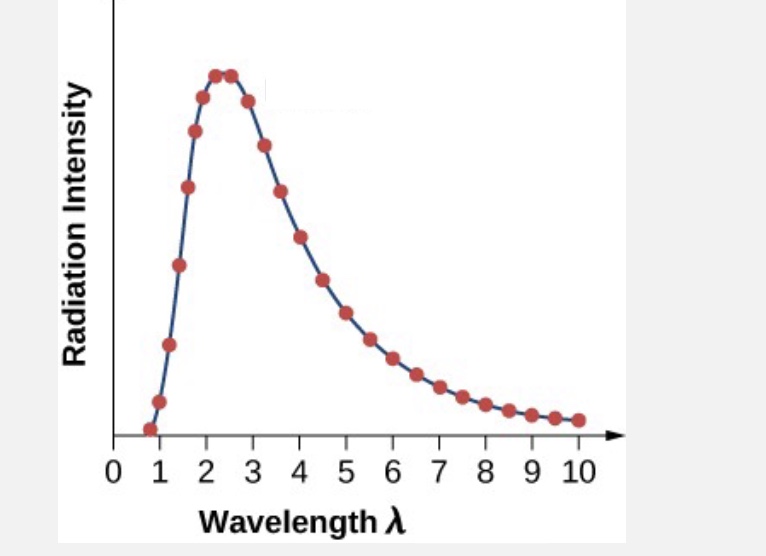
blackbody spectrum
here are three objects shown on a blackbody spectrum
notice what happens to the peak of the graph with objects at different temperatures
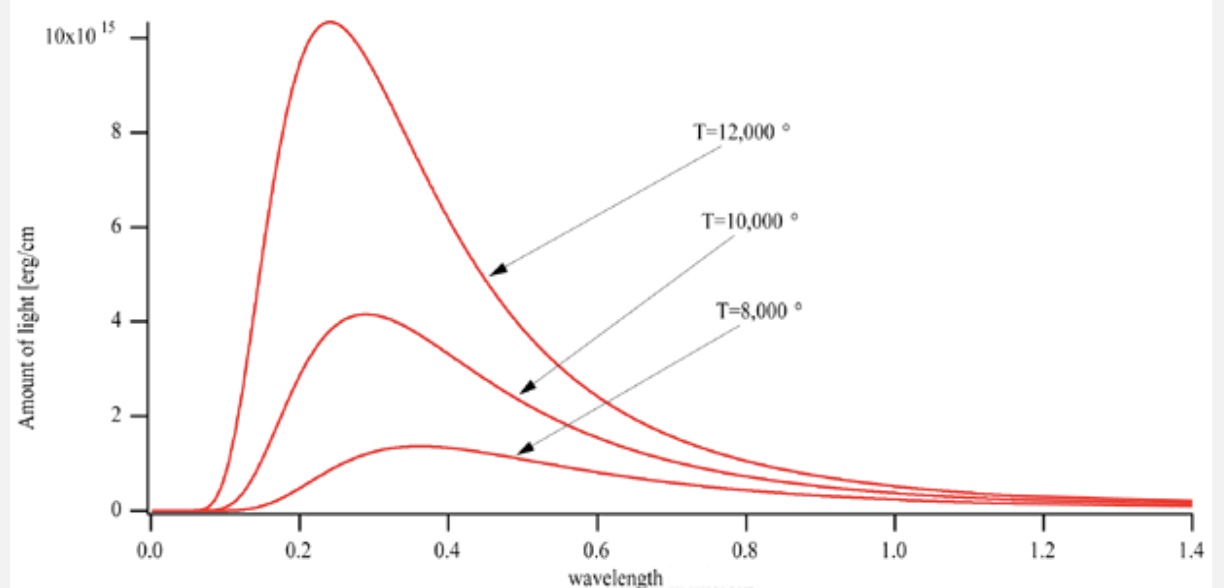
blackbody curves: things to notice
the wavelength at which a hot object (a metal rod or a star) emits the most electromagnetic radiation is inversely proportional to the temperature of the object
the peak wavelength is the wavelength at which most of the radiation is given off
the hotter the object, the peak light emitted shifts to the left: shorter wavelength
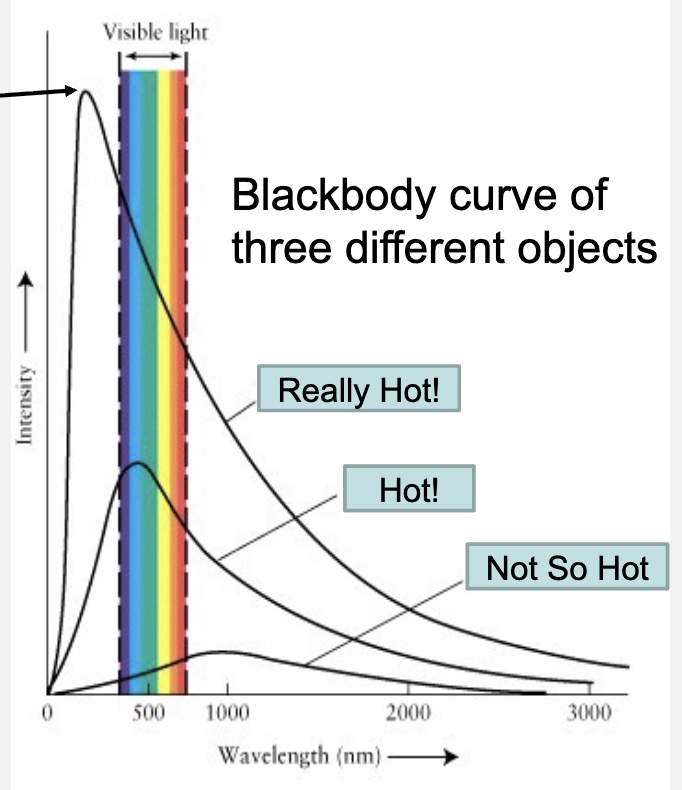
peak wavelength
the wavelength at which the peak of the graph appears is the peak wavelength
where this peak occurs is the most important part of this graph
the peak wavelength can tell us how hot the object is
hotter blackbodies give off more light than the cooler one
the peak of the blackbody curve in a spectrum moves to shorter wavelengths for hotter objects
putting blackbodies all together
as the object gets hotter, it changes from red to orange to yellow white and eventually to blue and beyond
hotter objects will have shorter wavelengths
blue is hot, red is cool
hotter objects emit light with shorter wavelengths (towards the blue end of the visible spectrum)
stars of different temperatures shine with different colours (blue stars are hottest red are coolest)