StemUp: AQA A level Physics 3.5.1 Current electricity
 Call Kai
 Learn
Learn Practice Test
 Spaced Repetition
 Match
Match Flashcards
 Knowt Play
1/109

There's no tags or description
Looks like no tags are added yet.
Name | Mastery | Learn | Test | Matching | Spaced | Call with Kai |
|---|
No analytics yet
Send a link to your students to track their progress
110 Terms
What is current? (2)
- Current is the rate of flow of charge.
- It is measured in amperes (A).
What is conventional current? (2)
- Conventional current is defined as the flow of positive charge from the positive terminal to the negative terminal.
- Conventional current flows opposite to the direction of electron flow.
What is the equation for electric current? (2)
- The equation is: I = ΔQ / Δt.
- Where I is current (A), ΔQ is charge transferred (C), and Δt is time taken (s).
What is a coulomb? (1)
A coulomb is the unit of electric charge.
What is meant by one coulomb? (1)
One coulomb is the amount of charge that passes through a point in one second if the current is 1 ampere.
What is potential difference? (2)
- Potential difference is the work done per unit charge between two points in a circuit.
- It is measured in volts (V).
What does 1 volt represent? (1)
1 volt means that 1 joule of energy is transferred per 1 coulomb of charge.
What is the equation for potential difference? (2)
- The equation is V = W / Q.
- Where V is potential difference (V), W is energy transferred (J), and Q is charge (C).
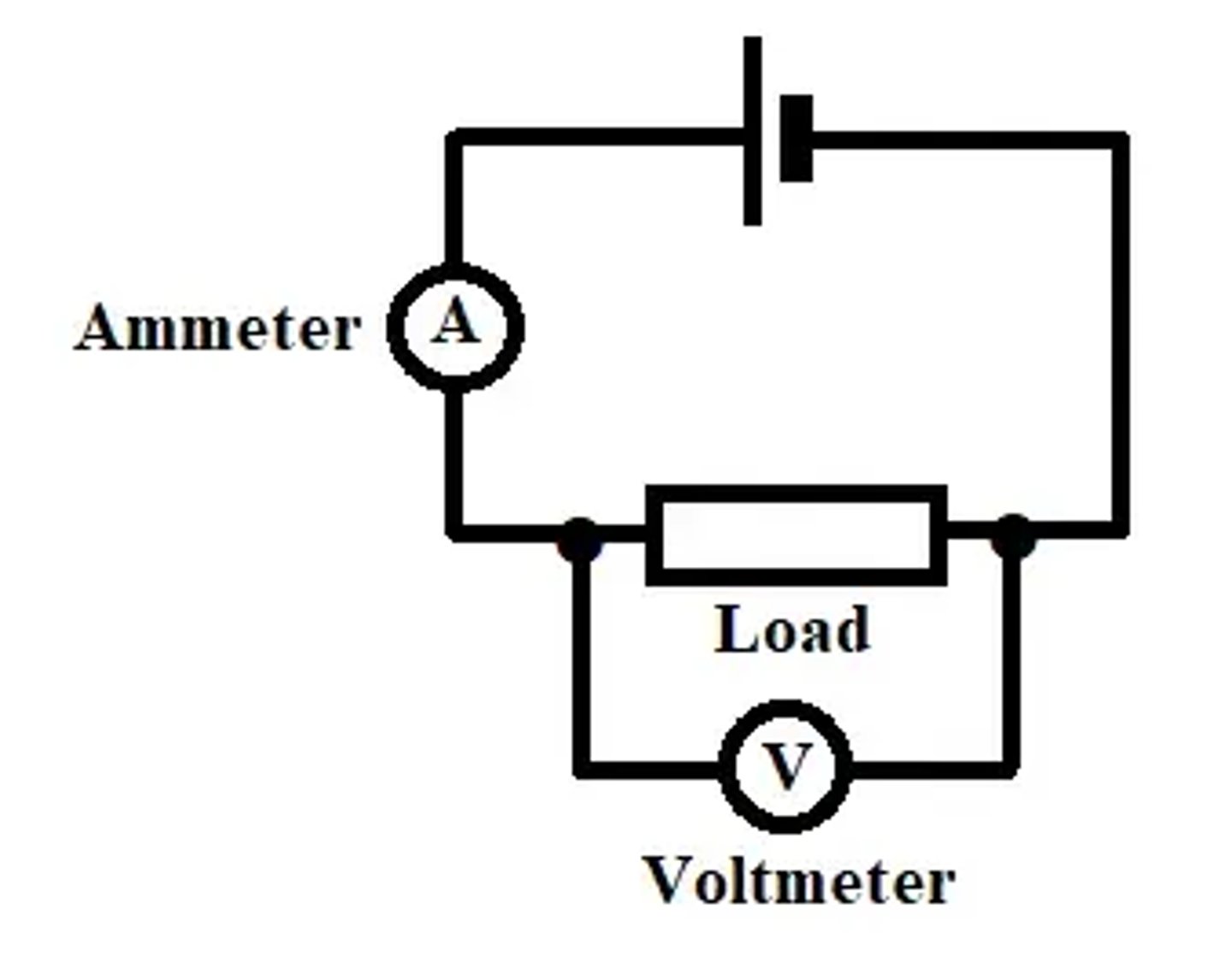
How is current measured in a circuit? (1)
Current is measured using an ammeter connected in series with the component.
How is potential difference measured in a circuit? (1)
Potential difference is measured using a voltmeter connected in parallel with the component.
How are ammeters and voltmeters placed in a circuit? (2)
What is resistance? (2)
- Resistance is a measure of how difficult it is for current to flow through a component.
- It is measured in ohms (Ω).
What is the equation for resistance? (2)
- The equation is R = V / I.
- Where R is resistance (Ω), V is potential difference across the component (V), and I is current through the component (A).
What is Ohm's law? (2)
- Ohm's law states that current is directly proportional to potential difference across a component.
- This applies given that physical conditions (such as temperature) remain constant.
How does Ohm's law apply to an ohmic conductor? (2)
- An ohmic conductor obeys Ohm's law.
- Its current-voltage graph is a straight line through the origin, showing constant resistance.
What is an I-V characteristic graph? (1)
It is a graph showing current plotted against potential difference for a specific component.
What is a V-I characteristic graph? (2)
- It is a graph where potential difference is plotted on the y-axis and current on the x-axis.
- It shows the same information as an I-V graph but with reversed axes.
What does the gradient of an I-V characteristic graph represent? (1)
The gradient of an I-V characteristic graph is equal to the resistance of the component.
What does the I-V graph of an ohmic conductor look like? (2)
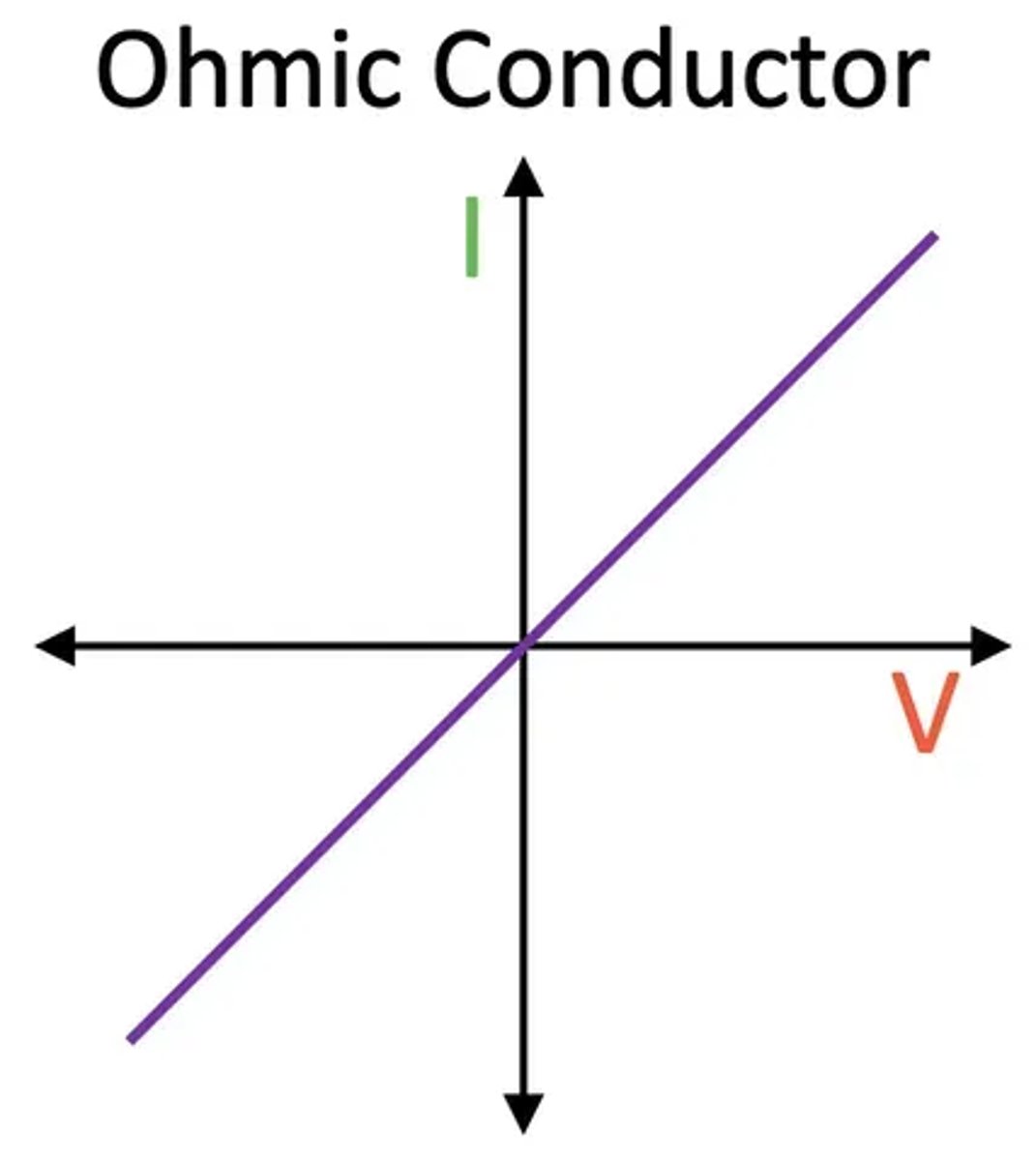
What does the shape of the I-V graph of an ohmic conductor indicate? (2)
- The shape of the I-V graph is a straight line through the origin.
- It shows current increases proportionally with voltage, meaning resistance is constant.
Why are semiconductors good sensors for changes in the environment? (2)
- They start with few charge carriers (less than conductors) but can release more when energy is supplied.
- Making them sensitive to external conditions.
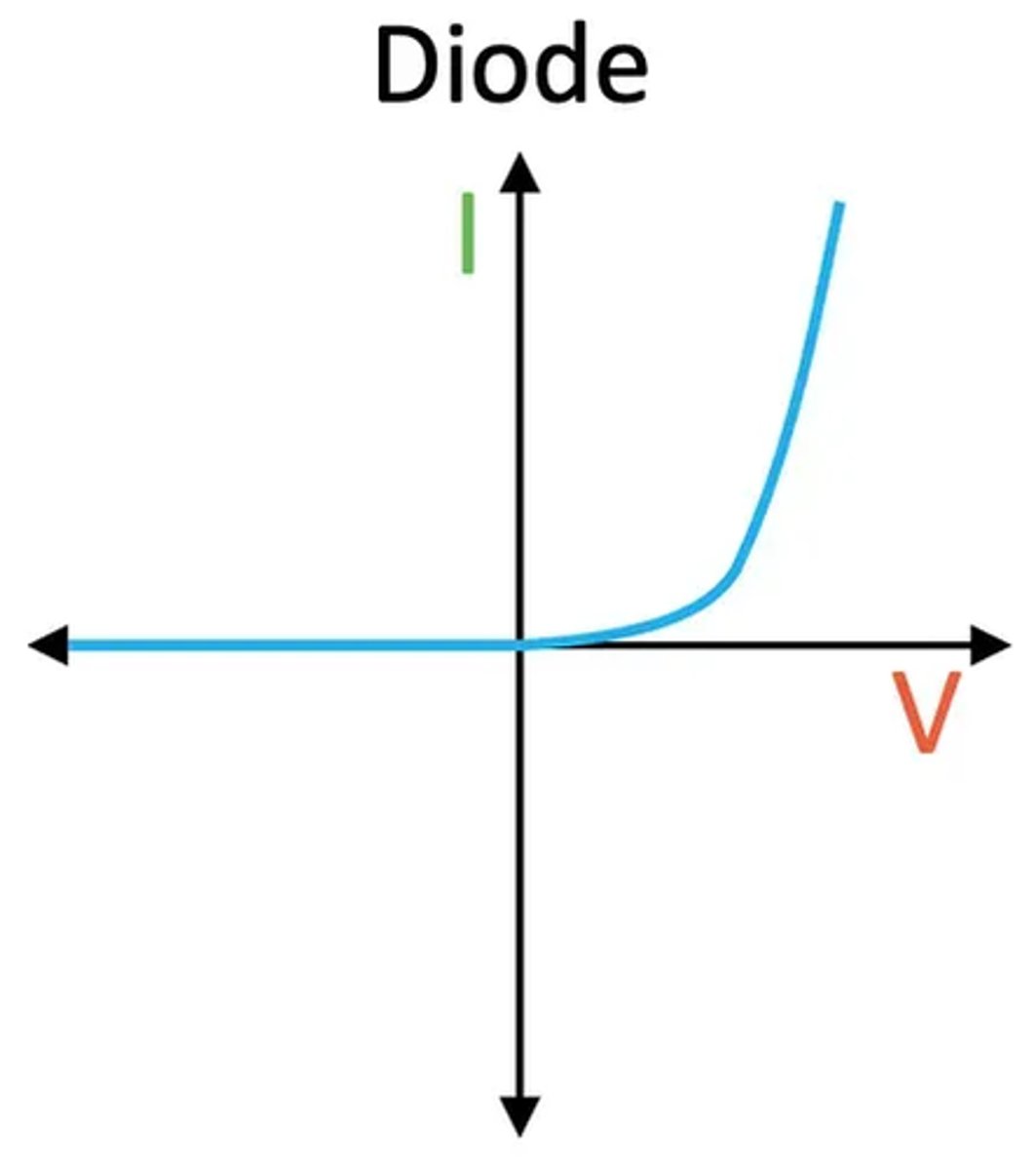
How does a semiconductor diode behave in forward bias? (2)
- In forward bias, a semiconductor only conducts significantly after a threshold voltage.
- This happens where current increases steeply.
How does a semiconductor diode behave in reverse bias? (1)
In reverse bias, very little current flows because resistance is extremely high.
What does the I-V graph of a semiconductor diode show overall? (2)
- The graph is asymmetrical.
- Steep current rise after threshold in forward bias will be shown, with almost no current in reverse bias.
What does the I-V graph of a semiconductor diode look like? (2)
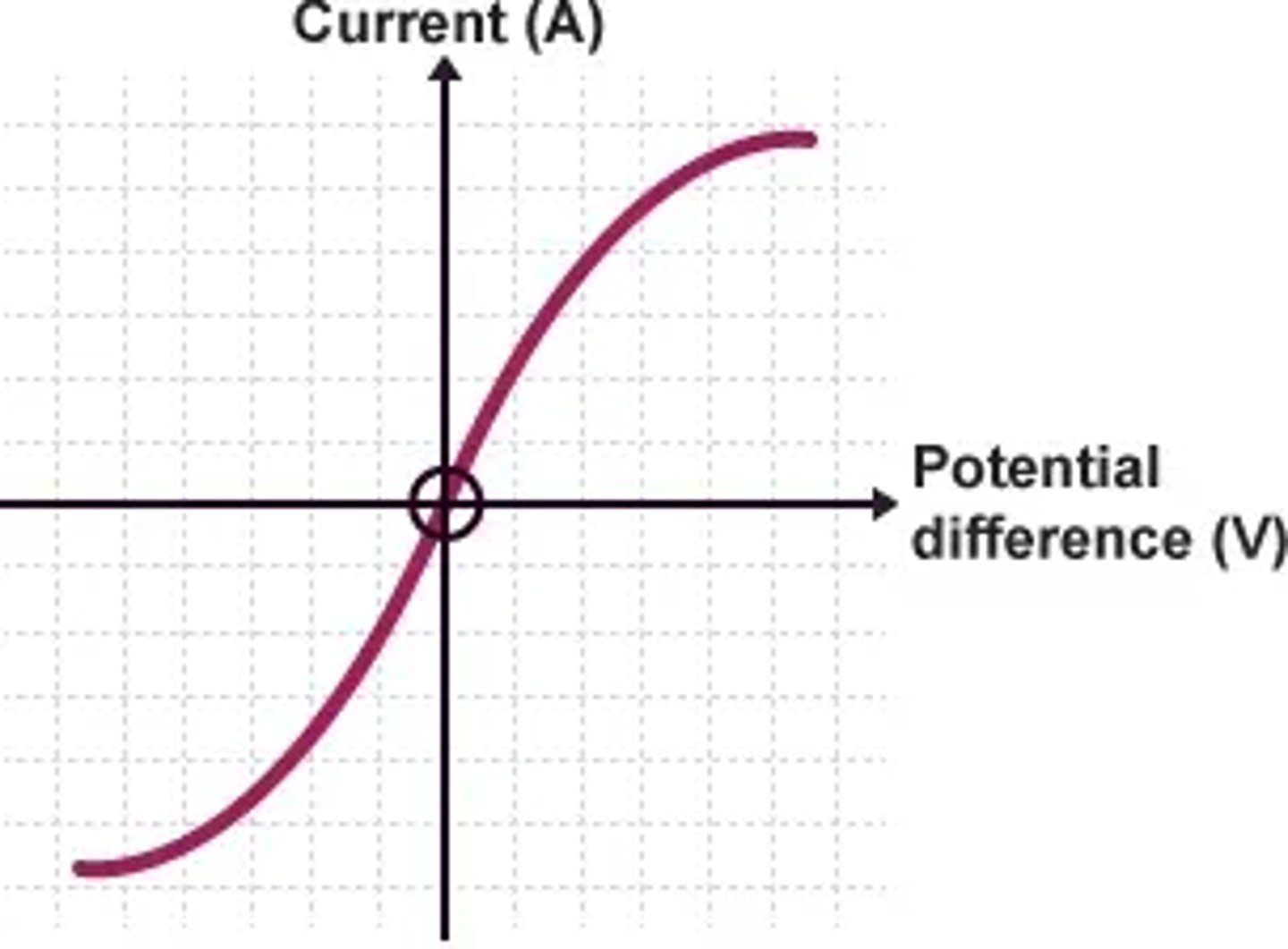
What happens in a filament lamp as current increases? (2)
- The metal filament heats up as current increases.
- This causes its resistance to increase.
What does the I-V graph of a filament lamp look like at low current? (1)
The I-V graph of a filament lamp starts as a straight line where Ohm's law is obeyed.
Why does the filament lamp graph curve at higher current? (2)
- As temperature increases, resistance increases.
- So current increases less rapidly with higher voltage in filament lamps.
How does the V-I graph of a filament lamp differ from its I-V graph? (1)
The V-I graph is a curve that starts shallower and gets steeper as current and voltage increase.
What does the I-V graph of a filament lamp look like overall? (2)
What is the assumed resistance of an ammeter in circuit questions? (1)
An ammeter is assumed to have zero resistance so it does not affect current measurements.
What is the assumed resistance of a voltmeter in circuit questions? (1)
A voltmeter is assumed to have infinite resistance so no current flows through it and it measures potential difference accurately.
What is resistivity? (2)
- Resistivity is a measure of how easily a material conducts electricity.
- It is measured in ohm-metres (Ω·m).
How is resistivity defined? (1)
Resistivity is the resistance of a material that is 1 metre long and has a cross-sectional area of 1 square metre.
What does resistivity allow us to do? (2)
- Resistivity allows comparison between different materials regardless of size.
- Although it is affected by environmental conditions like temperature.
What is the equation for resistivity? (2)
- The equation is: ρ = RA / L.
- Where ρ is resistivity (Ω·m), R is resistance (Ω), A is cross-sectional area (m²), and L is length (m).
How does temperature affect the resistance of a metal conductor? (3)
- As temperature increases, metal atoms vibrate more because they gain kinetic energy.
- There are more collisions between charge carriers and vibrating atoms.
- This makes it harder for current to flow, increasing in resistance.
What is the result of temperature increase on resistance in metals? (1)
Resistance increases as charge carriers move less freely through the conductor.
How does the length of a wire affect resistance? (1)
A longer wire makes it harder for current to flow, increasing resistance.
Why does increasing wire length raise resistance? (2)
- Electrons collide with more metal ions over a longer distance.
- This slows them down and increases resistance.
How does cross-sectional area affect the resistance of a wire? (1)
A wire with a greater cross-sectional area allows current to flow more easily, decreasing resistance.
Why does a narrower wire have greater resistance? (1)
In a narrow wire, electrons hit metal ions more frequently, increasing resistance.
How does the resistance of an NTC thermistor change with temperature? (1)
As temperature increases, the resistance of an NTC thermistor decreases.
Why does resistance decrease in an NTC thermistor as temperature rises? (2)
- More charge carriers become available as electrons are released from atoms.
- This increases current flow.
What does the I-V graph for an NTC thermistor look like? (2)
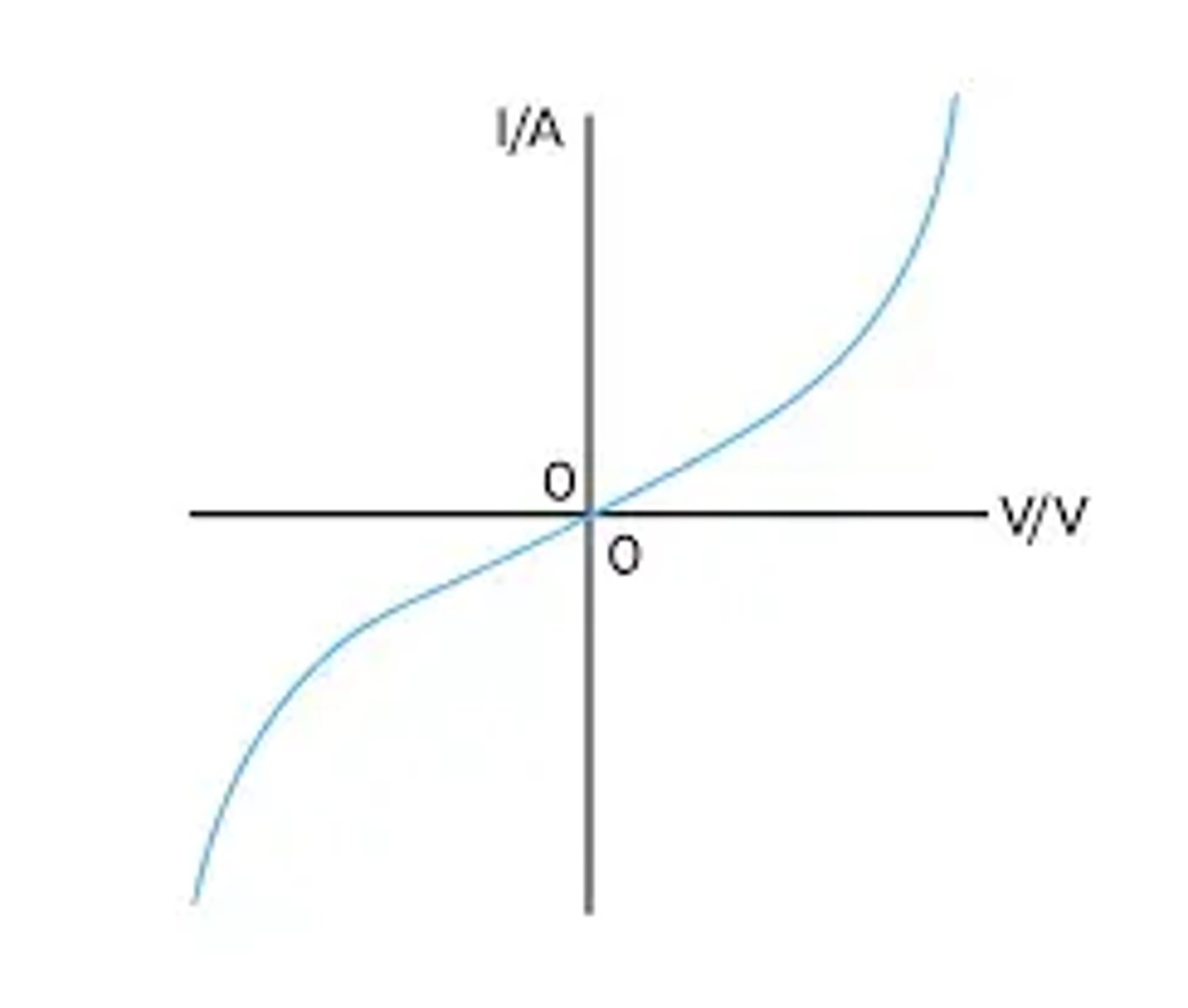
Why does the gradient increase in the I-V graph for an NTC thermistor? (3)
- As potential difference and current increase, the gradient increases.
- Resistance decreases at high voltage due to heating.
- This allows more current to flow.
How is a thermistor used in a temperature-sensing circuit? (2)
- Thermistors trigger an event when temperature goes above or below a set level.
- This is based on its resistance change.
Give an example of a thermistor application in temperature sensing. (1)
In a heating system, the thermistor activates the heater when the room temperature drops below a set value.
What is a superconductor? (2)
- A superconductor is a material with zero resistivity.
- This applies only below a specific temperature called the critical temperature.
What happens to electrical resistance in a superconductor? (1)
The resistance becomes zero, so current can flow without energy loss.
Why is no energy wasted in a superconductor? (2)
- None of the electrical energy is converted into heat.
- This means all energy is preserved.
What is the critical temperature of a superconductor? (2)
- The critical temperature is the temperature below which the material becomes superconducting.
- This is usually close to absolute zero (0 K or -273 °C).
Why are superconductors used in power cables? (1)
Superconductors eliminate energy loss due to heating during electrical transmission.
How are superconductors used in magnetic field applications? (2)
- Superconductors generate strong magnetic fields without a continuous power supply.
- This is useful in maglev trains and medical equipment.
Why are superconductors used in electronic circuits? (1)
Circuits using superconductors operate quickly and efficiently because there is no resistance.
Why are superconductors difficult to use in practice? (2)
- They must be kept at very low temperatures.
- This is hard to maintain over long distances.
What is the main challenge relating to temperature in using superconductors practically? (1)
Keeping the material below its critical temperature is difficult and energy-intensive.
What is the rule for total resistance in a series circuit? (1)
The total resistance is the sum of all individual resistances is RT = R1 + R2 + R3 + ...
How is the series resistance formula derived using three resistors? (3)
- The total emf is split between the components so, emf = V1 + V2 + V3.
- Since current is the same throughout the series, and V = IR, we get IRT = IR1 + IR2 + IR3.
- Cancelling the I's gives RT = R1 + R2 + R3.
What is the rule for total resistance in a parallel circuit? (1)
The reciprocal of the total resistance is equal to the sum of the reciprocals 1/RT = 1/R1 + 1/R2 + 1/R3 + ...
How is the parallel resistance formula derived using three resistors? (3)
- Current splits at each junction, but potential difference is constant across each branch.
- I = V/R and IT = I1 + I2 + I3, so V/RT = V/R1 + V/R2 + V/R3.
- Cancelling the V's gives: 1/RT = 1/R1 + 1/R2 + 1/R3.
What is power in an electrical context? (2)
- Power is the rate of energy transfer.
- It is measured in watts (W), where 1 watt = 1 joule per second.
What is the equation for electrical power using energy and time? (2)
- The equation is P = E / t.
- Where P is power (W), E is energy transferred (J), and t is time (s).
What are the three formulas for calculating electrical power? (2)
- The formulas are P = VI, P = V² / R, and P = I²R.
- Where V is potential difference (V), I is current (A), and R is resistance (Ω).
What is the formula for total energy transferred using voltage, current and time? (2)
- The formula is E = VIt.
- Where V is voltage (V), I is current (A) and t is time (s).
What is an energy formula using voltage, resistance and time? (2)
- The formula is E = (V² / R) × t.
- Where V is voltage (V), R is resistance (Ω), and t is time (s).
What is an energy formula using current, resistance and time? (2)
- The formula is E = I²Rt.
- Where I is current (A), R is resistance (Ω), and t is time (s).
How does current behave in a series circuit? (1)
The current is the same at every point in a series circuit.
How does voltage behave in a series circuit? (2)
- The total potential difference is shared between components.
- The sum of voltages equals the battery's emf.
How does current behave in a parallel circuit? (1)
The total current is the sum of the currents in each branch.
How does voltage behave in a parallel circuit? (1)
The potential difference across each branch is equal to the voltage of the power supply.
How is total voltage calculated when cells are in series? (1)
The total voltage is the sum of the voltages given by VT = V1 + V2 + V3 + ...
How is total voltage calculated when identical cells are in parallel? (1)
The total voltage is equal to the voltage of a single cell given by VT = V1 = V2 = V3 = ...
What is Kirchhoff's first law? (1)
Kirchhoff's first law states that total current entering a junction equals the total current leaving it.
What does Kirchhoff's first law show about charge? (2)
- Kirchhoff's first law shows that charge is conserved at any junction.
- No charge is lost or gained.
What is Kirchhoff's second law? (1)
Kirchhoff's second law states that the sum of voltages in a series loop equals the emf supplied by the battery.
What does Kirchhoff's second law show about energy? (2)
- Kirchhoff's second law confirms that energy is conserved.
- This is because all energy supplied is transferred across components.
What is a potential divider circuit? (1)
A potential divider is a circuit with resistors in series across a voltage source that is used to produce a desired fraction of the total voltage.
How does a potential divider control voltage? (2)
- The output voltage depends on the relative values of the resistors.
- It is also dependent on the ratio in which the source potential difference is divided.
What do potential dividers look like? (2)
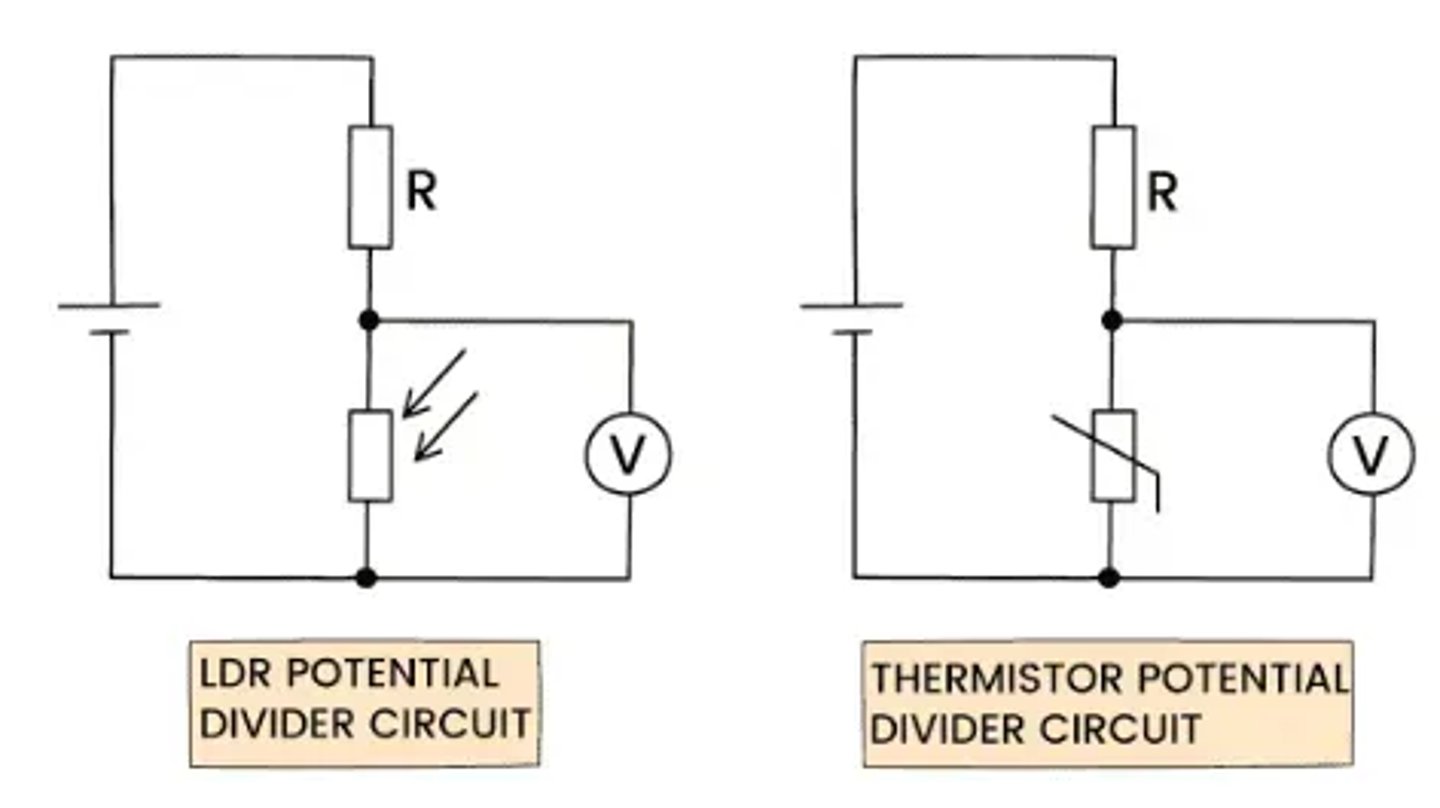
What determines the voltage across each resistor in a potential divider? (1)
The potential difference across each resistor is in proportion to its resistance compared to the total resistance.
How can a variable resistor be used in a potential divider? (1)
A variable resistor can replace one resistor in the potential divider to make the output voltage adjustable.
How does changing the variable resistor affect the output voltage? (2)
- Increasing R₁ decreases the output voltage across R₂.
- This is because it reduces the total current in the circuit (V = IR).
How does an LDR behave as light intensity increases? (1)
An LDR's resistance decreases as light intensity increases.
How does an LDR behave as light intensity decreases? (1)
An LDR's resistance increases as light intensity decreases.
How does an LDR affect output voltage in a potential divider? (2)
- As light intensity decreases, the LDR's resistance increases.
- This lowers the current and increases voltage across the LDR.
What happens to the output voltage if an LDR is swapped with a fixed resistor in a potential divider? (1)
As light intensity decreases, the output voltage increases, instead of decreasing.
How does a thermistor behave as temperature decreases? (1)
A thermistor's resistance increases when temperature decreases.
How does a thermistor affect the output voltage in a potential divider? (2)
- As temperature decreases, resistance increases.
- This reduces current and increases the voltage across the thermistor.
What happens to the output voltage if the thermistor is swapped with a fixed resistor? (1)
As temperature decreases, the output voltage increases instead of decreasing.
How can sensors in a potential divider be used to trigger events? (1)
An LDR or thermistor can detect changes in light or temperature and alter output voltage based on conditions.
What happens when output voltage from a sensor crosses a threshold? (2)
- The output voltage can activate another component in the circuit.
- This could be components such as a bulb or buzzer.
How does switching positions of the sensor and resistor affect output behaviour? (1)
Switching the position of the sensor and resistor reverses how the output voltage responds to environmental changes (e.g. rising or falling).
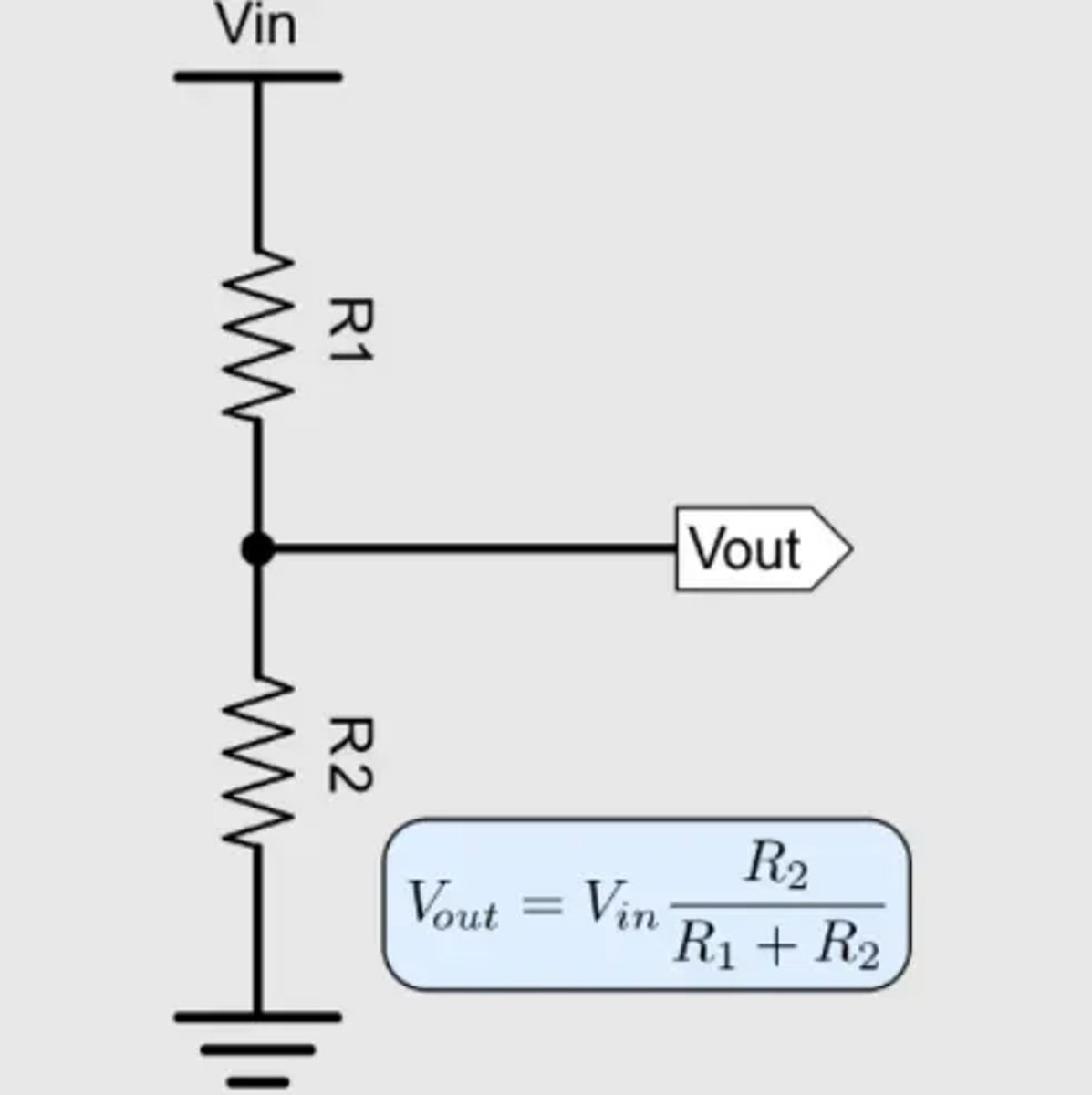
What is the equation for output voltage in a potential divider circuit? (3)
- The equation is V_out = V_in × (R2 / (R1 + R2)).
- Where V_out is output voltage (V), V_in is supply voltage (V), R1 and R2 are resistances in ohms (Ω).
What is internal resistance in a battery? (2)
- Internal resistance is caused by electrons colliding with atoms inside the battery.
- This causes energy loss before charge leaves the battery.
How is internal resistance modelled in circuit diagrams? (1)
Internal resistance is represented as a small resistor inside the battery and adds to the total resistance of the circuit.
What is electromotive force (emf)? (1)
Emf is the energy transferred from chemical to electrical energy per coulomb of charge passing through the cell.
What does the emf of a cell represent? (2)
- The emf of a cell is the total energy supplied by the cell.
- This includes both the useful energy delivered to the circuit, and energy lost due to internal resistance.
What is the equation for emf in terms of total resistance? (2)
- The equation is ε = I(R + r).
- Where ε is emf (V), I is current (A), R is external load resistance (Ω), and r is internal resistance of the battery (Ω).
What is terminal potential difference? (2)
- Terminal potential difference is the potential difference across the external resistance.
- It is, also, the useful energy transferred per coulomb of charge through the load.