Political Behaviour 2 Exam
 Call Kai
 Learn
Learn Practice Test
 Spaced Repetition
 Match
Match Flashcards
 Knowt Play
1/55

There's no tags or description
Looks like no tags are added yet.
Name | Mastery | Learn | Test | Matching | Spaced | Call with Kai |
|---|
No analytics yet
Send a link to your students to track their progress
56 Terms
what is public opinion?
what people think
Aggregation of individual opinions
Collective will
Those opinions held by private persons which governments find it prudent to heed
Measuring Public Opinion
Public opinion is hard to measure, it is still hard to measure public opinion even w/ alternatives
another aspect with public opinion is hard to find methods that are representative
surveys
big data
Protests / rallies
Town hall meetings
Letters to elected officials
Social media
Public vs Private Expression and opinion
public = intended for audiences
private = expressed in confidentiality
Polls are private and anonymous.
Riots are public but may allow anonymity.
Structured vs. Unstructured
Riots = unstructured, expressive, flexible
Sample surveys = highly structured, require expertise, limit responses
definitions for structures vs unstructured are the standard ones
Uncivil Disagreement (book)
The main concept the book looks towards is social sorting- in which the political parties have become more than just representing policy positions, but also representing social groups. As a result, this creates social polarization, which encompasses stereotyping, prejudice, and emotional instability. With said polarization, the parties are more unwilling to compromise, and instead more willing to escalate conflict.
Us vs. Them mentality
as social identities become more linked with parties, parties become more involved in American political decision-making, behaviour, and emotion.
Surveys
Surveys offer one way to measure public opinion
Can’t trust polls
• Can design the survey to better match what you want - public or private / structured or unstructured
• Surveys are one of the few ways we have to gather opinion data from those less motivated to express through other means
• Big data often not accurate
Blood Test Analogy
Taking blood for blood test- assume that that blood sample is representative
Hard to have blood test for whole country, easier if its just one person
Dimensions of public Opinion
Direction
• Extremity
• Intensity
• Salience
• Stability
• Informational content
• Variation among groups
• Ambivalence
Direction
which side are ppl on
ex: self-identified ideology
When it comes to politics, do you usually think of yourself as a liberal, a conservative, a moderate, or haven’t you thought much about this?”
Conservative ———— 32%
Moderate ————— 22%
Liberal ————— 21%
Don’t know ———— 25%
Extremity
does the opinion fall toward the end of the range of possible opinions or towards the middle?
Example: ideology
Extremely conservative ———— 3%
• Conservative ———— 17%
• Slightly conservative ———— 12%
• Moderate ———— 22%
• Slightly liberal ———— 9%
• Liberal ———— 10%
• Extremely liberal ———— 3%
Intensity
Personal importance
How much you personally care- how strongly you feel about it in relation to you
Sample question: how important is that issue to you personally
Stability
Is overall opinion changing? if so in what direction? • If we an an individual the same question at two points in time, do we get the same answer?
Examples: • Opinions about gay marriage, Identification with a political party
Opinions on gay marriage have changed over time
a way to measure whether an opinion has changed over time is to do a panel study (long term) of individuals over time
Information content
How much people know the issues
Variation among groups (cleavages)
whether opinions of various societal groups (based on age, race, party etc) are similar or different
Ambivalence
opinion about an issue is characterized by conflicting underlying values
Nuances in beliefs due to complex topics in of itself, people don’t believe black and white
Examples: attitudes toward death penalty and abortion
The questions are simple minded- yes or no, - wont be ambivalence
Do not overestimate the public’s ___ but not underestimate their __
knowledge, intelligence
Political knowledge measurement
People will offer an opinion even when they do not know the topic asked in a question
People believe things that are not true
Contested truth
things can be debatable
Belief System
one way to think about political beliefs
a configuration of ideas and attitudes where the elements are bound together by some form of constraint or functional interdependence
Static Constraint
in one single moment in time my opinions are correlated with each other and these are my beliefs that I’m set on
Dynamic constraint
if I change my mind abt an issue do I change my mind abt other issues (later?)
the change is causily related to the first thing that happened… slowly your opinions turn a certain belief and affect other opinions
Non attitudes thesis
ppl don’t have meaningful beliefs even on issues they should have beliefs about- issues that have led to intense controversy among elites for a long time
Ideologues
People who understand what goes with what
Most people are not ideological
Group interest
Converse category- do these set of politics help people like me or my social group?
Nature of the times
Converse category capture vague reactions about whether times feel better or worse within that context of that time period
No issue content
Converse Category- Evaluate candidates based on personal traits or admit no political understanding
Converse’s Black and White Model
Small % of people with real, stable attitudes on an issue
Much larger % with random, “non-attitudes” on that issue
most ppl have one or two issues they care abt only
Ideology
“Ideology expresses what people take to be right and proper”
“Opinions and actions justified in ideological terms lay claim to what all members of a political community should value”
“Ideas that comprise ideology form organized structure”
“Implies that ideas are arranged in orderly, predictable patterns”
Converse says…
people always changing their minds, instability in survey questions
period effects
Super deep polarized time. When converse was doing the study, they weren't ideological, but maybe they weren't, because the parties weren't that different,
durable political imprints
Why does change happen?
- generation turnover- but people are stuck in their ways and new gen has different opinion
People holds onto real stable opinions and change in response to new opinions
Cohort replacement- people have real opinions and don’t change them
People construct responses on the fly- change as elite opinion change- hasty opinion
Cohort Effects
durable political imprints created by the environment people encounter when they are young
9/11, covid
Age effects
- in contrast, people are changing as they age
Measurement error
The way you frame questions will change people's answers
Framing
Issues and events can be viewed from multiple perspective
A frame highlights a particular set of considerations
Frames change the chance that people pull considerations into their sample when they answer a question → change the weights
RAS Model
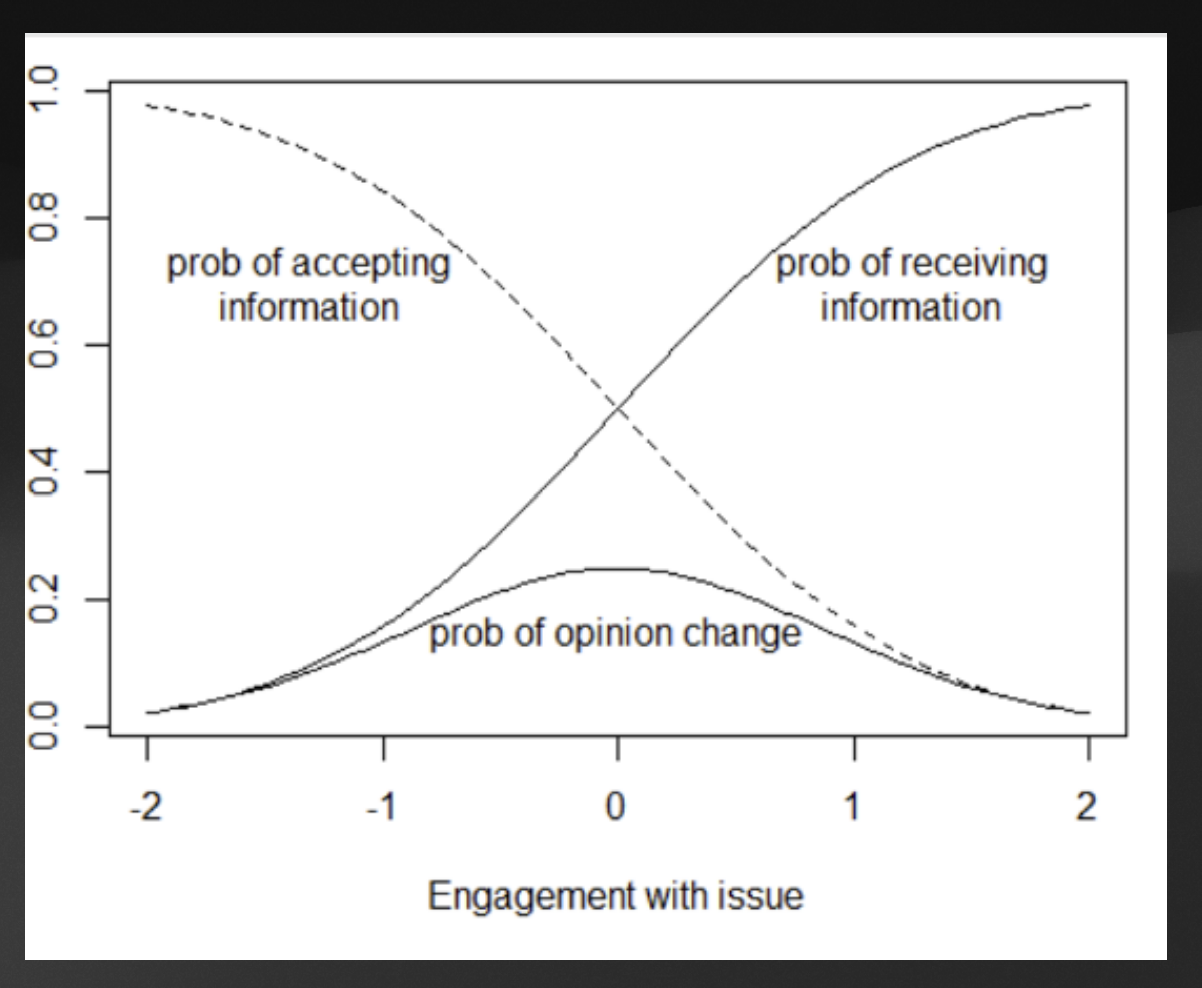
Active Updating
A big tent theory
Changing environments cause people to change their minds
changes persist because they shift baselines
Settled dispositions
A big tent theory
People are rooted in the past and once they pick a position they stick to it
Changes revert because people return to baseline
Three stages of belief updating
Acquire- acquire new information
Evaluate- evaluate new information
Combine- combine new information with old information
Acquisition
Selective exposure and “echo chambers”
Limits to selective exposure: Trust vs bias Most consumption is mainstream (fox news conservatives, cnn democrats) Large % don’t care, Competing goals, Weak ties in social networks
Directionally motivated reasoning
People prefer identity‑consistent beliefs over accurate ones.
ex: Racial resentment predicted belief in the Obama “birther” myth.
Confirmation bias
the tendency to search for, interpret, favor and recall information in a way that confirms or supports one's prior beliefs
Unbiased evaluation
an assessment conducted impartially and objectively, relying solely on relevant evidence and predefined criteria rather than personal opinions, prejudices, or favoritism.
you’ll change your mind (revise your beliefs) as new evidence comes out that is contrary or different to your prior beliefs
Politically motivated reasoning
when a factual position becomes a marker of group identity, individuals unconsciously adjust their assessments of information—expert testimony, data, arguments, even sensory impressions—to match their group’s position.
Partisan Cheerleading
respondents give the answer that helps their side, even if they may not sincerely believe it
Nyhan's definition of misperceptions
Beliefs in claims that can be shown to be false
Unsupported by "convincing and systematic evidence”
What is the problem with this definition?
ex: About 1% of federal employees are “actually working in the office” … not true. They found that about 6% of federal workers “report in person on a full time basis”
statistics can exaggerate or not tell the full story
Does exaggerating count as a lie?
It can be misperception when it misleads people to believe in false info. (so in the example above, although that dude was exaggerating abt federal workers, it led people to actually believe in it. Therefore, it was a lie)
Thermostatic Politics
public often pushes back in the opposite direction when policy moves too far one way
you set it to something but never gets what you want- too cold or too hot
Public opinion- ppl responding to politics- public opinion will always go back and forth
Strength: World is always changing
Weakness
There is no sweetspot
Cops patrol
We are like the cops
We monitor politicians constantly and directly
We read the news and see what they are doing
Fire alarm oversight
We wait for things to go wrong
We don’t always have to read the news, just wait until we get the alarm
Theoretical medias action contrast
Agenda setting
Network covers a topic more, holding constant the information conveyed about that topic
People already have fixed issues about something, but if you talk about it more, people think its more important
Framing
The media providing interpretation by highlighting parts of an issue
Partisain coverage filtering
People of different parties literally hear different things on the same topic
Is the media to blame?
Paying people to switch from fox to cnn did have some impacts, but not on vote choice
Their issue positions did change though, just not the vote choice
What kind of snapshot of public opinion do protests rallies or social media usually fail to provide?
Representative picture- people tend to go are the ones who care, so not representative to look at them
Representative sample- sample that encompasses everyone
Polls good for surface level reading and getting opinions of ppl who r not motivated to voting or go to rallies
Salience
dimension of opinion asks how high an issue sits on the public agenda, often through the “most important problem question” importance on national level, not intensity (how important it is to you)
Selective exposure
choosing environments that are more congenial to our prior views? - match our views
‘considerations
thoughts sampled from memory when someone answers a survey questions
3 or 4 considerations abt a certain issue, people are ambivalent about any issue, because ppl are ambivalent abt details of issue, then they have multiple considerations, and those considerations are conflicting, different considerations come top of the head at different times
Motivated Reasoning
political commitments shape how people evaluate new evidence