Anthropology Final Study
 Call Kai
 Learn
Learn Practice Test
 Spaced Repetition
 Match
Match Flashcards
 Knowt Play
1/88

Earn XP
Description and Tags
ventral
Name | Mastery | Learn | Test | Matching | Spaced | Call with Kai |
|---|
No analytics yet
Send a link to your students to track their progress
89 Terms
What is Macroscopic Analysis
It’s the examination of physical traits and skeletal remains with your eyes
What are the advantages of using Macroscopic instead of Osteometric Analysis
It’s quick, and no specialized equipment is needed
What are the disadvantages of using Macroscopic instead of Osteometric Analysis
It is subjective, and it’s dependent on examiner experience. No correct estimation for sizes
What is Osteometric Analysis
It’s the scientific measurement and quantitative analysis of human skeletal remains
What are the advantages of using Osteametric instead of Macroscopic Analysis
It’s Objective, Statical weight, reduces subjective bias
What are the disadvantages of using Osteometric instead of Macroscopic Analysis
It requires specialized tools and training; also requires full complete bones
What is Histology
It is the microscopic study of bone tissue, it is often used to examine bone at the cellular level when macroscopic features are missing or altered
What is the purpose of Histology
It is to differentiate human from non-human bones
When do you use the analytical technique such as Histology
When assessing microscopic remodeling to estimate age at death, analyzing burnt bone, and determining the timing of injuries
What is Radiography
It is when you use X-ray, CT scans or other imaging modalities to visualize internal bone structures without destroying the specimen/bone
What is the purpose of Radiography
To detect antemortem and perimortem trauma, such as fracturs, bullet fragments or disease
What are some criteria for distinguishing human vs non-human bones
The bone size, density, texture and thickness
How is a Contemporary Bone like
It is, fresh, greasy, light-colored(yellow-white), heavy, contains moisture and collagen within less than 50 years.
How is a Non-Contemporary Bone like
It is, dry, brittle, stained, and lightweight due to loss of collagen and moisture over time
What are the 3 main techniques for finding human remains
It is, detecting, mapping, and recovering
Describe the Detecting Technique for finding human remains
You use the Line Search method, where investigators stand shoulder to shoulder and walk in a straight line across an area to locate evidence of bones
What do you usually look for in a Line Search
Vegetation & Soil Changes
Describe the Recovering Technique for finding human remains
This where you assign tasks to people. (Recorder, Mapper, Photographers and Excavators) Then switch to hand tools when grave pit is clear and screen all the soil so you do not miss small bones, or loose teeth
What is a datum?
It is a fixed, permanent reference point, marker or structure at a crime scene from which all measurements and locations of evidence are taken
Describe the Mapping Technique for finding human remains
The spatial distribution of evidence must be recorded, creating a grid, and establishing a Datum
What is Forensic Taphonomy
It is the study of the processes that affect organisms between death and discovery
Why is Forensic Taphonomy studied
It is studied because it is used in forensics to reconstruct circumstances of death
What is the importance of Forensic Taphonomy
It is to Estimate Postmortem interval (PMI), interpreting postmortem events and treatment of remains, and distinguishing between taphonomy alteration and perimortem trauma
What is Autolysis
It is the destruction of cells through the action of their own internal enzymes. It occurs primarily in dead or injured tissues, acting as a crucial first step in decomposition.
What is Putrefaction
It is the fifth stage of death, where anaerobic bacteria and fungi decompose organic matter, breaking down proteins and liquefying tissues (skin)
What factors influence the decomposition of human remains (6)
Temperature, Moisture, Environment, Soil chemistry, perimortem trauma, scavenging
What are some characteristic signatures of Taphonomic Changes that must be distinguished from perimortem trauma?
Consumptions & modification of remains by animals
What type of animals causes changes in Forensic Taphonomy & How, (4)
Insects: They arrive quickly and in predictable pattern
Carnivores: Pits punctures, scoring, furrows affecting bones
Birds: Damage varies, often shallow scratches, targeting facial bones, Larger species can break ribs
Rodents: Small/Big scratches can be done
What do you look at to estimate Biological Sex in a person
Influenced by, Chromosomes, Genetics and Hormones
What do you look at to estimate Gender in a person
You look at one’s personal and social identity, gender is a social category, based on cultural norms
Why do we estimate sex rather than gender?
Because male/female are biological categories, men/women are products of enculturation
What is sexual dimorphism?
It is the phenotypic differences between males & females of the same specifies
What is the difference between biological and chronological age?
Chronological age is the amount of time that passes between birth and death
Biological age is the influence of intrinsic factors like genetics and extrinsic factors like nutrition, stress, environment, disease, and status
How do forensic anthropologists understand the concept of race?
Reject scientific racism and biological determinism, races are socially constructed categories that are based on differences in phenotypic traits
What are some complications involved in estimation of Stature?
Biological versus reported stature are often inconsistent
Age at death stature decreases with age
What factors produce individual skeletal variation ? (5)
Genes, age, activity, nutrition, disease
Why is recognizing individual variation important to forensic anthropologists?
It is important to distinguish from perimortem trauma to taphonomy
What is Nominal Variation
It refers to the study of differences in qualitative, categorical data that cannot be ranked or ordered. It is used to categorize individuals or cultural traits into distinct groups (eye color, blood type, martial status)
What is Skeletal Anomalies
It refers to the deviations from typical skeletal anatomy
(Non-fusion anomalies, supernumerary bones or teeth, accessory foramina)
What is Skeletal Pathologies
It’s the study of abnormal changes, diseases, and injuries manifested in human skeletal remains
What is Biochemical Stress
It is the physiological and molecular reactions (such as cortisol release) within the body when exposed to environmental, social, or nutritional pressures
What are the 5 outcomes of mechanical loading of the skeleton?
Compression (Squeezing force)
Tension (Stretching force)
Bending (Compression one side, tension on the other)
Shear (Slides portions of an object relative to one another)
Torsion (Both shear and twisting)
What is Antemortem Trauma
Before death, evidence of an osteogenic reaction (formation of new bone in response to injury, infection, or chronic stress)
What is Perimortem Trauma
Around the time of death, no osteogenic reaction, bone would be fresh
What is Postmortem Trauma
After death, Bone features are dried up, more brittle jagged appearance
Describe a Blunt Force Trauma
Such as a punch, fall, etc. Low-velocity impact over a large surface area
The bone is pushed inward and changes shape before breaking, leaving permanent warping.
Describe High-Velocity Projectile Trauma
Such as a bullet, Bone acts as a brittle material
Shatters rather than deforms, beveling takes place
What is Beveling, & what is Internal/External Beveling
Morphology of the void left behind by punched out piece of bone(from a bullet)
Internal Beveling = Entrance (Bigger Hole)
External Beveling = Exit (Smaller Hole)
Describe a Sharp Force Trauma
Such as a saw/knife, Deeper punctures, sometimes showing "hilt marks" (impression of the handle).
The bone can have microscopic parallel scratches within the cut, which can identify the type of tool
An example of Forensic Anthropology contributions to Mass Disaster Response (3)
Sorting, Biological Profiling, & Trauma Analysis
An example of Forensic Anthropology contributions to Human Rights Violations
Exhuming Mass Graves:
Using archaeological techniques to map how bodies were placed, which can prove intent or execution-style killings.
Evidence of Torture:
Identifying healed or perimortem fractures that suggest systematic abuse before death.
What are some examples of factors that complicate the identification of undocumented migrants along the U.S. - Mexico Border?
Environmental Degradation:
Extreme heat and scavenging animals in the Sonoran Desert can skeletonize a body in days, destroying soft tissue and DNA.
Lack of Ante-Mortem Data:
Many migrants come from rural or impoverished areas where dental or medical records
What are some examples of methods used by forensic anthropologists to help identify migrant remains?
Isotope Analysis:
By analyzing oxygen and strontium isotopes in teeth and bones, scientists can determine the geological region where a person grew up
Cultural Artifact Analysis:
Anthropologists carefully document "personal effects" like distinct clothing brands, religious icons (rosaries), or phone numbers written on scraps of paper, which often provide more clues than the bones themselves.
What methods applied by forensic anthropologists contribute to a positive/scientific ID? (3)
DNA (Nuclear not mitochondrial)
Fingerprints
Radiologic comparison
What are some examples of skeletal features that are useful when deciding whether to include or exclude an individual as the source of unknown remains? (2)
Comparative Dental Radiography
Radiological comparisons using non dental imaging
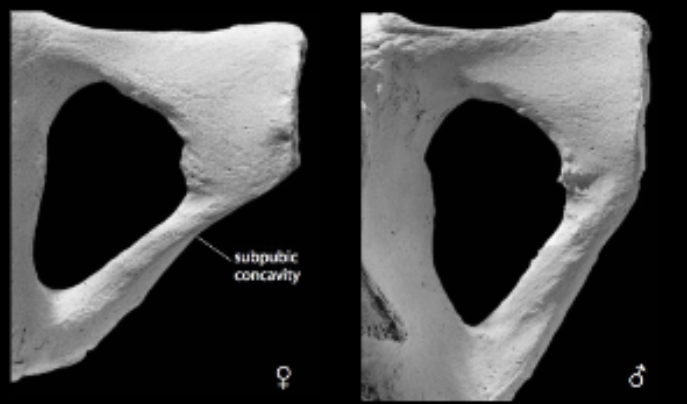
Subpubic Concavity - Pelvis
Present = Female
Absent = Male
Subpubic Concavity
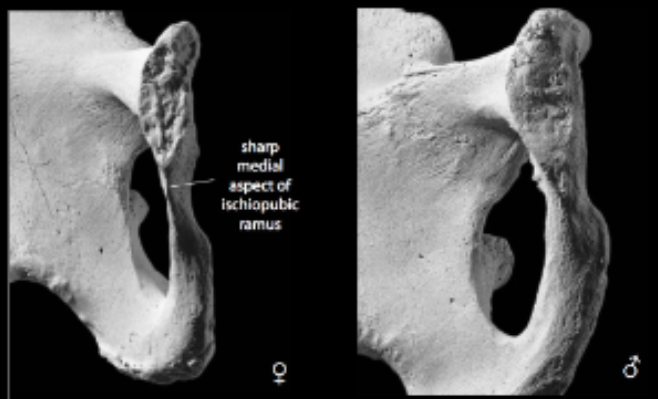
Ischiopubic Ramus - Pelvis
Narrow, Sharp - Female
Broad, Dull - Male
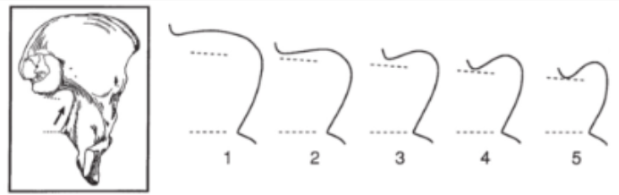
Sciatic Notch Morphology - Pelvis
Bigger and Wider - Female
Smaller and Thinner - Male
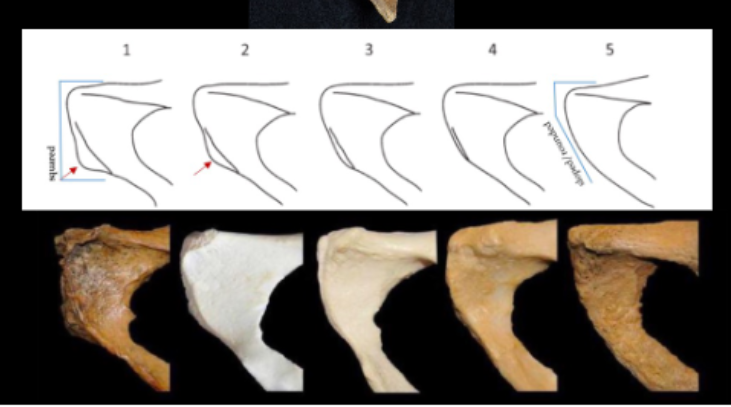
Ventral Arc - Pelvis
More square and fatter body - Female
Less square and less body - Male
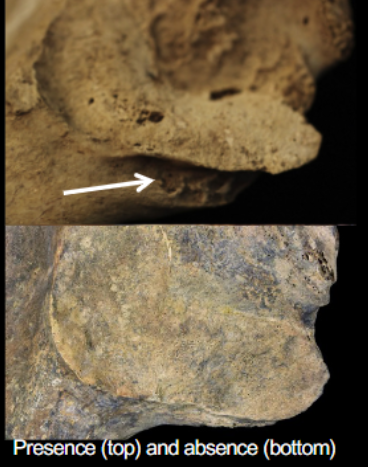
Preauricular sulcus - Pelvis
Present - Female
Absent - Male
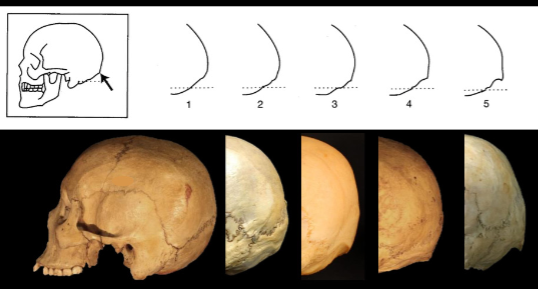
Nuchal Crest - Cranial
Smooth, no nuchal crest - Female
Bumpy, pointy nuchal crest - Male
Determine what is Male/Female
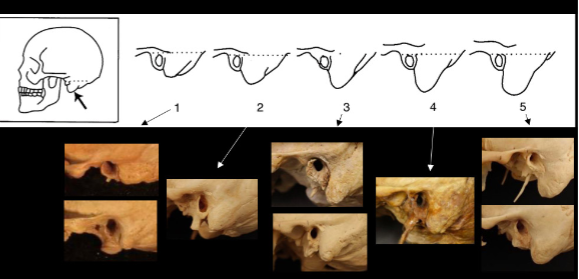
Mastoid Process - Cranial
Short, Small - Female
Long, Big - Male
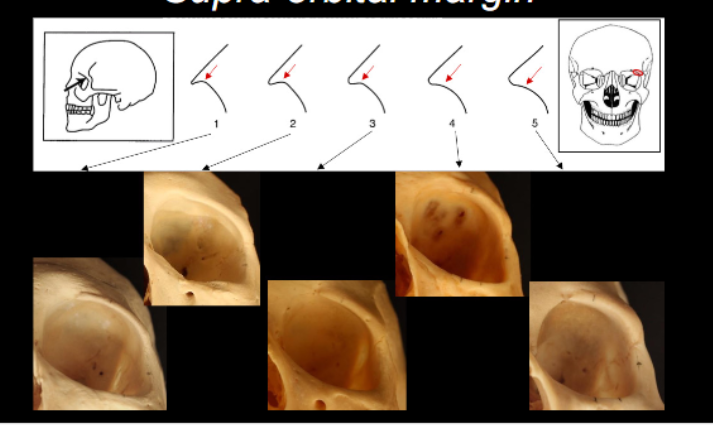
Supra-Orbital Margin - Cranial
Thin, Sharp - Female
Thick, Dull - Male
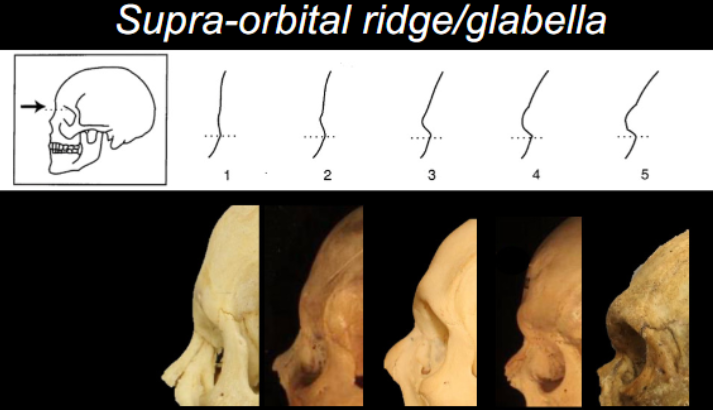
Supra-Orbital Ridge - Cranial
Smooth, flat - Female
Massive, Dull - Male
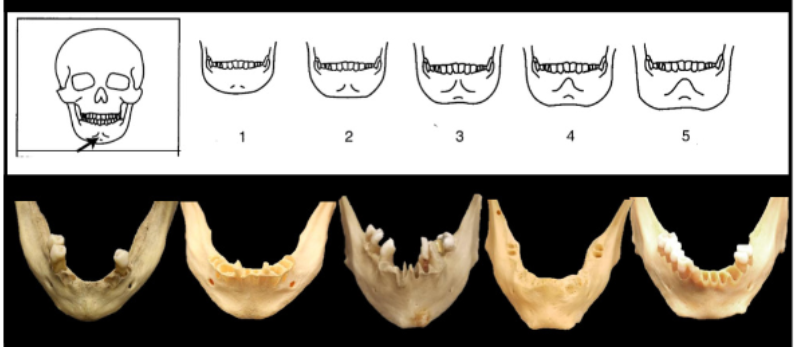
Mental Eminence - Cranial
Smaller, V-shaped - Female
Bigger, Square Shaped - Male
How does a Pubic Symphysis look like in a young person
It has prominent ridges and furrows billowing is present
Superior and inferior extremities become delimited
How does the Pubic Symphysis look like in a Middle aged person
Remnants of billowing
Lower rim is complete on dorsal side
Oval outline is complete
How does the Pubic Symphysis look like in a Older person
Symphyseal face becomes depressed
Irregular in shape
Porosity is present
How does a Sternal Rib (4) end look like in a young person
Shallow pit depth
V-shaped pit
Thick walls
How does a Sternal Rib (4) end look like in a middle aged person
Pit depression
More U-shaped but not fully U-shaped
Thinner walls but not fully thin
How does a Sternal Rib (4) end look like in a older person
Depressed pit
U shaped pit
Extended, thing, irregular walls
In 1969, Phenice published on 3 traits useful in estimating sex
The Ventral Arc, Subpubic Concavity, Ischiopubic Ramus
Measuring the lengths of these can assist in the estimation of age at death in adults
Long Bone diaphysis
In Pubic Symphysis aging, this feature is usually fully separated from the symphyseal face by middle adult age
Pubic tubercle
This groove created by a saw or knife may preserve characteristics of the class of the implement
Kerf
This extrasutural bone is created when the division between two portions of the occipital bone does not disappear as normal
Inca Bone
Don’t mistake this hole in the sternum for a gunshot wound, it’s an anatomical variation
Sternal Foramen
The location, size and shape of this feature of the frontal bone is as unique as a fingerprint., its potent used in radiographic comparison
Frontal Sinus
This condition related to repetitive stress in the lower back is characterized by the separation of the neural arch from the vertebral body
spondylolysis
this type of defect is produced when a high velocity projectile impacts bone at a tangential angle
Keyhole
What is the Nasal Aperture Width (NAW)
The horizontal distance across the bony opening of the nose on the human skull
What is the Nasal Bone Contour (NBC)
The shape, profile, and structural outline of the bony bridge of the nose
What is the Anterior Nasal Spine (ANS)
The vertical distance between the Anterior Nasal spine and the top of your Nasal Bone
What is the Interorbital Breadth (IOB)
The straight-line distance between the medial margins of the eye sockets (orbits) of the skull
What is Inferior Nasal Aperture(INA)
Is the bottom-most boundary of the skull's pear-shaped nasal opening
What is post bregmatic depression (PBD)
It is is a normal, non-pathological anatomical variation of the human skull. It appears as a visible, shallow dip or indentation on the top of the head just behind the bregma
What is Triage & Sorting
Anthropologists separate commingled remains to ensure that families receive the correct individual
What is Biological Profiling
Anthropologists establish age, sex, ancestry and stature to narrow down missing persons list
What is Trauma Analysis
the study of injuries to living tissue—primarily bone—caused by external forces