BioChem Exam 2 Review
 Call Kai
 Learn
Learn Practice Test
 Spaced Repetition
 Match
Match Flashcards
 Knowt Play
1/17

There's no tags or description
Looks like no tags are added yet.
Name | Mastery | Learn | Test | Matching | Spaced | Call with Kai |
|---|
No analytics yet
Send a link to your students to track their progress
18 Terms
At what wavelength do heterocyclic nucleic acid bases absorb UV?
260 nm
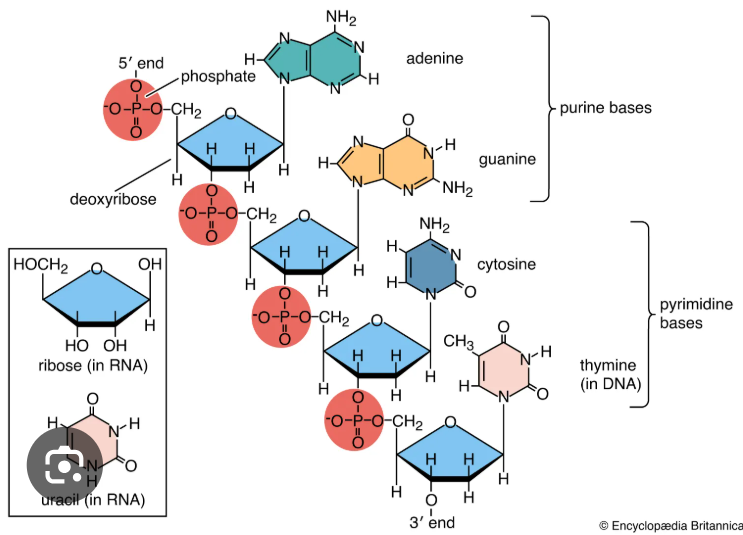
Which nucleic acid is shown here?
DNA
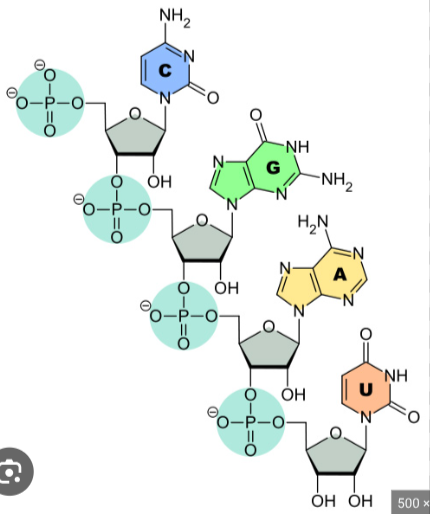
Which nucleic acid is shown here?
RNA
True or False: DNA polymerase adds nucleotides at the 3’ end
True
Who developed the chain termination method (dideoxy method)?
F. Sanger
The base-specific chemical cleavage was developed by?
Maxam and Gilbert
What is the precursor of hypoxanthine?
Adenine
What is the precursor of xanthine?
Guanine
How are hypoxanthine and xanthine made?
deamination
What is the direction and number of base pairs per turn of DNA type A?
Right-handed, 11 bp
What is the direction and number of base pairs per turn of DNA type B?
Right-handed, 10 bp
What is the direction and number of base pairs per turn of DNA type C?
Left-handed, 12 bp
Who discovered radioactivity?
Marie Curie
Who discovered A binds to T and C binds to G?
Erwin Chargaff
Fill in the blanks: 1962 Nobel Prize
___, ___, and ___ took credit for ___’s discovery of the DNA diffraction pattern or double helix.
James Watson, Francis Crick, Maurice Wilkins, Rosalind Franklin
Name the term for the self-insertion of an electron rich molecule (ex. an aromatic molecule) into the electron deficient double stranded helix.
(In other words, this describes flat, planar molecules slipping and binding in-between the stacked base pairs of the DNA double helix.)
Intercalation
Fill in the blanks: (a)
When S is ___, the equation for rate is ___ order in S
low, 1st
Fill in the blanks: (b)
When S is ___, the equation for rate is ___ order in S
high, 0