Davies Ultrasound Physics Review
 Call Kai
 Learn
Learn Practice Test
 Spaced Repetition
 Match
Match Flashcards
 Knowt Play
1/716

There's no tags or description
Looks like no tags are added yet.
Name | Mastery | Learn | Test | Matching | Spaced | Call with Kai |
|---|
No analytics yet
Send a link to your students to track their progress
717 Terms
1. What action would be most in keeping w the ALARA principle while performing a diagnostic ultrasound exam?
Complete the diagnostic scan in a timely fashion at the lowest output power that achieves a quality image
Advocating use of the ALARA principle (as low as reasonably achievable) prudently minimizes the risk of bio effects (even tho epidemiological studies have revealed no known risk associated with the use of diagnostic ultrasound).
2. During performance of an obstetric ultrasound exam, you adjust the system parameters to improve the image. Which of the following parameters would increase acoustic exposure?
Increase transmit power.
The transmit power is the only control listed that will affect the exposure of the patient to acoustic power. Gain, TGC, and frame averaging (persistence) do not affect sound transmission and therefore do not affect exposure. Increasing frequency will not increase exposure.
3. To minimize the risk of biologic effects of ultrasound to the fetus, which imaging mode tradeoff would be most applicable?
Use M-mode instead of pulsed-wave Doppler to measure the fetal heart rate.
Pulsed wave Doppler increases the time average intensity compared to M-mode.
4. What potential bioeffect occurs through absorption of sound energy by tissue?
Heating
Sound attenuation in tissue is primarily due to absorption (conversion of ultrasound to heat).
5. When practicing universal precautions, you should do all the following EXCEPT:
Wash gloves between exams for reuse from one patient to another. (It is recommended that gloves be worn during every ultrasound examination. They should be discarded after use).
-wear gloves when there is a potential for contract with patient body fluid
-change gloves when moving from one patient to another
-Wash hands immediately after gloves are removed
- Wear face masks or eye protection whenever there is a possibility of blood splashing in your face
6. A nosocomial infection is defined as one that:
Is hospital-acquired
7. Thermally induced biologic effects should be preventable by avoiding a local tissue temperature increase exceeding:
1°C
8. Which intensity descriptor has the lowest numeric value for the characterization of a pulsed-wave ultrasonic field?
SATA
SATA, a term that is infrequently used, means spatial average, time average. Note: I(SPTA) is the spatial peak, time average intensity; I(SPTP) is the spatial peak, temporal peak.
9* Increased tissue heating could occur when you:
Increase transmit power
A study designed to determine if there is an association between an adverse effect in a population and exposure to a particular agent is an:
Epidemiological study
Which of the following actions is NOT compliant w HIPPA?
Reviewing your neighbors medical studies on your hospital PACS system so you can give her your opinion of her condition
The Health Insurance Portability and Accountability Act (HIPPA) includes rules to protect the privacy of the individuals health information. This answer would violate HIPPA
What does the mechanical index indicate on an ultrasound system?
The likelihood of cavitation during an ultrasound exam
Mechanical index is derived from the peak rarefaction pressure and the ultrasound freq, parameters shown to be associated w onset of cavitation
In medicine, what do the initials PHI indicate?
Protected health information
14*What should you limit when the thermal index exceeds 1?
Exposure time
15*To practice the ALARA principle, which of the following techniques should you employ?
Use the lowest transmit power that allows adequate tissue visualization
Use a high gain and low transmit power
The thermal index indicates:
Estimated temperature increase in tissue
Temperature increase is calculated assuming certain values for the absorption and thermal properties of tissues and taking into account factors such as beam geometry, freq and power. Technically, it is the ratio of the power being produced to the power needed for a 1° C temperature increase if tissues have the assumed properties
17*The operator control most directly adjusts the intensity of the transmitted pulse?
Acoustic output (transmit) power
Pulse repetition freq can also affect the intensity, specifically the I(SPTA) because it affects the duty factor
Which of the following would show the highest intensity value?
SPTP
Note that Im is the intensity over the half wave period within the transmit pulse where it is the greatest! This term is seldom specified
Which intensity parameter is not applicable for continuous wave ultrasound?
SPPA and SAPA refer to pulse average intensities, which do not apply to continuous wave ultrasound.
Which of the following would most likely have the highest SPTA value?
PW doppler
Using a hydrophone, you can measure:
Pressure amplitude and duty factor
Which of the following parameters relates to tissue heating?
Absorption
23* Which of the following occurs when you use the maximum system gain?
Increased tissue heating
Increased risk of cavitation
Fluid particle streaming
Increased sound absorption
None of the above
None of the above
You are performing a sonographic examined notice that the thermal index (TI) is > 1. Any increase in temperature would be greatest in:
Bone
The motion of particles in a fluid is sometimes observed in an intense ultrasound beam. This is termed:
Acoustic streaming
Acoustic streaming is defined as an acoustically generated transport of fluid within the body of the insinuated fluid or tissue (AIUM nomenclature, 09). This is a mechanical instruction of tissue and sound, where the beam literally pushes the media. If the medium is a fluid and fluid is free to move or it particles in the medium are free, they can move in directions determined by the beam and any obstacles that are present, such as interfaces
You are performing a sonographic exam and notice that the TI reading is 1. What does this indicate
The output level is high enough that temperature could increase as much as 1° C if the txd were held stationary
What sonographic application has the lowest FDA approved SPTA values?
Ophthalmic
The following advantage is associated w use of the MI and TI indices:
Information is available on the screen to help the sonographer implement the ALARA principles
When scanning w pulsed wave doppler, you would affect the acoustic exposure by changing which of the following?
Pulse repetition freq
The pulse repetition freq is the number of pulses per second transmitted by the transducer, which varies w the velocity setting on the spectral display. Increasing pulse repetition freq has the potential to increase the acoustic exposure
What should you do to avoid nosocomial and cross infection w sonographic probes?
-Probe cleaning should aways proceed high level disinfection
-Disinfection using a germicide compatible w the txd is indicated when the probe is in contact w mucous membranes
Alone, covering the prove w a condom is insufficient. Proper cleaning of the probe both before and after the procedure is required. Alcohol wipes are not recommended by manufacturers as they will degrade the txd surface over time
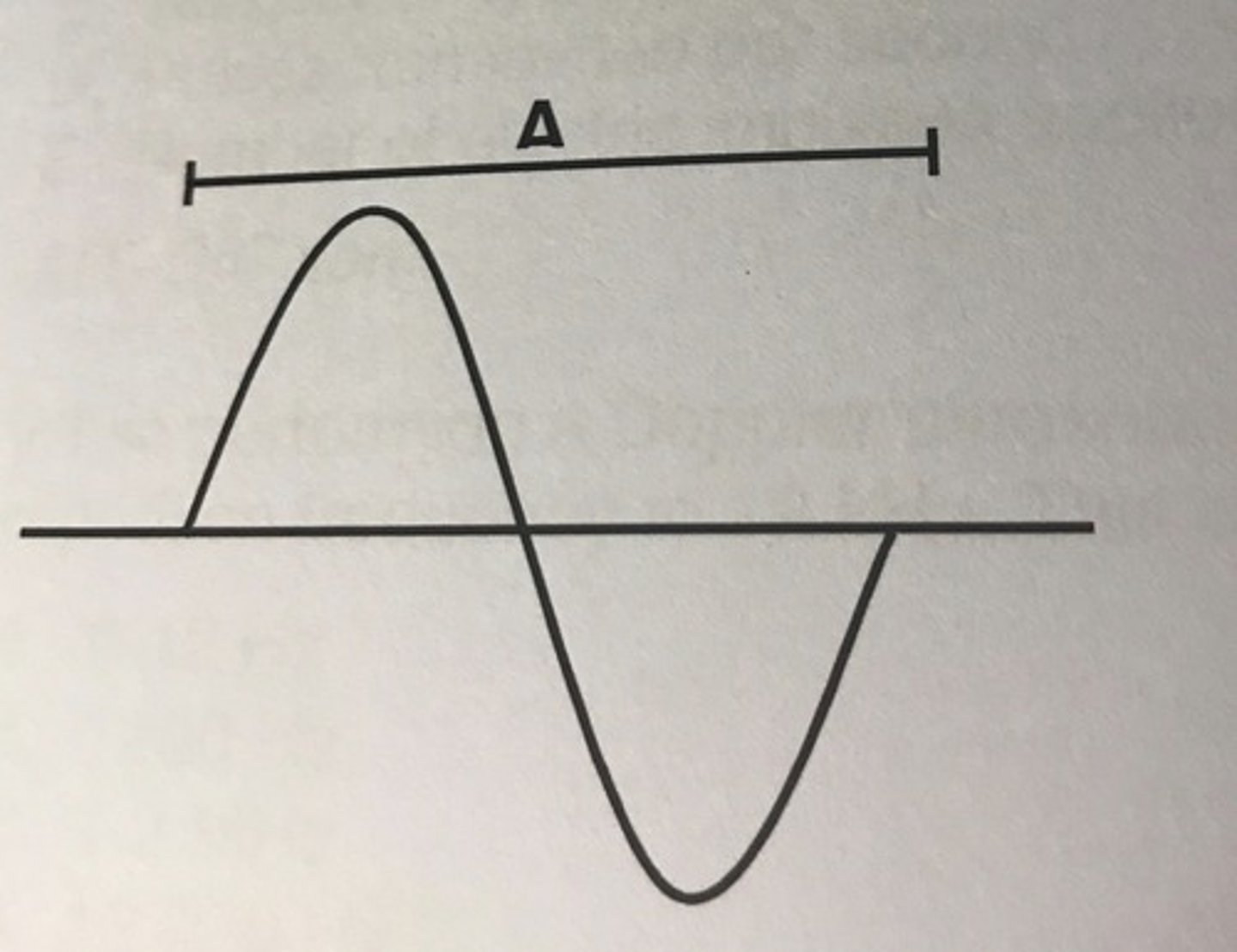
The following illustration depicts acoustic pressure v distance in a medium in which a sound wave is present What wound parameter is measured by the length of the bar labeled A in the following illustration?
Wavelength
The mass you are imaging has a diameter of 35 mm. This value can also be expressed as:
3.5 cm
Relative measurement of intensity based on a logarithmic scale is expressed in:
Decibels
The unit of sound intensity is the decibel. Decibel actually means one-tenth of a bel and is named for Alexander Graham ell (the inventor of the telephone). A decibel does not specify a specific level of sound intensity. Rather it is a way to express the ratio or comparison between two sound intensity levels. A decibel scale is logarithmic. The Richter scale used to measure earthquakes is another example of a logarithmic scale. A common value to remember w decibels is that a 3dB decrease represents 50% and a 6 dB decrease represents 75%.
Which prefix equals 10-3?
Milli
Micro is 10-6, mega is 10+6 and centi is 10-2
35* When you change the transmit freq, which of the following is altered?
Number of cycles per second
While performing a doppler ultrasound exam, you adjust the pulse repetition freq to 12kHz. This can also be expressed as:
12,000 Hz
Kilo is 1000 or 10+3
In sound wave propagation, a region of elevated pressure is termed:
Compression
Sound propagates thru tissue as a series of compressions and rarefactions (regions of lower pressure).
When you switch from a 2.5 MHz to a 5MHz txd, the sound wavelength?
Halves
Wavelength is inversely proportional to freq. Doubling the freq halves the wavelength
Wavelength depends on what two factors?
Frequency and propagation speed
Wavelength is determined by the following equation:
Y=c/f
Where y represents wavelength , c represents propagation speed and f represents freq
Which of the following human tissues has the highest rate of attenuation of an ultrasound wave?
Lung
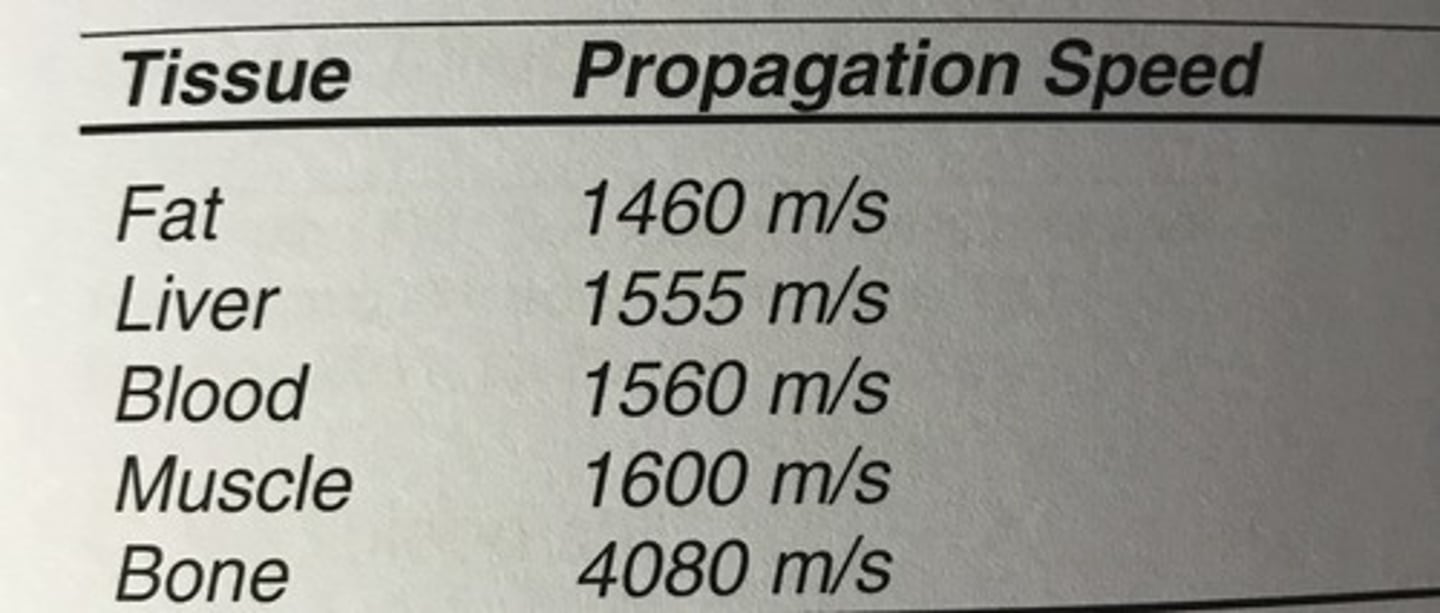
The propagation speed for sound is lowest in which of the following biologic tissues?
Fat
Propagation speeds of commonly encountered human tissue:
Which of teh following factors does NOT affect impedance?
Frequency
Impedance increases if density or propagation speed increases. Impedance is also affected by stiffness. It is not affected by freq. Z = pc, where p is the density and c is the speed of sound. C depends on density and tissue stiffness.
You are imaging a structure containing two media having the same acoustic impedance. What will occur a the boundary of the two structures?
All of the sound will be transmitted
For sound to be reflected, there must be a difference in acoustic impedance at the interface. If no difference is present, all of the sound will be transmitted at the boundary. (Normal incidence indicates a 90° angle of incidence; i.e. the sound beam is perpendicular to the surface it strikes).
What is the purpose of the gel coupling between the txd and the skin?
To provide a medium for sound transmission, since ultrasound does not propagate thru air
Any air between the txd and skin would cause total reflection and hence poor coupling
The unit of impedance is the:
Rayl
With absorption, acoustic energy is converted to:
Heat
The intensity transmission coefficient at the interface between two structures equals 1/100. What is the intensity reflection coefficient?
99/100
The intensity transmission coefficient described the fraction of sound transmitted at a boundary. The intensity reflection coefficient described the fraction of sound reflected at a boundary. The sum of these two coefficients must equal 1. Therefore, if only 1/100th of the energy is transmitted, then 99/100th of the energy has been reflected. These fractions can also be expressed a percentages for the sake of clarifying the principle. In this case, only 1% if the incident sound is transmitted from one medium to the adjacent medium. Therefore, 99% of the incident sound is reflected.
Which of the following is an example of a Rayleigh scatter?
Red blood cells
A Rayleigh scatterer is an object that is much smaller than the wavelength of the sound beam. A commonly encountered Rayleigh scatterer in diagnostic ultrasound is the red blood cell.
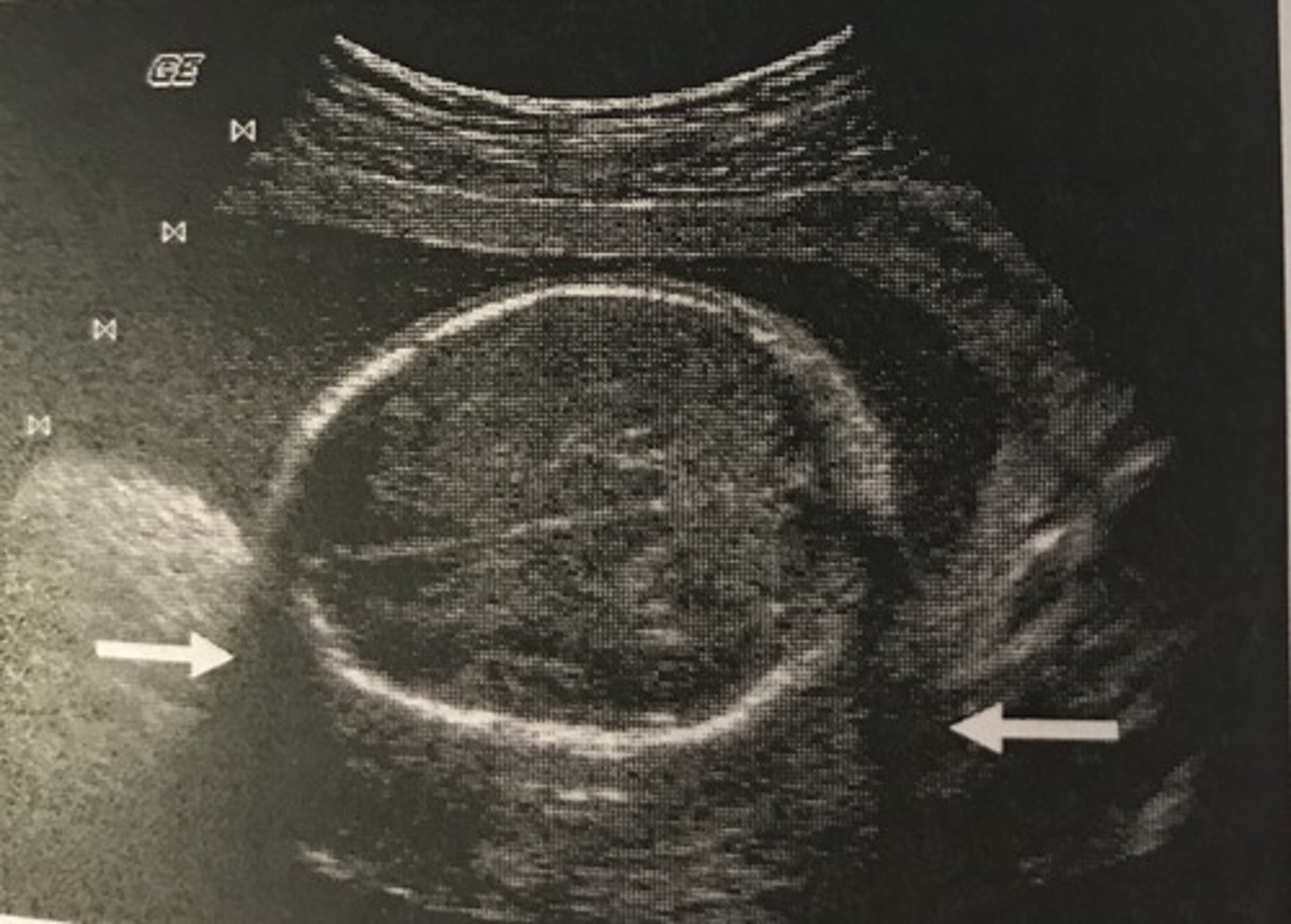
Which of the following sound interactions produced the shadows indicated by the arrows on the image?
Refraction
The edge shadowing seen w the curved interfaces is caused by refraction of the sound beam. This is the same physical principle that can be observed by placing a pencil in a partially filled glass of water. When viewed from the side, the pencil appears bent
In order to display a structure on your sonographic image, the sound beam must be reflected at the interface. What is required for sound reflection at the interface of two structures?
A difference in the acoustic impedance of the media
An example of a specular reflector is:
Pericardium
A specular reflector is a large, smooth interface such as the renal capsule, diaphragm or pericardium. Specular reflection is primarily responsible for the bright interfaces seen at organ boundaries
52* What system control can you adjust to compensate for the effect of sound attenuation in the body?
TGC
The TGC (time gain compensation) is used to amplify echo signals from deeper structures, which have undergone greater amounts of attenuation more than echo signals from shallow structures
While imaging a cyst, you notice shadowing posterior to each lateral border of the cyst. What is the source of the shadows?
Bending of the sound beam due to different media propagation speeds. This is refraction of the sound beam and occurs wherever there is both oblique incidence and a difference in media propagation speeds
The algebraic summation of waves leading to patterns of minima and maxima is called?
Interference
As waves from multiple interfaces come in contact w each other, they can interact either positively or negatively, If they are of the same phase, constructive interference occurs and the resultant wave has increased amplitude. If they are not of the same phase, the resultant wave has a weaker amplitude. If they are completely out of phase and of equal amplitude, they will completely cancel each other out.`
An interaction of echoes that leads to reinforcement rather than to partial or total cancellation is known as:
Constructive interference
Which phenomenon is associated w a pattern produced by a sound beam after passing thru a small aperture?
Diffraction
Diffraction is te general term for various phenomena in which waves from different parts of a source add or subtract (AIUM recommended nomenclature 09)
What sound parameter is determined only by the medium?
Propagation speed
Snell's law describes:
The angle of sound transmission at an interface between media having different propagation speed
Snell's law related the angle of transmission of the sound beam to the relative velocities of sound in the two media. Refraction of sound at an interface obeys Snell's law.
As a general observation about media in diagnostic sonography, sound propagates faster in material w greater:
Stiffness
During the performance of a sonographic exam you would be most likely to encounter refraction in the view:
Curved interfact
Refraction of the sound beam requires sound reflection from a curved interface. Therefore, this is the best answer. The curved interface may also be a specular reflector, but specular reflection is NOT required for refraction to occur.
You may observe sound attenuation by all of the following EXCEPT:
Compression
-Reflection
-Scattering
-Conversion of sound to heat
-absorption
Attenuation includes all sound interactions that result in a weakening of the beam. These include reflection, scattering, absorption and to a lesser extent, refraction. Absorption is the conversion of sound to heat in tissue. Refraction results in a bending of the beam.
When you image sound reflected from a large smooth interface, you are observing results of:
Specular reflection
During a sonographic exam of a large vessel, a 45° beam to vessel angle would be called?
Oblique incidence
Normal incidence is also known as perpendicular incidence. It occurs when the sound beam strokes the interface at a 90° angle
What occurs when you image a structure w oblique incidence?
The angle of reflection will be orientated away from the txd resulting in decreased visualization of the structure
With specular reflectors, the angle of reflection is equal to the angle of incidence but will be orientated in the opposite direction. So if perpendicular indigence (also known as normal incidence) is used, most of the sound will be reflected back at the transducer But if oblique incidence is used, most of the sound will be reflected away from the transducer at an angle equal to that of the transmitted angle.
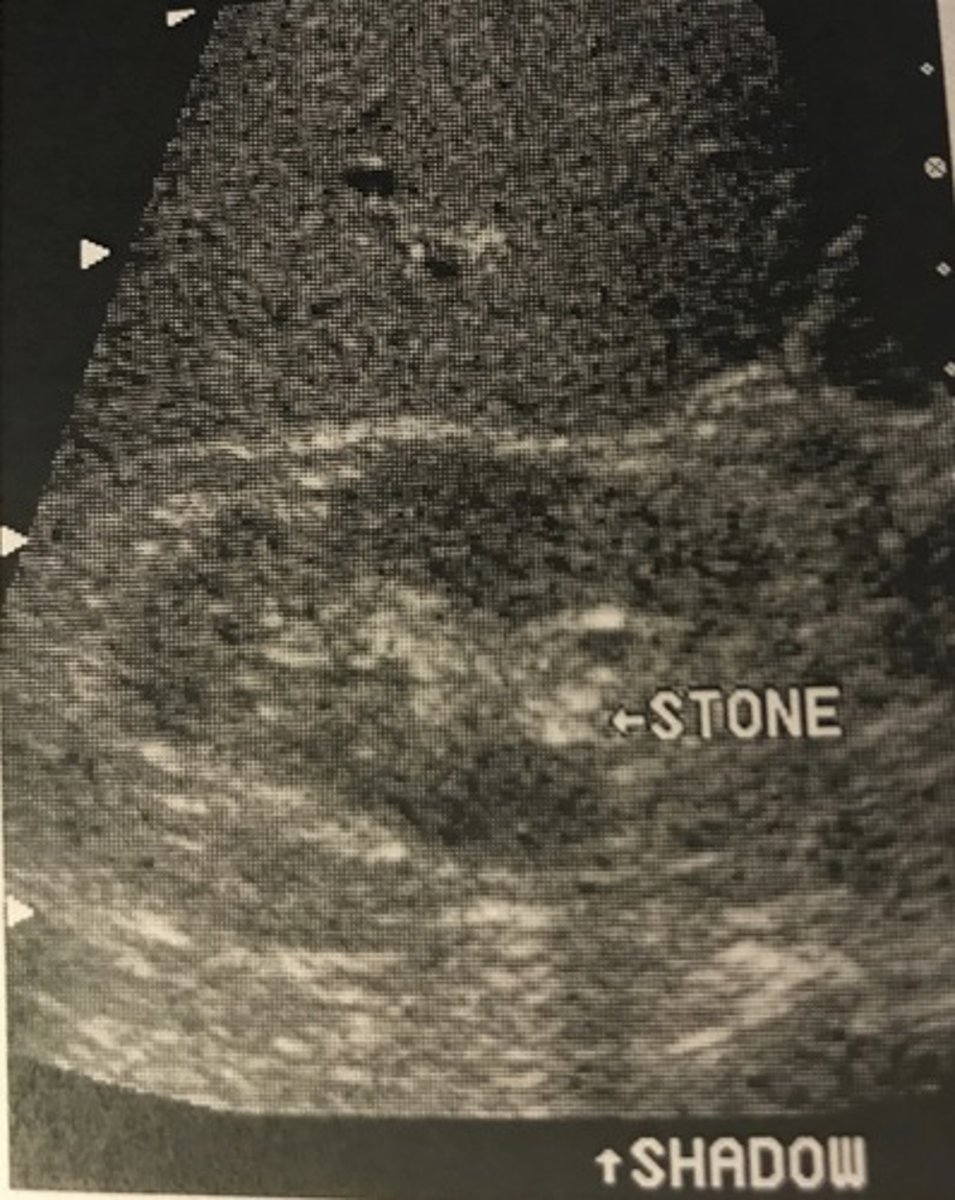
The shadow depicted in this image of a renal stone is primarily a result of the following sound tissue interaction:
Reflection
Because of the large acoustic impedance mismatch between soft tissue and calcium, most of the sound is reflected at the stone tissue interface. Very little sound is transmitted thru the stone to provide reflections from tissue distal to the stone. This results in shadowing distal to the calcification
Which of the following statements regarding the effect of freq on Rayleigh scattering is TRUE?
Scattering intensity is proportional to freq raised to the 4th power
An echo from which one of the following sound reflectors is most dependent on the angle of incidence:
Specular reflector
With specular reflection, the angle of reflection is equal to the angle of incidence. So in order to get most of the reflected sound to be angled back at the transducer, the transducer must be oriented so that the sound will strike the interface perpendicularly. That is why we get the best images of the kidney, aorta and similar structures when we have them positioned horizontally on the ultrasound image.
What term describes the hyper echoic region (arrow) seen beneath this complex structure?
Acoustic enhancement
Enhancement is caused by a lower attenuation within the structure than in the surrounding tissue.
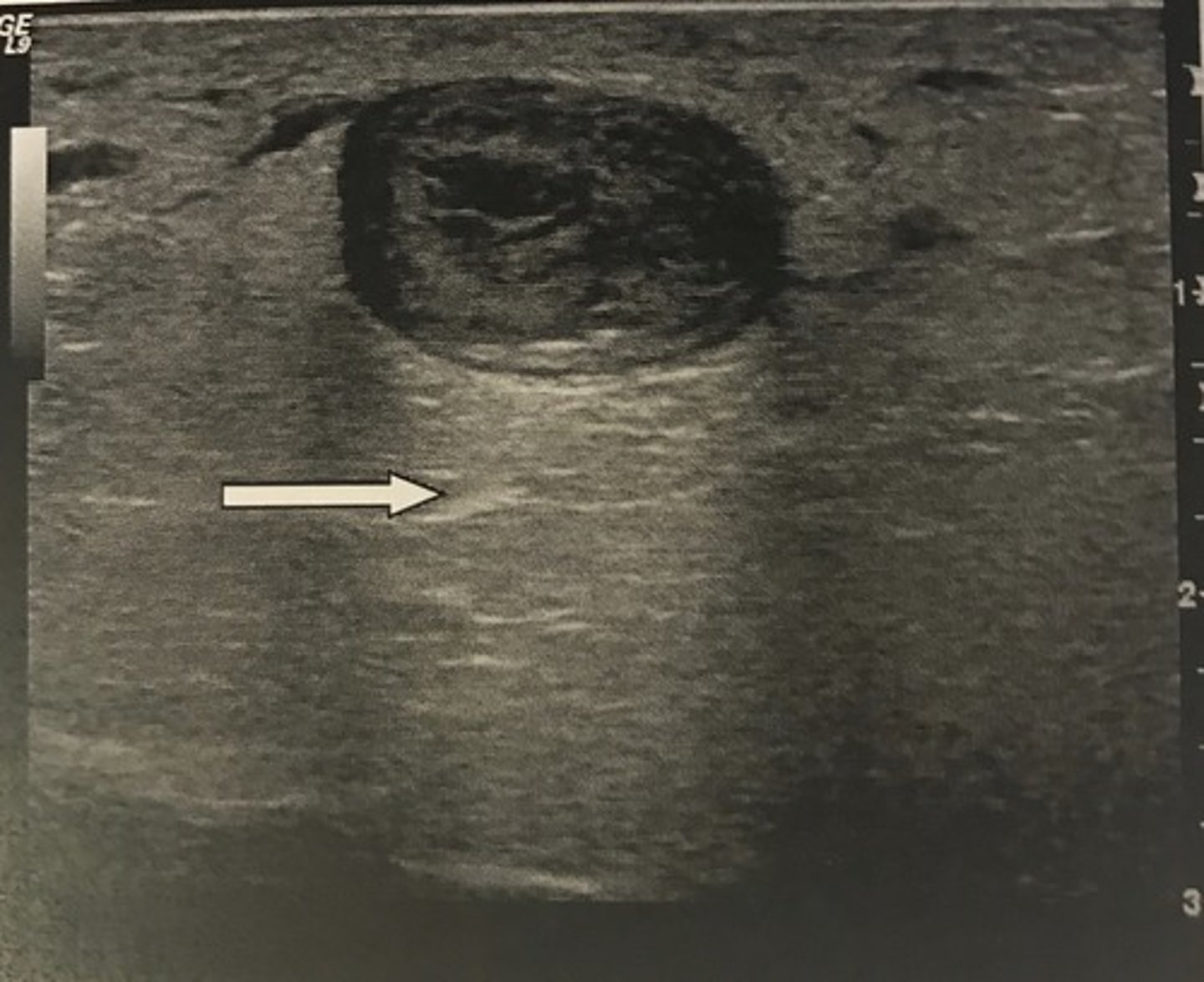
The hyper echoic region in the preveious illustration results from:
Decreased attenuation thru a fluid filled structure
Acoustic enhancement results from decreased attenuation thru a fluid filled structure compared to the adjacent tissue. Changes in propagation speed do not produce acoustic enhancement. The sound absorption in the region distal to the fluid filled structure is not affected. A high acoustic impedance mismatch at the cyst tissue interface would result in greater reflection of sound w possible shadowing instead of enhancement. She shadowing posterior to the lateral border of the cyst is refraction due to bending the sound beam w oblique incidence.
What determines acoustic impedance?
Density and propagation speed of the medium
Acoustic impedance is determined by the density and propagation speed of the medium as expressed in this equation:
z=pc
where z represents acoustic impedance, p represents density and c represents propagation sp
Diagnostic ultrasound is limited in its diagnostic application to the adult brain because:
The great acoustic 23 mismatch between the cranium and soft tissue causes most of the sound to be reflected at that interface.
This acoustic impedance mismatch causes nearly all of the sound to be reflected at the bone soft tissue interface and leaves very little energy for transmission into the brain, Since attenuation is greatest with hi-freq transducers, imaging of the adult brain must be limited to very low freq to enhance penetration. This results in poor spatial resolution
Which of the following describes diffuse reflection?
The reflected beam is scattered in various directions
With diffuse reflection, the beam is weakened bc of incoherence. Diffuse reflection occurs when the sound beam strikes a large, rough surface. The beam is reflected at many different angles bc it strikes the rough surface at varying angles of incidence This has the result of causing the reflected waves to be incoherent (out of phase) w each other, weakening and defocusing the beam
According to Snell's law, the angle of transmission is related to the incident beam angle and:
The relative speeds of sound in the two media
Snell's law dictates the angle of transmission that will occur at an interface w refraction of the sound beam. Refraction (bending) of the sound beam occurs whenever there is oblique incidence and different propagation speeds between two media
Which of the following interactions of sound and tissue decreases the intensity of the trnsmtted beam?
All of these interactions will result in decreased intensity of the transmitted beam
What is the relationship of freq to absorption?
If frequency is doubled, absorption is also doubled
There is a direct relation between absorption and freq. As freq doubles, the rate of absorption doubles. That is why there is less penetration w higher freq --absorption is increased
What term is used to describe the reduction in the intensity of sound as it propagates thru tissue?
Attenuation
Another term for nonspecular reflection is:
Scattering
Specular reflection occurs when the interface is large and smooth. Non specular reflection or scattering occurs when the interface is small, less than several wavelengths across
While performing a sonographic exam, you encounter the following interfaces. Which will produce the weakest reflected signal?
Organ parenchyma/organ parenchyma
Reflected signal strength depends on acoustic impedance mismatch, A small reflected signal occurs when the acoustic impedance mismatch is negligible, as it is at small interfaces within a parenchymal organ such as the liver or kidney, A large reflected signal occurs when the acoustic impedance mismatch is large, as it is between organ parenchyma (soft tissue) and fluid, air, bone or ligament.
During a diagnostic ultrasound exam, you encounter all of the interactions of ultrasound and tissue listed below. Which one will NOT cause a redirection of part of the ultrasound energy?
Absorption
Absorption is the conversion of sound into heat. It does contribute to attenuation but does not redirect the sound beam.
As you perform a sonographic exam, you switch from a 3.5 MHz txd to a 7 MHz txd to image a superficial structure. Compared to the 3.5 MHz txd, what will the 7 MHz attenuation rate and wavelength be?
Double the attenuation rate, one half the wavelength
If freq is doubled, the rate of attenuation is doubled but the wavelength is haled. Remember: as freq increase wavelength decreases, improving resolution but decreasing penetration because of increased sound absorption
You are scanning a large mass that is composed primarily of fat. Which of the following are you most likely to encounter?
Axial misregistration of objects distal to the mass on the screen due to the slower propagation speed thru fat.
Because sound travels slower in fat than in soft tissue, a large mass composeed primarily of fat may cause axial misregistration of the objects distal to the mass on the ultrasound image. This occurs bc the system must assume a constant sound propagation speed of 1540 m/s. If sound travels more slowly thru a medium, the round trip travel time will be longer and the system will place the structure deeper on the image. Conversely, if sound travels thru a medium w a propagation speed faster than that of soft tissue, the round trip travel time will be shorter and the structure will be placed shallower on the image.
What two conditions must be present to cause refraction of a sound wave?
Oblique incidence and different media propagation speeds
Both must be present for refraction to occur. Reflector size does not affect refraction. Refraction does not occur w perpendicular incidence
The txd you are using transmits wide bandwidth pulses whose freq content is 2-5 MHz. Which of the following most correctly described the reflected echo signals after they have traversed the tissue?
The echo signals will be shifted down in freq due to the increased attenuation of higher freq
When the sound beam is refracted during a sonographic exam, which of the following might you detect on the ultrasound image?
Lateral misregistration
Refraction is a bending of the sound beam that results in lateral misregistration of structures posterior to the refracted beam. Refraction depends on both oblique incidence and different media propagation speeds
During production of a sonogram, you image the following structures, which is the MOST attenuating?
Calcification
86* What can you do to enhance the visibility of a specular reflector?
Scan w perpendicular incidence
With specular reflectors, the angle of reflection is equal to the angle of transmission, so the greatest reflection will be received back by the txd whenever perpendicular incidence i used Increasing the amount of received energy enhances the visibility of the reflector
What interaction of ultrasound and tissue is primarily responsible for imaging the internal structure or organs?
Scattering
What sound tissue interaction is necessary to form an ultrasound image?
Reflection
Reflection and scattering give rise to the echo signals that are displayed on the monitor
For soft tissue, one of the factors responsible for determining acoustic impedance is:
Density
The equation for acoustic impedence is
z=pc
where z is the rayl (unit for acoustic impedance), p is density, and c is the speed of sound. Because the speed of sound in tissue is relatively constant (1540 m/s), the main factor determining acoustic impedance is changes in tissue density
When you image a structure that is a specular reflector, the strength of the received signal depends on the following two facotrs:
Difference in acoustic impedance and angle of incidence
The amplitude os the reflected signal depends on the difference in acoustic impedance between the two tissues. The greater the difference, the greater the reflection. As mentioned previously, specular reflection is highly angle dependent. If the beam strikes the interface at a right angle (90°), the reflected energy will be directed back to the txd. But if the beam strikes the interface at another angle, the reflected energy will be directed at the same angle AWAY from the txd.
91* Attenuation of the sound beam increases w increasing:
Path length
Absorption
Frequency
Scattering and reflection
The attenuation coefficient is the degree of attenuation for each centimeter of sound propagation. Anything that increases attenuation will increase the attenuation coefficient
You are imaging a rounded mass w irregular borders. The mass has a much slower propagation speed than surrounding tissue. What sound tissue interaction will be encountered as the ultrasound propagates thru this interface?
Refraction
Reflection
Absorption
Scattering
Refraction occurs bc of the oblique incidence (round surfaces) and different propagation speeds of the insonated media. Reflection occurs bc the acoustic impedance is different (different densities and propagation speeds). Absorption occurs as sound propagates thru tissue, and so it will be present. Scattering occurs as a result of the irregular margins of the mass.
You are imaging a structure that is highly attenuating. Which imaging effect do you expect to encounter?
Shadowing
With increased attenuation, there will be loss of sound energy thru reflection, scattering and absorption. This loss will result in less penetration and shadowing distal to the highly attenuating region.
When you are educating your patient about the sonographic exam, sound travels thru air from your mouth to your patients ears. Which of the following is true regarding the speed of sound travel thru air?
The speed of sound in air is slower than the speed of sound in soft tissue
Sound travels much more slowly in air than in soft tissue (approx 330 m/s vs 1540 m/s). The speed of sound in any medium does not approach the speed of light (approx 300,000 km/s in vacuum or air)
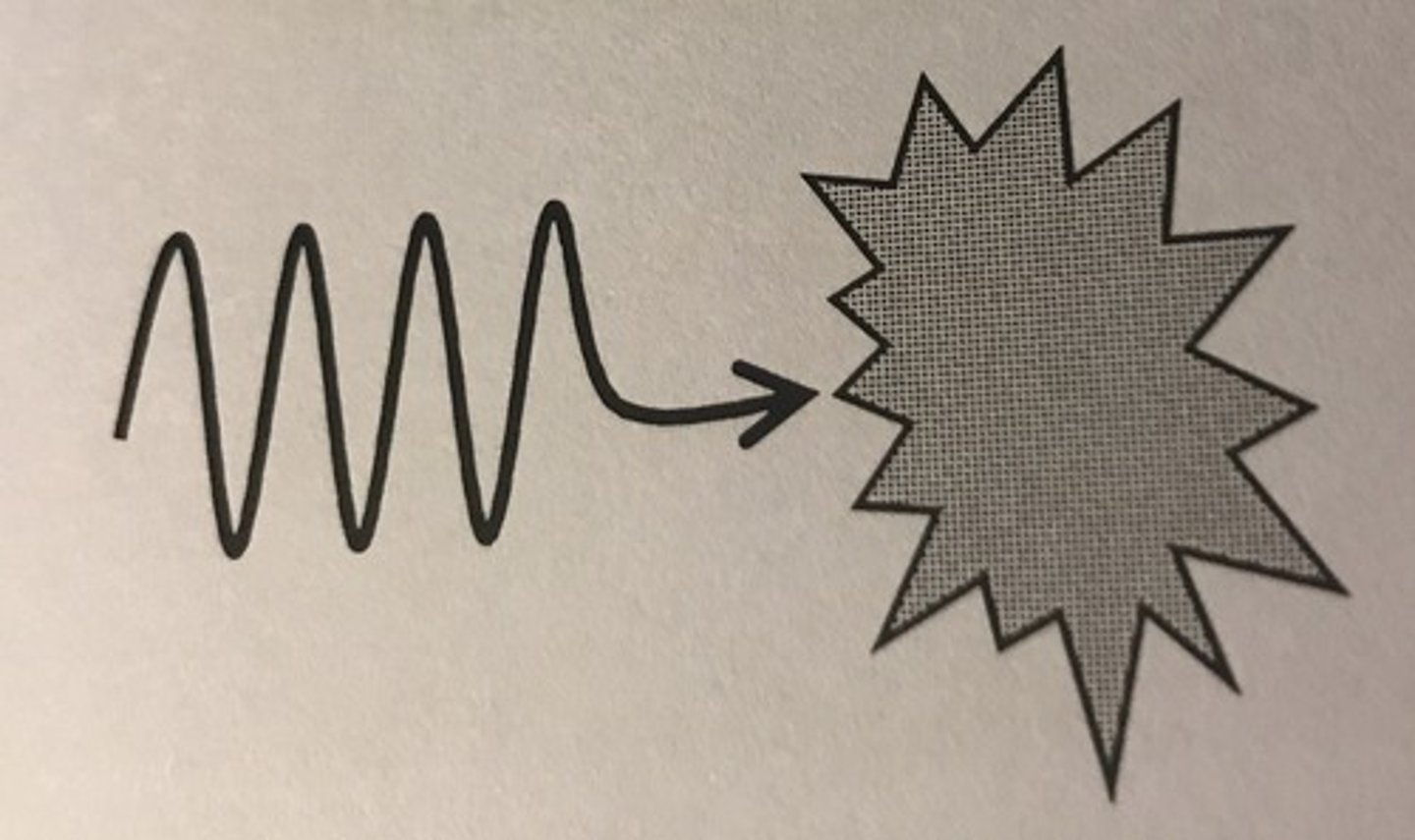
In the following illustration, if the propagation speed is unchanged at the interface, whih most correctly describes the sound tissue interaction taht will take place when the ultrasound
Scattering
Occurs when the sound strikes an irregular or rough surface that is small compared to the wavelength. Specular reflection occurs when the surface is smooth and large compared to the wavelength. Diffraction requires the speed to pass thru a small aperture. Refraction occurs w oblique incidence and a change in propagation speeds at the interface.
96* You have increased the transmit power while performing a pelvic ultrasound exam. This action increases which of the following?
Penetration
Acoustic power
Image brightness
Voltage applied to the txd elements
If sound waves of 3 MHz, 5 MHz and 10 MHz are transmitted thru the same section of anatomy, reflections from which freq would reach the txd first?
Reflections from all three freq would have nearly identical transit times.
The speed of sound does not vary appreciably w freq. Freq describes the number of cycles that occur in one second. The speed of sound is determined by the medium, not the sound source. Freq is determined by the sound source (the txd), not by the medium
98* What would you do if the image does not show adequate penetration and the far field displays noise instead of tissue?
Decreases transmit freq
When penetration thru the tissue is inadequate and the far field demonstrates noise, lower the transmit freq is a good option and may provide adequate penetration. Increasing the TGC will not help if the far field is already demonstrating noise. Increasing the acoustic output may also be helpful if it is not already set to the maximum level. Another option maybe to move the focal zone position to a deeper position.
For pulsed ultrasound, which of the following factors determines the freq of the sound wave?
Transmitter freq
Txd can be operated over a range of freq; the transmitter generally dictates the actual freq. The number of electric pulses delivered to the active element per second is the pulse repetition frequency (PRF) but does not affect the imaging freq. The freq is determined by the propagation speed and the thickness of the piezoelectric material in the txd, and by the center freq of the drive signal applied to the txd.
100* You have decreased the acoustic power by -3dB. Which of the following post accurately describes this adjustment?
The intensity has been halved
An intensity change of 3 dB corresponds to a doubling of the intensity. If the intensity is changed by -3dB, then the intensity is halved.