physics 153 take home
 Call Kai
 Learn
Learn Practice Test
 Spaced Repetition
 Match
Match Flashcards
 Knowt Play
1/135

There's no tags or description
Looks like no tags are added yet.
Name | Mastery | Learn | Test | Matching | Spaced | Call with Kai |
|---|
No analytics yet
Send a link to your students to track their progress
136 Terms
If the distance between two point charges is doubled, will the electrostatic force that one charge exerts on the other be cut in half?
No, since the force is proportional to the square of the distance, it will be cut to ¼.
If two point charges are both doubled in magnitude without changing the distance between them, will the force that one charge exerts on the other also be doubled? Explain in words.
The force would not be doubled. Instead, the force would be four times larger because both charges would become 2q. (2q1) (2q2) = 4(q1q2). When both charges are doubled, each one contributes to increasing the force.
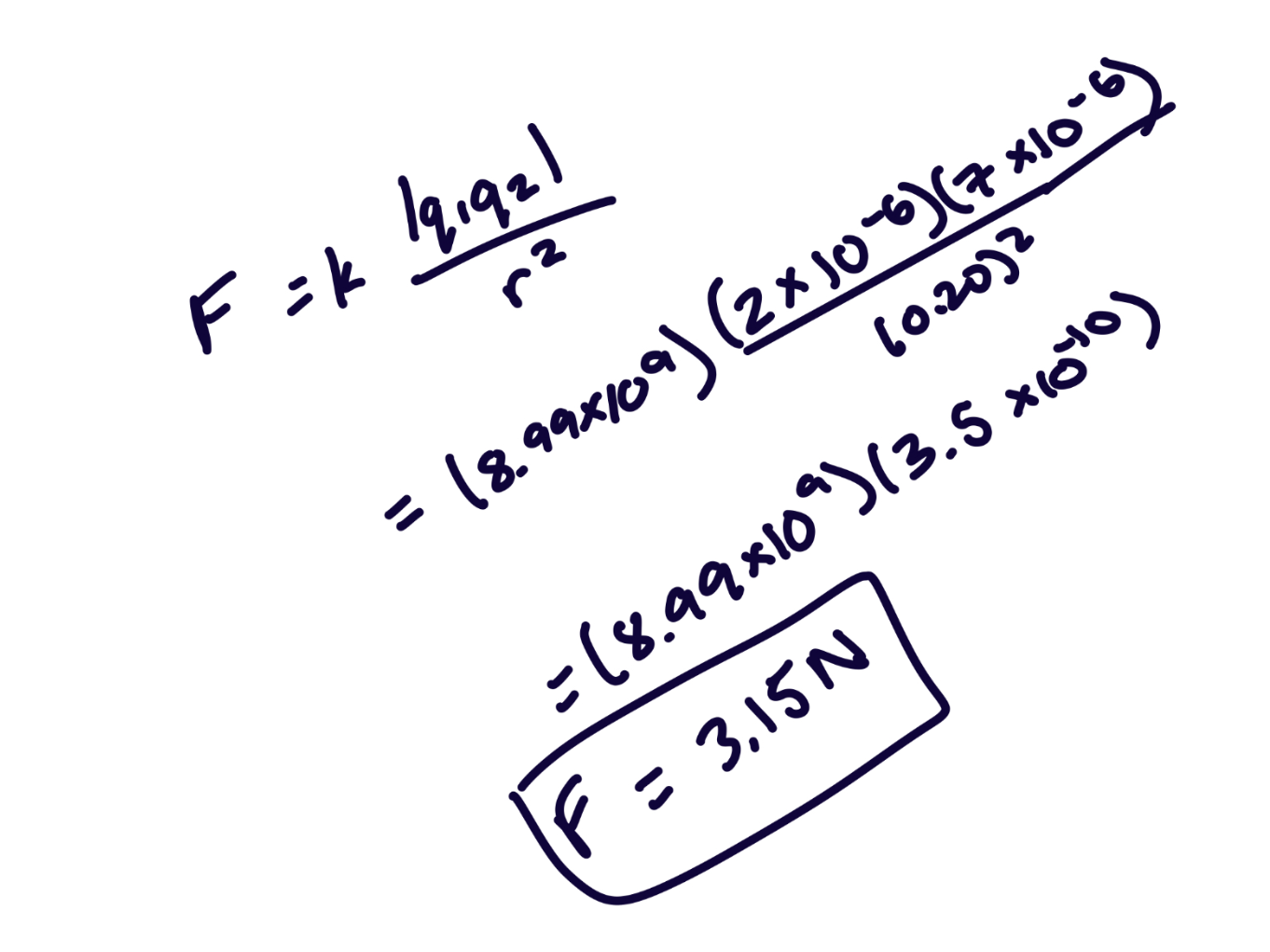
Two positive charges, one 2 µC and the other 7 µC are separated by a distance of 20 cm. What is the magnitude of the electrostatic force in Newton (N) that each charge exerts upon the other?
3.15
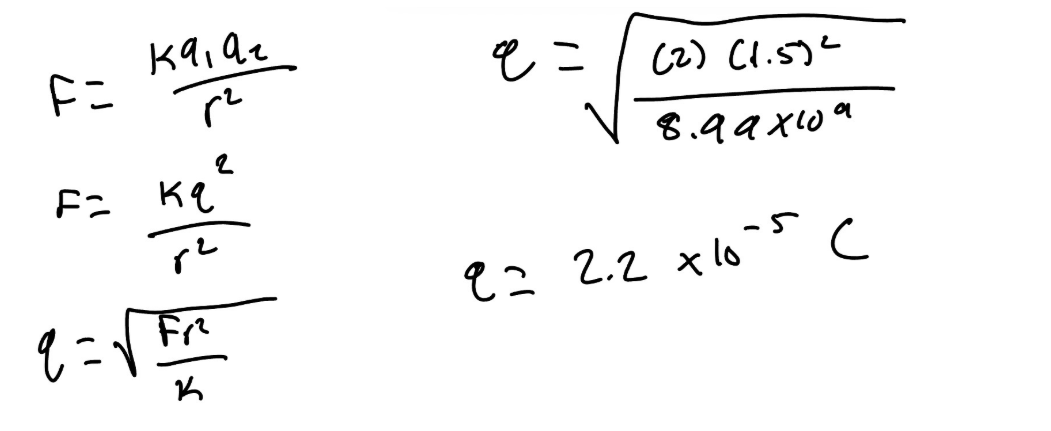
Two small spheres in vacuum are 1.5 m apart center to center. They carry identical charges. Approximately how large is the charge on each if each sphere experiences a force of 2 N?
2.2e-5 C
Charges 1 and 2 exert repulsive forces on each other. Also q1 = 4q2. Will the force exerted by charge 1 on 2 be greater than or the same as or smaller than the force exerted by charge 2 on 1? Justify in words.
The force exerted is the same because, according to Coulomb's law, q1 and q2 are multiplied and then divided by r. Whether or not q1 or q2 are 4x, the magnitude is the same.
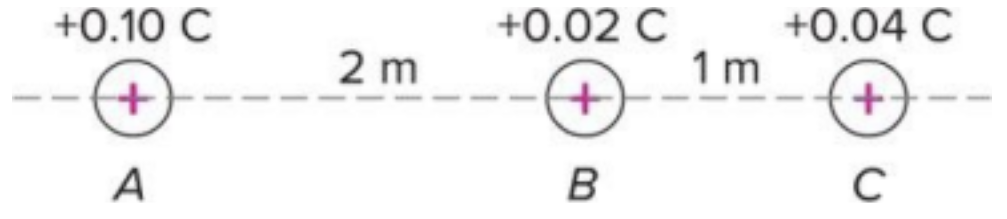
The 0.10 C charge at point A is 2m to the left of the 0.02C charge at point B and the 0.04C charge at point C is 1m to the right of point B. What is the magnitude of the force exerted on the 0.02C charge by the 0.10C charge in Newton?
Using Coulomb's law, F(AB)= 8.99*10^9(0.02*0.10)/2^2= 4.49*10^6 N
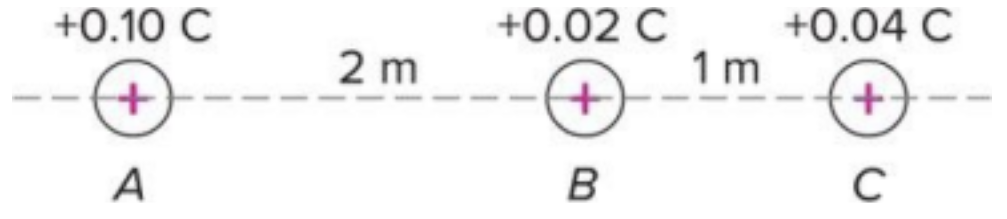
The 0.10 C charge at point A is 2m to the left of the 0.02C charge at point B and the 0.04C charge at point C is 1m to the right of point B. What is the magnitude of the force exerted on the 0.02 C charge by the 0.04C charge in Newton?
F(BC)= 8.99*10^9(0.02*0.04)/1^2= 7.19*10^6 N
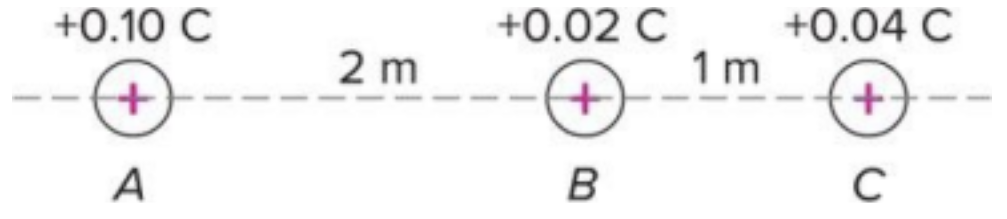
The 0.10 C charge at point A is 2m to the left of the 0.02C charge at point B and the 0.04C charge at point C is 1m to the right of point B. What is the net force exerted on the 0.02C charge by the other two charges in Newton?
F(net)= 7.19*10^6 N - 4.49*10^6 N= 2.70 x 10^6 N
Two +10 nC charged particles are 2 cm apart on the x-axis. What is the net force on a +1.0 nC charge midway between them? Draw a figure showing the direction of the forces as well as the net force.
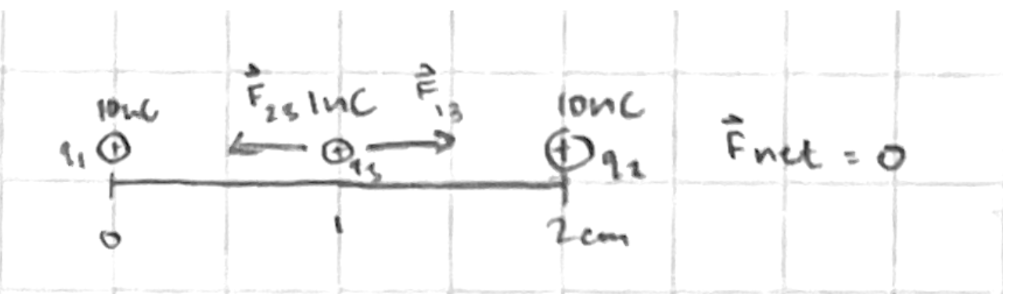
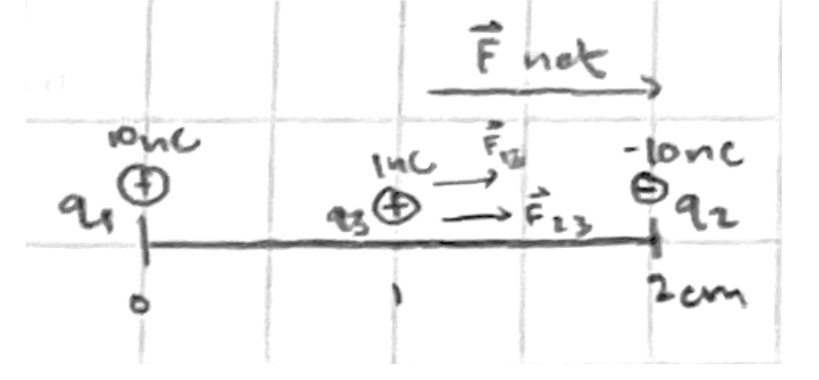
Two +10 nC charged particles are 2 cm apart on the x-axis. With a +1.0 nC charge midway between them, what is the net force if the +10 nC charge on the right is replaced by a –10 nC charge? Draw a figure showing the direction of the forces as well as the net force.
Coulomb’s Law predicts the electrostatic force: F existing between two point charges: q1 and q2 separated by a distance: r. For simplicity we will assume both charges to be positive. Suppose these charges are now resting on two spherical conductors of finite size separated center to center by the same distance r. Would the force: F1 between the two spheres be the same, greater than or smaller than F? Explain in words.
F1 would be smaller than F because force is inversely proportional to distance and the positive charges will redistribute themselves to be farther apart on the spheres. Since the distance is slightly larger, F1 will decrease in response. The diagram below shows an electrode configuration with corresponding electric field lines.
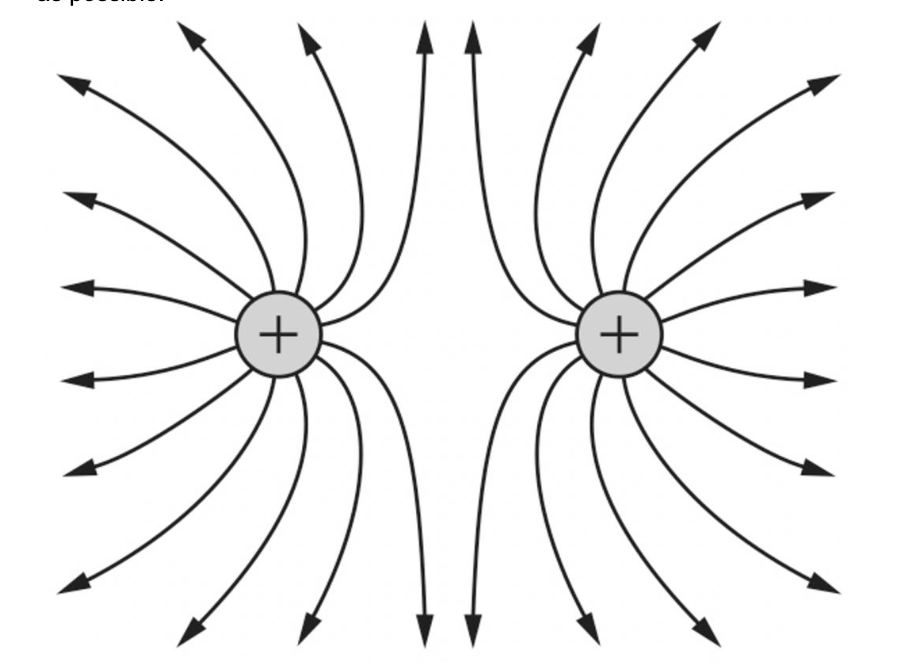
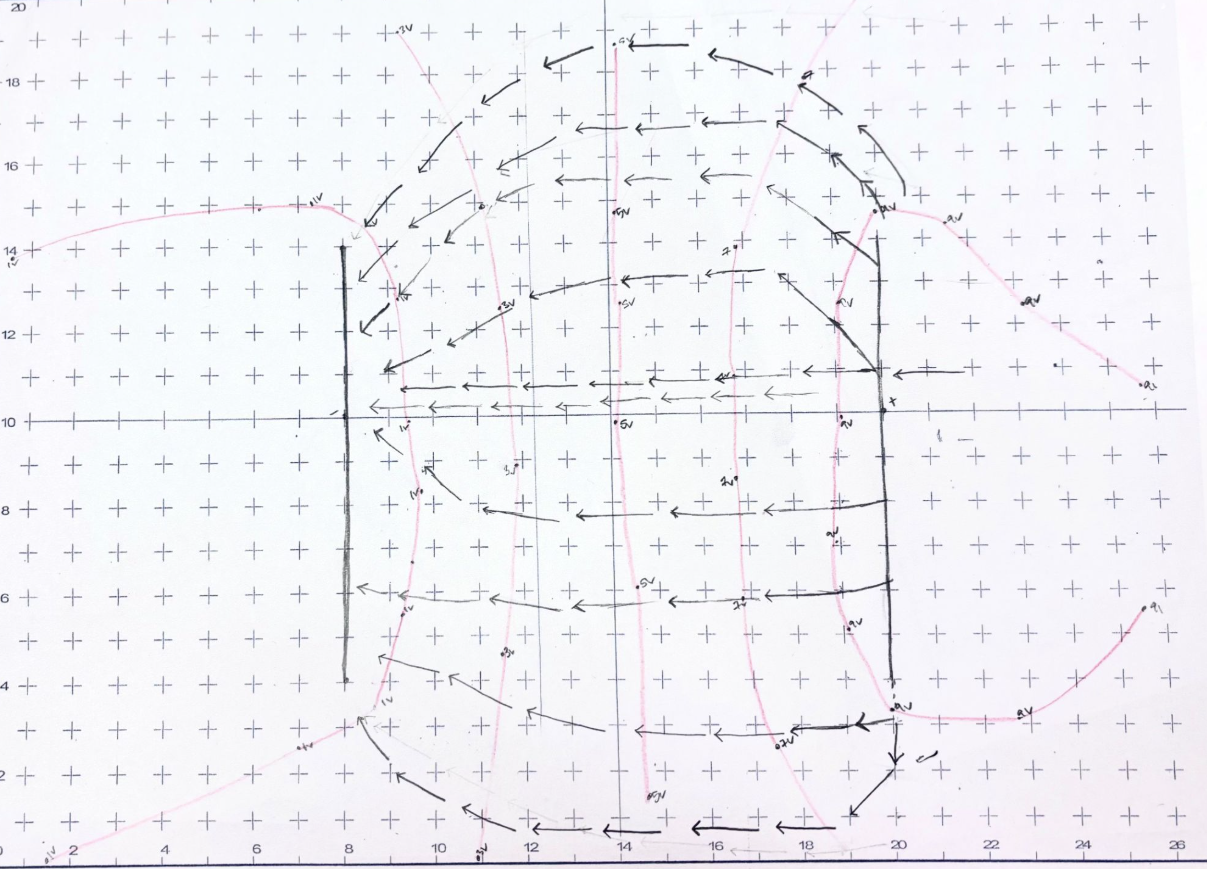
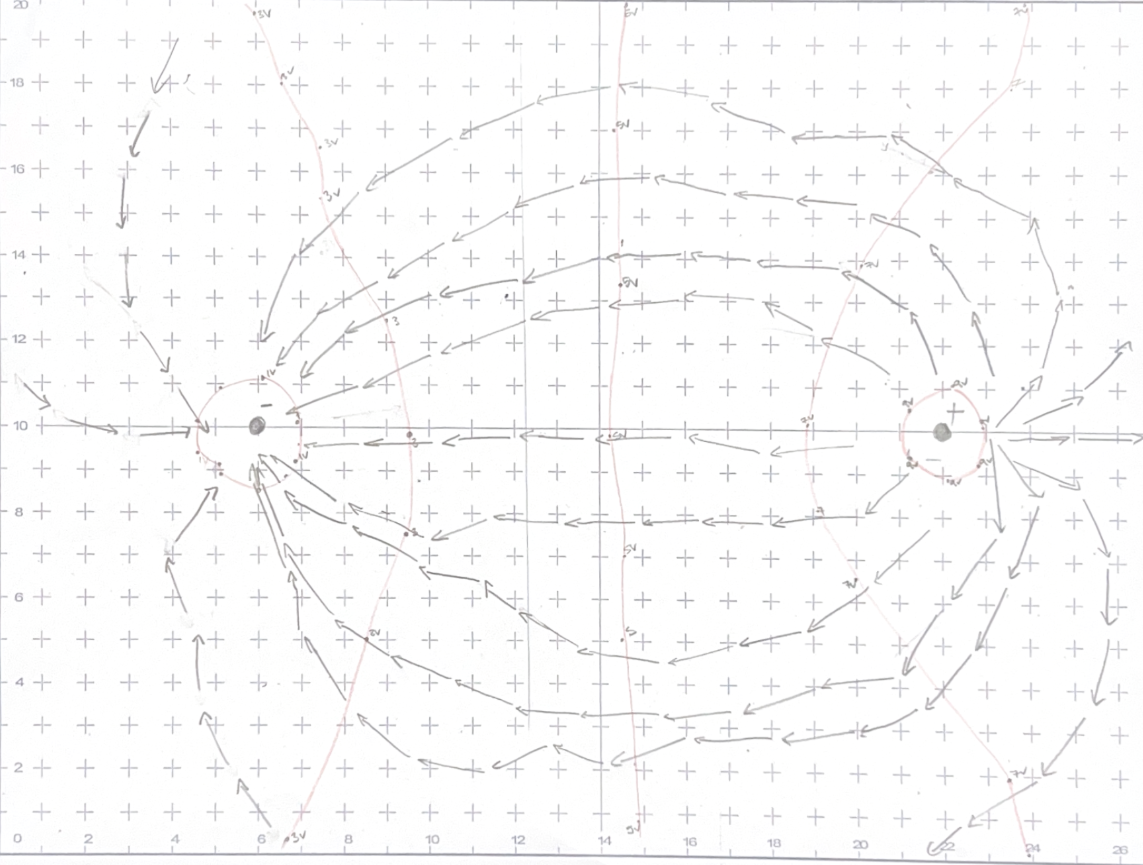
The diagram below shows an electrode configuration with corresponding electric field lines. Draw 3 equipotential lines surrounding the electrodes. Space the lines as evenly as possible.
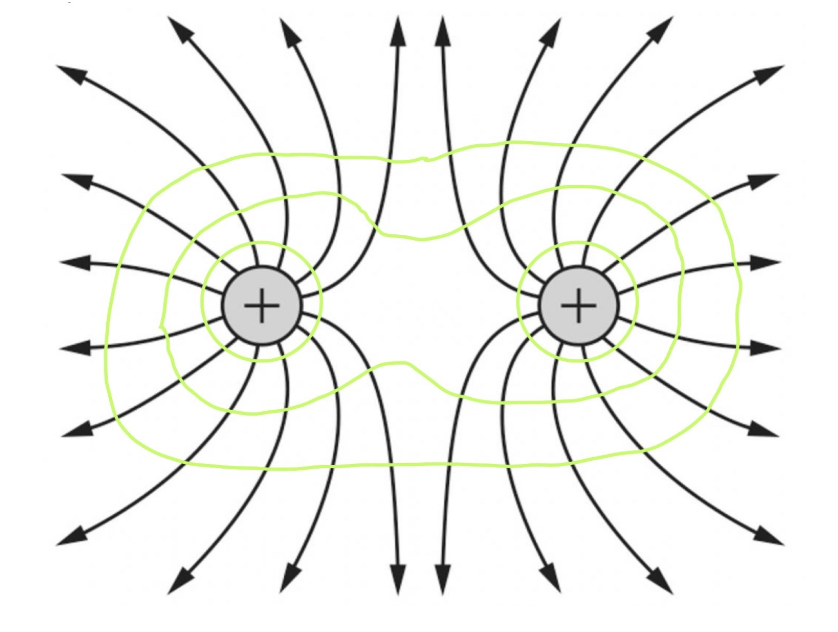
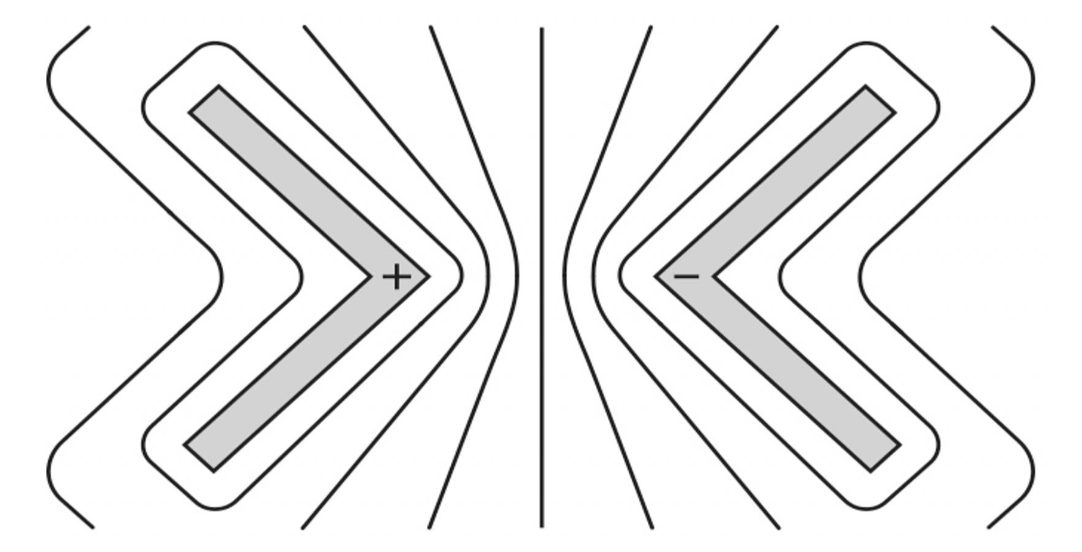
The diagram below shows an electrode configuration with corresponding equipotential lines. Draw about 10 evenly-spaced electric field lines between the electrodes.
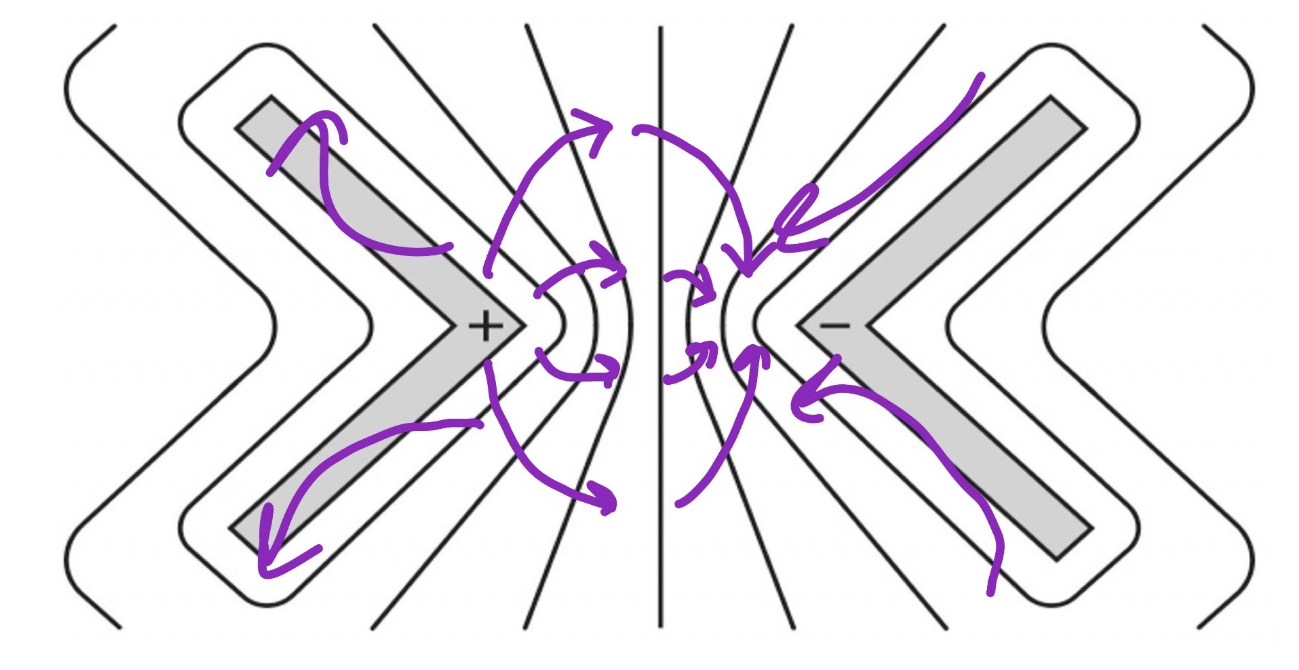
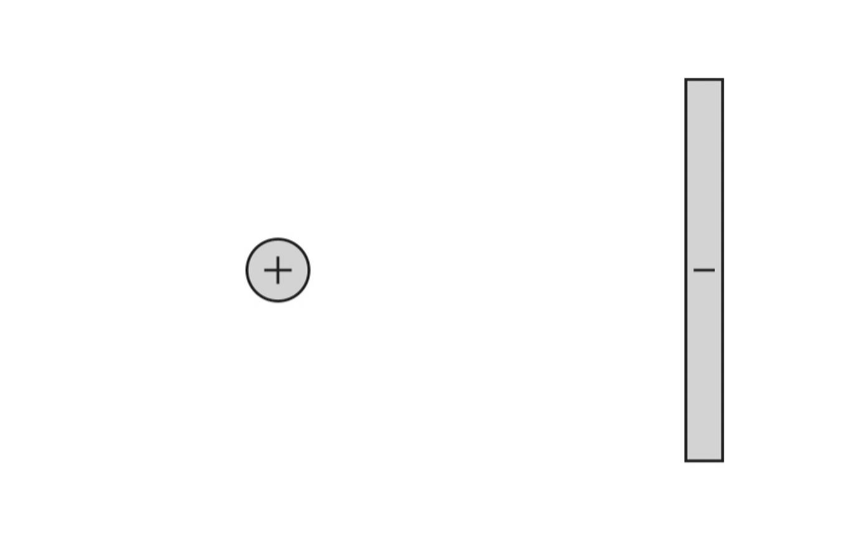
Estimate the shape of the electric field surrounding the electrodes shown below: draw isolines of electric potential and enough electric field lines surrounding the electrodes to distinguish the shape of the field corresponding to your prediction. Assume that the amount of charge on both electrodes is equal and opposite
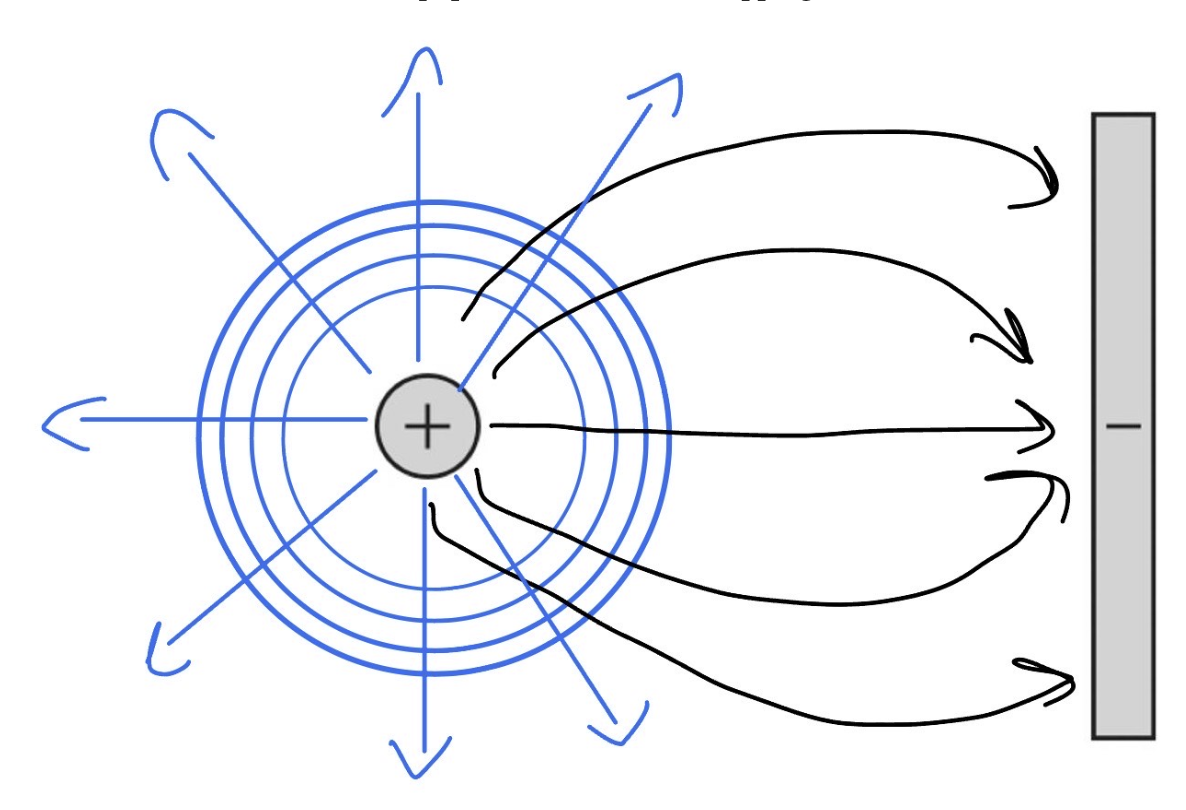
Describe the properties of equipotential lines and electric field lines seen on the mapping done by your group. Be specific.
Equipotential lines are perpendicular to electric field lines. Each line has the same voltage at any point on it. The closer the lines, the stronger the electric field. Observing the E-field lines, they point toward the negative charge. They also move from high to low potential. Similarly, the E-field is denser where the field is stronger.
What are the primary similarities and differences between the electric fields surrounding each electrode configuration?
In both configurations, the lines run from positive to negative and are perpendicular to the equipotential lines. In the dipole configuration, the lines are dispersed and curve around the charges. In the parallel-plate configuration, the lines are mainly straight and end at the plate.
Where was the electric field strongest in each electrode configuration? Justify your answer.
For the dipole electrode configuration, the electric field was strongest near the electrode, and field lines were closest together in these regions. In the parallel-plate capacitor configuration, the electric field was strongest between the two electrodes and slightly weaker near the edges. The value shown on the digital multimeter was highest between the two plates.
What can be said about the voltage at each point of an equipotential line?
At each point of an equipotential line, the voltage is the same. An equipotential line connects points of equal voltage.
How would the shape of the electric field lines in each configuration change if you increased the potential difference between the electrodes? Justify your answer.
If the potential difference between the electrodes were to be increased, it would not change the shape of the electric field lines in either configuration. The lines would be closer together because of a greater field strength.
Is the electric field produced by a single positive charge a uniform field? Explain in words.
The electric field produced by a single positive charge is not uniform; it is radial. As the distance increases, the field weakens. In a uniform electric field, the field strength is the same at every point.
If we move a positive charge towards a negative charge, does the potential energy of the positive charge increase or decrease. Explain.
Potential energy decreases because a positive charge moves from a higher to a lower potential energy, becoming more negative.
If a negative charge is moved in the same direction as the electric field lines in some region of space, does the potential energy of the negative charge increase or decrease. Explain.
The potential energy of the negative charge will increase because it is moving against the direction of the field lines and requires positive work.
A uniform electric field of 1000 N/C is established between two oppositely charged metal plates. A particle with a charge of +0.005 C is moved from the bottom (negatively charged) plate to the top plate. The distance between the plates is 3 cm. What is the change in potential energy of the charge in Joules?
W= F x s(displacement) ; F=qE
ΔU=qE(s)-> (0.005)(1000)(0.03)= 0.15J
A uniform electric field of 1000 N/C is established between two oppositely charged metal plates. A particle with a charge of +0.005 C is moved from the bottom (negatively charged) plate to the top plate. The distance between the plates is 3 cm. What is the change in electric potential from the bottom to the top plate in Volts?
E=−Δx/ΔV -> ΔV=−EΔx -> ΔV=−(1000)(0.03)= -30V= 30V
The negative becomes positive because the direction is going from negative to positive.
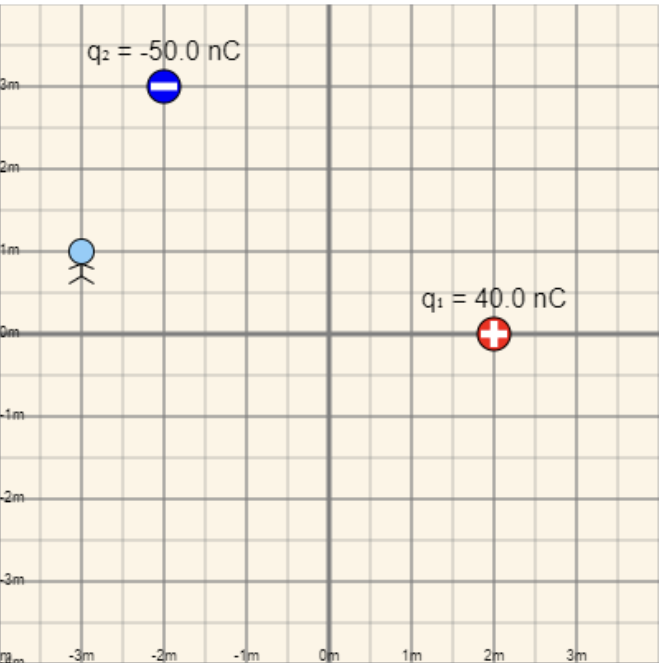
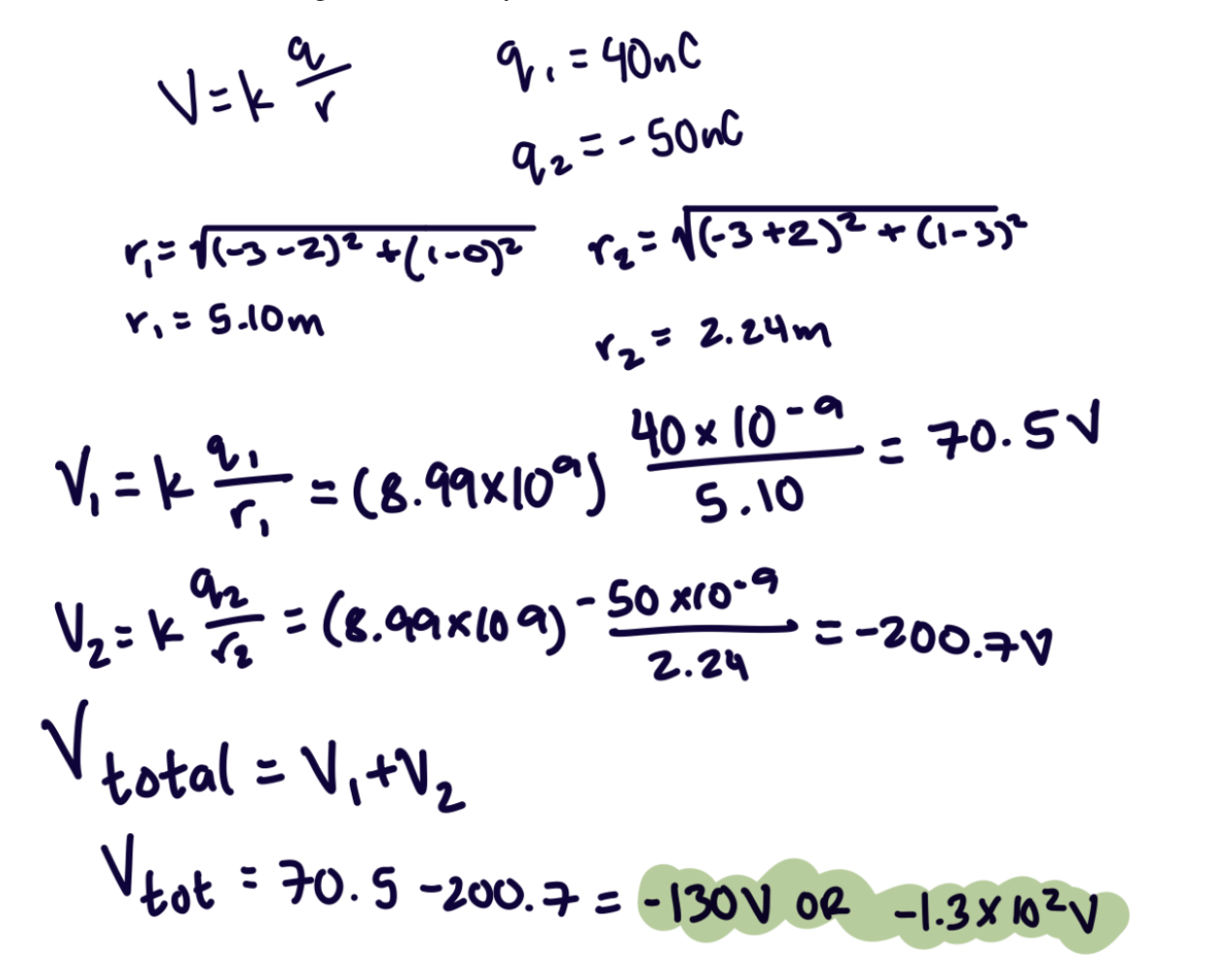
Calculate the combined electric potential: VTotal due to charges: q1 and q2 as seen by an observer. See the figure below for your reference:
-130V
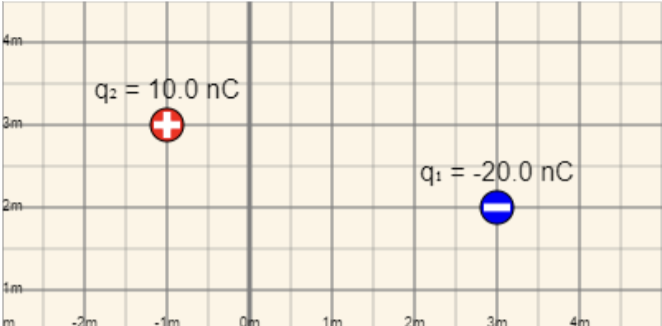
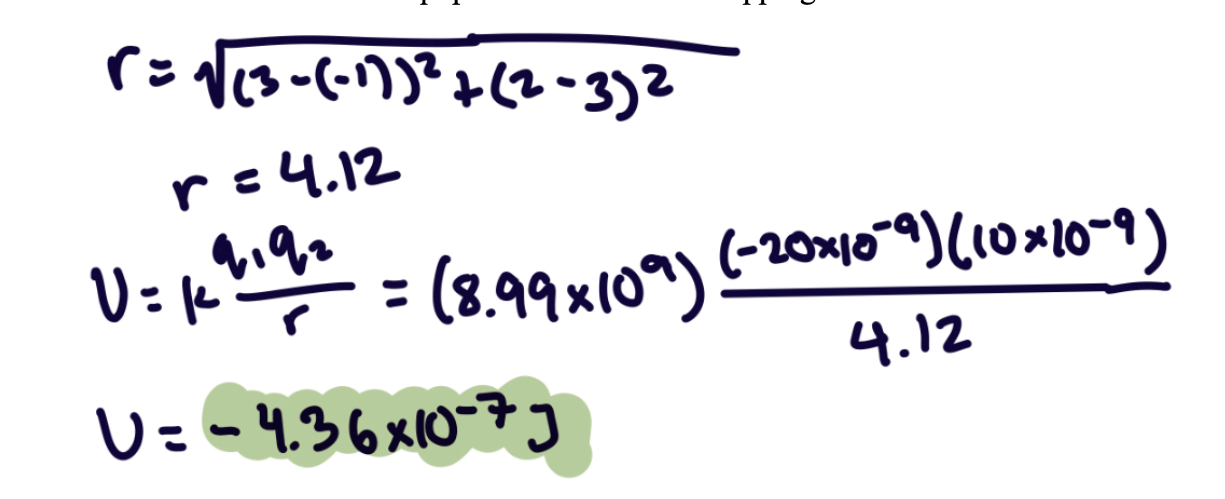
Calculate the electric potential energy in Joules from two charges shown in the figure below:
-4.36 e-7J
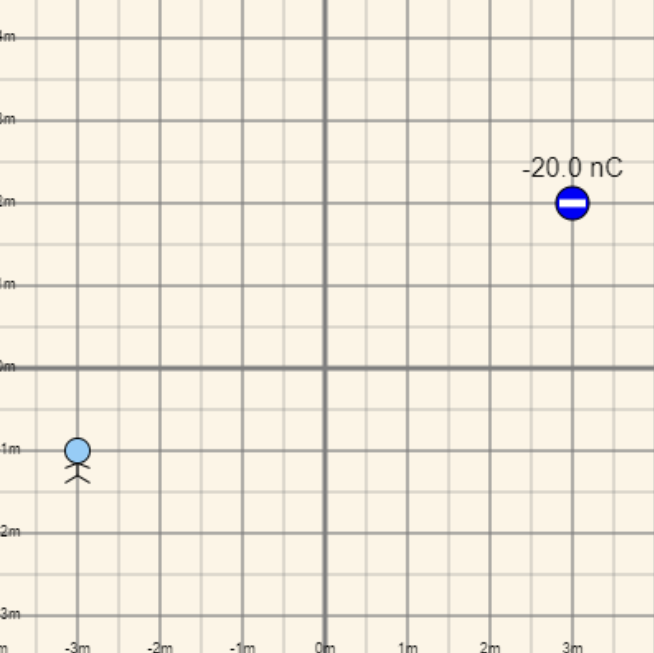
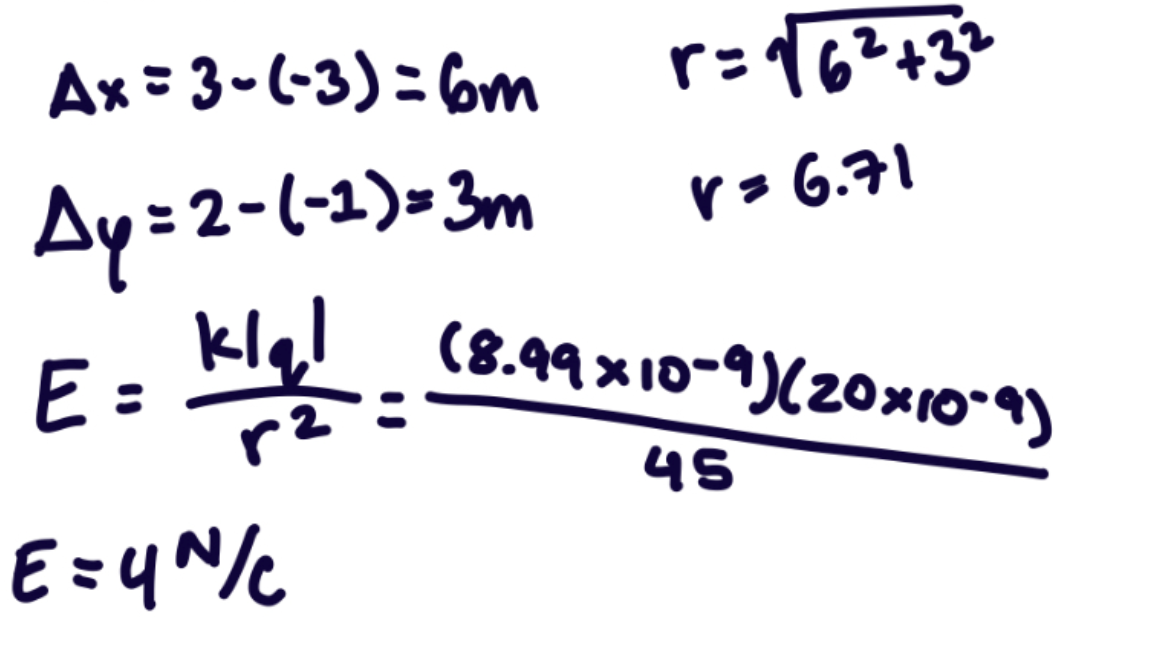
Calculate the magnitude of the electric field as seen by the observer relative to a single charge in units of N/C. See the figure below for reference.
Parallel plate configuration, electric field lines and equipotential lines
dipole configuration, electric field lines and equipotential lines
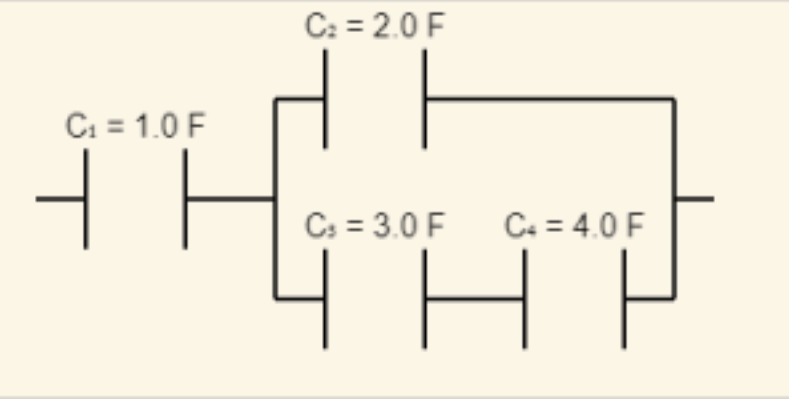
3.71F
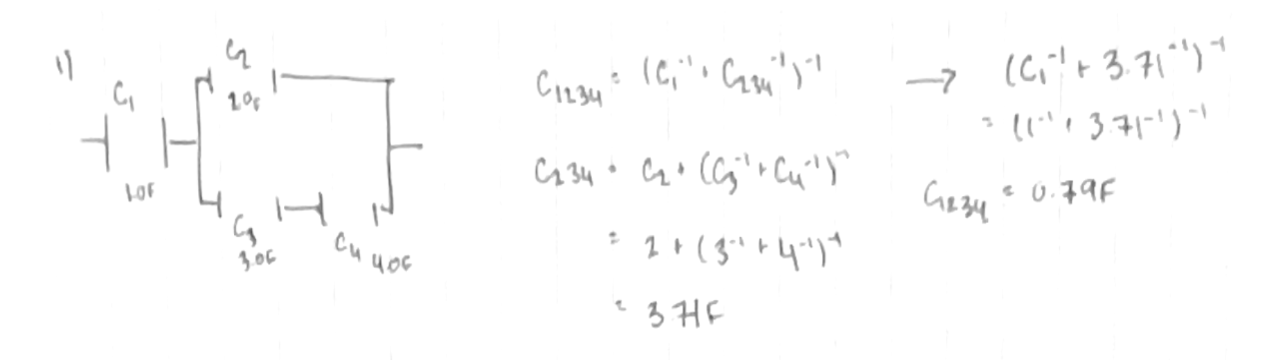
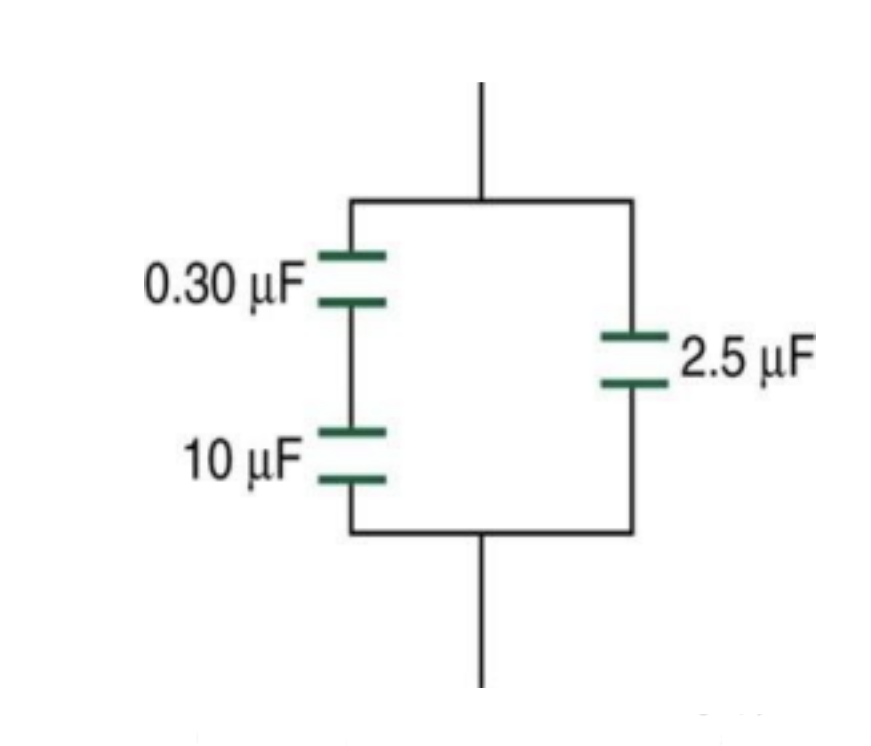
= 2.79 μF
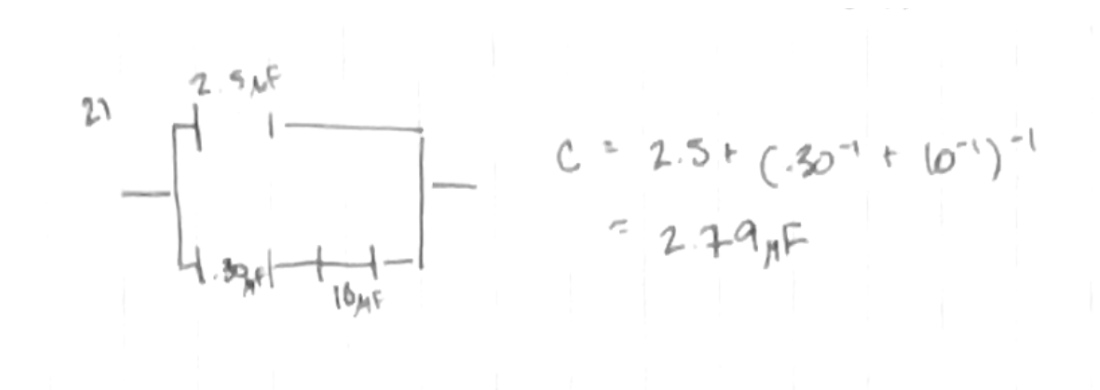
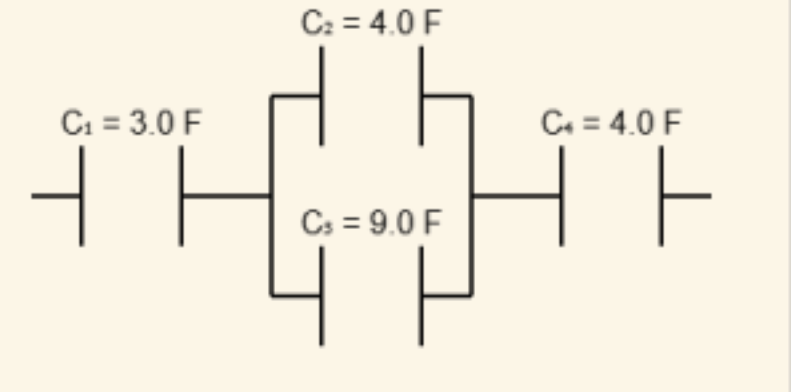
= 1.51F
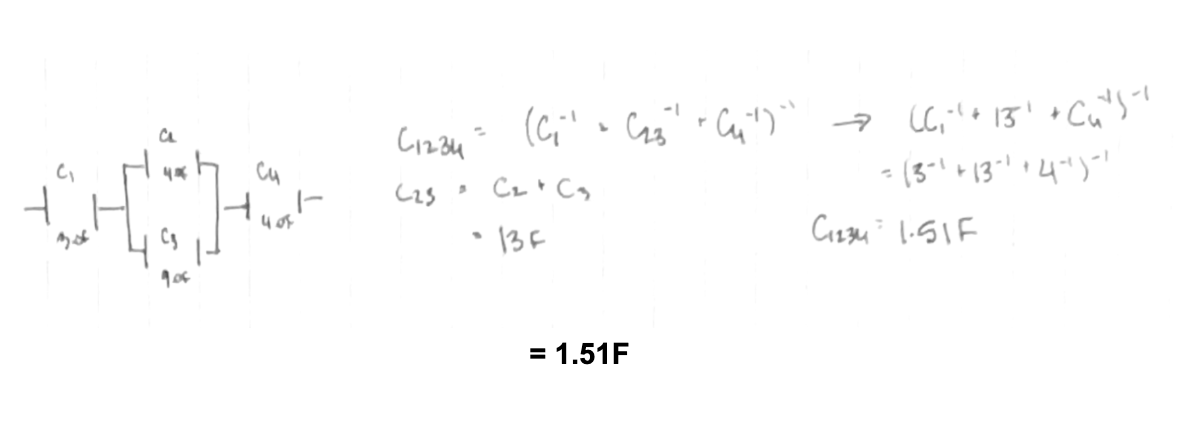
When capacitors are connected in series, does the combined capacitance increase or decrease? Prove your claim mathematically.
Since in the formula for capacitors in series is adding the reciprocals of capacitors (1/C1…), the final capacitance will always decrease.
When resistors are connected in parallel, does the combined resistance increase or decrease? Prove your claim mathematically.
Similarly to capacitors, the formula adds reciprocals of these values, thus decreasing the resistance.
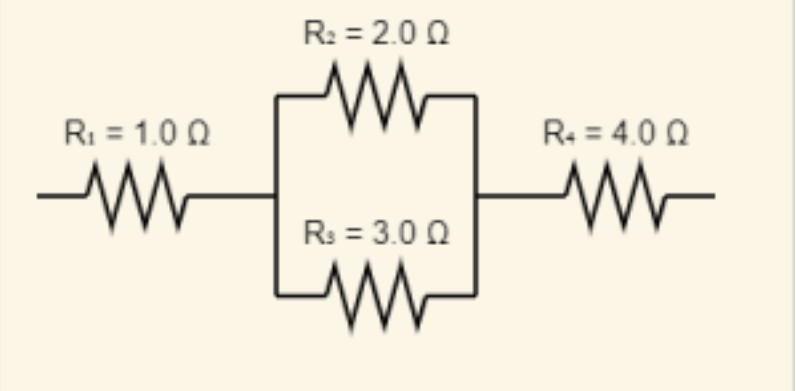
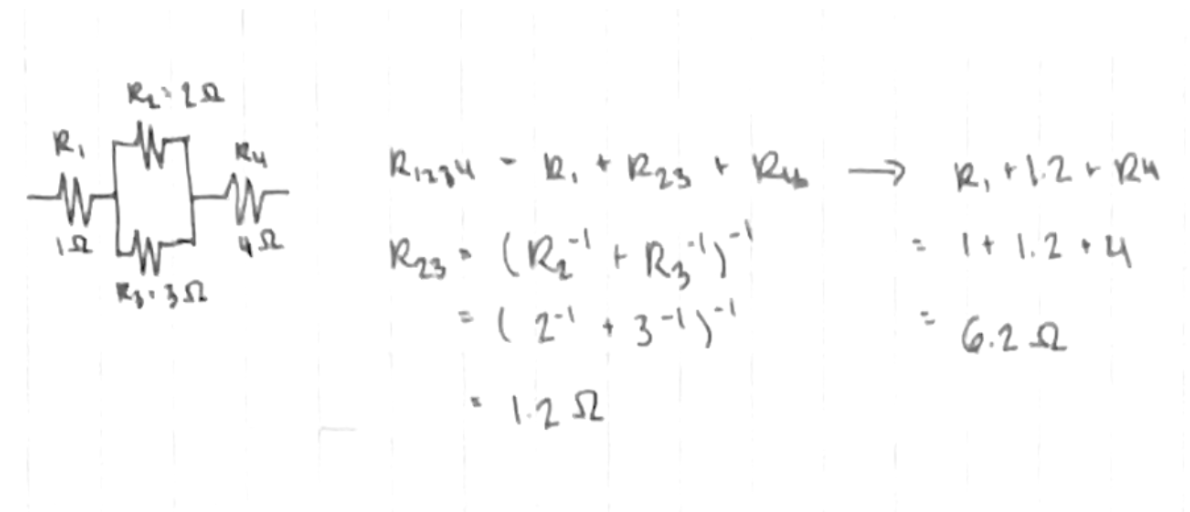
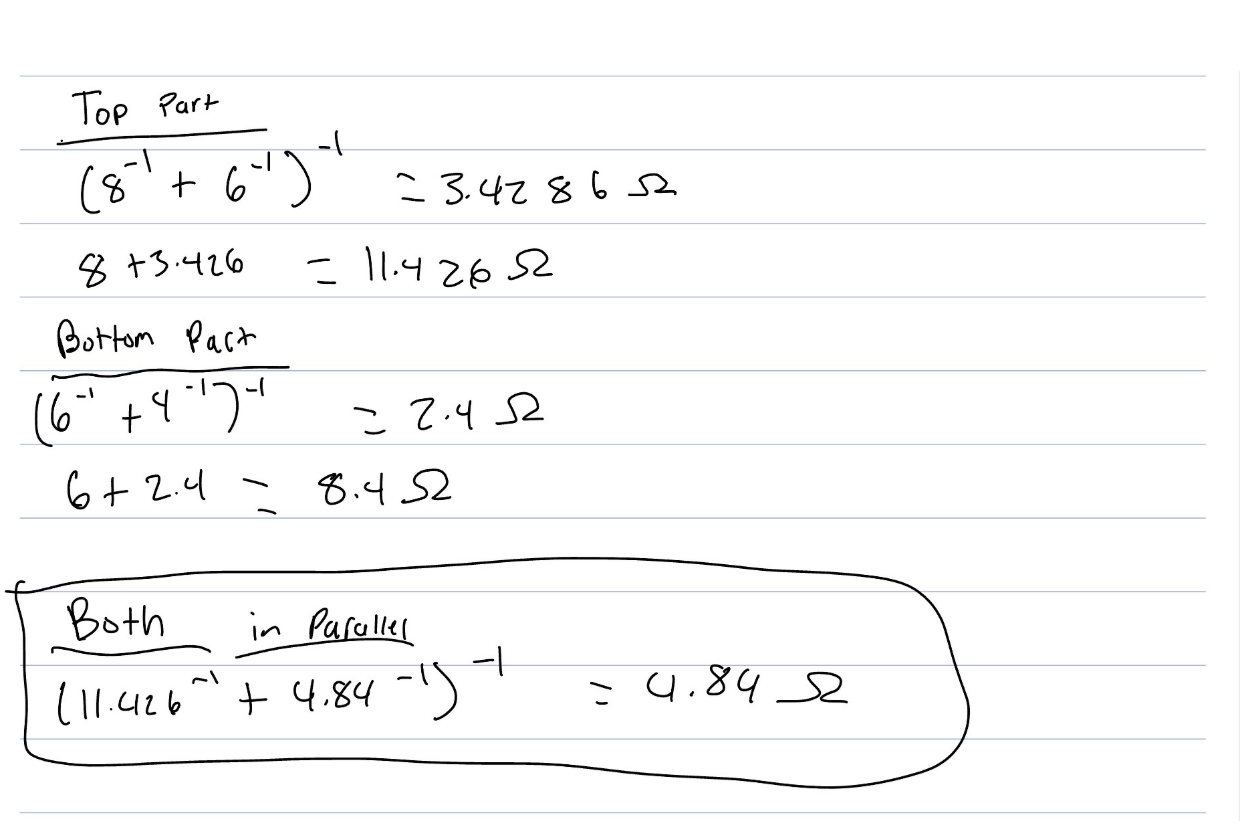
=6.2 ohm
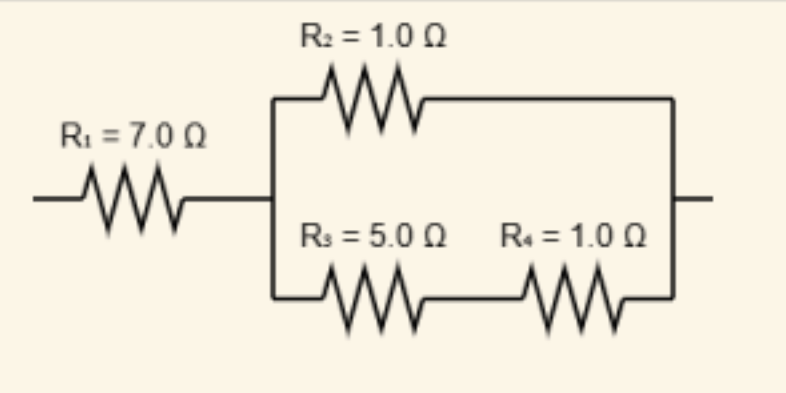
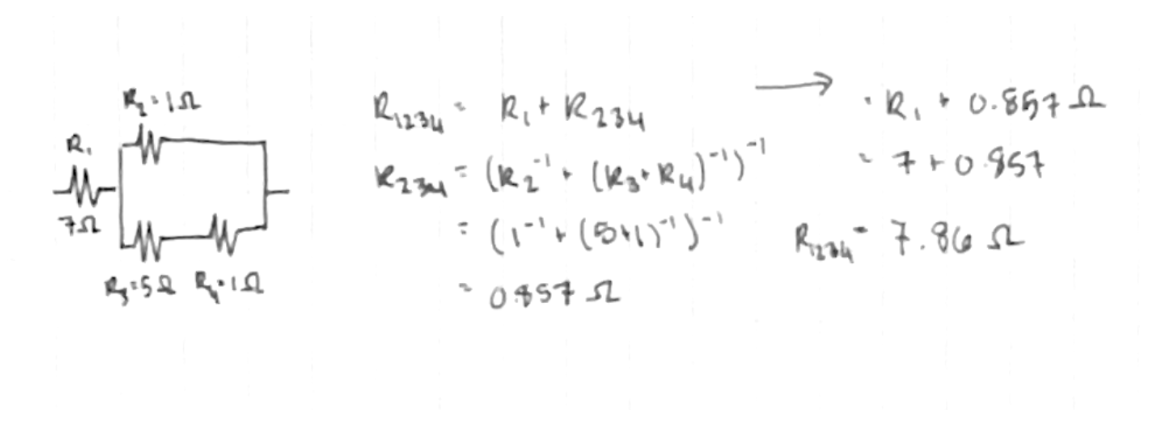
7.86 ohm
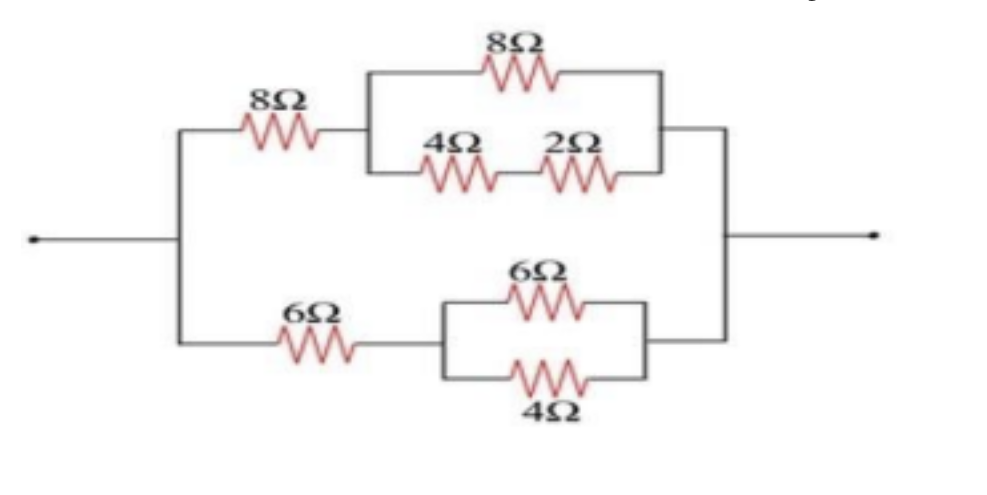
4.84 ohm
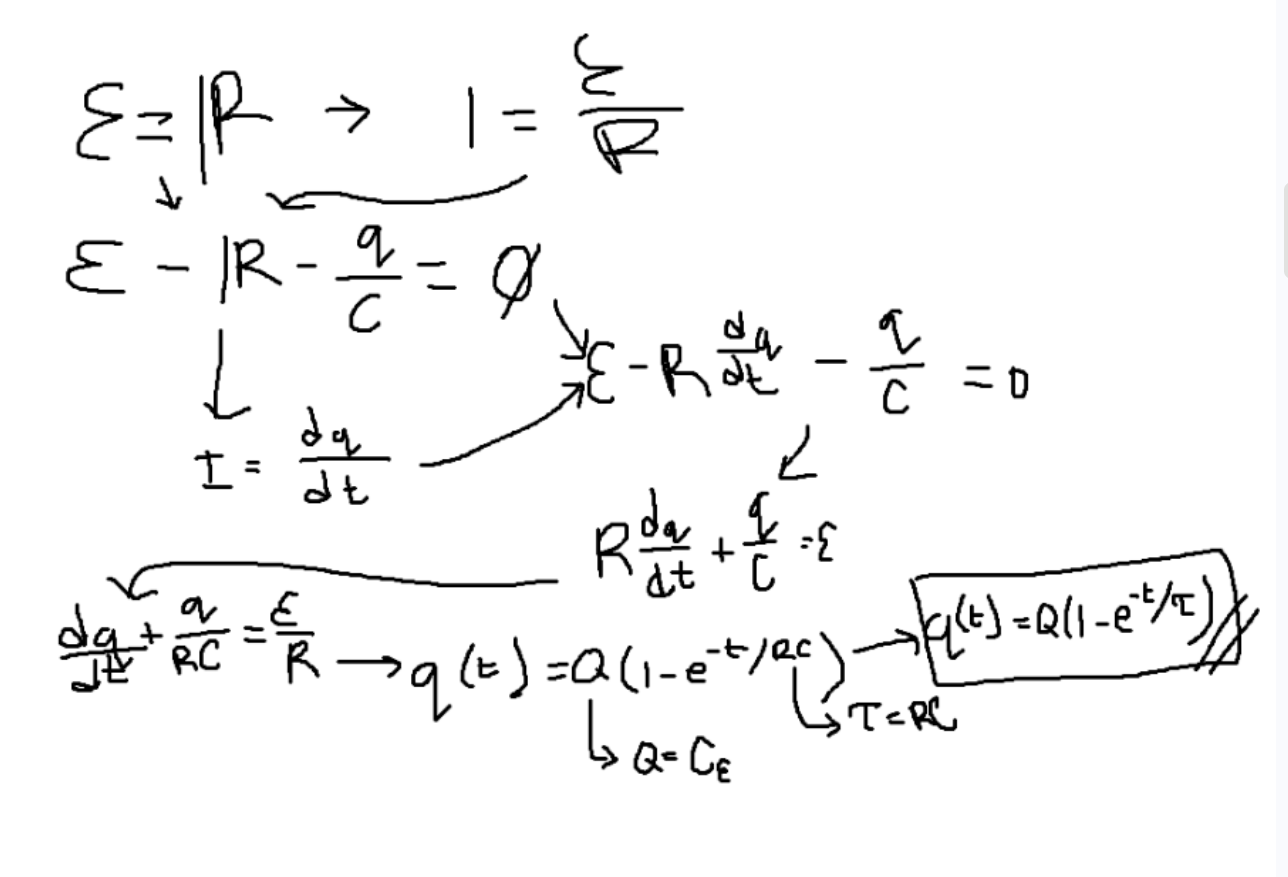
Derive equations for the charge on the capacitor at any instant of time during charging with a neat circuit diagram.
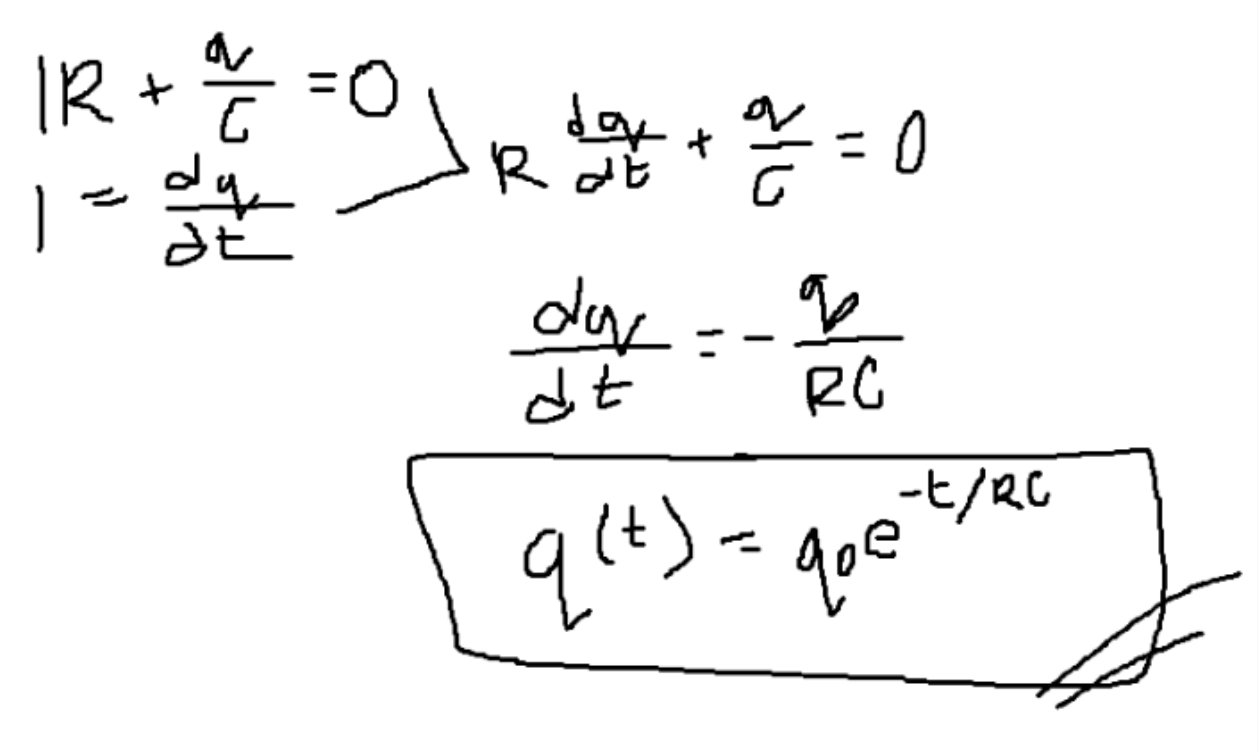
Derive equations for the charge on the capacitor at any instant of time during discharging with a neat circuit diagram.
Show that the Time Constant: 𝜏 = 𝑅𝐶 has units of seconds.
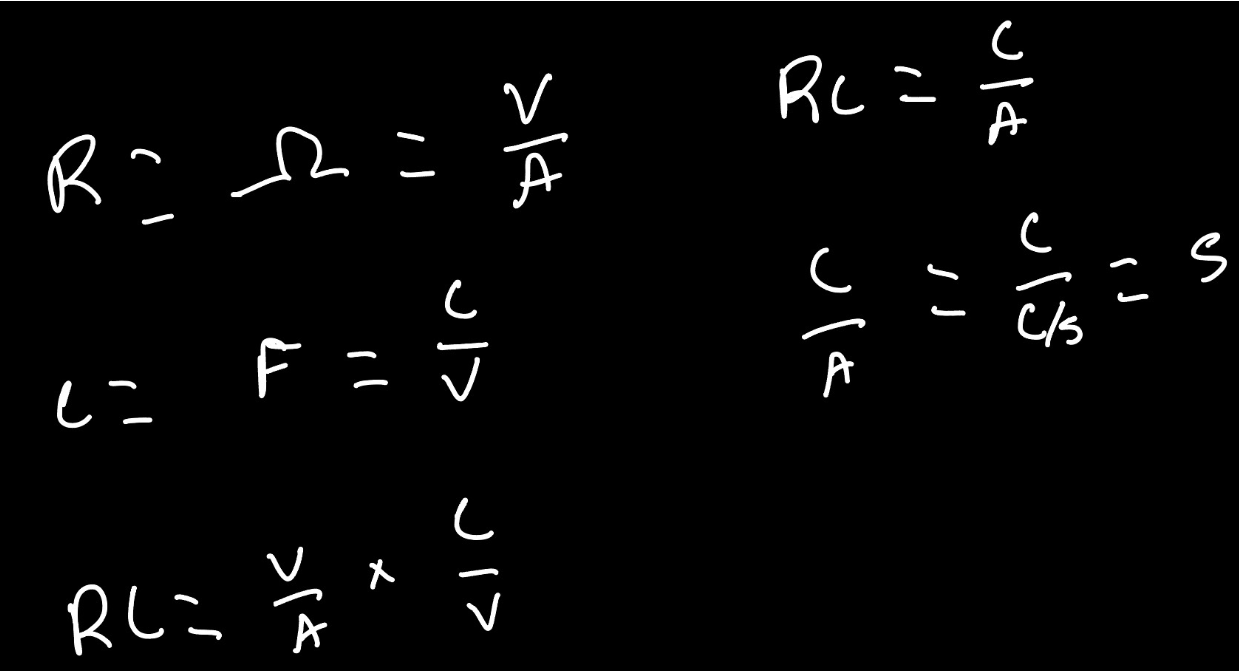
What makes the time constant the longest?
The time constant τ depends on the product of the resistance and capacitance. If both 𝑅 and 𝐶 are high, their product is larger, which makes the largest time constant.
What makes the largest percent error when trying to find the time constant?
When the time constant is very small, the charging and discharging happens faster, making it harder to measure the times accurately. Small measurements cause a larger percentage error.
Prove that 𝑡 ½ = 𝜏 ln 2
q(t) = qmax (1-e-t/𝜏)
1-e-t/𝜏 = (q(t)/qmax)
e-t/𝜏 = 1- (q(t)/qmax)
-t/𝜏 = ln(1- (q(t)/qmax))
t = -𝜏ln( 1- (q(t)/qmax))
t1/2 = -𝜏ln( 1- 1/4))
t1/2 = -𝜏ln(½)
t1/2 = 𝜏ln(2)
Consider a capacitor being discharged through a resistor . After how many time constants is the charge on the capacitor one fourth of its initial value?
q(t) = q0e-t/𝜏
e-t/𝜏 = (q(t)/q0)
-t/𝜏 = ln(q(t)/q0)
t = -𝜏ln(q(t)/q0)
t1/4 = -𝜏ln(¼)
t1/4 = 𝜏ln4
t1/4 = 𝜏(1.386) 1.386 time constants
A capacitor with a capacitance of 5 µF is charged by a battery with an e.m.f (𝜉 ) of 8V through a resistor of 7 MΩ. Calculate The Time Constant:𝜏 in seconds
τ=RC => (7×10^6)(5×10^−6)= 35 s
A capacitor with a capacitance of 5 µF is charged by a battery with an e.m.f (𝜉 ) of 8V through a resistor of 7 MΩ. Calculate Maximum charge on the capacitor: 𝑄0 in units of µC
Qmax=CE => (5×10^−6)(8)= 40 μC
A capacitor with a capacitance of 5 µF is charged by a battery with an e.m.f (𝜉 ) of 8V through a resistor of 7 MΩ. Calculate Charge on the capacitor after ten seconds in units of µC
q(t)= qmax (1-e^-t/τ) => q(10)= 40(1-e^-10/35)= 9.94μC
A capacitor with a capacitance of 5 µF is charged by a battery with an e.m.f (𝜉 ) of 8V through a resistor of 7 MΩ. Calculate The half-life: 𝑡1/2 in seconds.
t1/2=τln2 => 35(ln 2)= 24.26s
A 10 µF capacitor is discharging through a 1000 kΩ resistor. Initially, the capacitor has a voltage of 400 V. Find the time constant in seconds.
τ=RC=> (1.0×10⁶)(10×10−6)=10 s
A 10 µF capacitor is discharging through a 1000 kΩ resistor. Initially, the capacitor has a voltage of 400 V. Find the time it takes for the voltage to decrease to 100 V
Vc= Vinitial(e^-t/τ)=> 100=400e-t/10=> 0.25=e^-t/10
ln(0.25)=-t/10 => t=-10ln(0.25)= -1.386; t=13.9s
If we decrease the potential difference across a resistance in a circuit, will the current flowing through that resistance increase, remain the same or decrease? Explain in words.
If potential difference were to decrease, the current would also decrease. Following Ohm’s Law, current is directly proportional to voltage when resistance is the same. So less voltage would result in less current.
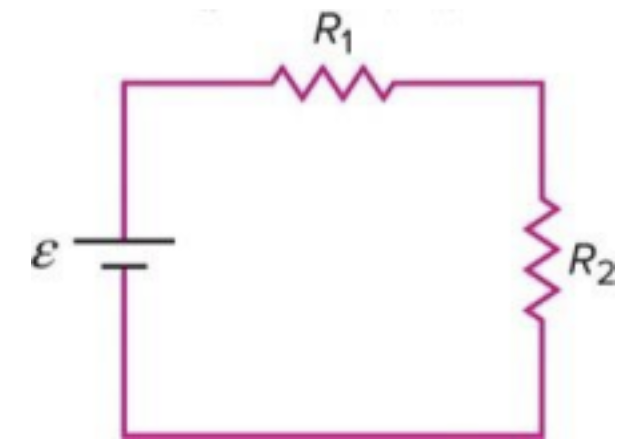
Which of the two resistors in the image, if either, has the greater current flowing through it? Explain in words.
Since it is a series circuit, the charge only flows one way. So neither resistors have more current. Whatever current flows through R1 will flow through R2.
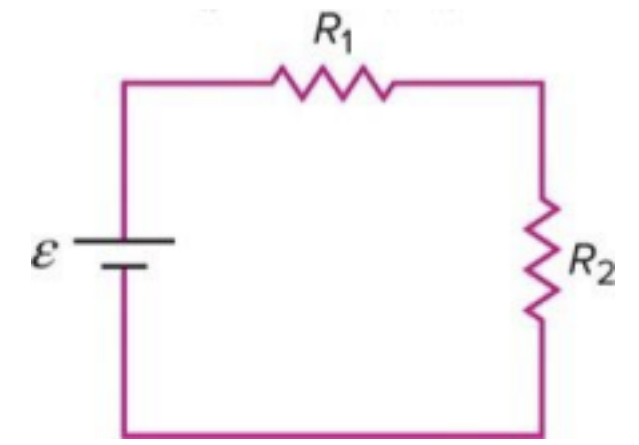
Which of the two resistors un the image, if either, has the greatest voltage difference across it? Explain in words.
R2 has the greater voltage difference across it. Voltage in series divides based on resistance. Since R2 > R1 it takes a larger share of the total voltage. Thinking of it as a speed bump.
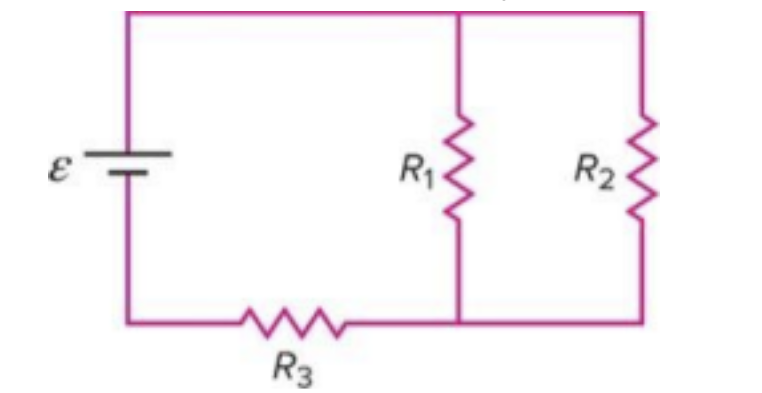
In the circuit shown below, R1, R2 and R3 are three resistors of different values such that R3 > R2 and R2>R1. Which of the three resistors has the greatest current flowing through it? Explain in words
R3 carries the most current because it is in series with the whole circuit. Current splits between R1 and R2.
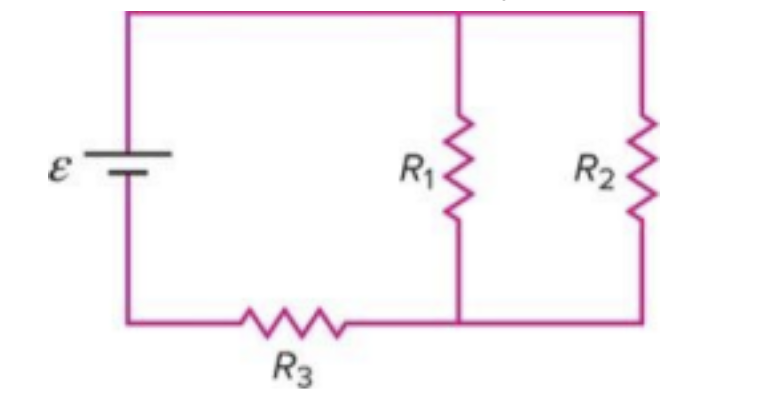
In the circuit shown below, R1, R2 and R3 are three resistors of different values such that R3 > R2 and R2>R1. Which of the three resistors if any has the largest voltage difference across it? Explain in words.
R3 has the largest voltage difference across the circuit because R1 and R2 are in parallel so they have the same voltage.
In the circuit shown below, R1, R2 and R3 are three resistors of different values such that R3 > R2 and R2>R1. If we disconnect R2 from the rest of the circuit, will the current through R3 increase, decrease or remain the same? Explain in words.
If R2 were to be disconnected, the current of R3 would decrease. Since a parallel part of the circuit is being removed, the total current would decrease.
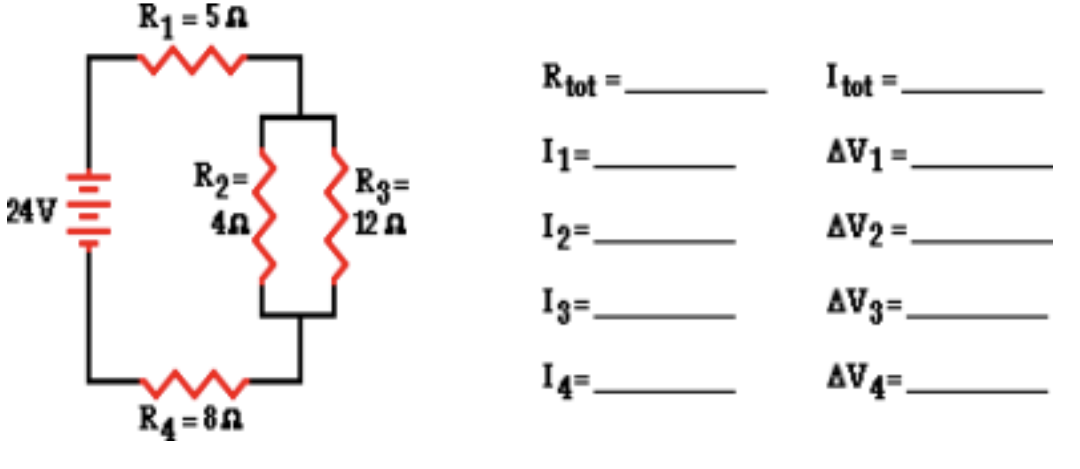
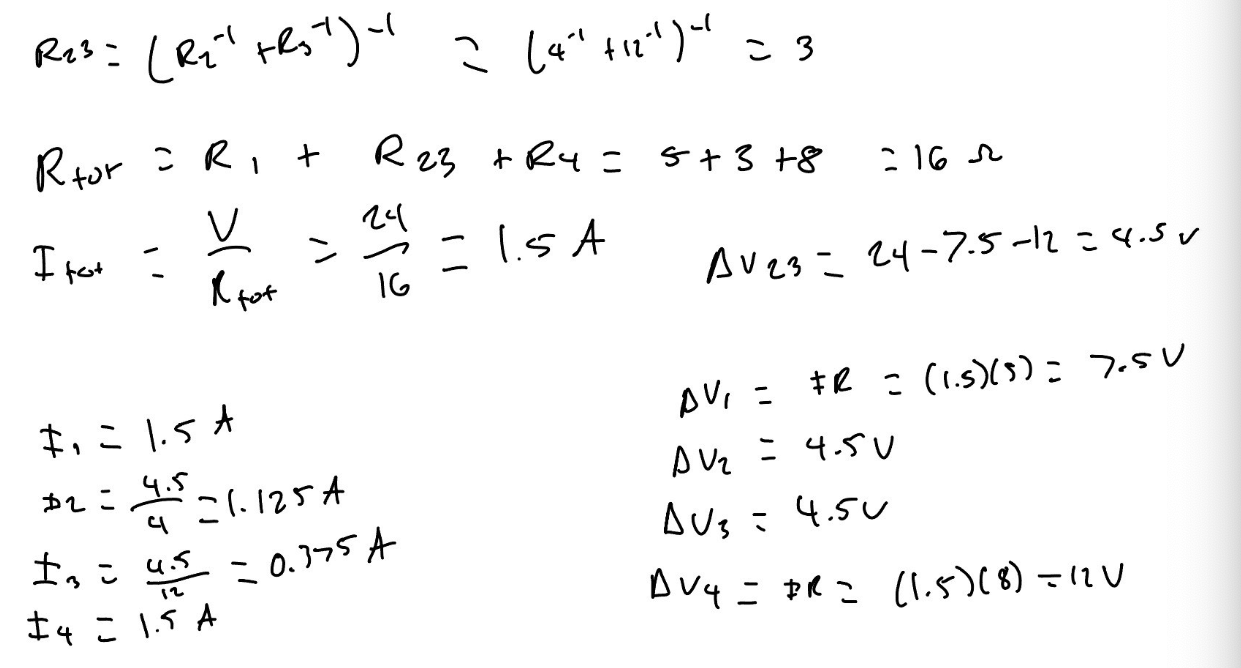
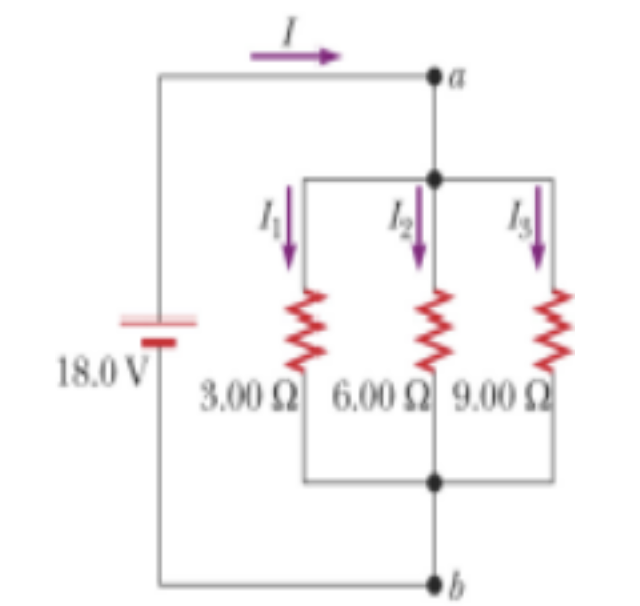
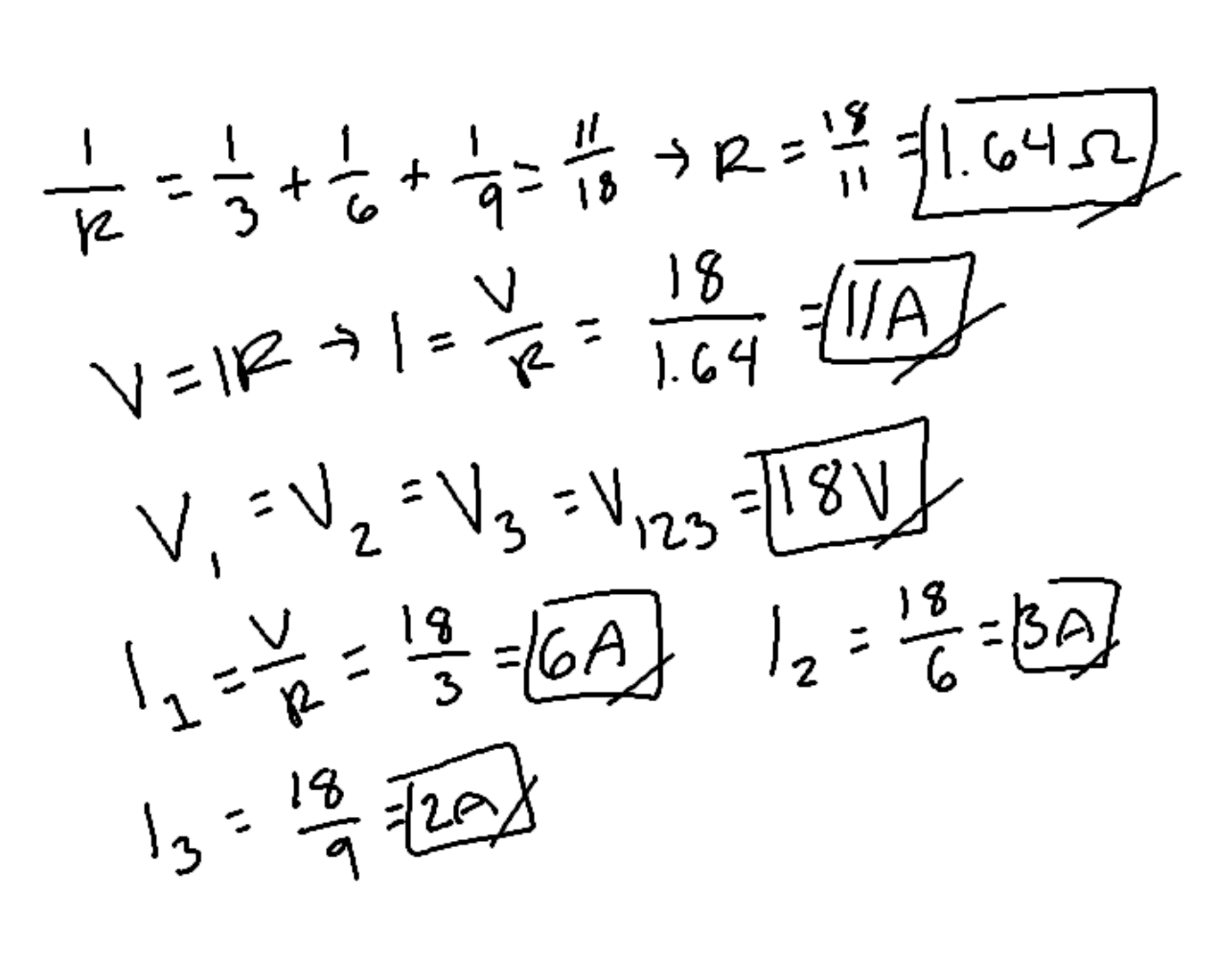
For the circuit below, calculate the equivalent resistance, total current, individual currents and voltages through each of the resistors. Show all your calculations.
What should a graph of magnetic field (B) versus distance (r) look like?
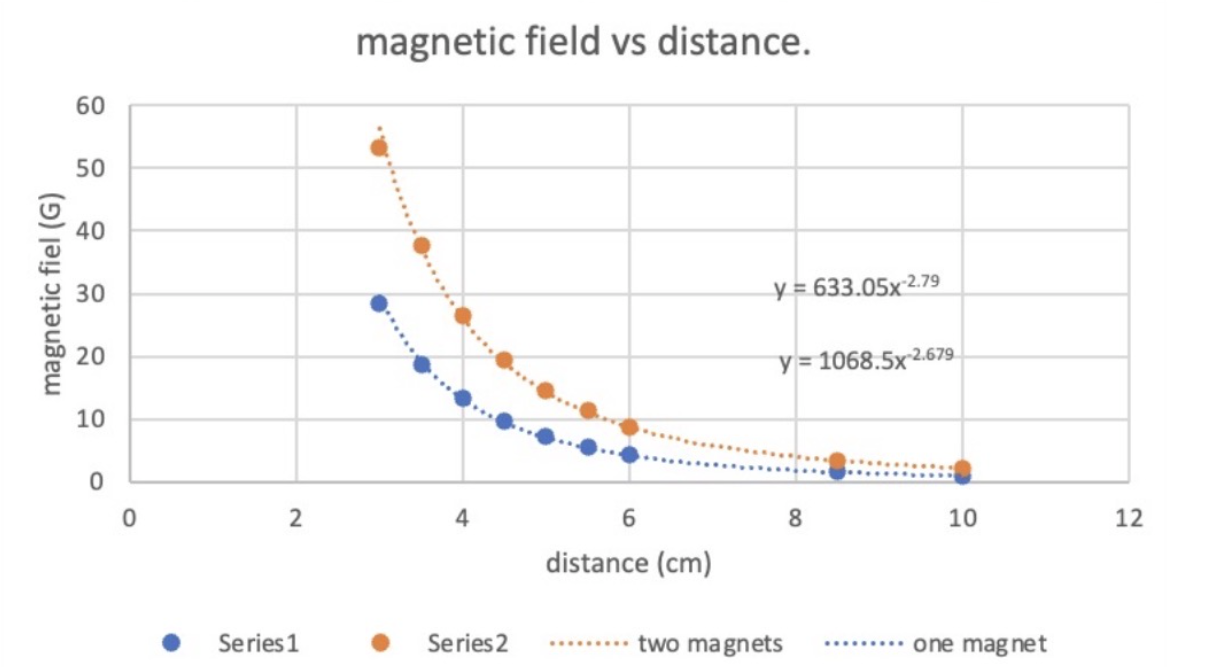
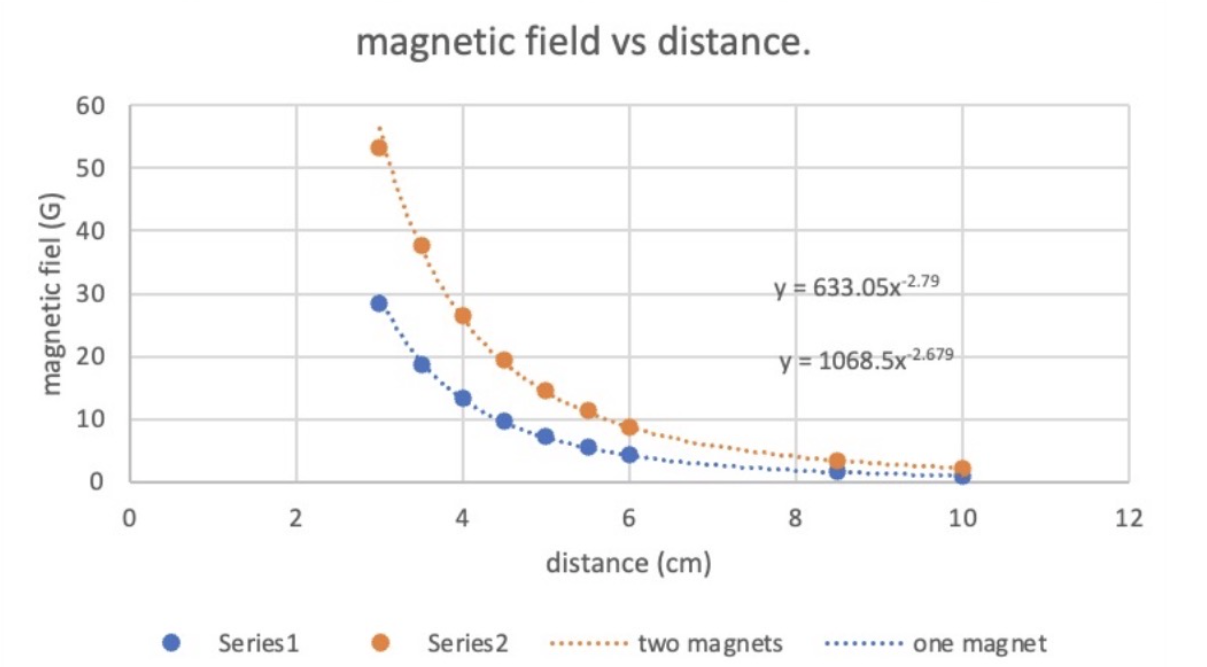
Looking at the equation of your fit in the graph above, what type of relationship exists between B and r? (Linear/Inverse/Inverse Square/Inverse Cube?)
In the graph above, there is an inverse-cube relationship between the magnetic field and distance.
Is an inverse-cube relationship between magentic field and distance in accordance with the theoretical equation for magnetic field of a dipole given in the lecture slides?
Yes, it is in accordance with the theoretical equation for the magnetic field. B (the magnetic field) is indirectly proportional to the cube of the distance. Despite errors from our lab, the exponents are very close to 3, indicating that as the distance increases, the magnetic field decreases.
What should a graph for magnetic field (B) vs. current (I) look like? For 200, 400, and 800 turn coils?
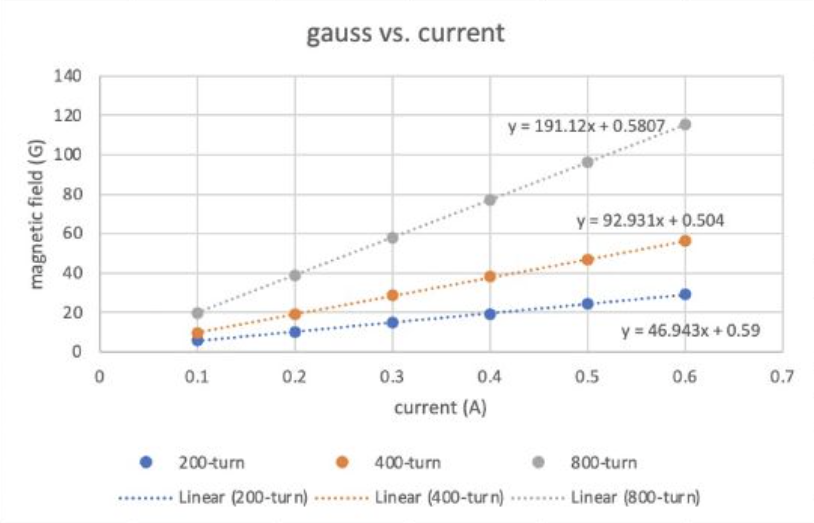
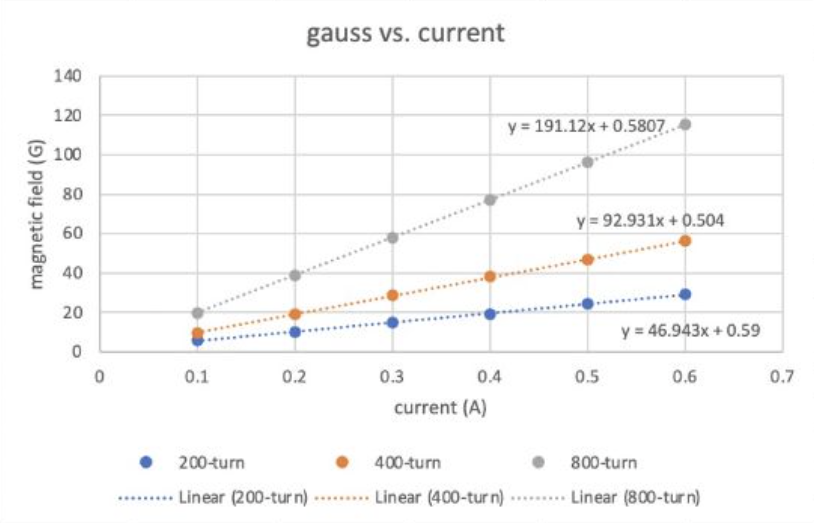
Looking at the plot above, what type of relationship exists between B and I? (Linear/Inverse/Inverse Square/Inverse Cube).
The relationship between B and I in table two is LINEAR.
Is a linear relationship between magnetic field and current in accordance with the theoretical equation for the magnetic field of a coil given in the lecture slides?
Yes because the magnetic field B is directly proportional to the current I as shown in the theoretical equation.
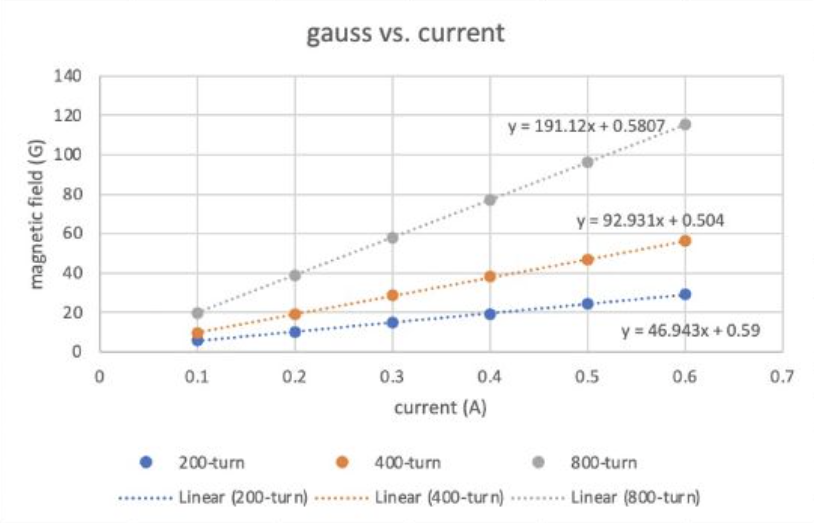
Using the value of your slope for the 200 turn coil, calculate the value of the Permeability Constant: 𝜇0 which will have units of G.cm/A Given: the length of the coil is about 4 cm.
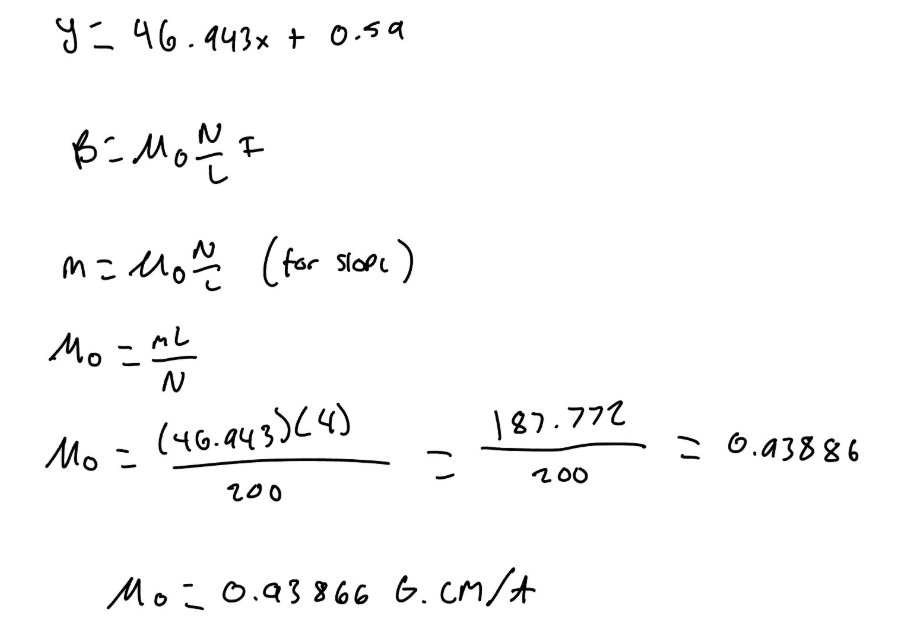
Now convert 𝜇𝑜 of 0.93866 G*cm/A to T*m/A by using the conversion factors: 1meter = 100 cm and 1 Gauss = 10-4 Tesla.
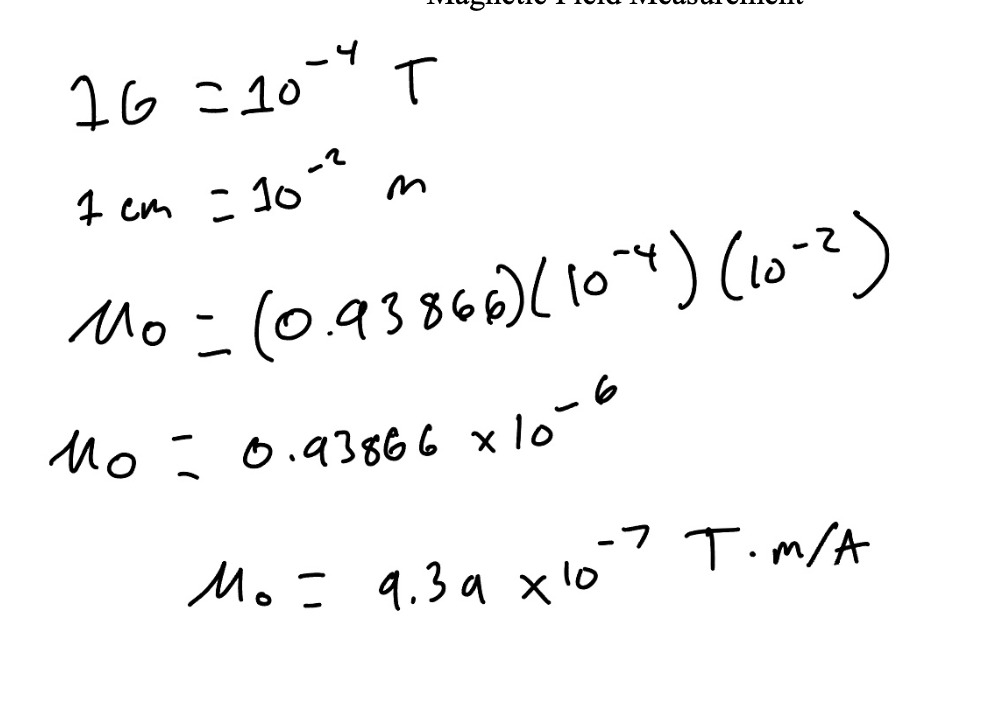
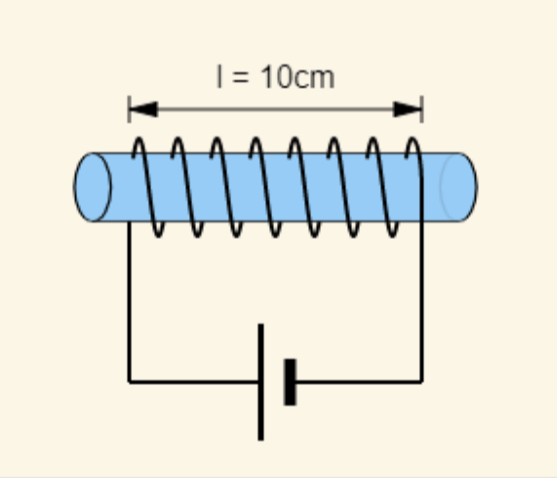
A solenoid of length l = 10 cm has a total of N = 2000 turns and carries a current I of 2.2 A. Find the number of turns per unit length: n in units of per meter.
2.0e4 m^-1
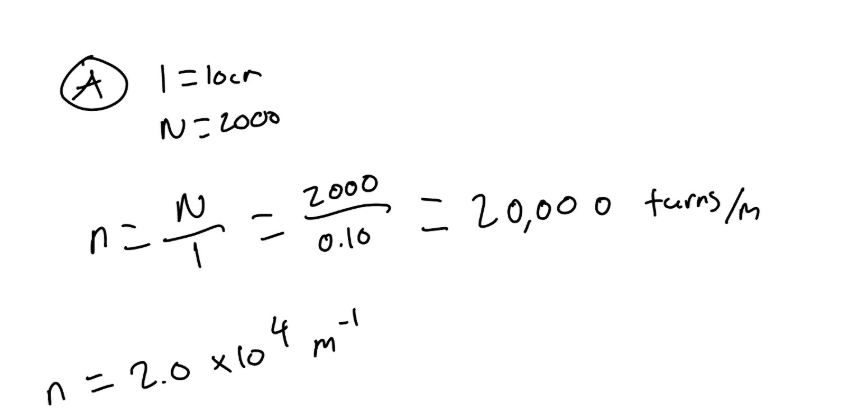
A solenoid of length l = 10 cm has a total of N = 2000 turns and carries a current I of 2.2 A. Find the magnitude of the magnetic field inside the Solenoid in units of Tesla. Given: The Permeability Constant:𝜇0 = 4𝜋 𝑋 10−7 Tm/A
5.53e-2 T
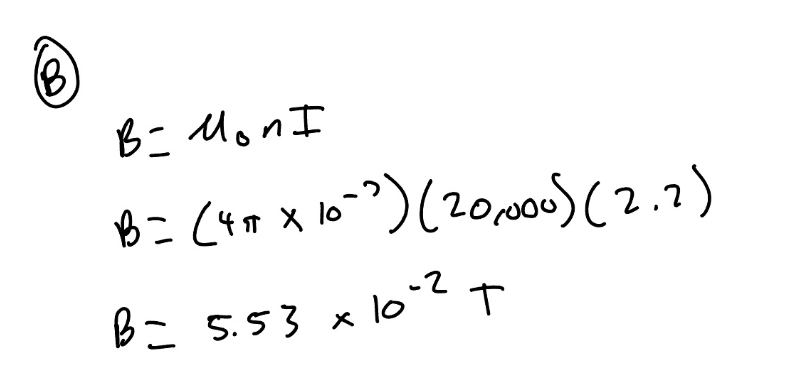
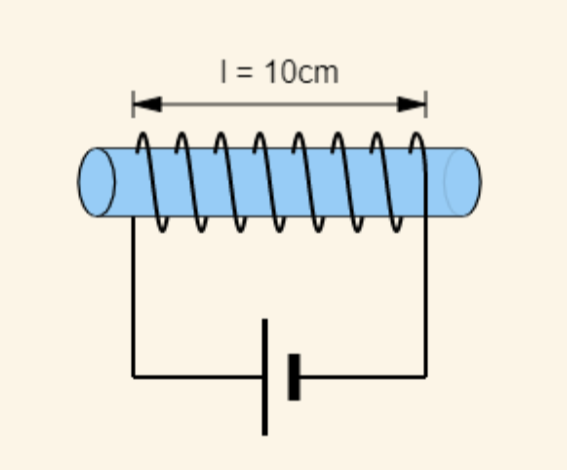
A solenoid of length l = 10 cm has a total of N = 2000 turns and carries a current I of 2.2 A. What would be the direction of the magnetic field inside the solenoid? (Left or right?)
Right
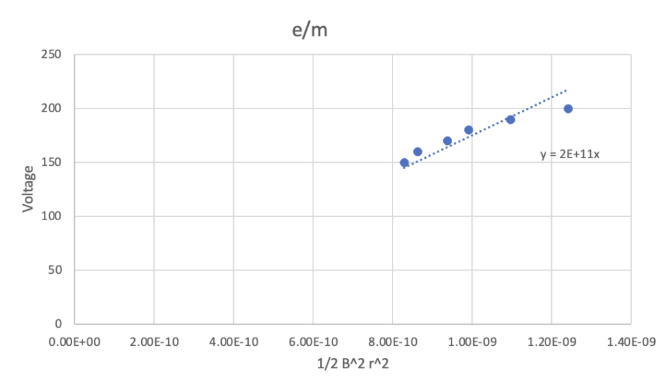
The electron charge to mass ratio equation is given by:
𝑒/𝑚 = (2𝑉)/(𝐵2 𝑟2 ).
If V is plotted on the Y-axis, which quantity must be plotted on the X-axis to give a slope that equals e/m ?
½ (B2)(r2)
What does a graph of V vs. ½ (B2)(r2) look like? Axes, relationship?
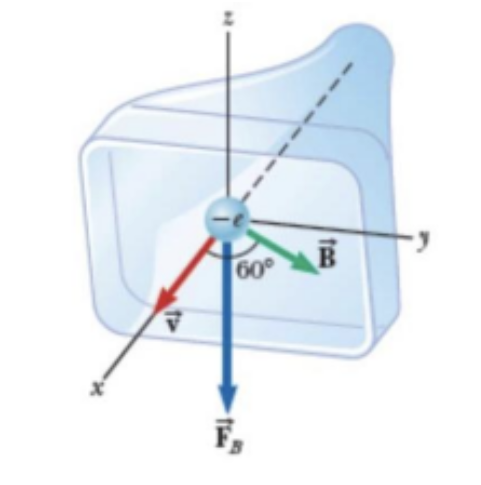
An electron in a television picture tube moves toward the front of the tube with a speed of 8.0 x 10⁶ m/s along the X-axis. The neck of the tube is surrounded by a coil of wire that creates a magnetic field of magnitude 0.025 T directed at an angle of 60 degrees to the X-axis and lying in the XY plane. Calculate the magnetic force on and the acceleration of the electron. Given: the absolute value of an electron’s charge is 1.60x10⁻¹⁹ C and its mass is 9.1x10⁻³¹ kg.
F = qvBsin(theta) = (1.60x10^-19)(8.0x10^6)(0.0025sin60) = 2.8e-14N
A = F/m = 2.8e-14/9.1e-31 = 3.1e16 m/s^2
A proton is moving in a circular orbit of radius 14.0 cm in a uniform 0.350 T magnetic field directed perpendicular to the velocity of the proton.
Find the magnitude of the proton’s velocity. Given: charge on the proton = 1.60x10⁻¹⁹ C and its mass = 1.67x10⁻²⁷ kg.
qvB = mv^2/r → v = qBr/m
V = (1.60x10^-19)(0.350)(0.140)/1.67x10^-27 = 4.7x10^6 m/s^2
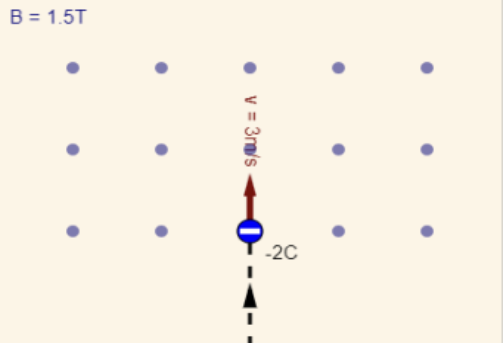
A –2C charge having a mass of 2.5 kg is traveling with a velocity of 3 m/s in a uniform magnetic field of strength 1.5 T as shown in the figure. Find the magnitude of the magnetic force in Newton.
F=qvB → 2)(3)(1.5)= 9N
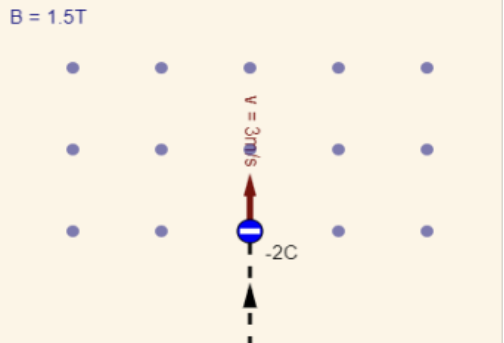
A –2C charge having a mass of 2.5 kg is traveling with a velocity of 3 m/s in a uniform magnetic field of strength 1.5 T as shown in the figure. Find the radius of the charge’s trajectory in meters.
r= (2.5*3) /(2*1.5)= 2.5m
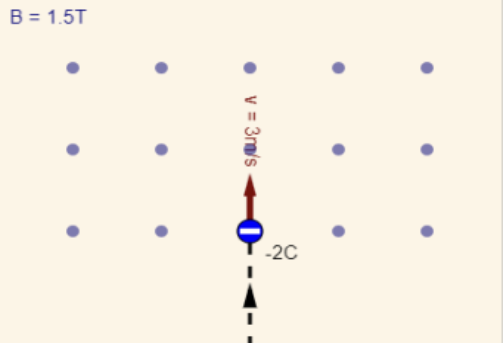
A –2C charge having a mass of 2.5 kg is traveling with a velocity of 3 m/s in a uniform magnetic field of strength 1.5 T as shown in the figure. In which direction will the charge move clockwise or counter-clockwise?
The charge is moving counter-clockwise (using the hand rule)
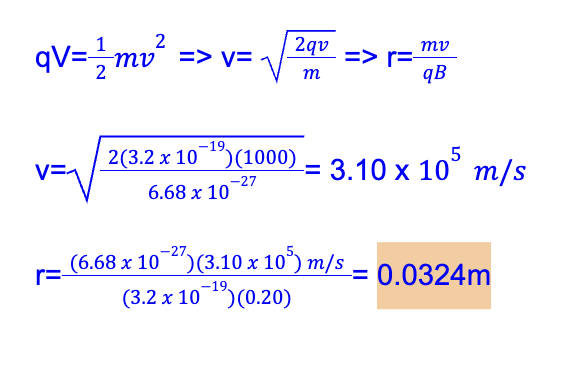
Alpha particles with a mass of 6.68 x10⁻²⁷ kg and a charge of 3.2x10⁻¹⁹ C are accelerated from rest through a potential difference of 1000 volts. They then enter a magnetic field of 0.20 T, perpendicular to their direction of motion. Calculate the radius of their circular orbit in meters.
How does the Mutual Inductance vary with the number of turns?
Mutual inductance varies with the number of turns by depending directly on the number of wire turns. If the number of turns in one coil were to be cut in half, the mutual inductance also drops by about half.
How does the presence of the core (Air versus U-shaped Iron Core) impact the value of the Mutual Inductance?
The cores have a higher permeability than air, which lets them create a higher level of inductance within the same amount of space.
Consider an ideal transformer (where there is no loss of flux through the core and ignoring the effects of internal resistance and inductance of the coils) connected to a 120 V ac line to supply 9600 V for a neon sign. What is the ratio of secondary to primary turns of the transformer?
9600/120=80, The ratio is 80:1
Consider an ideal transformer (where there is no loss of flux through the core and ignoring the effects of internal resistance and inductance of the coils) connected to a 120 V ac line to supply 9600 V for a neon sign. If the transformer consisted of 275 primary windings, how many secondary windings would be there?
80*275= 22,000 secondary windings
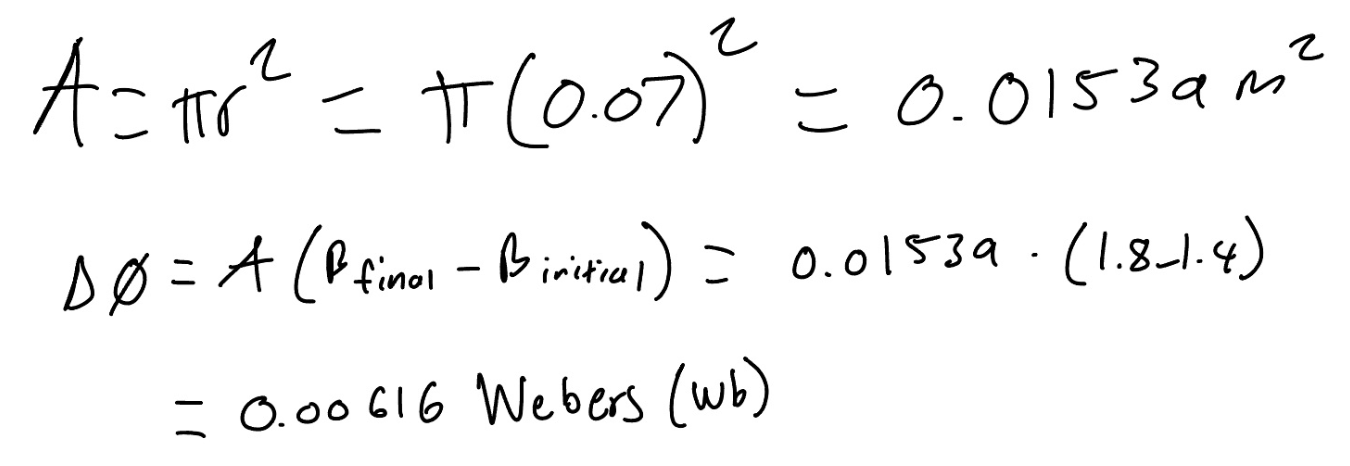
A coil with 1200 turns has a radius of 7 cm and the magnetic field inside the coil changes uniformly during a time interval of 3.7 seconds. If the initial and final magnetic fields have values of 1.4 and 1.8 Tesla both pointing down into the coil (see figures below), Calculate: The change in Magnetic Flux in units of Weber.
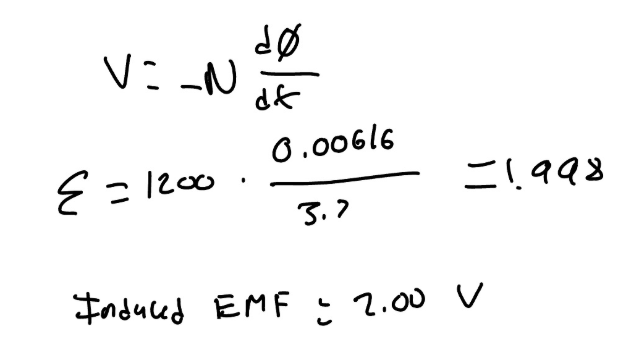
A coil with 1200 turns has a radius of 7 cm and the magnetic field inside the coil changes uniformly during a time interval of 3.7 seconds. If the initial and final magnetic fields have values of 1.4 and 1.8 Tesla both pointing down into the coil (see figures below), Calculate: the induced emf using Faraday’s Law in volts.
What would be the direction of the induced emf?
Direction of the induced EMF would be in a counter-clockwise direction.
The current flowing in the primary coil changes from 2 A to 10 A in 0.4 seconds. Find the mutual inductance between the two coils if an emf of magnitude 60 mV is induced in the secondary coil.
dI/dt = 10-2 / 0.4 = 8/0.4 = 20 A/s
Emf = 60 mV = 0.060 V
M = emf/dI/dt = 0.060/20 = 0.003 H
The current flowing in the primary coil changes from 2 A to 10 A in 0.4 seconds. What would be the magnitude of the induced emf in the secondary coil if the current in the primary coil changed from 4 A to 16A in 0.03 seconds?
dI/dt = 16-4 / 0.03 = 12 / 0.03 = 400 A/s
Emf = M(dI/dt) = 0.003 x 400 = 1.2 V
A long air-core solenoid has a cross-sectional area A and N loops of wire on its length d. Write an equation for its Self-Inductance: L.
N(delta Theta/delta t) = L(delta I/delta t)
L = N(delta Theta/delta I)
A long air-core solenoid has a cross-sectional area A and N loops of wire on its length d. If the current changes from zero to I, then the flux changes from zerot o 𝜙. So, in the equation that you obtained in a), Δ𝑖 = 𝐼 𝑎𝑛𝑑 Δ𝜙 = 𝜙. So the equation for Self-Inductance: L ? If L = N(delta Theta/delta I) before?
deltaTheta = theta and deltaI = I
So -> L = N(theta/I)
A long air-core solenoid has a cross-sectional area A and N loops of wire on its length d. The equation for self-inductance: L = N(theta/I) after plugging in the equation for magnetic field becomes, L = ?
B = μ0(N/d)I
Theta = BA = μ0(N/d)I * A
L = N (μ0(N/d)I A)/I
L = μ0((N^2A)/d)
Use L = μ0((N^2A)/d) to calculate the self inductance of an air-core solenoid in units of Henry. Given: The Solenoid has a length of 30 cm and has a cross-sectional area of 1.5 cm2 and has 2000 turns.
D = 30 cm = 0.30 m
A = 1.5 cm^2 = 1.5e-4 m^2
N = 2000
μ0 = 4pie-7
L = (4pie-7) (2000^2 (1.5e-4))/0.30
L = (4pie-7) (4e6 1.5e-4)/0.30
L = 4pie-7 600/0.30 = 4pie-7 2000
L = 8pie-4 = 2.51e-3 = 2.5 mH
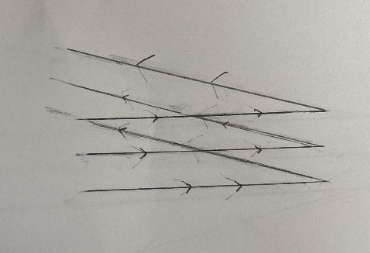
Ray paths of a plane mirror
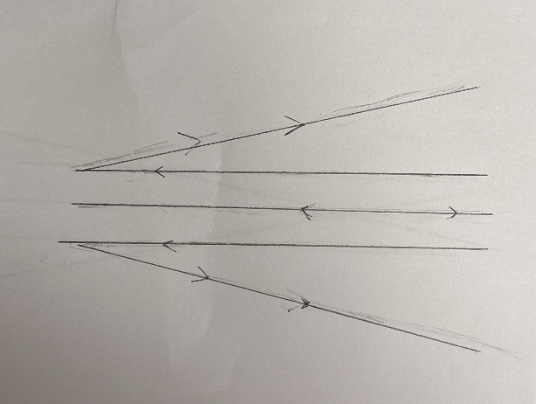
Ray paths of a convex mirror
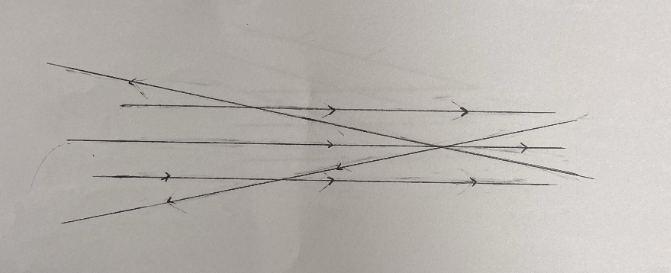
Ray paths of a concave mirror
do reflection from curved mirrors follow the same rule as that for a plane mirror? Why or Why not?
the reflection from all three mirrors is similar. The angle that is reflected is the same as the angle of incidence.
What differences are in the ray diagrams of Concave and Convex Mirrors?
In the concave ray diagram, the reflected lines intersected and created an image. the convex diagram’s reflected lines do not intersect therefore not creating a real image.
What does a graph of sinalpha (incidence) vs. sinbeta (refraction) look like? Axes, relationship?
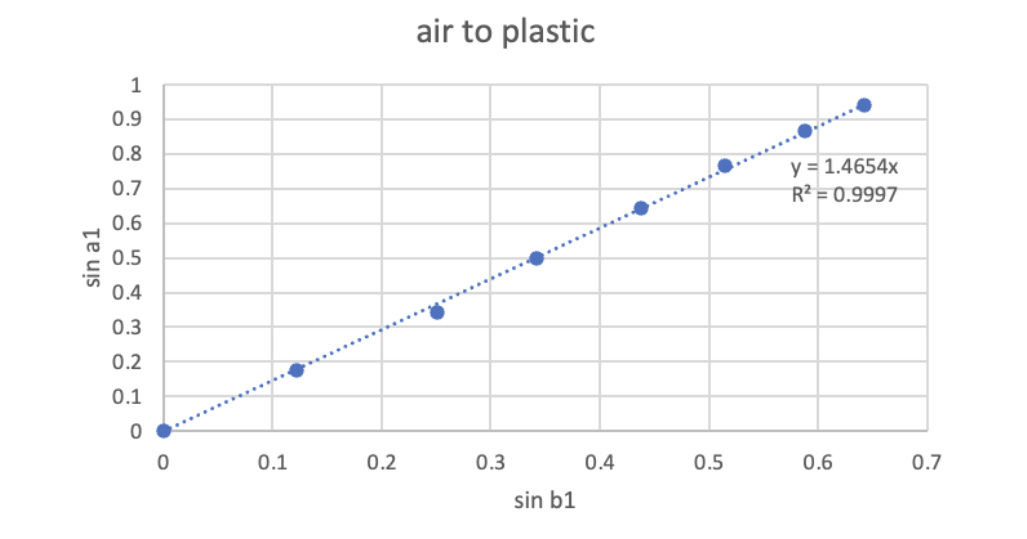
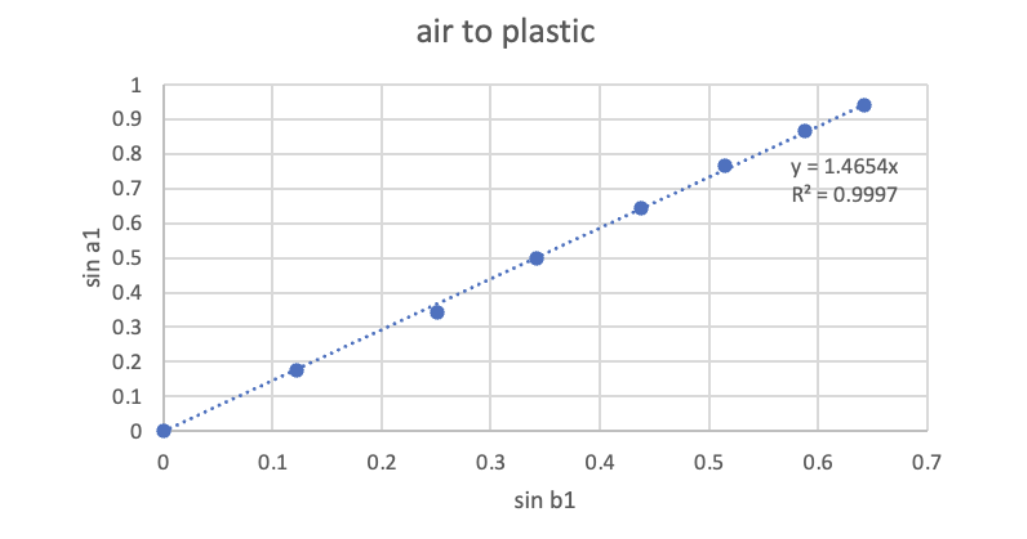
According to Snell’s Law of Refraction, your slope value should be equal to
The index of refraction for plastic
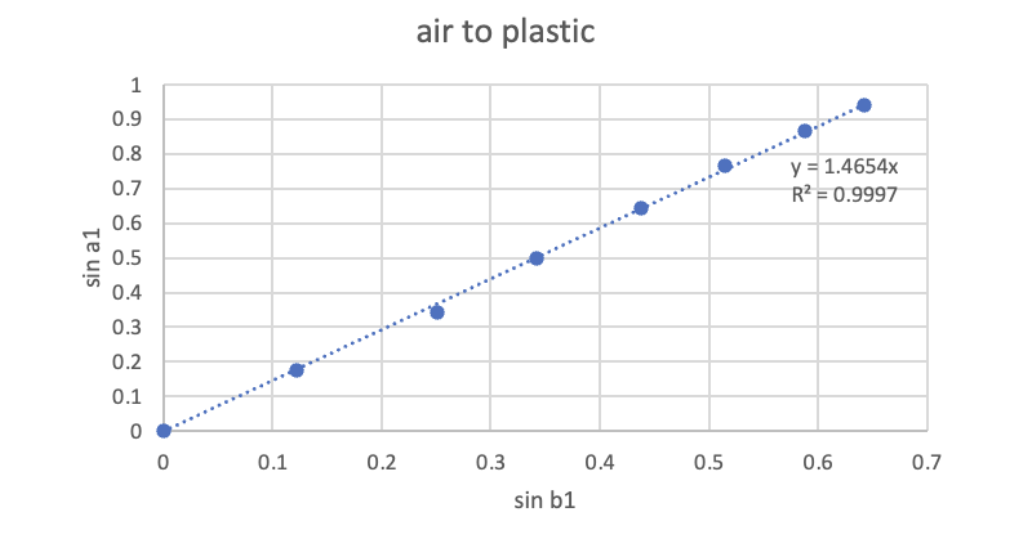
Given that the index of refraction for air = 1.00, the index of refraction for the plastic lens is
1.4654
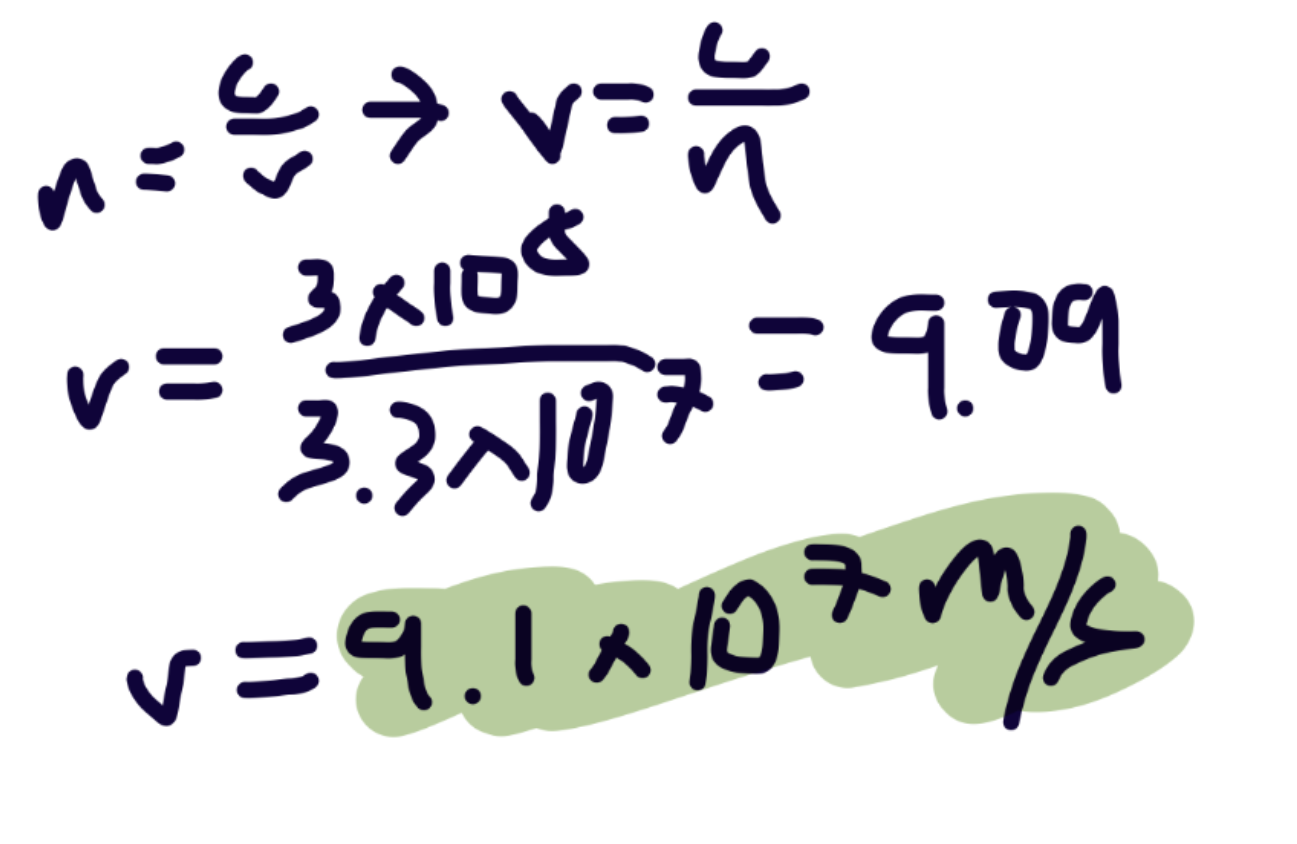
What is the speed of light in a medium having a refractive index of 3.3? Given: The speed of light in vacuum is 3x10⁸ m/s.
9.09 e7 m/s
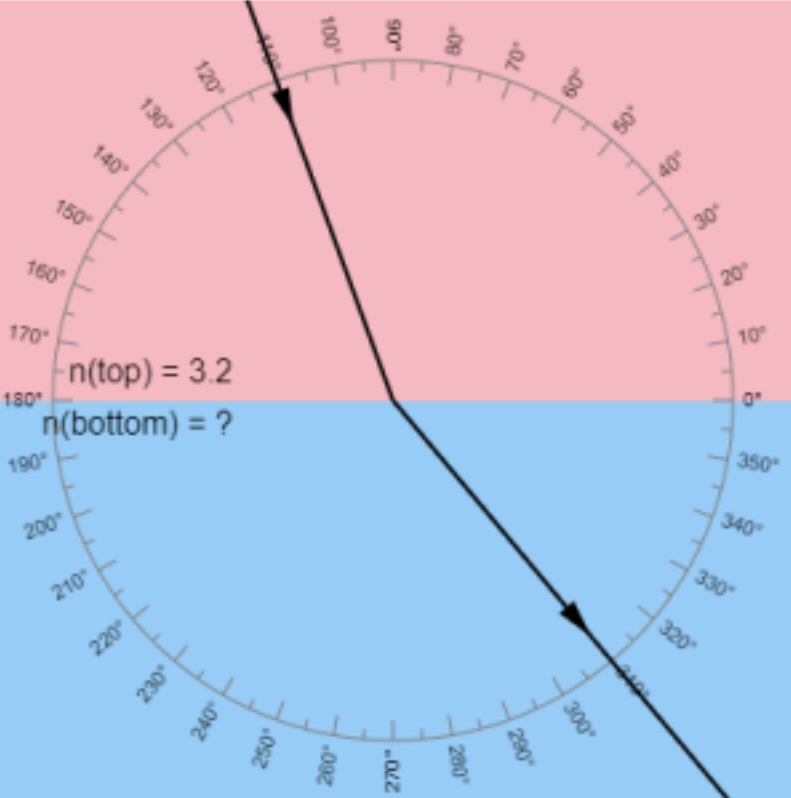
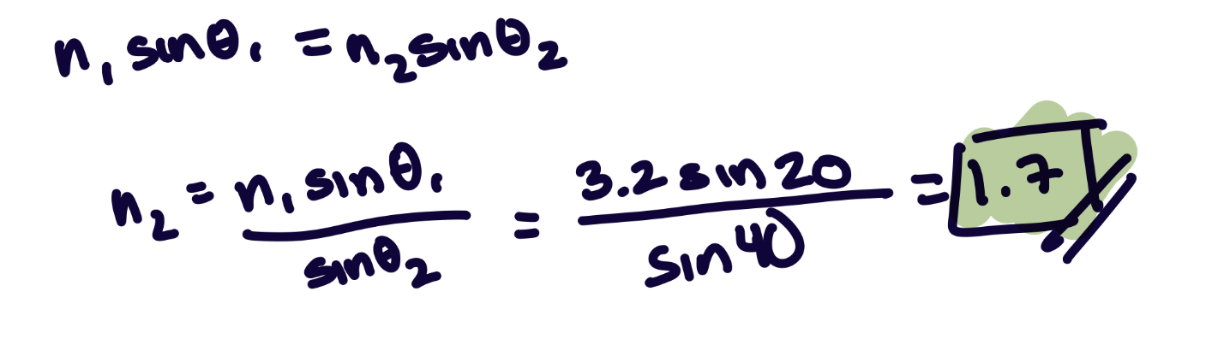
A light ray strikes the boundary of two materials. Use the figure below to find the index of refraction: nbottom