Lesson 10. Assay of Ascorbic Acid Tablets
 Call Kai
 Learn
Learn Practice Test
 Spaced Repetition
 Match
Match Flashcards
 Knowt Play
1/49

There's no tags or description
Looks like no tags are added yet.
Name | Mastery | Learn | Test | Matching | Spaced | Call with Kai |
|---|
No analytics yet
Send a link to your students to track their progress
50 Terms
Vitamin C
Assay of Ascorbic Acid is commonly performed using commercially available tablets of ____________________.
non-chewable, uncoated, white
The assay uses _________________________ Ascorbic Acid Tablets.
residual method
The ascorbic acid assay employs a a.________________________ known as b.__________. It is a redox method where a sample of analyte is made to react with a source of c.______, and the excess Br2 is back-titrated with a solution of d.___________________.
a = ?
bromination
The ascorbic acid assay employs a a.________________________ known as b.__________. It is a redox method where a sample of analyte is made to react with a source of c.______, and the excess Br2 is back-titrated with a solution of d.___________________.
b = ?
Br2
The ascorbic acid assay employs a a.________________________ known as b.__________. It is a redox method where a sample of analyte is made to react with a source of c.______, and the excess Br2 is back-titrated with a solution of d.___________________.
c = ?
Na2S2O3
The ascorbic acid assay employs a a.________________________ known as b.__________. It is a redox method where a sample of analyte is made to react with a source of c.______, and the excess Br2 is back-titrated with a solution of d.___________________.
d = ?
accuracy of the label
The ascorbic acid assay is useful to check the ___________________ claim for commercially available Ascorbic acid tablets (500 mg).
expired
Ascorbic Acid Assays can be used to determine whether the drug is a.________ (less than 90% API) or is a b.__________________ (less than 80% API).
a = ?
counterfeit
Ascorbic Acid Assays can be used to determine whether the drug is a.________ (less than 90% API) or is a b.__________________ (less than 80% API).
b = ?
5 ascorbic acid tablets
Ascorbic Acid Assay Procedure:
1. Weigh ____________________ and pulverize them thoroughly in a mortar.
2. Weigh accurately _________________________ sample in an iodine flask.
3. Dissolve the sample in ____________________________.
4. Add __________ to the sample solution.
5. Titrate immediately with standard a._________ solution to the first b._______ color due to excess bromine.
6. Record _________ of standard KBrO3 solution used
7. Add _____________.
8. Add _________________.
9. Back-titrate with standard a.____________ solution to the b._____________ color.
1 = ?
0.4 to 0.5 g of the powdered tablet
Ascorbic Acid Assay Procedure:
1. Weigh ____________________ and pulverize them thoroughly in a mortar.
2. Weigh accurately _________________________ sample in an iodine flask.
3. Dissolve the sample in ____________________________.
4. Add __________ to the sample solution.
5. Titrate immediately with standard a._________ solution to the first b._______ color due to excess bromine.
6. Record _________ of standard KBrO3 solution used
7. Add _____________.
8. Add _________________.
9. Back-titrate with standard a.____________ solution to the b._____________ color.
2 = ?
50 mL of 1.5M H2SO4
Ascorbic Acid Assay Procedure:
1. Weigh ____________________ and pulverize them thoroughly in a mortar.
2. Weigh accurately _________________________ sample in an iodine flask.
3. Dissolve the sample in ____________________________.
4. Add __________ to the sample solution.
5. Titrate immediately with standard a._________ solution to the first b._______ color due to excess bromine.
6. Record _________ of standard KBrO3 solution used
7. Add _____________.
8. Add _________________.
9. Back-titrate with standard a.____________ solution to the b._____________ color.
3 = ?
5 g KBr
Ascorbic Acid Assay Procedure:
1. Weigh ____________________ and pulverize them thoroughly in a mortar.
2. Weigh accurately _________________________ sample in an iodine flask.
3. Dissolve the sample in ____________________________.
4. Add __________ to the sample solution.
5. Titrate immediately with standard a._________ solution to the first b._______ color due to excess bromine.
6. Record _________ of standard KBrO3 solution used
7. Add _____________.
8. Add _________________.
9. Back-titrate with standard a.____________ solution to the b._____________ color.
4 = ?
KBrO3
Ascorbic Acid Assay Procedure:
1. Weigh ____________________ and pulverize them thoroughly in a mortar.
2. Weigh accurately _________________________ sample in an iodine flask.
3. Dissolve the sample in ____________________________.
4. Add __________ to the sample solution.
5. Titrate immediately with standard a._________ solution to the first b._______ color due to excess bromine.
6. Record _________ of standard KBrO3 solution used
7. Add _____________.
8. Add _________________.
9. Back-titrate with standard a.____________ solution to the b._____________ color.
5.a. = ?
faint yellow
Ascorbic Acid Assay Procedure:
1. Weigh ____________________ and pulverize them thoroughly in a mortar.
2. Weigh accurately _________________________ sample in an iodine flask.
3. Dissolve the sample in ____________________________.
4. Add __________ to the sample solution.
5. Titrate immediately with standard a._________ solution to the first b._______ color due to excess bromine.
6. Record _________ of standard KBrO3 solution used
7. Add _____________.
8. Add _________________.
9. Back-titrate with standard a.____________ solution to the b._____________ color.
5.b. = ?
volume
Ascorbic Acid Assay Procedure:
1. Weigh ____________________ and pulverize them thoroughly in a mortar.
2. Weigh accurately _________________________ sample in an iodine flask.
3. Dissolve the sample in ____________________________.
4. Add __________ to the sample solution.
5. Titrate immediately with standard a._________ solution to the first b._______ color due to excess bromine.
6. Record _________ of standard KBrO3 solution used
7. Add _____________.
8. Add _________________.
9. Back-titrate with standard a.____________ solution to the b._____________ color.
6 = ?
3 g of KI
Ascorbic Acid Assay Procedure:
1. Weigh ____________________ and pulverize them thoroughly in a mortar.
2. Weigh accurately _________________________ sample in an iodine flask.
3. Dissolve the sample in ____________________________.
4. Add __________ to the sample solution.
5. Titrate immediately with standard a._________ solution to the first b._______ color due to excess bromine.
6. Record _________ of standard KBrO3 solution used
7. Add _____________.
8. Add _________________.
9. Back-titrate with standard a.____________ solution to the b._____________ color.
7 = ?
5 mL of starch T.S
Ascorbic Acid Assay Procedure:
1. Weigh ____________________ and pulverize them thoroughly in a mortar.
2. Weigh accurately _________________________ sample in an iodine flask.
3. Dissolve the sample in ____________________________.
4. Add __________ to the sample solution.
5. Titrate immediately with standard a._________ solution to the first b._______ color due to excess bromine.
6. Record _________ of standard KBrO3 solution used
7. Add _____________.
8. Add _________________.
9. Back-titrate with standard a.____________ solution to the b._____________ color.
8 = ?
Na2S2O3
Ascorbic Acid Assay Procedure:
1. Weigh ____________________ and pulverize them thoroughly in a mortar.
2. Weigh accurately _________________________ sample in an iodine flask.
3. Dissolve the sample in ____________________________.
4. Add __________ to the sample solution.
5. Titrate immediately with standard a._________ solution to the first b._______ color due to excess bromine.
6. Record _________ of standard KBrO3 solution used
7. Add _____________.
8. Add _________________.
9. Back-titrate with standard a.____________ solution to the b._____________ color.
9.a. = ?
disappearance of the blue
Ascorbic Acid Assay Procedure:
1. Weigh ____________________ and pulverize them thoroughly in a mortar.
2. Weigh accurately _________________________ sample in an iodine flask.
3. Dissolve the sample in ____________________________.
4. Add __________ to the sample solution.
5. Titrate immediately with standard a._________ solution to the first b._______ color due to excess bromine.
6. Record _________ of standard KBrO3 solution used
7. Add _____________.
8. Add _________________.
9. Back-titrate with standard a.____________ solution to the b._____________ color.
9.b. = ?
KBr and KBrO3
Ascorbic Acid Assay Procedure:
H2SO4 makes the environment acidic, which hydrolyzes a.____________, liberating b.___________________. It also acts as a c._______________.
a = ?
Bromine
Ascorbic Acid Assay Procedure:
H2SO4 makes the environment acidic, which hydrolyzes a.____________, liberating b.___________________. It also acts as a c._______________.
b = ?
catalyst
Ascorbic Acid Assay Procedure:
H2SO4 makes the environment acidic, which hydrolyzes a.____________, liberating b.___________________. It also acts as a c._______________.
c = ?
source of Bromine
Ascorbic Acid Assay Procedure:
KBr acts as an additional ___________________
additional source of Br2
Ascorbic Acid Assay Procedure:
role of KBrO3
orange solution
Ascorbic Acid Assay Procedure:
overstep
source of iodine
Ascorbic Acid Assay Procedure:
KI serves as a _________________ and forms a blue-black or deep blue starch-iodo complex.
starch-iodo complex is broken
Ascorbic Acid Assay Procedure:
When Sodium Thiosulfate reacts with Iodine, the ____________________ causing the blue-black coloration to disappear
bromination
There are 4 chemical reactions involved, and the first and second reactions are part of the a.____________ process. Meanwhile, the third and fourth reactions are what happen during b.___________________________.
a = ?
back-titration with sodium thiosulfate
There are 4 chemical reactions involved, and the first and second reactions are part of the a.____________ process. Meanwhile, the third and fourth reactions are what happen during b.___________________________.
b = ?

Chemical Reaction #1
Bromate (from KBrO3) and Bromine (from KBr)
CHEMICAL REACTION (1ST RXN)
a.______________________________________ are reacted in an b._______ environment to aid the formation of molecular c.________. Overall, it shows the d.______________________.
a = ?
acidic
CHEMICAL REACTION (1ST RXN)
a.______________________________________ are reacted in an b._______ environment to aid the formation of molecular c.________. Overall, it shows the d.______________________.
b = ?
Bromine
CHEMICAL REACTION (1ST RXN)
a.______________________________________ are reacted in an b._______ environment to aid the formation of molecular c.________. Overall, it shows the d.______________________.
c = ?
liberation of Bromine
CHEMICAL REACTION (1ST RXN)
a.______________________________________ are reacted in an b._______ environment to aid the formation of molecular c.________. Overall, it shows the d.______________________.
d = ?
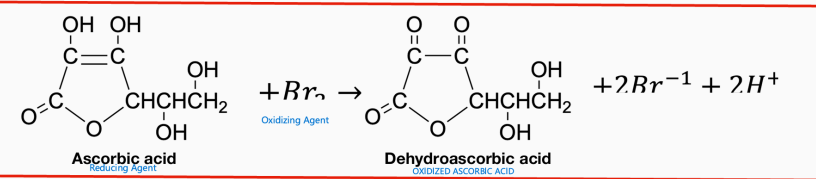
Chemical Reaction #2
oxidizing agent
CHEMICAL REACTION (2ND RXN)
Molecular bromine (a._____________) reacts with ascorbic acid, an antioxidant (aka b.______________). This forms c._______________, the oxidized form of ascorbic acid. Oxidation is also known as d.____________. Since ascorbic acid was oxidized, it involves the principle of e._____________.
a = ?
reducing agent
CHEMICAL REACTION (2ND RXN)
Molecular bromine (a._____________) reacts with ascorbic acid, an antioxidant (aka b.______________). This forms c._______________, the oxidized form of ascorbic acid. Oxidation is also known as d.____________. Since ascorbic acid was oxidized, it involves the principle of e._____________.
b = ?
dehydroascorbic acid
CHEMICAL REACTION (2ND RXN)
Molecular bromine (a._____________) reacts with ascorbic acid, an antioxidant (aka b.______________). This forms c._______________, the oxidized form of ascorbic acid. Oxidation is also known as d.____________. Since ascorbic acid was oxidized, it involves the principle of e._____________.
c = ?
dehydrogenation
CHEMICAL REACTION (2ND RXN)
Molecular bromine (a._____________) reacts with ascorbic acid, an antioxidant (aka b.______________). This forms c._______________, the oxidized form of ascorbic acid. Oxidation is also known as d.____________. Since ascorbic acid was oxidized, it involves the principle of e._____________.
d = ?
VILEORA
CHEMICAL REACTION (2ND RXN)
Molecular bromine (a._____________) reacts with ascorbic acid, an antioxidant (aka b.______________). This forms c._______________, the oxidized form of ascorbic acid. Oxidation is also known as d.____________. Since ascorbic acid was oxidized, it involves the principle of e._____________.
e = ?

Chemical Reaction #3
molecular bromine
CHEMICAL REACTION (3RD RXN)
Excess a.____________ reacts with b.__________ to form c.__________ and d._________________.
a = ?
iodide ions
CHEMICAL REACTION (3RD RXN)
Excess a.____________ reacts with b.__________ to form c.__________ and d._________________.
b = ?
bromide ions
CHEMICAL REACTION (3RD RXN)
Excess a.____________ reacts with b.__________ to form c.__________ and d._________________.
c = ?
molecular iodine
CHEMICAL REACTION (3RD RXN)
Excess a.____________ reacts with b.__________ to form c.__________ and d._________________.
d = ?

Chemical Reaction #4
liberated iodine
CHEMICAL REACTION (4TH RXN)
The a.________________ from the previous reaction reacts with the standard b._____________________ to produce c.___________________.
a = ?
sodium thiosulfate
CHEMICAL REACTION (4TH RXN)
The a.________________ from the previous reaction reacts with the standard b._____________________ to produce c.___________________.
b = ?
tetrathionate and iodide
CHEMICAL REACTION (4TH RXN)
The a.________________ from the previous reaction reacts with the standard b._____________________ to produce c.___________________.
c = ?