4.2.6.4 - Exchange rate systems
 Call Kai
 Learn
Learn Practice Test
 Spaced Repetition
 Match
Match Flashcards
 Knowt Play
1/15

There's no tags or description
Looks like no tags are added yet.
Name | Mastery | Learn | Test | Matching | Spaced | Call with Kai |
|---|
No analytics yet
Send a link to your students to track their progress
16 Terms
Effective Exchange Rate =
Weighted average of a currency's value relative to a basket of major foreign trading partners
Floating Exchange Rate =
Exchange rate is determined solely by the forces of demand and supply of the currency, without any government intervention.
Country Examples with Floating Exchange Rate
UK, US, Australia
Factors influencing/determining a Floating Exchange Rate
any factors that affect supply or demand for the currency
Demand-side:
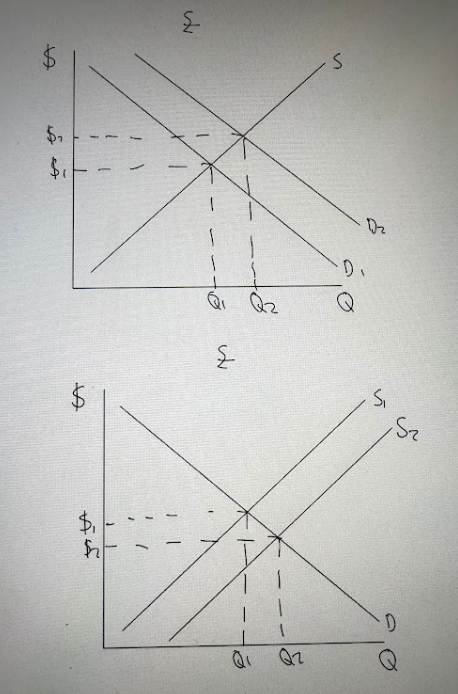
Interest rates increase higher than other countries → Hot money inflows → ↑D for £ → D shifts right → ↑P of £
New popular tourist attraction
Inward FDI
Speculation
Supply-Side:
Increase in imports, decrease in exports - ↑S of £
Speculation
Capital Outflows - outward FDI, outward portfolio investments
Diagrams showing shifts in demand & supply for currency in a Floating Exchange System
Fixed Exchange Rate =
When the government fixes/pegs the value of its currency against another currency. The central bank must actively intervene in forex markets to maintain this value.
Ways the Central Bank manages a Fixed Exchange Rate
Direct buying/selling on Forex Market:
If ER too high, central bank sells domestic currency and buys foreign currency.
If ER too low, central bank buys back domestic currency using foreign reserves
Central bank must hold sufficient foreign exchange reserves in order to intervene
Monetary Policy:
Change interest rates → Movement of hot money → Appreciation/depreciation
Capital Controls:
Gov restricts flow of capital into and out of a country
Taxation of foreign deposits in banks to cut profit from hot money flows
Country Examples with Fixed Exchange Rate
Hong Kong Dollar (HKD) pegged to USD
Danish Krone (DKK) pegged to Euro
Advantages of Floating Exchange Rates
Freedom of Monetary Policy:
In fixed ER system, central bank needs to manage the ER - one way they do that is through interest rates.
However, IR affects macroeconomic policy objectives - Inflation, EG, u/e, X-M
In floating ER, interest rates can be solely focused on these domestic issues of policy objectives without worrying about the ER → IR can be better used to achieve macroeconomic stability
APP: In response to 2007/8 GFC, BoE slashed IR from 5% to 0.5% - UK able to do that because floating ER
IDO: Quality of a country’s Central bank → still requires good use of monetary policy to achieve macroeconomic objs
Reduced need to hold large amounts of currency reserves
Automatic correction of balance of trade:
If country has CAD - Imports>Exports
High imports → ↑S of £ → Depreciation → Exports cheaper, imports more expensive → Naturally, demand for imports now fall, and ↑Exports → Current account position improves → Fixes CAD automatically
APP: Japan 2012 following Fukushima nuclear accident had a CAD → Yen depreciated → Exports became cheaper, like Toyota cars → ↑Exports → Japan’s trade improved again
IDO: Marshall-Lerner Condition - Depreciation only improves CAD if PED of exports + PED of Imports > 1
Disadvantages of Floating Exchange Rates
Volatile:
Unpredictable fluctuations of ER
Uncertainty for businesses engaged in international trade and investment → ↓Business confidence → ↓Inward & domestic investment → AD left + LRAS left → Reduced SREG & LREG
APP: UK pound during brexit voting & negotiations was very volatile → Led to high uncertainty for business planning so investment delays
Advantages of Fixed Exchange Rates
Gives certainty:
Fixed ER → certainty of currency value → less speculation
Increased stability for businesses → more confidence about planning → ↑Confidence for inward & domestic investment → AD and LRAS right
APP: Hong Kong Dollar pegged to USD has helped attract FDI → became major financial hub
IDO: Whether country can maintain enough forex reserves
Stability forces businesses to keep costs down as cannot rely on appreciations to reduce costs
Reduced currency hedging costs for firms
Lower borrowing costs (lower bond yields) as don’t need to compensate for ER risk
Disadvantages of Fixed Exchange Rates
opposite of advantages for floating
Reduced freedom of monetary policy
Increased need to hold large amounts of currency reserves - developing countries not able to hold sufficient amount
Speculation that gov cannot maintain that ‘fix’ → large speculative flows → Forced revaluation
Currency Union (+example) =
An agreement between a group of countries to share a common currency, and usually have a single monetary & forex policy.
e.g. Eurozone
Advantages of joining a Currency Union
Trade Creation:
Sharing a currency eliminates ER fluctuation risks → Lowers uncertainty in trade
+Reduced transaction costs as no need for currency conversion
↑Exports → ↑AD → ↑Emp → ↓U/E
+Trade creation diagram - World supply shifts downwards → Price falls
Access to fiscal transfers:
If in financial difficulties w/ high national debt, can get cheaper loans or emergency grants from other member countries
Increased Investment:
Less uncertainty → Firms can predict cost of imported raw materials so can adequately plan price of exports → ↑Business confidence → ↑Investment → ↑AD + ↑LRAS
Disadvantages of joining a Currency Union
Loss of independent monetary policy:
Share a single monetary policy with currency union, so individual countries cannot use monetary policy to achieve their own macroeconomic objectives
→ Risk of Asymmetric shocks - Countries have different needs - currency union cannot adjust IR just for one country’s needs because it affects all the other countries in the union too
If an economic shock affects one country more than others, can be difficult to manage the risk.
APP: Greece sovereign debt crisis - Greece couldn’t reduce IR to support falling GDP and high u/e
IDO: How aligned the economic cycles of the countries are - If economic shocks affect all countries together, then currency union is able to change IR in response
Loss of exchange rate as a policy tool:
Cannot devalue currency to improve competitiveness & fix balance of payments deficits
IDO: How aligned the economic cycles of the countries are - If economic shocks affect all countries together, then currency union is able to change IR in response
Factors affecting whether a Currency Union is Optimal
Flexbility/mobility of labour market (language barriers, flexibility of employment contracts, flexibility of wages)
Whether member nations are willing to make fiscal transfers between each other to help members experiencing difficult times
Alignment of economic cycles of the countries - whether economic shocks impact countries in a similar way
Amount of trade done with each other