Antra Adamish dalis
 Call Kai
 Learn
Learn Practice Test
 Spaced Repetition
 Match
Match Flashcards
 Knowt Play
1/36

There's no tags or description
Looks like no tags are added yet.
Name | Mastery | Learn | Test | Matching | Spaced | Call with Kai |
|---|
No analytics yet
Send a link to your students to track their progress
37 Terms
Two radio transmitters are broadcasting on the same frequency at the same time, and their coverage areas overlap. What phenomenon occurs?
Interference occurs because the signals overlap in space, time, and frequency.
Why are multiple frequency sets required in a cellular network?
To ensure neighboring cells use different frequencies and avoid interference.
How many frequency sets are theoretically required?
A minimum of 4 frequency sets.
Why does a 900 MHz signal cover a larger area than an 1800 MHz signal?
It follows the Earth's surface better.
What are three advantages of small cells?
They support higher traffic density, longer battery life and more parallel calls.
Why do small cells improve battery life?
Lower transmitter power is sufficient for communication.
What is the main disadvantage of small cells regarding infrastructure?
More base stations are required.
What is the purpose of the SIM card in GSM?
Stores subscriber information independently of the mobile device.
Allows users to move their subscription between phones.
What switching method is used in GSM?
Circuit switching.
What types of transmission are supported in GSM?
Voice transmission.
Data transmission.
What are the primary components of a Mobile Station and what are the main functions of the Subscriber Identity Module (SIM)?
Components: ME (Mobile Equipment) and the SIM (Subscriber Identity Module).
SIM Functions: Handles identifiers, authentication and stores user data.
What is the purpose of the IMSI (International Mobile Subscriber Identity)?
Identifies the subscriber in the GSM network.
What happens to the IMSI when a subscriber changes mobile operator?
The SIM card must be replaced.
Therefore the IMSI changes.
What is the purpose of the MSISDN?
It is the subscriber's telephone number.
What is the purpose of the IMEI (International Mobile Equipment Identity)?
Identifies the mobile device.
What is the purpose of the MSRN (Mobile Station Roaming Number)? exm.
Temporary routing number for incoming calls
Which network element assigns the MSRN?
MSC/VLR.
Match the identifier with its purpose.
IMSI
MSISDN
IMEI
MSRN
Identifies subscriber
Telephone number
Identifies mobile device
Temporary routing number for incoming calls
What may indicate that a mobile phone is stolen?
The IMEI displayed by *#06# differs from the IMEI written under the battery.
Or no IMEI label is present.
What is the main difference between circuit switching and packet switching? (2 points)
Circuit switching establishes a dedicated end-to-end channel before communication.
Packet switching divides data into packets that are forwarded independently.
What is the main advantage of circuit switching?
Provides a dedicated end-to-end channel.
Guarantees communication quality.
What is the main disadvantage of circuit switching?
Resources remain reserved even when no information is being transmitted.
The channel must still be paid for.
What is the main advantage of packet switching?
If one user is not transmitting, others can use the available capacity.
More traffic can be handled on the same channel.
What is the main disadvantage of packet switching?
QoS is not guaranteed.
Which existing GSM network elements had to be extended for GPRS, and what were the extensions? exm.
HLR: Stores data-service-related parameters and serving SGSN information.
BSS: Extended with the PCU (Packet Control Unit) for code conversion and encryption.
Why shall we use mobility management in mobile networks? exm.
The network must know the location of a mobile station (MS) to deliver incoming calls and SMS messages.
Mobility management tracks the movement of mobile stations using Location Areas and Location Updates.
Draw the building blocks of a PLMN in which both GSM and GPRS are available. exm.
Yes
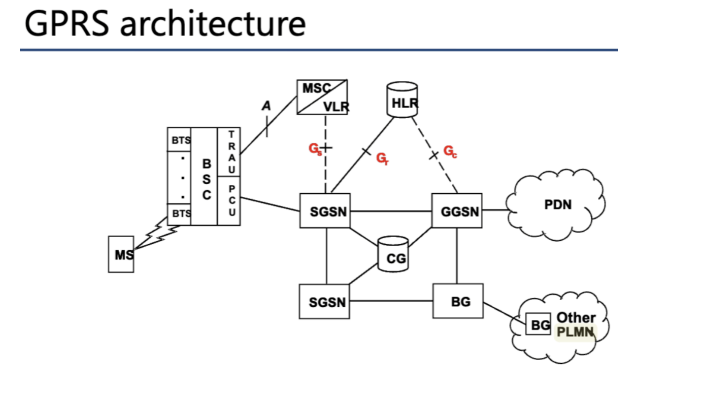
What were the main goals of UMTS?
Better voice quality.
Better spectrum utilization.
Higher data transmission speed.
Backward compatibility with GSM.
What is the main advantage of UMTS over GSM?
Significantly higher data transmission speed.
Why do we need duplexing in UMTS systems?
Allows simultaneous two-way communication between mobile and base station.
What is the main functional difference between FDD and TDD in UMTS?
FDD (Frequency Division Duplex): UL and DL use different frequency bands simultaneously.
TDD (Time Division Duplex): UL and DL share the same frequency but are separated in time slots.
What is the main functional difference between a BTS and a NodeB? exm.
BTS (in GSM): Handles radio communication and connects to the BSC for managing radio resource control and mobility.
NodeB (in UMTS): Performs similar tasks but with added capabilities for radio resource management and control, reducing dependency on the RNC.
In short, NodeB has more processing and control responsibilities than BTS
Why is it important to control the power of the mobile in UMTS? exm.
Prevents stronger signals from suppressing weaker ones by ensuring all signals arrive at NodeB with the same power.
Minimizes interference and avoids disrupting communication within the cell.
In which part of the network does UMTS differ from GSM/GPRS the most? exm.
UMTS introduces new technology in the radio access network, replacing BTS with NodeB and BSC with RNC, and using WCDMA for the air interface. NSS and GPRS elements remain largely unchanged.
What are the main advantages of having wider channels in UMTS than in GSM? exm.
Higher Data Rates: Wider channels (5 MHz) support higher transfer rates compared to GSM (200 kHz).
Better Spectrum Utilization: Enables efficient use of spectrum with support for multiple users/services.
Why is it important to control the power of the mobiles in UMTS? exm.
Ensures signals arrive at Node B with the same power to prevent interference and avoid disruptions.
What is UMTS cell breathing, and why does it complicate network design?
As more users are active in a cell, background noise increases, shrinking the effective cell radius, distant UEs cannot raise power beyond the maximum to compensate.
The cell size therefore varies, making coverage planning more difficult since a cell's boundary is not fixed.
Arba gali pasilikt:
Cell breathing: dynamic change of cell size with traffic load. More users → higher background noise (due to imperfect code orthogonality) → far‑away UEs cannot overcome noise with max power → effective cell shrinks. Complicates cell structure design.