MS-CEM A&P Exam 1
 Call Kai
 Learn
Learn Practice Test
 Spaced Repetition
 Match
Match Flashcards
 Knowt Play
1/193

There's no tags or description
Looks like no tags are added yet.
Name | Mastery | Learn | Test | Matching | Spaced | Call with Kai |
|---|
No analytics yet
Send a link to your students to track their progress
194 Terms
Receptors
Usually transmembrane proteins, very specific regarding binding to messenger (ligand)
Specificity
Receptors ability to bind to single or very limited types of ligands. High specificity limits reactions with other ligands
Affinity
How strongly a receptor binds to ligand
Saturation
Percentage of receptor sites bound by messengers. Percentage of time an individual receptor is bound by a ligand. Concentration+ affinity. Higher saturation= higher activity
Competition
How effectively other similar compounds may be able to bind to same receptor.
Agonist
Competes with normal chemical messenger but triggers the receptor response. Enhances (increases) natural activity
Antagonist
Competes with ligand but does not trigger response. Blocks the signal transduction.
Downregulation
Decrease in number of receptors. Typically in response to high concentration of messenger.
Upregulation
Increase in receptors
Signal transduction pathways
Binding of ligand leads to conformational change (receptor activation). Signal transduction pathway is activated —> leads to cell response.
Allosteric modulation
Noncovalent binding changes protein shape.
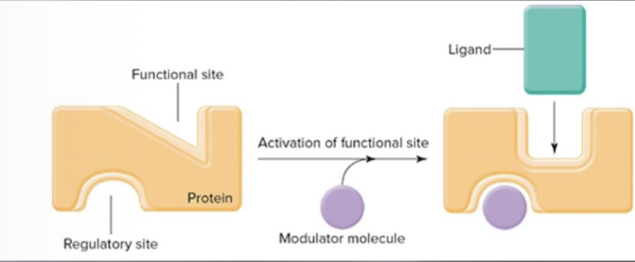
Functional site
Where ligand binds. May alter other functional sites- cooperativity
Regulator site
Binding changes shape of functional site. Can “turn on” or “turn off” functional site. Alters affinity of functional site to ligand
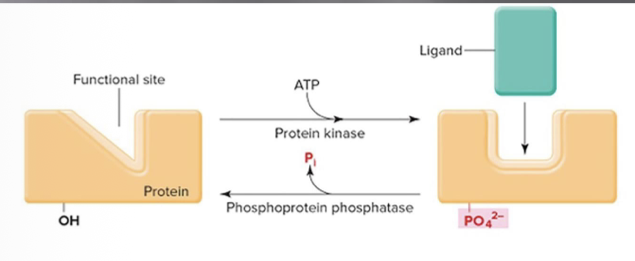
Covalent modulation
Binding charged groups to receptor (on/off switch). Changes electrical distribution, change in conformation. Ex: phosphorylation
Lipid soluble messengers
Able to penetrate membrane. Receptors usually in the nucleus. Binding leads to gene transcription/ protein synthesis (or possibly inhibition)
Water soluble messengers
Binds at membrane. Receptor activation may yield second messenger inside cell, which enacts response.
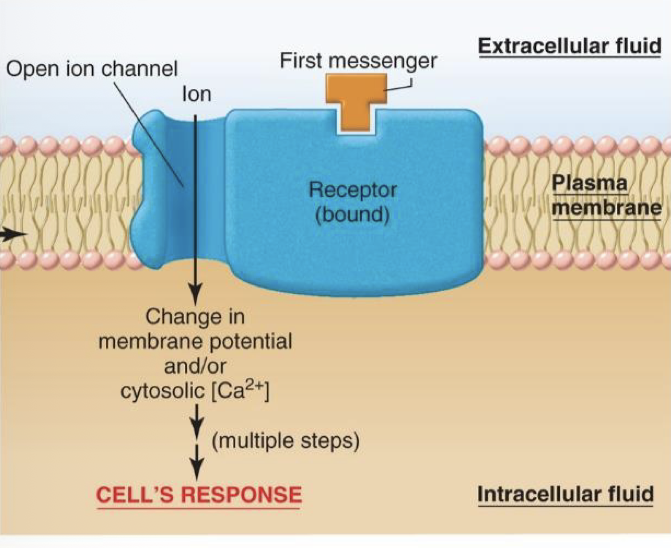
Receptor as ion channel
Activated by ligand, conformational change opens ion channel —> ions move by diffusion
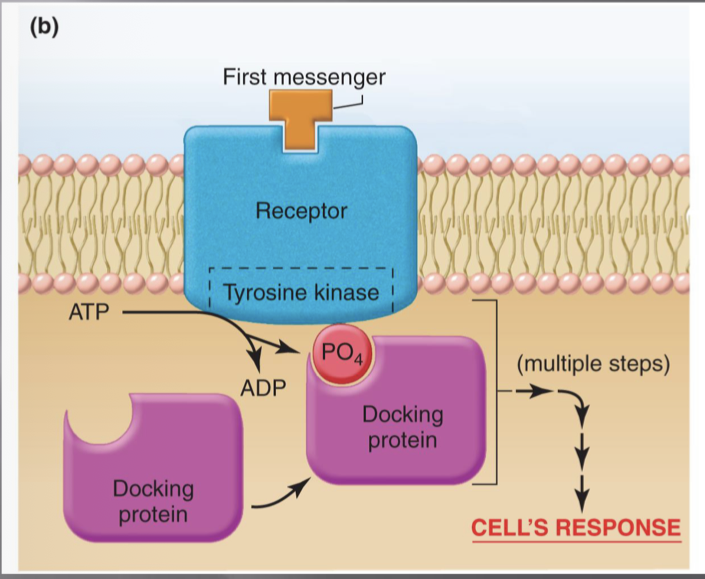
Receptor which acts as enzyme
Receptor had protein kinase activity (usually tyrosine kinases) —> ligand binding activates enzymatic portion. Creates cascade of events which leads to desired response.
Interaction with cytoplasmic kinases
Receptor does not directly have enzyme (kinase) activity. Targets proteins TFs resulting in protein synthesis.
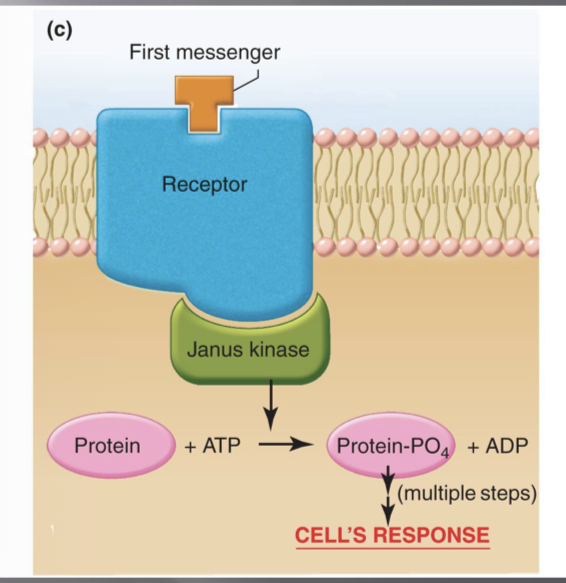
JAKs
Cytoplasmic tyrosine kinases.
G-protein coupled receptors
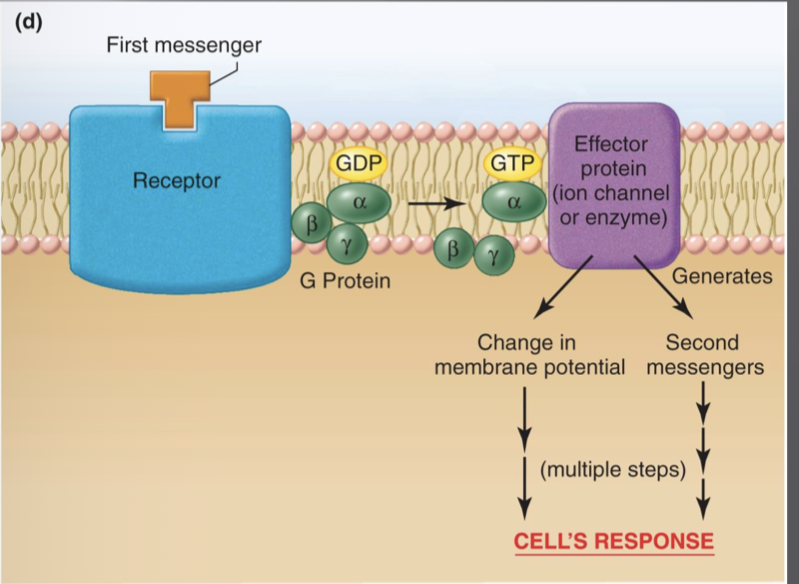
G proteins
Complex with 3 subunits- alpha, beta, gamma
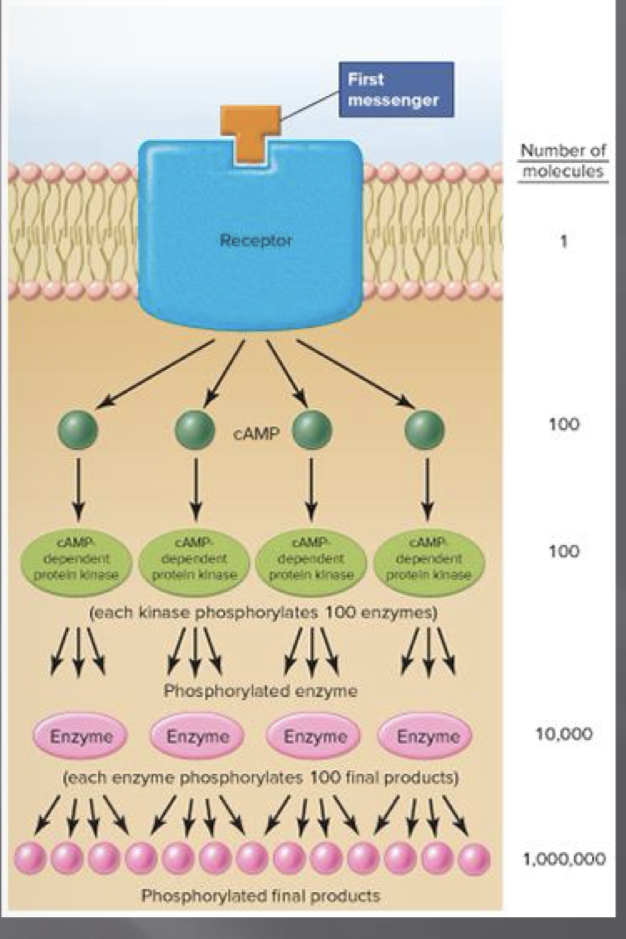
Second messenger- cAMP
Specific second messenger for G protein pathway. Converts ATP to cAMP —> cAMP dependent protein kinase —> cell response
Signal amplification
One messenger can lead to potentially millions of product molecules
Second messenger- Calcium
Very low intracellular concentration due to active transport. Voltage gated channels
Arachadonic acid —> cycloogygenase
Cyclic endoperoxides. Vascular and inflammatory action. Blood clotting
Arachadonic acid —> lipoxygenesase
Leuktrienes. Allergic/ inflammatory response. (Respiratory)
Anatomy
The study of the structures, shape and form of the parts of the human body (morphology) and their relative arrangement
Physiology
Study of the function of body parts “what they do and how they do it”
Functional role
The “jobs” a part does in the body (may be more than one)
“Form follows function”
Over many generations parts evolve to perform their functions more efficiently
Pathology
Abnormalities/ disruptions of A&P that lead to disease
Homeostasis
Maintenance of a stable internal environment
Normal range
Homeostatic mechanism keep values in a normal range
Dynamic consistency
Short term variations “average out” to consistent long-term stability
Steady state
Set point is maintained, but energy is required
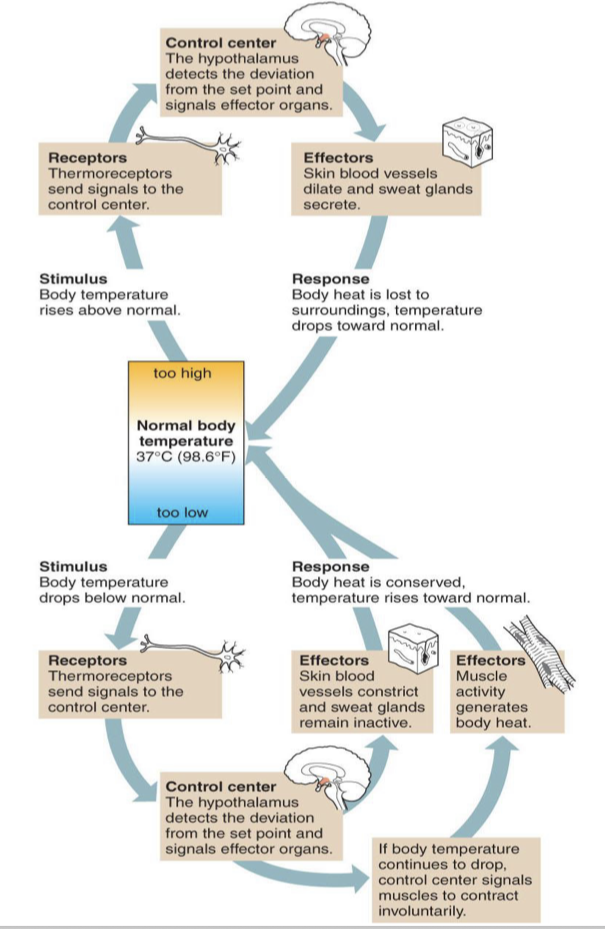
Negative feedback
Most common regulation system. As conditions deviate from set point, effectors are activated. As conditions get closer to normal, signal to effectors gradually decreases
Positive feedback
Homeostatic change occurs, response initiated. End product stimulates continuation of response
Feedforward regulation
Sensors note a change that likely will affect set point. The body responds by making changes in anticipation before change actually occurs. Minimizes effect if stimulus and deviation.
Intercellular messengers
Hormones, neurotransmitters, paracrine, autocrine, juxtracrine, gap junctions
Paracrine agents
Act on local cells
Autocrine agents
Act on secreting cell. Ex: monocytes
Juxtracrine
Surface proteins —> growth, differentiation, barriers, tissue formation
Adaption
Presence of a characteristic increasing survival in specific environments
Acclimation
Improvement of adaption with exposure
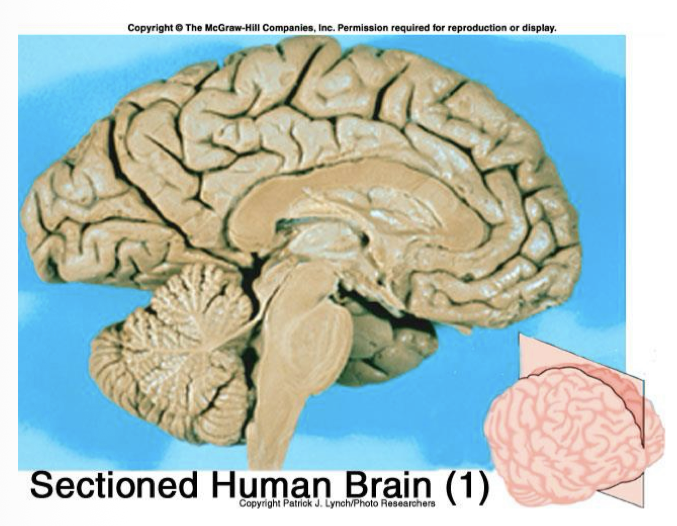
Sagittal plane
Divides body into right and left
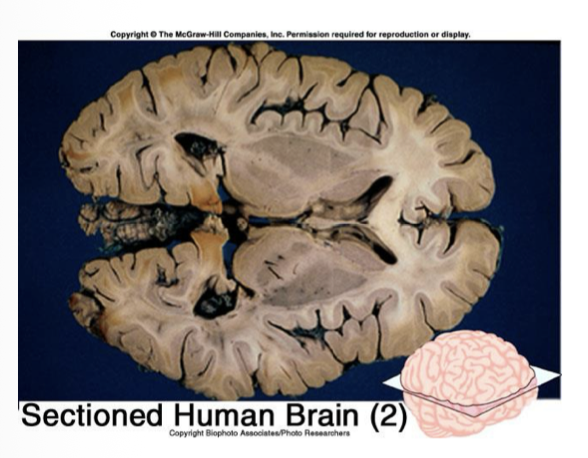
Transverse (horizontal) plane
Divides the body into superior and inferior
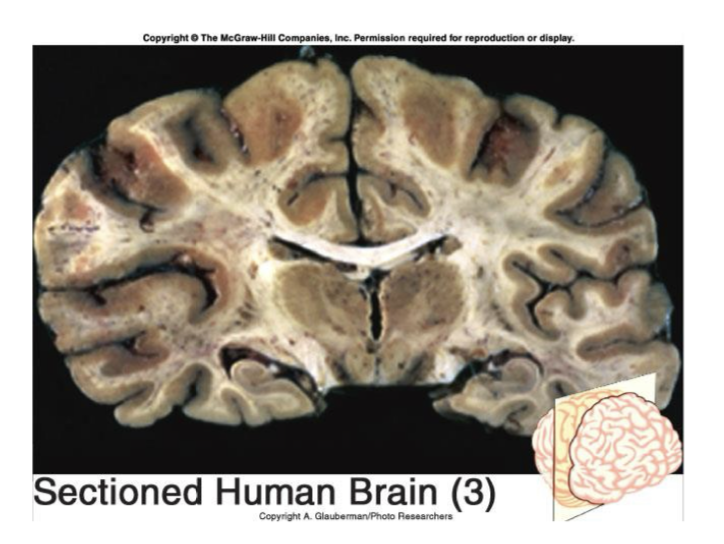
Coronal (frontal) plane
Divides the body into anterior and posterior
Abdominal
Region between thorax and pelvis
Acromial
Point of the shoulder
Antebrachial
Forearm
Anticubital
Anterior surface of elbow
Axillary
Armpit
Brachial
Arm
Buccal
Cheek
Carpal
Wrist
Celiac
Abdomen
Cephalic
Head
Cervical
Neck
Costal
Ribs
Coxal
Hip
Crural
Leg
Cubical
Elbow
Digital
Finger/toe
Dorsal
Back
Femoral
Thigh
Frontal
Forehead
Genital
External reproductive organs
Gluteal
Buttocks
Inguinal
Groin
Lumbar
Lower back
Mammary
Breast
Mental
Chin
Nasal
Nose
Occipital
Posterior region of head
Oral
Mouth
Orbital
Eye cavity
Otic
Ear
Palmar
Palm of hand
Patellar
Anterior part of knee
Pectoral
Anterior chest
Pedal
Foot
Pelvic
Pelvis
Perineal
Inferior region of trunk between thighs and buttocks
Plantar
Sole of foot
Popliteal
Posterior area of knee
Sacral
Posterior region between hip bones
Sternal
Anterior center of thorax
Sural
Calf
Tarsal
Ankle
Umbilical
Navel
Vertebral
Spinal column
Superior
Above
Inferior
Below
Anterior
In front of
Posterior
Behind
Medial
Towards the midline
Lateral
Away from midline
Proximal
Close to center (or point of attachment)
Distal
Far from center (or point of attachment)