BISC 300 Lecture 17 & 18
 Call Kai
 Learn
Learn Practice Test
 Spaced Repetition
 Match
Match Flashcards
 Knowt Play
1/112

There's no tags or description
Looks like no tags are added yet.
Name | Mastery | Learn | Test | Matching | Spaced | Call with Kai |
|---|
No analytics yet
Send a link to your students to track their progress
113 Terms
fomites
inanimate objects that may carry microbial contamination
how are fomites treated
more aggressive control methods, for a longer time
to achieve lower levels of contamination
why cant we aggressively treat living tissue for contamination
living tissue is more fragile and either requires gentler methods
or we tolerate greater contamination levels
what methods of decontamination can you use for fomites (objects/surfaces)
disinfection
sanitization
sterilization
which decontamination method results in the lowest level of contamination
sterilizatoin
disinfection
reduces/destroys microbioal load of an inanimate item through heat or antimicrobial chemicals
sanitization
reduces microbioal load of inanimate object to safe public health levels through heat or antimicrobial chemicals
sterilization
completely eliminates all vegetative cells, endospores, and viruses from an inanimate object
what methods of decontamination can you use on living tissue
antisepsis
degerming
antisepsis
reduces microbioal load on skin or tissue by applying antimicrobial chemical
degerming
reduces microbial load on skin or tissue through gentle to firm scrubbing and the use of mild chemicals (soap)
aseptic technique
set of protocols that maintain sterility (asepsis), which prevents contamination of the patient with microbs
sepsis
systemic inflammatory response to a systemic infection
methods that kill microbes
end in -cide or -cidal
complete sterility
methods that inhibit growth
end in -stat or -static
allow immune system opportunity to clear infection
physical control methods
heat
radiation
refrigeration/freezing
pressure
chemical control methods
gas
liquid
mechanical removal control methods
filtration
biological control methods
virus
toxin
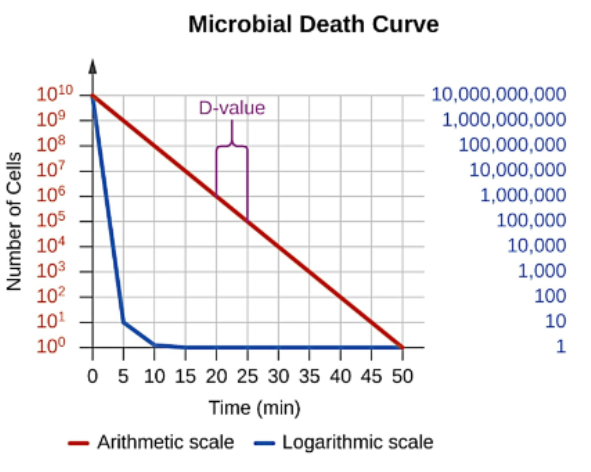
microbial death curve
semi-log plot
d-value on microbial death curve
decimal reduction time
time to kill 90% = 1 Log unit
types of heat control methods
boiling
dry-heat oven
incineration
what does boiling do to microbes
denatures proteins and alters membranes
what does dry-heat oven do to microbes
denatures proteins and alters membranes, dehydration, desiccation
what does incineration do to microbes
destroy by burning
how does clostridium botulinum respond to high temp
endospores
does boiling kill all microbes
no
some endospores survive >20 hours of boiling
less effective at higher altitudes
does incineration kill all microbes
yes at very high temps
autoclaving
denatures proteins and alters membranes
rely on moist-heat sterilization and raise temp above boiling point of water
most effective method
internal indicators to ensure autoclave sterilization
heat-sensitive autoclave tape
biological indicator spore test
biological indicator spore test
endospores of the thermophile geobacillis sterothermophilus to determine whether endospores were killed
pasteurization
denatures proteins and alters membranes
uses heat but does not render the food sterile
reduces # of spoilage-causing microbes
three levels of pasteurization
LTH
HTST
UHT
LTH
low temperature holding
63 degrees for 30 mins
HTST
high temp short temp
72 degrees for 15 seconds
lowers bacterial number and preserving quality
UHT
ultra high temp
138 degrees for 2 seconds
can be stores for a long time in sealed containers without refrigeration
refrigeration
inhibits metabolism
slows or arrests cell division
0 to 7 degrees
freezing
stops metabolism, may kill microbes
below 2 degrees
ultra-low temp
dry ice -70 degrees
liquid nitrogen tanks -196 degrees
for long-term storage or transport
high-pressure processing
100-800 MPa
denatures proteins and can cause cell lysis
hyperbaric oxygen therapy
air pressure 3x higher than normal
inhibits metabolism and growth of anaerobic microbes
how is pressure used in food
kills microbes while maintaining food quality and extending shelf life
how is pressure used clinically
hyperbaric oxygen therapy is used to treat infectoin
patient breathes pure o2
simple desiccation
drying
inhibits metabolism
desiccation reduce water activity
addition of salt or water
inhibits metabolism and can cause lysis
desiccation lyophilization
rapid freezing under vacuum- water is lost by sublimation
inhibits metabolism
water activity
water content
can be lowered by adding solutes
ionizing radiation
exposure to x rays or gamma rays or high energy electron beams
alters molecular structure, introduces double-stranded breaks into DNA
how does ionizing radiation interact with paper and plastic
penetrate paper and plastic to sterilize packaged materials
nonionizing radiation
ultraviolet (UV) light
introduces thymine dimers → mutation
less energetic/penetrating, used for surface disinfection
filtration
physical separation of microbes from air or liquid
high efficiency particulate air (HEPA)
filter have pores about 0.3 um
filter out bacteria, endospores, and many viruses
membrane filters
porous membranes with defines pore sizes
removed by physical screening
cellular microbes >0.2um
viruses > 0.1um
phenolic chemical disinfectants
denature proteins and disrupt membranes
metal chemical disinfectants
bind to proteins and inhibit enzyme activity
halogens chemical disinfectants
oxidation and destabilization of celluular macromolecules
alcohol chemical disinfectant
denature proteins and disrupt membranes
surfactant chemical disinfectant
lowers surface tension of water to help with washing away microbes and disrupt cell membranes
bisbiguanides chemical disinfectants
disruption of cell membranes
alkylating agents chemical disinfectants
inactivation of enzymes and nucleic acid
peroxygen chemical disinfectants
oxidation and destabilization of cellular macromolecules
supercritical gases as chemical disinfectants
penetrates cells, formed carbonic acid, lowers intracellular pH
chemical food preservatives as chemical disinfectants
decreases pH and inhibit enzymatic function
natural food preservatives as chemical disinfectants
inhibition of cell wall synthesis
disk-diffusion method for chemical agents
filter disks contain chemical placed on an agar plate inoculated with bacterium
compound causes zones of inhibition- size correlates with potency of compound
Kock’s postulates
•causative microbe must be present in diseased organisms, but not healthy organisms
•must be able to isolate the causative organism in pure culture
•must be able to infect a healthy organism with the isolated culture
•must be able to re-isolate microbe from experimentally infected organism
exceptions to koch’s postulates
•some pathogens are part of the normal microbiome
•some diseases involve multiple agents, or can be caused by different microbes
•some infections have varied symptoms (pleiotropic)
•some infectious agents cannot be cultured
primary pathogens
almost always cause disease
opportunistic pathogens
•normally exist outside of the host (e.g., commensals)
•cause infection under the right circumstances
•age, weakened immune system, injury
•Staphylococcus epidermidis
obligate pathogens
•cannot exist outside host in the natural environment
•(perhaps can be cultured in the lab)
•Chlamydia, Rickettsia, Mycobacteria
reservoir
natural population outside of the host
drinking water, soil, animals (zoonoses)
vectors
organisms that spread disease
mosquitos carrying malaria
extracellular pathogens
pathogens exist on or in host fluids and tissues, but do not enter host cells
may move through circulatory system or migrate through the matrix between host cells
can directly encounter elements of the immune system
examples of extracellular pathogens
E. coli
Staphylococcus aureus
Helicobacter pylori
Borrela burgdorferi
intracellular pathogens
microbes enter and multiply within host cells
allows them to evade many elements of host immune system
examples of intracellular pathogens
Listeria monocytogenes
Mycobacterium tuberculosis
Salmonella enterica
Legionella pneumophila
incubation period
pathogen entry, before symptoms
prodromal stage
first onset of symptoms
period of illness
disease is most severe, symptoms apparent
period of decline
body fights off infection
convalescence
symptoms resolve
infectious dose 50 (ID50)
number of pathogens that will infect 50% of hosts in a specified time
how does ID50 vary
•varies with pathogen, strain, etc.
•this is why antisepsis and disinfection are sufficient to reduce incidence of many infections
The dose of pathogens needed to bring on disease varies greatly – can be as few as 1
virulence
intensity of pathogenicity
pathogen lifestyle, opportunistic vs obligate
which type of pathogen is more likely to kill the host
opportunisitc
which type of pathogen is less likely to severely (or rapidly) harm the host
obligate
virulence factors
facilitate infection, tissue invasion, or farm
encoded by genes on chromosome or plasmid (HGT)
pathogenicity islands
where genes encoding virulence factors cluster on the chromosome
correlate with pathogenicity
absent in non-pathogenic strains
common phenotype of pathogenicity islands
•toxin secretion
•pilus, or other features for attachment to host
•iron uptake
•biofilm formation
adherence
once a pathogen has gained entry into host, it must adhere somewhere
recognizes specific host molecules
mediated by adhesins
adhesins in e coli
•diarrhea: fimbriae bind sugars on intestinal epithelium
•hemolytic uremia: pili bind sugars on kidney cells
•urinary tract infection: pili bind sugars on urethral epithelium
invasiveness
ability to spread to adjacent tissues
exoenzymes
may aid in spreading by
break down extracellular matrix
degrade carbohydrate-protein matrix between cells
can also disrupt host cell surface
collagenase
breaks down collagen
hyaluronidase
breaks down hyaluronic acid
bacteremia
presence of bacteria in the blood
septicemia
pathogens of their toxins in the blood
endoxins
factors secreted by bacteria to cause damage to the host
•may induce tissue damage, aiding invasion
•may cause host cell lysis, releasing nutrients
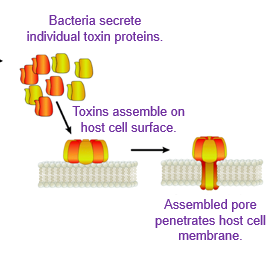
channel-forming toxins
•self-assemble into pores in host-cell plasma membrane
•cause host cell lysis
AB toxins
•A and B components form a complex
•B component attaches to host cell, triggers endocytosis of AB complex
•A component is released, causes toxicity
•(many ways to cause cell death)