The Life Cycle Of A Star
 Call Kai
 Learn
Learn Practice Test
 Spaced Repetition
 Match
Match Flashcards
 Knowt Play
1/49

There's no tags or description
Looks like no tags are added yet.
Name | Mastery | Learn | Test | Matching | Spaced | Call with Kai |
|---|
No analytics yet
Send a link to your students to track their progress
50 Terms
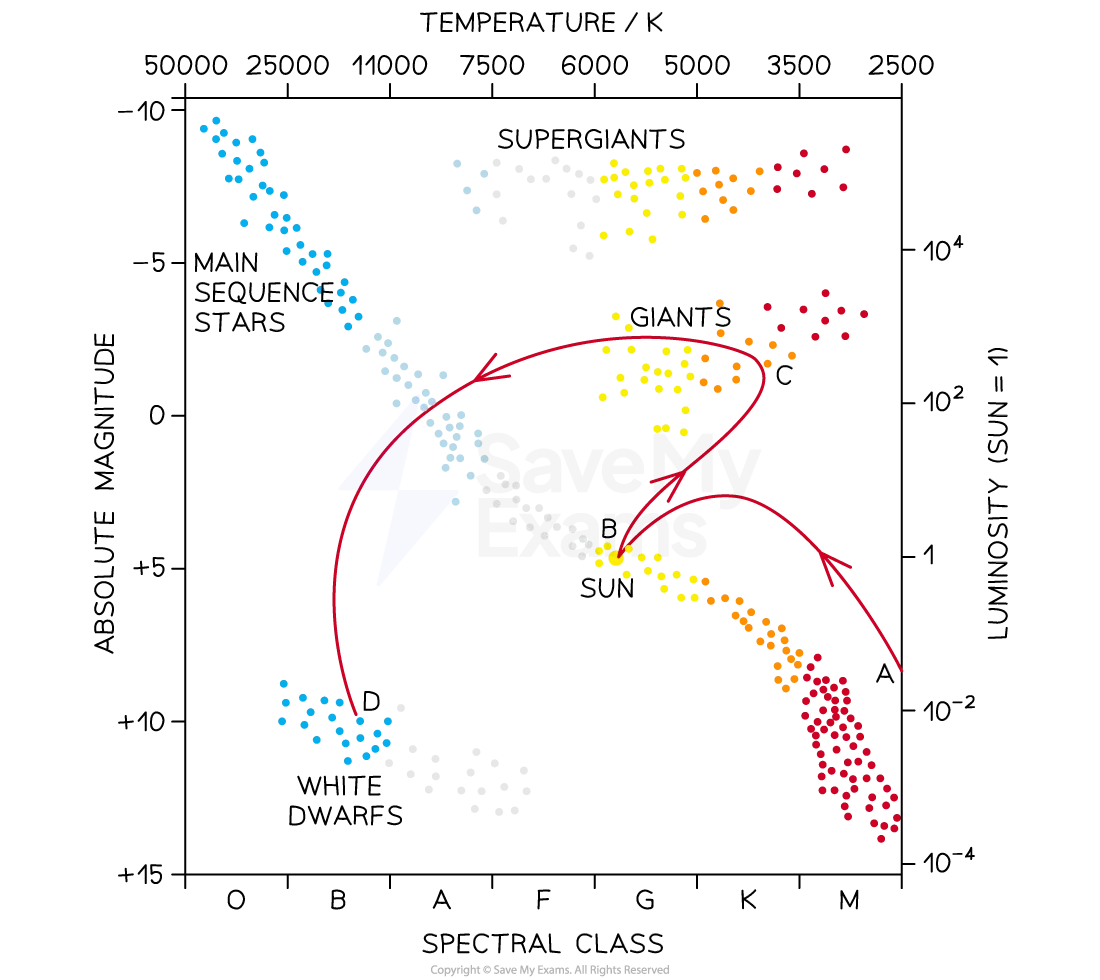
The life cycle of a star (low mass)
Nebula → Protostar → Main Sequence → Red Giant → White Dwarf → Black Dwarf
The life cycle of a star (high mass)
Nebula → Protostar → Main Sequence → Red Supergiant → Supernova → Neutron Star or Black Hole
What is a nebula?
A nebula is a large cloud of gas and dust in space, mainly made of hydrogen. Stars form when gravity causes parts of a nebula to collapse.
What is a protostar?
A protostar is a forming star created when a nebula collapses under gravity. As it contracts, its temperature and pressure increase, but nuclear fusion has not yet started.
What is a main sequence star?
A main sequence star is a stable star that generates energy by fusing hydrogen into helium in its core.
What forces act on a main sequence star?
Gravity acts inwards, pulling the star's matter towards its centre.
Radiation pressure (from nuclear fusion in the core) acts outwards.
These forces are balanced, keeping the star stable.
How long do smaller stars spend in its main sequence stage?
1 - 10 billion years
How long do massive stars spend in its main sequence stage?
10 - 100 million years
Why do massive stars spend less time in the main sequence stage?
Massive stars have higher core temperatures and pressures, so they fuse hydrogen into helium much faster than smaller stars. As a result, they use up their fuel more quickly and have shorter main sequence lifetimes.
What is the approximate cut-off between low-mass and high-mass stars?
About 8 times the mass of the Sun
What is a solar mass?
A solar mass is a unit of mass equal to the mass of the Sun.
What is a red giant?
A red giant is a large, cool star formed when a low-mass main sequence star runs out of hydrogen in its core. The outer layers expand and the surface cools, making it red.
Why does a star enter the red giant stage?
A star becomes a red giant when it runs out of hydrogen in its core. The core contracts under gravity, while hydrogen fusion continues in a shell around the core, causing the outer layers to expand and cool, making the star large and red.
Why does a star’s surface temperature decrease when it expands into a red giant?
As the star expands, its energy is spread over a larger surface area. Using Stefan law, the power emitted depends on temperature,
If the star’s luminosity does not increase enough to match the large increase in surface area A, then the surface temperature T must decrease. This results in a cooler, redder star.
What elements are formed in the red giant stage?
Hydrogen fusion continues in a shell → produces helium
In the core (later stage), helium fusion occurs (helium burning)
This forms carbon and some oxygen
What happens in the planetary nebula stage?
A planetary nebula forms when a red giant sheds its outer layers into space. These layers are pushed away, leaving behind the hot core.
What is a white dwarf?
A white dwarf is the hot, dense core left behind after a red giant has shed its outer layers in a planetary nebula. It no longer undergoes nuclear fusion.
What is a red supergiant?
A red supergiant is a very large, cool, and luminous star formed from a high-mass main sequence star after it runs out of hydrogen in its core.
What elements are formed in a red supergiant?
Hydrogen → Helium (shell fusion)
Helium → Carbon and Oxygen
Further fusion forms heavier elements in layers:
Neon
Magnesium
Silicon
Fusion continues until Iron (Fe) is formed
Why can’t fusion above iron occur?
Iron has the largest binding energy per nucleon of any nuclei in the universe
What is a supernova?
A supernova is a violent explosion of a massive star caused by the gravitational collapse of its core after nuclear fusion can no longer continue.
What is a neutron star?
A neutron star is the extremely dense core left after a supernova when a high-mass star collapses.
What is a black hole?
A black hole is an object formed when the core of a very massive star collapses after a supernova and becomes so dense that not even light can escape.
What is the cut-off point for a black hole?
If the remnant core after a supernova has a mass greater than about 3 solar masses (3M⊙), gravity is too strong for neutron degeneracy pressure to support it, so it collapses into a black hole.
Define supernova
An object which exhibits a rapid and enormous increase in absolute magnitude
What are the two types of supernova?
Type I (Ia):
White dwarf in a binary system
Gains mass until it explodes
Type II:
Massive star runs out of fuel
Core collapses and star explodes
What is a Type Ia supernova?
A Type Ia supernova occurs when a white dwarf in a binary system gains mass from a companion star until it becomes unstable and explodes.
What elements are formed in a supernova?
During a supernova explosion, elements heavier than iron are formed.
Define standard candle
An astronomical object of known brightness that can be used to calculate galactic distances
Why are Type Ia supernovae used as standard candles?
A Type Ia supernova is used as a standard candle because it always has a similar peak luminosity.
Define gamma ray burst
A short, extremely high energy burst of gamma radiation emitted by a collapsing supergiant star
How does the energy of a gamma-ray burst compare to the Sun’s output?
A gamma-ray burst (GRB) can release in a few seconds the same amount of energy the Sun emits over its entire lifetime (~10 billion years).
What happens to hydrogen Balmer lines in different types of supernova?
Type II supernova:
Hydrogen Balmer lines are present
Outer layers still contain hydrogen
Spectra show strong hydrogen absorption/emission lines
Type Ia supernova:
No hydrogen Balmer lines
White dwarf contains mostly carbon and oxygen
Spectrum shows no hydrogen features
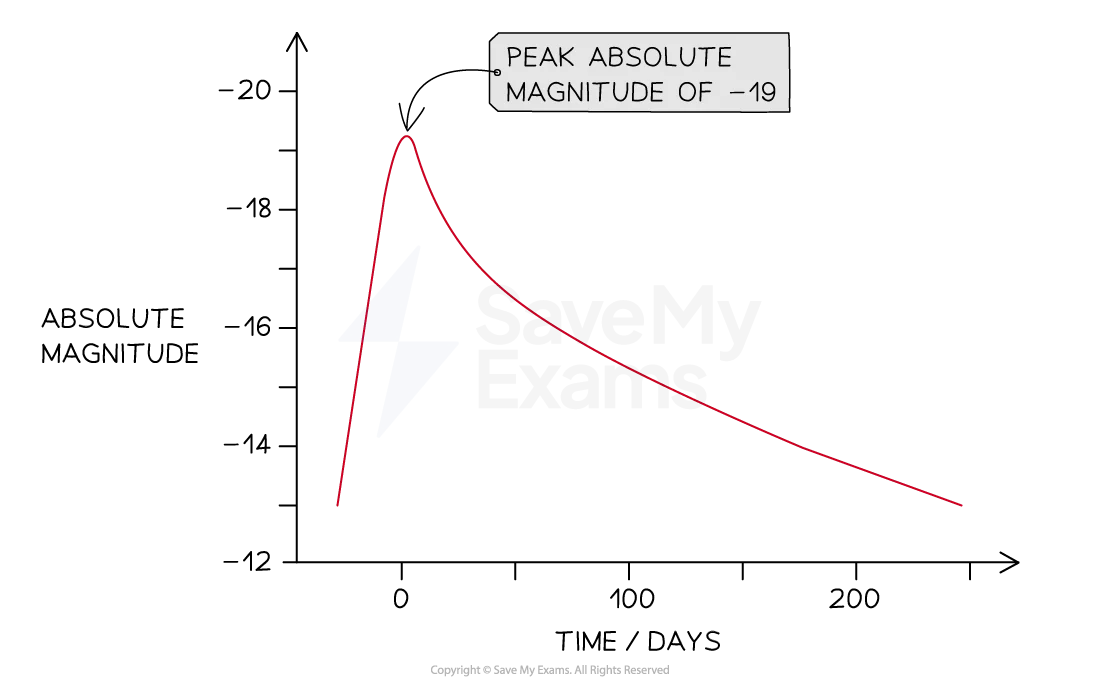
What is the peak absolute magnitude of a type 1a supernova?
-19
What does the light curve of a Type Ia supernova look like?
A Type Ia supernova light curve shows a rapid rise in brightness followed by a gradual, smooth decline.
Define neutron star
An extremely dense collapsed star made up of neutrons
What is reverse beta decay in neutron stars?
Reverse beta decay happens when electrons are forced into protons during the collapse of a massive star’s core, forming neutrons.
p+e−→n+Ve
What is a pulsar?
A pulsar is a rapidly rotating neutron star that emits regular pulses of electromagnetic radiation.
Why are pulsars much easier to detect than non-rotating neutron stars?
Pulsars are easier to detect because they emit regular, repeating pulses of electromagnetic radiation due to their rotation.
What type of radiation do pulsars emit?
Pulsars usually emit electromagnetic radiation, mainly:
Radio waves (most commonly detected)
Sometimes X-rays
Sometimes gamma rays
Define black hole
An object which is so dense that its escape velocity is greater than the speed of light
Event horizon
The boundary at which light and matter cannot escape the gravitational pull of the black hole
Escape velocity
The velocity / speed required to escape the black hole’s gravitational pull
Singularity
Infinitely dense point at which the laws of physics break down
What is the Schwarzschild radius?
The distance between the singularity and event horizon
What is a supermassive black hole?
A supermassive black hole is a black hole with a mass of millions to billions of solar masses, found at the centre of most galaxies.
What is the supermassive black hole at the centre of the Milky Way?
The Milky Way contains a supermassive black hole called Sagittarius A*.
What is a Hertzsprung–Russell diagram?
An H-R diagram is a graph that shows the relationship between a star’s luminosity and its surface temperature.
Hertzsprung–Russell diagram