physical chem
 Call Kai
 Learn
Learn Practice Test
 Spaced Repetition
 Match
Match Flashcards
 Knowt Play
1/75

There's no tags or description
Looks like no tags are added yet.
Name | Mastery | Learn | Test | Matching | Spaced | Call with Kai |
|---|
No analytics yet
Send a link to your students to track their progress
76 Terms
thermodynamics
the study of energy transformations and their reaction to macroscopic variables such as temperature, pressure and volume
applicable to all processes involving temperature and pressure
systems and surroundings
system is the part of the universe being studied
surroundings are everything outside the system
the boundary seperates the system from surroundings
types of systems
open system- exchanges mass and energy
closed system- exchanges energy only
isolated system- exchanges neither
ex. isolated system- thermos flask preventing heat flow
types of thermodynamic processes
isothermal- constant variable is temperature, ex. is water bath
isobaric- constant variable is pressure, ex. is cooking in an open pan
isochoric- constant variable is volume, ex. is pressure cooker
internal energy
internal energy of a system changes when heat or work is transferred
relationship-
delta V= delta W + delta Q
Q- heat added or removed
V- change in internal energy
W- work added or removed
heat- energy used to increase temperature, heat is not the same as temperature
work- energy used to move matter, ex. expanding gas performs work, compressing gas performs work
thermodynamic equilibrium
a system reaches this when it no longer changes with time, ex. 2 objects at different temperatures exchange heat until they reach the same final temperature
intensive vs extensive variables
intensive variables- do not depend on system sie
ex. temperature T, pressure P, mole fraction x
extensive variables- depend on system size
ex. volume V, number of moles n, internal energy U
state variables
properties that depend only on the thermodynamic state, not the path taken
ex. P, T, V, n, U
non state variables
depends on the process/path
ex. Heat Q, work W
straight line distance between wageninigen and amsterdam= state variable
driving distance depends on route= non state variable
0th law of thermodynamics
if 2 bodies are separately in thermal equilibrium with a third body they are in thermal equilibrium with each other
defines the concept of temperature
temperature scales
celsius scales- water boils at 100 degrees at 1 atm
kelvin scale- used in science, add 273.15 to celsius
temperatures in thermodynamics should generally be expressed in kelvin
0th law- thermal equilibrium principle, 1st law- energy is conserved, 2nd law- heat flows naturally from hot to cold bodies, 3rd law- absolute zero (0K) can never be reached
Ideal gas law
PV=nRT
P=pressure
V=volume
n=moles
T=temperature in kelvin
R= 8.314 J/K/mol
assumptions- valid only when particles are very small, no intermolecular forces exist, molar volume; v=V/n
why thermodynamics matter in food tech
how to create foods with desired properties, these properties depend on:
-ingredients used, ingredient concentration, processing conditions
-temperature and pressure strongly affect food structure and behaviour
-flavour partitioning; flavour molecules distribute differently between oil and water phases, thermodynamics predicts this partition equilibrium
-phase seperation in biopolymer mixtures- protein polysaccharide mixtures may seperate into 2 phases; one protein rich and one polysaccharide rich which creates unattractive layers in drinks
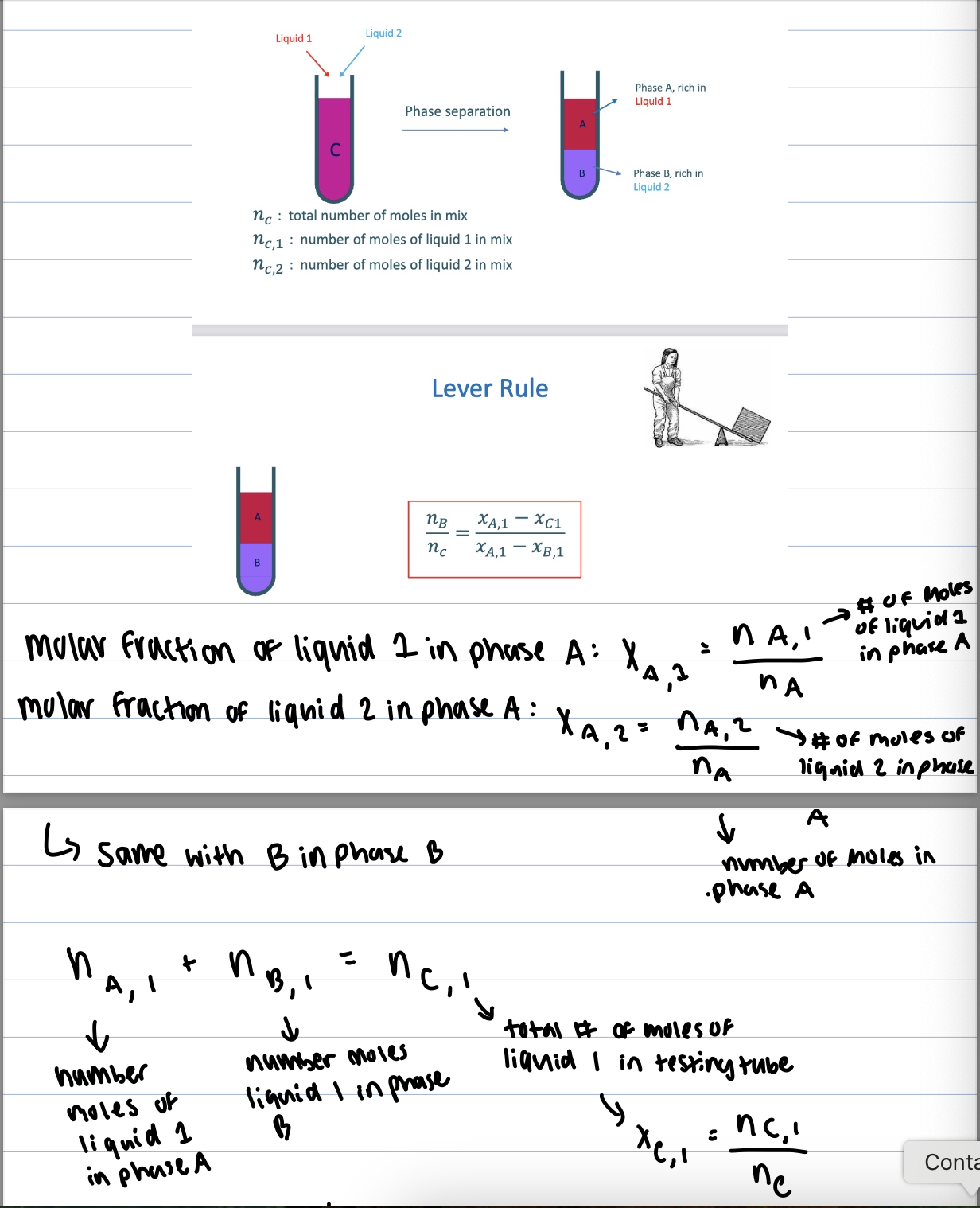
lever rule
calculate the amount of each phase in a 2 phase system
mole fraction- Xa=Na/N total
lever rule relation- Nb/Nc= Xa,1-Xc,1/Xa,1-Xb,1
used for partially miscible liquids and phase seperated mixtures
Phase diagrams
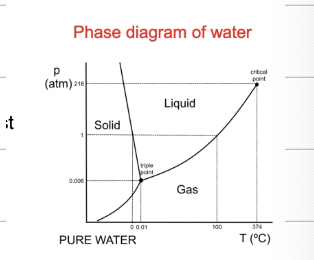
shows which state of matter exists at different temperatures and pressures
solid- strong interactions and long range order
liquid- weak interaction and short range order
gas- almost no order and very weak interactions
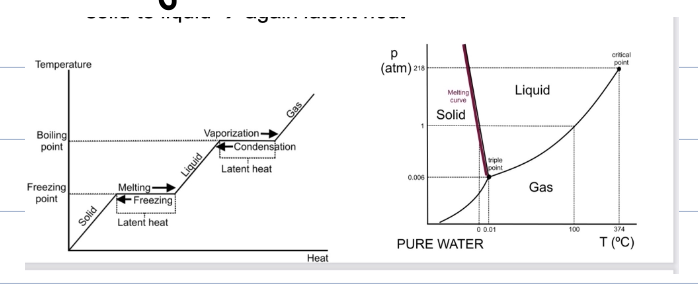
in a phase diagram each region represents one stable phase, the lines between regions are called coexistence curves or phase boundaries and on these boundaries two phases coexist in equilibrium
important curves in the water phase diagram
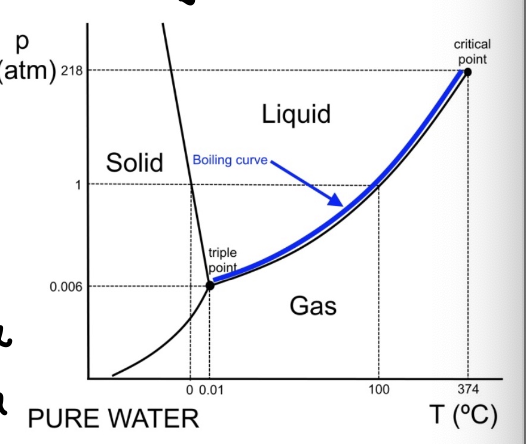
boiling curve- seperates liquid water and water vapour, at 1 atm water boils at 100 degrees celsius
during boiling temperatures stays constant as all added heat is used for the phase transition → this heat is called latent heat
pressure affects boiling
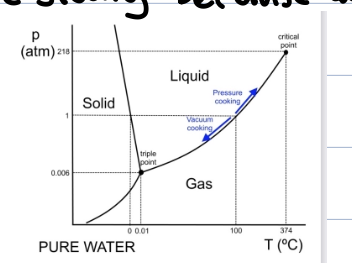
higher pressure → higher boiling point (pressure cooking)
lower pressure → lower boiling point (vacuum cooking)
at high altitude potatoes cook more slowly because water boils at a lower temperature (high altitude = low pressure)
melting curve
seperates solid and liquid phases-
melting; solid → liquid
freezing; liquid → solid
also requires latent heat
water is unusual because ice expands when freezing, the melting curve has a negative slope, increasing pressure can melt ice which explains ice skating (thin water layer forms under skates due to pressure)
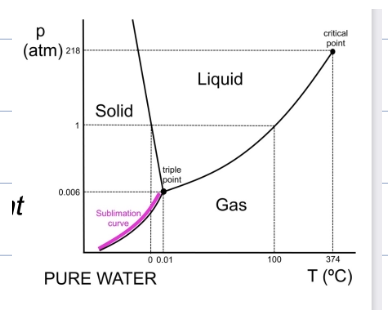
sublimation curve
seperates solid and gas phases
sublimation = solid → gas
deposition = gas → solid
freeze drying- a practical application;
1) water in food is frozen
2) pressure is lowered
3) ice sublimates directly into vapor
used for instant coffee, long shelf life foods, outdoor foods
triple point and critical point
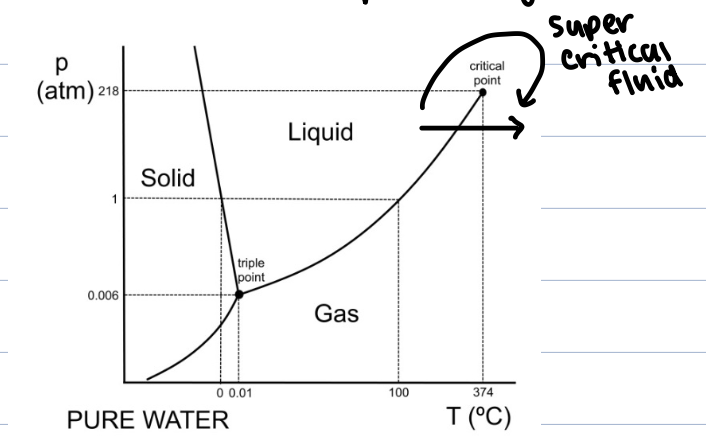
triple point- the point where solid, liquid, and gas coexist
for water- 273.16K, 0.006 atm
used for thermometer calibration
critical point- for water 647.15K, 218 atm, above this point no clear distinction exists between liquid and gas, the substance becomes a supercritical fluid
you can move from liquid to gas in 2 ways; cross the boiling curve and phase transition occurs or go around the critical point and gradual change with no phase transition occurs
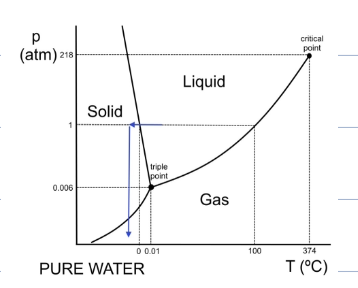
applications in food technology
liquid nitrogen boils at 77K, used for rapid freezing because it is extremely cold and chemically inert, applications are removing oxygen from wine bottles and drinks before sealing, increasing pressure inside cans to strengthen them
guiness widget- a plastic ball with a tiny hole added to guines cans, LN2 pressurizes both the can and the widget, when opened the widget releases gas rapidly which produces smooth foam
carbon dioxide and dry ice- CO2 triple point at 5atm and 216K, at atmospheric pressure solid CO2 cannot melt; it sublimates directly into gas, this solid CO2 is called dry ice; temperature is 194K, useful for refridgerated transport and packaging
heating processes
isochoric heating (constant volume)
ex. pressure cooker
because volume is fixed; heating increases pressure, liquid and vapour coexist, the system follows the boiling curve
important values-
20 degrees celsius- vapour pressure is 0.023 atm
70 degrees- 0.5 atm
100 degrees- 1 atm
121 degrees- 2 atm (safety valve opens)
why pressure rises- more molecules enter gas phase, gas pressure increases, harder for liquid molecules to evaporate, boiling point increases, this explains why pressure cookers cook faster
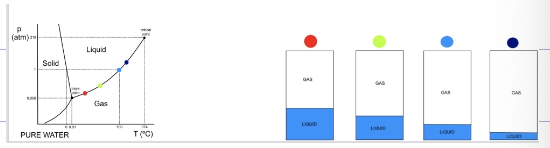
isobaric heating (constant pressure)
ex. container with movable lid at 1atm
process-
heat liquid water from 20 degrees celsius, temperature rises until boiling point (100 degrees), at boiling point liquid turns to vapour and temperature and pressure remain constant and volume increases because gas is less dense, after all liquid evaporates further heating increases temperature and volume
phase diagrams of other substances
water behaves differently from most substances because it expands upon freezing
ex. CO2 melting curve has a normal positive slope, does not behave like water
Phase diagram of salt water (NaCl + water)
food systems are usually mixtures, not pure substances
for salt water- horizontal axis is NaCl concentration, vertical axis is temperature, diagram valid only at atmospheric pressure
cooling salt water-
ex. start with 10% NaCl at 10 degrees celsius, cooling below freezing forms pure ice crystals, remaining liquid becomes more concentrated in salt, further cooling creates more ice and increases salt concentration further, the system follows the melting curve during freezing
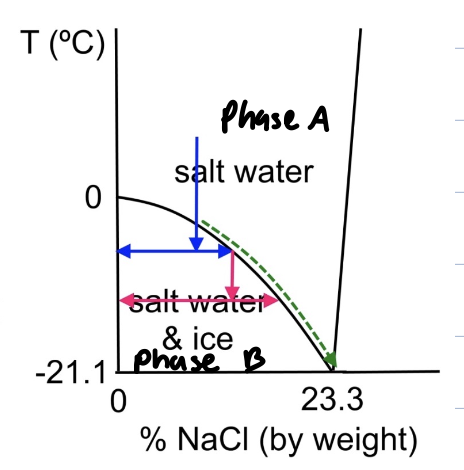
lever rule salt system
calculates how much of each phase exists in a 2 phase system
for salt water, phase A is pure ice, and phase B is concentrated salt solution
the relation is
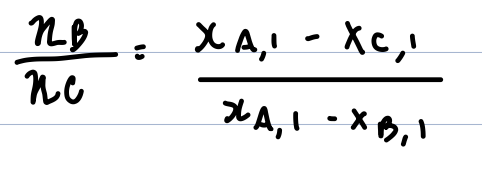
Nb= moles in phase B
Nc= total moles
X= mole fractions of a component
it allows calculation of ice formed, amount and concentration of remaining salt solution
ideal gas law
assumes particles are point like, particles do not interact, works best at low pressure, high temperature, dilute gases
real gases and corrections
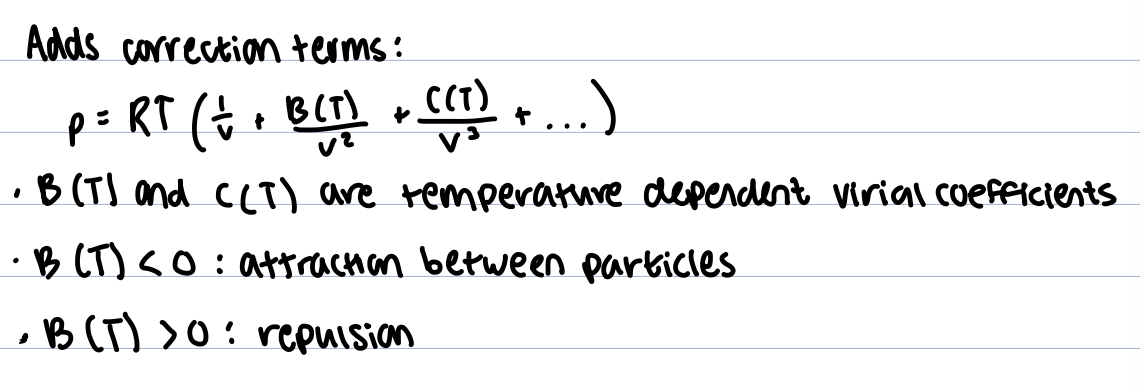
real gases deviate from ideal behaviour because particles interact, particles have finite size
virial equation
adds correction terms;
van der waals equation
includes attraction between particles, finite particle size, this model describes real gases better than ideal gas law

conservation of energy
energy cannot be created or destroyed, only transformed from one form into another, the total energy of an isolated system (and the universe) is always constant
fundamental formula- delta U= delta W + delta Q
can all take positive or negative values depending on the direction of energy flow
for an ideal gas, internal energy is strictly a function of temperature
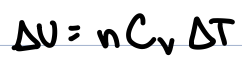
Cv is heat capacity at constant volume, yielding 3 special process paths
1) isothermal process (change of T is zero), internal energy remains constant (change in internal energy is zero) therefore any heat added turns completely into work, change in Q= -change in W
2) isochoric process; constant volume because volume doesn’t change, no expansion or compression work can be done (change in W=0), therefore change in U= change in Q
3) adiabatic process; no heat flow, the system is thermally insulated from its surroundings meaning change in Q=0, so change in U= change in W
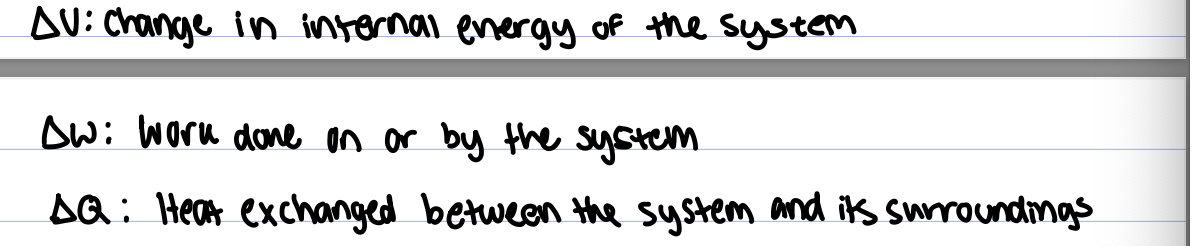
adiabatic processes+ adiabatic cooking
while perfect physical insulation doesn’t exist, very fast processes leave no time for heat to exchange across boundaries so rapid expansions/compressions in real life are safely assumed to be adiabatic (change in Q=0)
mechanism adiabatic cooling- when pressure is lowered quickly, a gas expands, to expand the system must perform mechanical work on its surroundings so delta W<0
because no heat can enter to replenish this energy (change Q=0) the energy must come from the gas’s own internal energy reserve, causing change in U to decrease, delta U<0
since delta U=nCvdelta T a drop in internal energy directly forces the temperature of the gas to drop
ex. opening a soda can; carbonated drinks contain compressed CO2 and cracking the tab open causes the gas to expand instantly and undergo adiabatic cooling, sudden localised drop in temperature causes the moisture in the ambient air to condense into a visible cloud/smoke flume
entropy (S)
thermodynamic property that quantifies degree of molecular disorder or randomness within a system
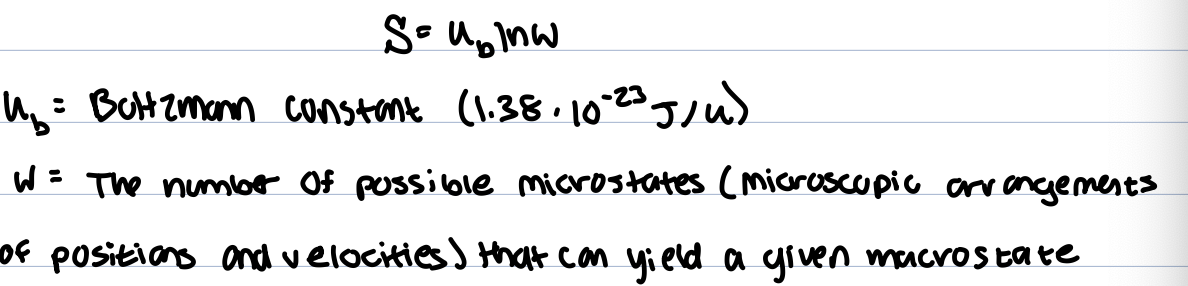
Boltzmann equation-
the lattice game model- a 4×4 vertical lattice grid containing 4 identical particles demonstrates that uniform, spread out configurations possess a significantly higher count of micro states (W) than highly organized configurations, systems naturally progress towards these disordered macro states simply because they are statistically the most probable arrangements
general behaviours
entropy increases during transitions that give molecules more structural freedom; solid → liquid → gas, it decreases during condensation/freezing
2nd law of thermodynamics- the entropy of the universe always strives to increase ( delta S universe >0) , this law dictates that heat flows spontaneously from a hot object to a cold object, never the reverse
entropic elasticity in food polymers; long polymer chains like gelatin networks/proteins naturally exist in highly curled disordered configurations to maximise their entropy, pulling/stretching the polymer forces the chain into a straight, highly ordered configuration which lowers its entropy, when you release the stretching tension, the molecules spontaneously snap back into their curled states to maximise their entropy, creating an elastic pulling force
enthalpy
represents the total heat content of a system and is defined mathematically as -

state vs path functions; unlike heat (Q) and work (W) which are path dependent, enthalpy (H) and internal energy (Q) are state variables, their values depend entirely on the current state of the system, not on how the system reached that state
when a process occurs under constant atmospheric pressure (change in pressure=0) the change in enthalpy is exactly equal to heat exchanged with the surroundings
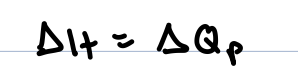
molar latent heats- phase transitions involve shifts in enpalthy without changing temperature, quantified as;
molar heat of fusion/melting (delta H fus)
molar heat of vaporisation (delta H vap)
molar heat of sublimation (delta H sub)
Gibbs free energy (G)
the thermodynamic potential used to determine if a process can happen spontaneously at constant temperature (T) and pressure (P)

temperature driven spontaneity examples-
ice melting- breaking hydrogen bonds of ice requires heat (change H>0) but liquid water is more disordered than ice (change S>0) at low temperature, the change H term dominates ( change G>0, ice stays frozen) at high temp, above 0 degrees the -TchangeS term outbalances change H causing change G<0 making melting spontaneous
boiling an egg- unfolding compact egg proteins requires input heat to break structural bonds (change H>0) but denaturing them into open random coils increases disorder (change S>0), at boiling temperatures the magnitude of the -TchangeS term becomes larger than change H forcing change G<0 this allows the proteins to spontaneously denature and form a solid gel

chemical potential (u)
gibbs free energy per mole of a specific substance
systems naturally minimise their gibbs free energy, matter always moves spontaneously from a region of high chemical potential to a region of low chemical potential, at thermodynamic equilibrium the chemical potential of a substance must be equal everywhere in the system
phase stability- the most stable state of matter under any given temperature/pressure is always the phase that possess the absolute lowest chemical potential (u)
along a phase boundary line, the potentials of 2 phases are equal ( ex. on the boiling line; u liquid= u gas), at the triple point all 3 phases coexist in balance ( u solid= u liquid= u gas)
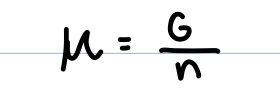
temperature dependence
The rate of change of chemical potential with temperature is proportional to negative molar entropy (s)
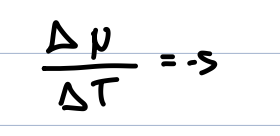
because molar entropy increases across states of aggregation (S solid < S liquid < S gas) lines plotted on a u vs. T graph slope downward, the gas phase has the steepest downward slopes, explaining why it becomes stable u phase at high temperatures
pressure dependence
the rate of change of chemical potential with rpessure is equal to the molar volume (v)
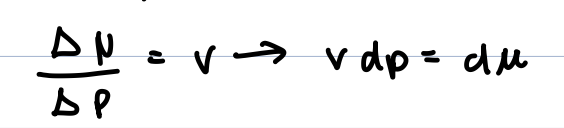
increasing pressure increases the chemical potential, exception when water expands when freezing so V ice> V water, increasing pressure raises the chemical potential of ice faster than liquid water explaining why applying pressure lowers the melting point of ice
isothermal compression of an ideal gas
extension to mixtures, in a multi component mixture, gas pressures are replaced by concentrations or mole fractions (xi) defining the chemical potential of components i as;

μi = chemical potential of component i in the mixture.
μi∗= chemical potential of the pure component i at the same temperature and pressure (the reference state).

entropy of mixing
when 2 components mix the number of possible arrangements (microstates) increases
resulting-
Smixture does not equal S1 + S2
mixing creates additional disorder, therefore entropy increases
ideal mixtures
have no interactions between components, only entropy drives mixing
lattice model visualisation
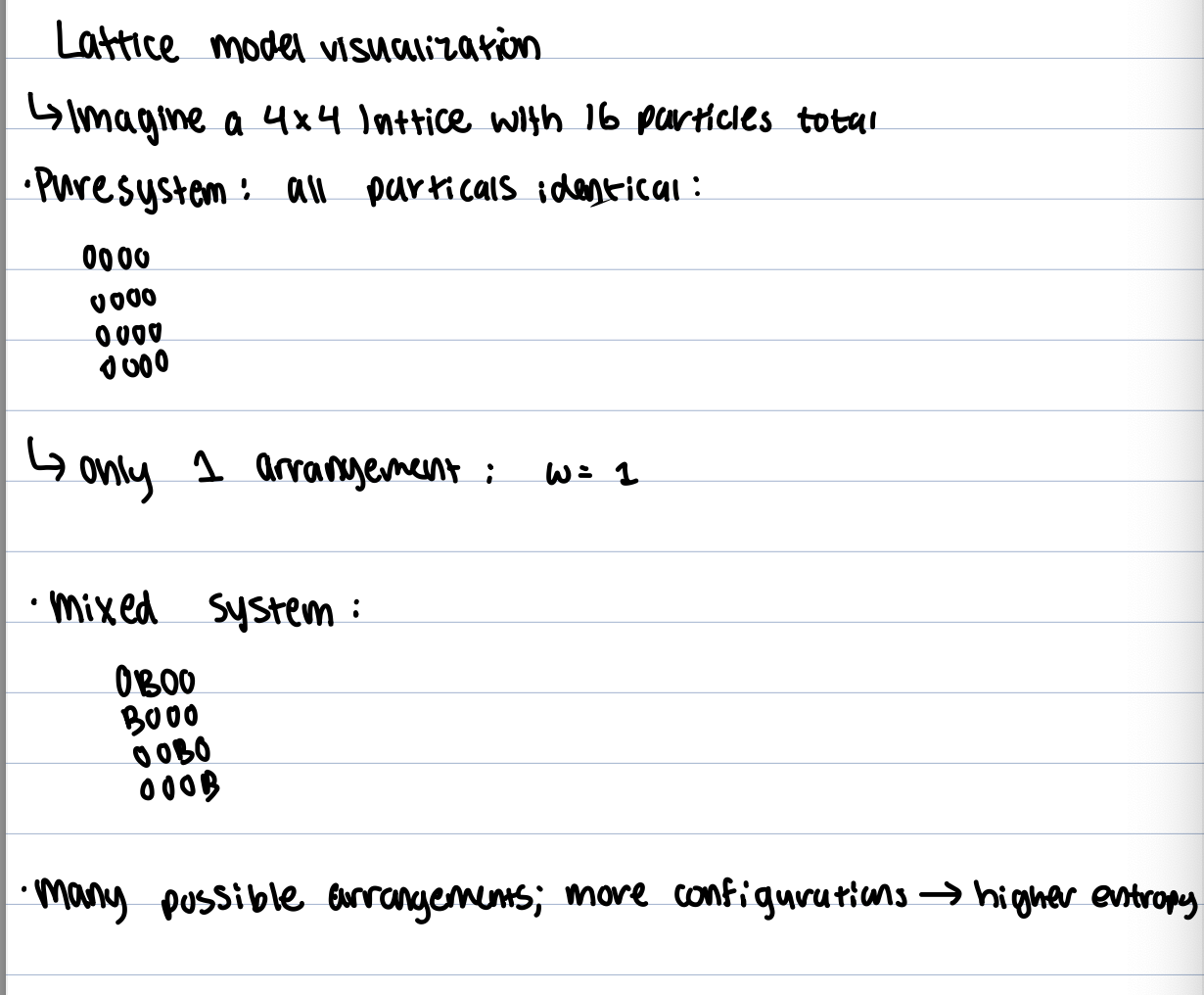
mole fraction
N1= number of particles of component 1
N= total particles
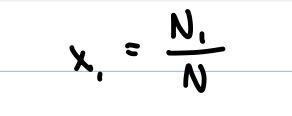
number of configurations
the number of possible configurations
where-
N= N1+N2
!= factorial
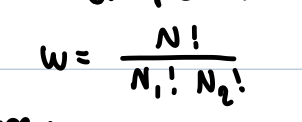
Boltzmann equation
entropy relates to configurations through
S= Kblnw
Kb= boltzmann constant
w= number of microstates
important trend
entropy is maximum at equal at equal mixing
reason- maximum disorder, largest number of configurations
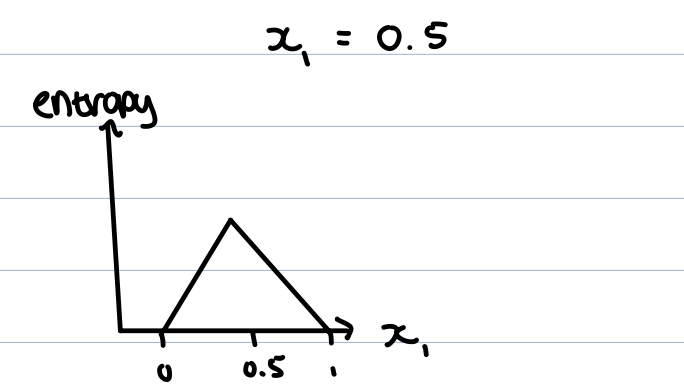
entropy of mixing equation
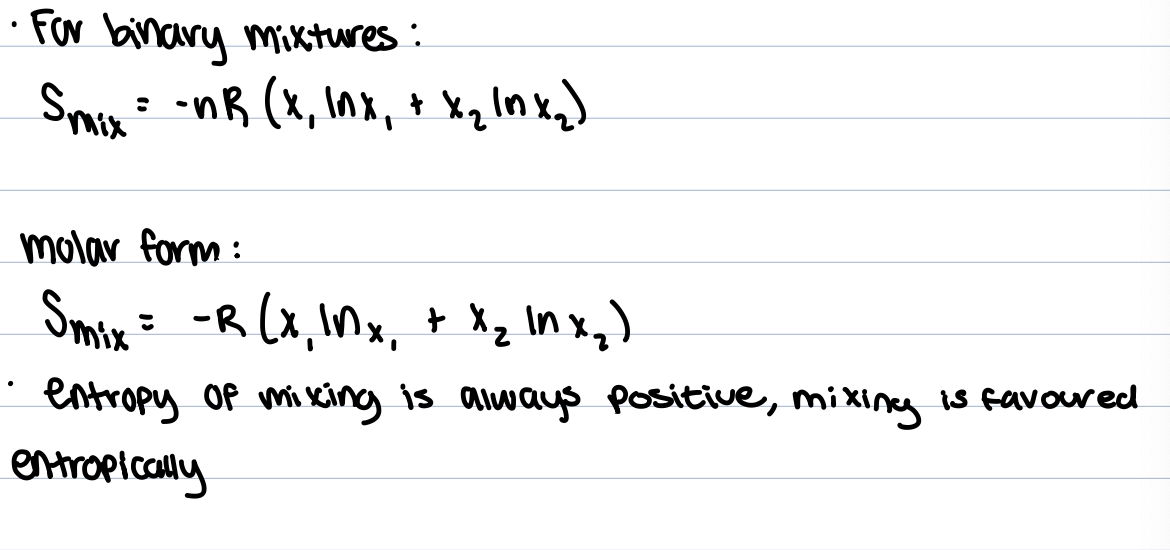
chemical potential of ideal mixtures
fundamental relation-
u=h-Ts
for ideal mixtures; h=0
because there are no intermolecular interactions
total chemical potential
the mixture contains
1) pure component contributions
2) entropy contribution from mixing
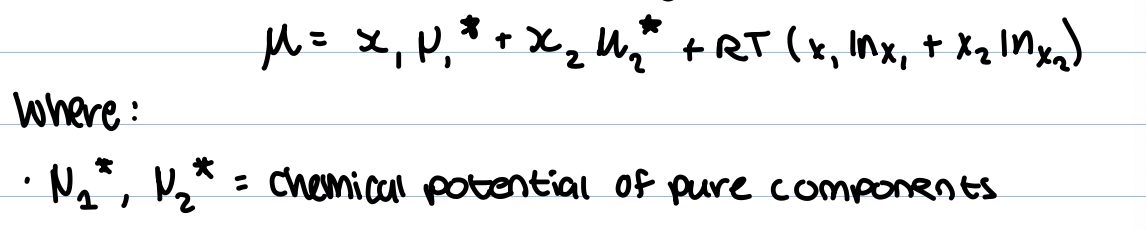
chemical potential of each component
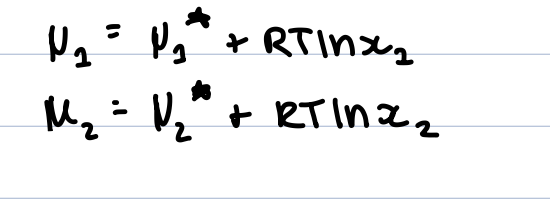
key consequences
As mole fraction decreases;
ln(x) → more negative
and therefore chemical potential decreases
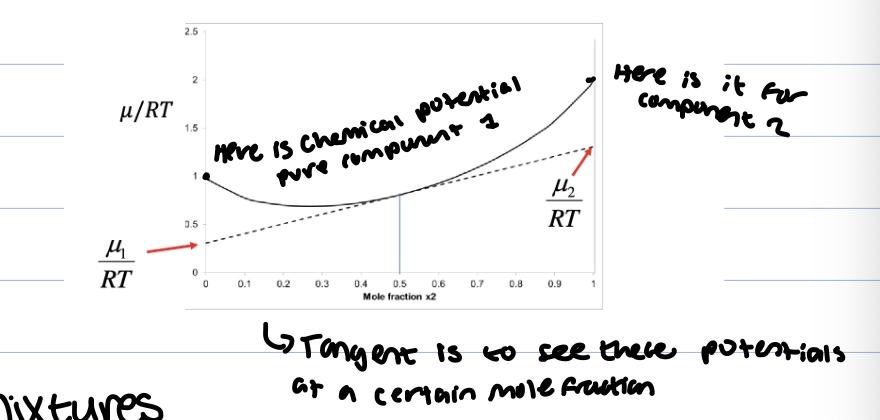
tangent/intercept method
to determine chemical potentials graphically;
Plot u/RT vs composition
Draw tangent line
Use intercepts to find u1, u2
regular mixtures
difference from ideal mixtures, now components interact
example- repulsive interaction between molecules
interaction energy- 1kT
effect of repulsive interactions
particles avoid each other
at low concentration- particles cluster at corners/edges to minimize interaction energy
at higher concentration- clustering becomes stronger
eventually- phase seperation, ex. oil and water
enthalpy of mixing
regular mixtures require an enthalpy term
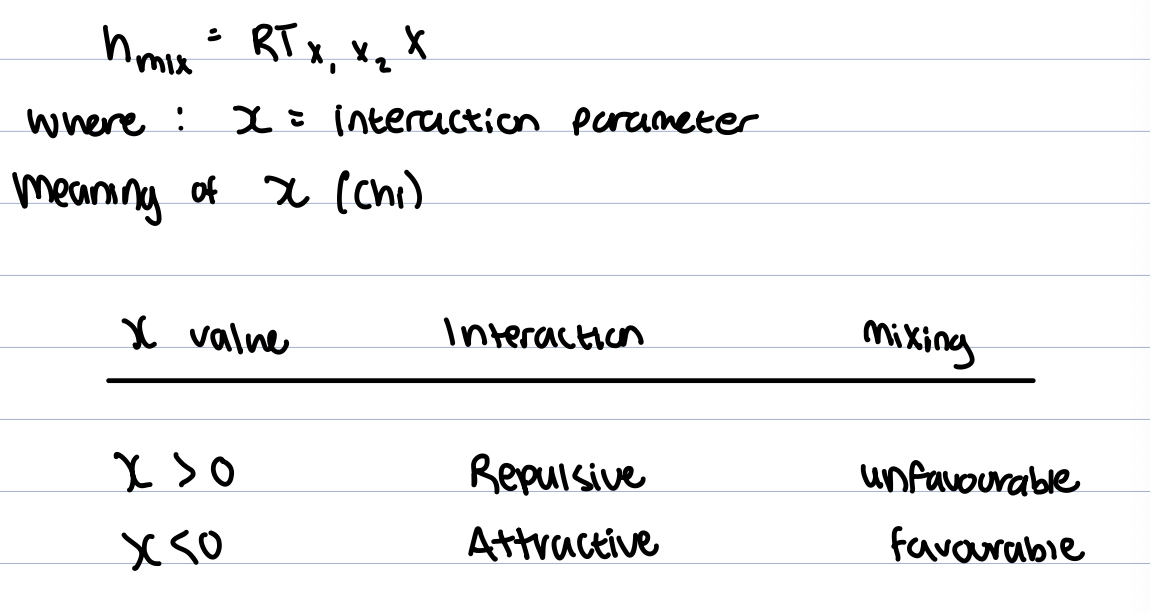
thermal effects of mixing
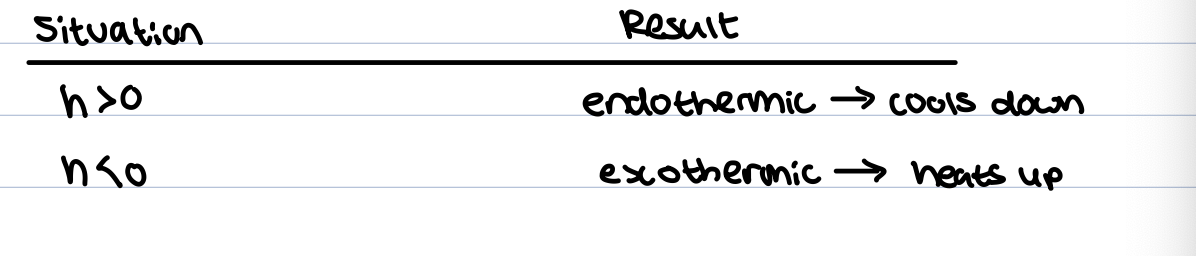
ex. ethanol and water
when mixed, temperature increases, therefore X<0, meaning attractive interactions, completely miscible
when does phase seperation occur
critical condition-
X>2
then gibbs free energy develops 2 minima, mixture seperates into 2 phases
gibbs free energy visualisation
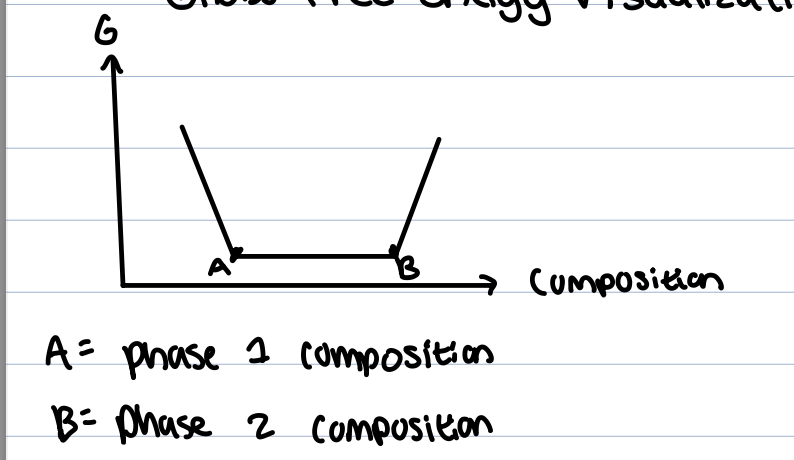
physical meaning
system lowers free energy by splitting into
one A rich phase and one B rich phase
binodal region
inside the binodal curve- mixture phase seperates, outside single phase
lever rule
used to calculate the amount of phases
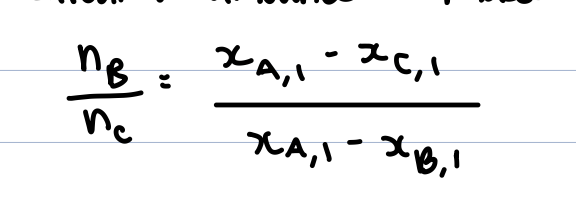
chemical potentials in regular mixtures, full gibbs expression
difference from ideal mixture-
additional enpalthy term

analytical expressions
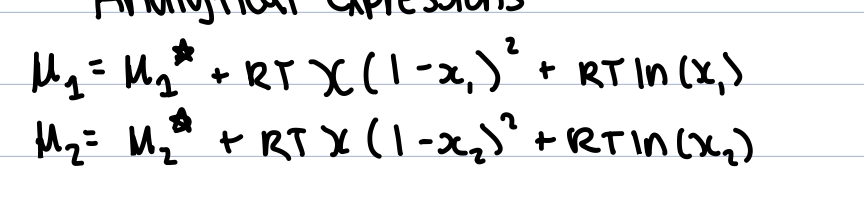
temperature dependence
the interaction parameter depends on temperature
some mixtures-
mix at high temperatures, seperate at low temperatures
example- h-hexane + nitrobenzene, phase seperation below 293K
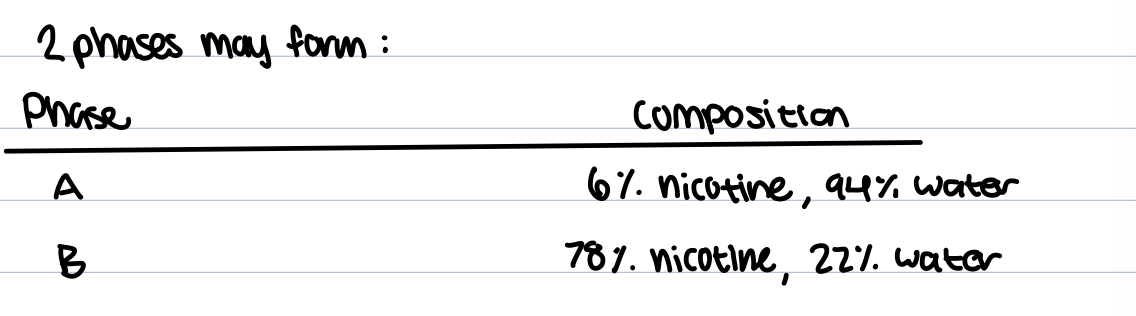
phase diagram
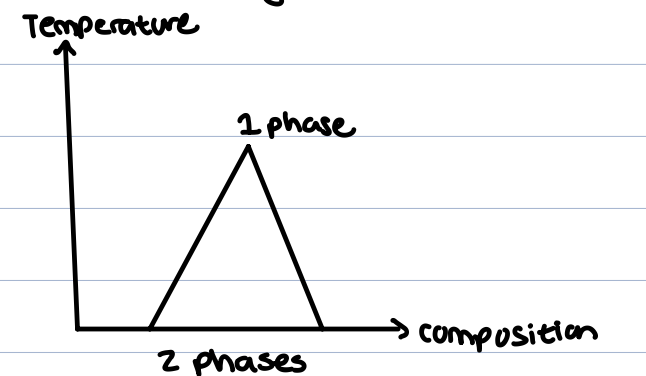
example water and nicotine
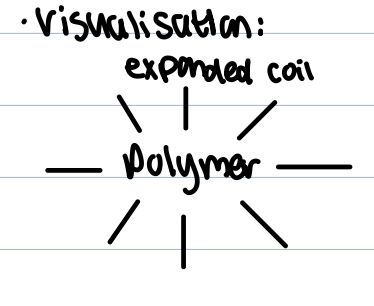
polymers in solution
polymer configuration depends on entropy and enthalpy
good vs bad solvent
good solvent- interactions; polymer-solvent stronger than polymer-polymer
result- polymer expands
bad solvent- interactions polymer-polymer stronger
result- polymer collapses, compact globule
partition equilibrium
most foods contain- dispersed phases, emulsions, ex. oil in water emulsions, molecules often prefer one phase another
chemical potential in 2 phases

equilibrium condition
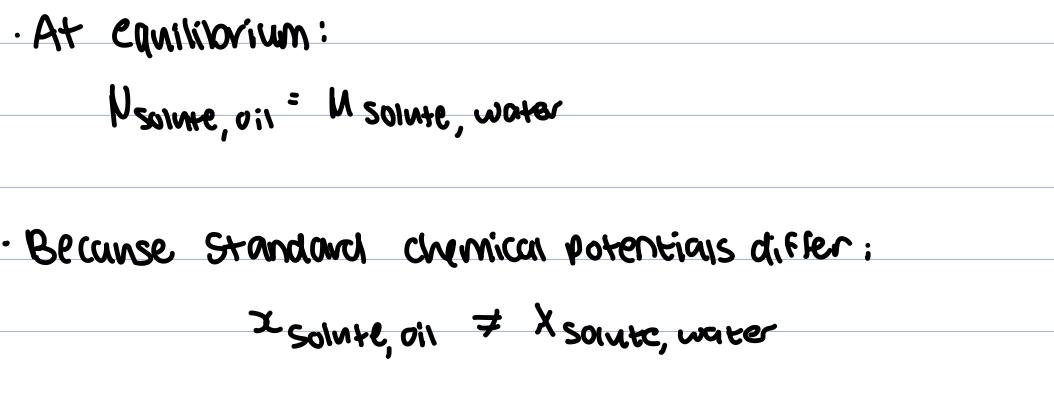
partition coefficient
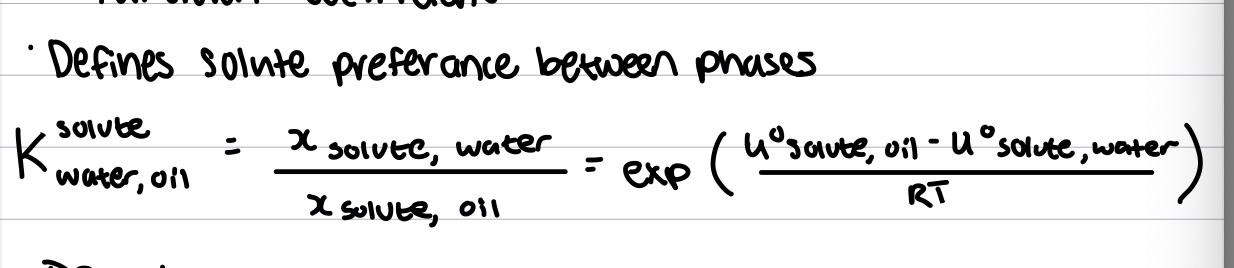
depends on temperature, pressure
food example- mayonnaise contains oil phase, water phase, preservatives distribute between phases according to the partition coefficient, important because fungi grow in water phase, preservative concentration there matters
food application of phase seperation
macroscopic phase seperation often undesirable but microscale phase seperation creates texture ex. cheese, whipped cream, mayo
clausius-claperyon relation
the clasius clapeyron equation describes how pressure changes with temperature along phase coexistence curves
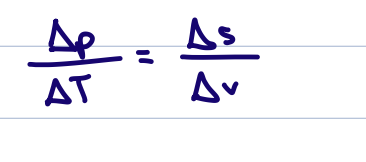
delta s= s1-s2= difference in molar entropy between phases
delta v= v1-v2= difference in molar volume between phases
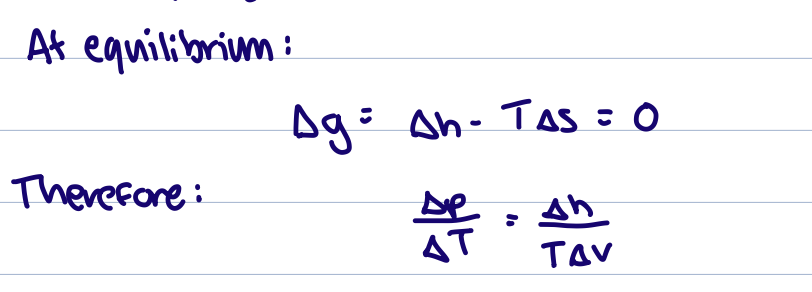
where delta h is the latent molar heat of the phase transition
application to the boiling curve
for liquid vapour equilibrium- vapor molar volume is much larger than liquid molar volume
therefore-