econ 335 practice final
 Call Kai
 Learn
Learn Practice Test
 Spaced Repetition
 Match
Match Flashcards
 Knowt Play
1/28

There's no tags or description
Looks like no tags are added yet.
Name | Mastery | Learn | Test | Matching | Spaced | Call with Kai |
|---|
No analytics yet
Send a link to your students to track their progress
29 Terms
The payments that migrant workers send back to their home countries are called:
a. Remittances
b. Foreign direct investment
c. Foreign portfolio investment
d. Capital outflows
a. Remittances
In a nation's balance of payments, which one of the following items is always recorded as a
positive entry?
a. Changes in foreign currency reserves
b. Imports of goods and services
c. Military foreign aid supplied to allied nations
d. Purchases by foreign travelers visiting the country
d. Purchases by foreign travelers visiting the country
Which of the following capital transaction items is entered as a debit in the U.S. balance of payments?
a. A U.S. resident transfers $100 from his account at Credit Suisse in Basel (Switzerland) to
his account at a San Francisco branch of Wells Fargo Bank.
b. A French resident transfers $100 from his account at Wells Fargo Bank in San Francisco
to his Credit Suisse account in Basel.
c. A U.S. resident sells his IBM stock to a French resident.
d. A U.S. resident sells his Credit Suisse stock to a French resident.
b. A French resident transfers $100 from his account at Wells Fargo Bank in San Francisco
_____ are money-like assets that are held by governments and that are recognized by governments as fully acceptable for payments between them.
a. Official international reserve assets
b. Unofficial international assets
c. Official domestic assets
d. Unofficial reserve assets
a. Official international reserve assets
The net value of flows of goods, services, income, and unilateral transfers is described as the:
a. capital account balance.
b. current account balance.
c. trade balance.
d. official reserve balance
b. current account balance.
The net value of flows of financial assets and similar claims (excluding official international reserve asset flows) is called the:
a. financial account balance.
b. current account balance.
c. trade balance.
d. official reserve balance.
a. financial account balance.
Which of the following would tend to contribute to a U.S. current account surplus?
a. The United States makes a unilateral tariff reduction on imported goods.
b. The United States cuts back on American military personnel stationed in Japan.
c. U.S. tourists travel in large numbers to Asia.
d. Russian vodka becomes increasingly popular in the United States
b. The United States cuts back on American military personnel stationed in Japan.
In the balance of payments, the statistical discrepancy is used to:
a. ensure that the sum of the components of the balance of payments is 0.
b. ensure that the value of imports equals the value of exports.
c. show how a balance-of-payments deficit is funded.
d. obtain an accurate account of a balance-of-payments surplus.
a. ensure that the sum of the components of the balance of payments is 0.
The current account balance does NOT equal:
a. the difference between gross domestic product and domestic expenditure.
b. the difference between national saving and domestic investment.
c. net foreign investment.
d. the difference between government saving and government investment.
d. the difference between government saving and government investment.
A large, persistent current account deficit signals what about the health of an economy?
a. A definite economic crisis in the future
b. The potential for an economic crisis in the future related to government debt
accumulation or other problems that limit saving
c. The potential for an economic crisis in the future related to government debt
accumulation or an investment boom
d. There will be a boom in investment that increases growth.
b. The potential for an economic crisis in the future related to government debt
accumulation or other problems that limit saving
What part of the current account is approximately equal to the current account for most developed countries?
a. Net income from foreigners
b. Net unilateral transfers
c. Net exports
d. Financial account
c. Net exports
In September 2005, exports of goods from the U.S. decreased $3.3 billion to $73.4 billion, and imports of goods increased $3.8 billion to $144.5 billion. This increased the deficit in:
a. the balance of payments.
b. the financial account.
c. the current account.
d. unilateral transfers.
c. the current account.
Rapid increases in the U.S. exports of goods and services will result in a(n) _____ foreign currency and a(n) _____ the U.S. dollars in the foreign exchange market.
a. increase in the demand for; increase in the supply of
b. increase in the supply of; increase in the demand for
c. shortage of foreign currency; surplus of
d. decrease in the supply of; decrease in the demand for
b. increase in the supply of; increase in the demand for
A decrease in German residents' willingness to invest in dollar-denominated assets will shift the demand curve for:
a. Euros to the right.
b. Euros to the left.
c. Dollars to the right.
d. Dollars to the left
d. Dollars to the left
In a floating exchange rate system, the dollar per pound exchange rate is determined by:
a. the American government.
b. the British government.
c. the interaction of the demand and supply of pounds in the foreign exchange market.
d. the interaction of the demand for and supply of dollar-denominated assets in the stock market.
c. the interaction of the demand and supply of pounds in the foreign exchange market.
Shifts in demand away from French products and toward the U.S. products (caused by forces other than changes in the exchange rate) would result in extra attempts to:
a. buy both euros and dollars.
b. sell both euros and dollars.
c. sell Euros and buy dollars.
d. buy Euros and sell dollars.
c. sell Euros and buy dollars.
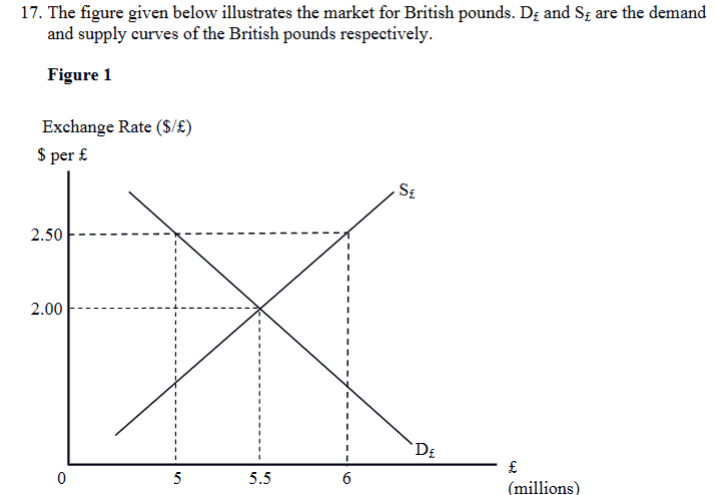
A downward movement along the vertical axis would correspond to a(n) _____ of the U.S. dollar.
a. arbitrage
b. swap
c. appreciation
d. depreciation
c. appreciation
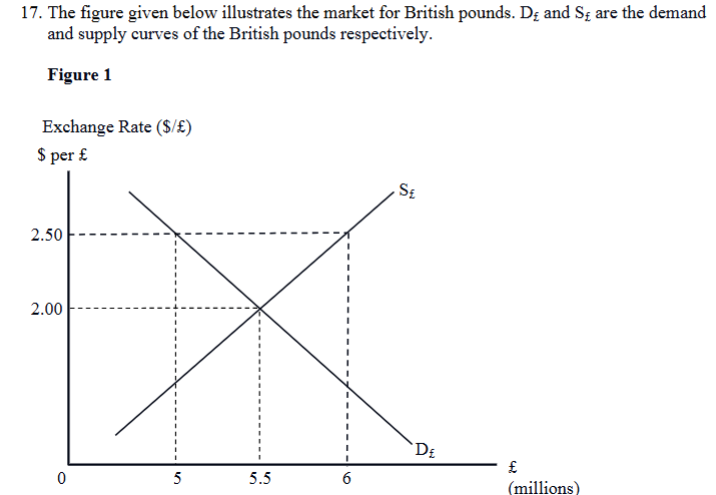
Please use figure 1 above to answer this question. If the British government wants to peg the dollar per pound exchange rate at $2.50 per pound, what action would British monetary authorities have to undertake?
a. Sell 1 million pounds and buy 2.5 million dollars
b. Buy 1 million pounds and sell 1 million dollars
c. Buy 1 million pounds and sell 2.5 million dollars
d. Buy 6 million pounds and sell 12 million dollars
c. Buy 1 million pounds and sell 2.5 million dollars
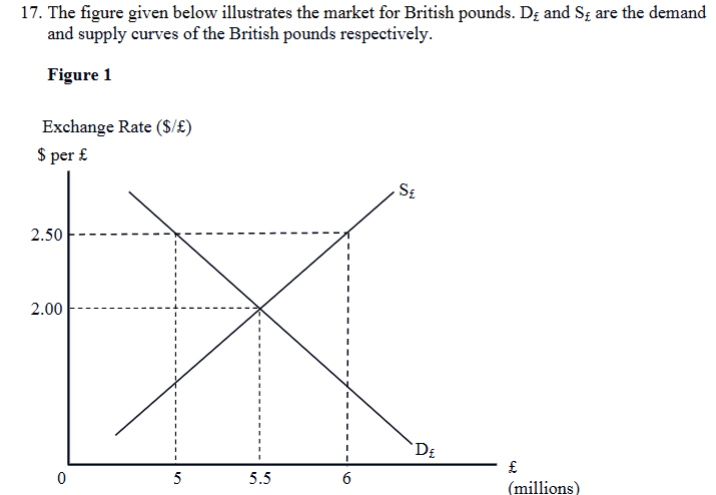
Please use figure 1 above to answer this question. If the exchange rate is pegged at $2.50 per pound:
a. the pound will be overvalued.
b. the pound will be undervalued.
c. the British goods will become cheap in U.S. markets.
d. the demand for the American goods will fall in British markets
a. the pound will be overvalued.
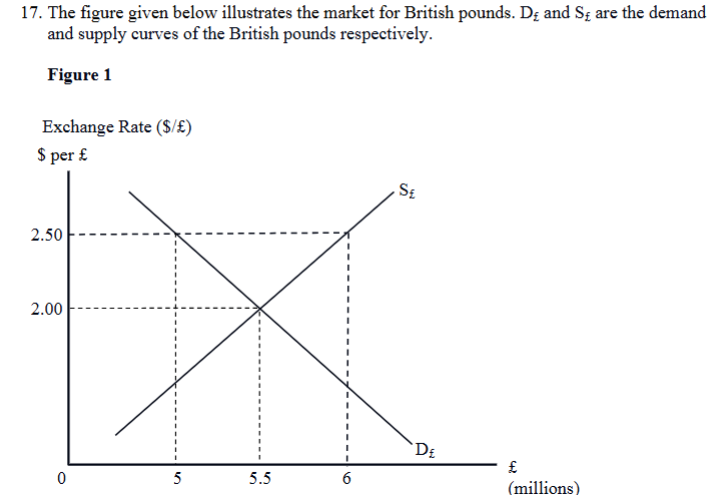
Please use figure 1 above to answer this question. Who among the following groups will most likely benefit if the exchange rate is pegged at $2.50 per pound?
a. The U.S. importers
b. The British importers
c. The British exporters
d. The import-competing producers in the U.K.
b. The British importers
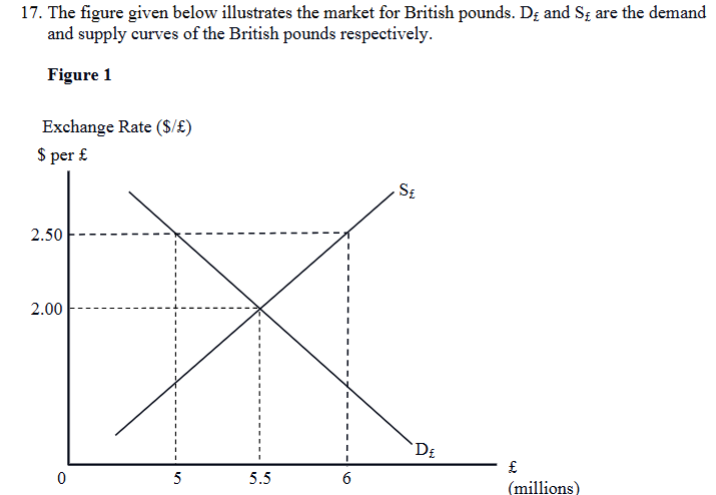
Please use figure 1 above to answer this question. Suppose initially the exchange rate is pegged at $2.50 per pound. If the governments allow the pound to float, the pound will experience a(n):
a. surplus.
b. buoyant period.
c. appreciation.
d. depreciation.
d. depreciation.
In a/an _____ exchange rate system the government or central bankers intervene to keep the exchange rate virtually steady.
a. fixed
b. free floating
c. managed float
d. intermediate
a. fixed
Which of the following groups is most likely to benefit from a strengthening of the U.S. dollar against other major currencies?
a. U.S. exporters
b. The U.S. government
c. U.S. consumers
d. Foreign consumers
c. U.S. consumers
Under a fixed exchange rate system, a fall in the market price (the exchange rate value) of a currency is called a(n) _____ of that currency.
a. revaluation
b. devaluation
c. appreciation
d. depreciation
b. devaluation
Under a floating exchange rate system, an increase in the international demand for electronic appliances manufactured in Japan will result in:
a. Deflation in the Japanese economy.
b. An increase in Japan’s trade deficit with other countries.
c. An appreciation of the yen vis-à-vis other currencies.
d. A depletion of international reserves held by the central bank of Japan.
c. An appreciation of the yen vis-à-vis other currencies.
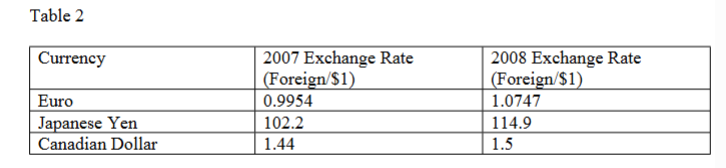
Table 2 above shows the exchange rates between various currencies and the US dollar. Between 2007 and 2008, the US dollar ____ against the euro and ____ against the yen.
a. Depreciated; appreciated
b. Appreciated; appreciated
c. Depreciated; depreciated
d. Depreciated; depreciated
b. Appreciated; appreciated
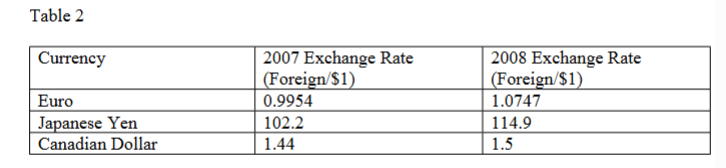
Table 2 above shows the exchange rates between various currencies and the US dollar. Between 2007 and 2008, the yen ____ against the US dollar and the euro ____ against the US dollar.
a. Depreciated; appreciated
b. Appreciated; appreciated
c. Depreciated; depreciated
d. Depreciated; depreciated
d. Depreciated; depreciated
What is a disadvantage of dollarizing a country’s currency?
a. Dollarization allows a country to benefit from the stability in value of another country’s currency
b. Dollarization prevents a country from having the value of its currency tied to the dollar or another currency
c. Dollarization prevents a country from printing currency to generate tax revenue.
d. Dollarization means that the country whose currency it adopts takes control of the government of the dollarizing country.
c. Dollarization prevents a country from printing currency to generate tax revenue.
What is an advantage of choosing to dollarize a country’s currency?
a. Dollarization allows a country to have a stable currency even if the government has had irresponsible government and management in the past.
b. Dollarization prevents other countries from engaging from “beggar-thy-neighbor” currency policies
c. Dollarization prevents other countries from adopting the US dollar as its currency since only one country other than the US can use the dollar at a time
d. Dollarization allows countries to engage in seigniorage.
a. Dollarization allows a country to have a stable currency even if the government has had irresponsible government and management in the past.